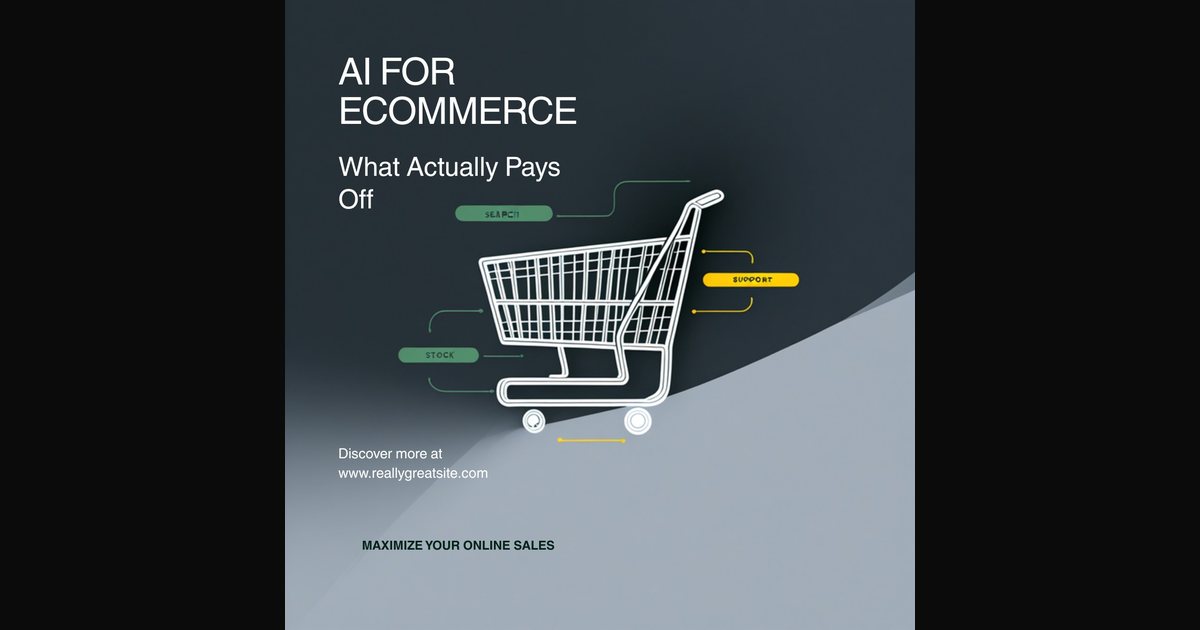


If you run an online store, you have been told that AI for ecommerce will fix your conversion rate, your inventory, your support queue, and your ad spend. Some of that is true. A lot of it is a dashboard nobody opens after week three.
This guide is about the difference. It covers where AI genuinely pays for itself in an ecommerce operation, where it quietly does not, and the one channel most stores automate last even though it is the one costing them the most per interaction.
A note on who wrote this. Bigly Sales builds AI voice agents, so we have an obvious interest in the phone section below. We have tried to be useful rather than promotional, which means saying plainly which parts of an ecommerce stack we do not touch and which problems a voice agent will not solve.
Summary
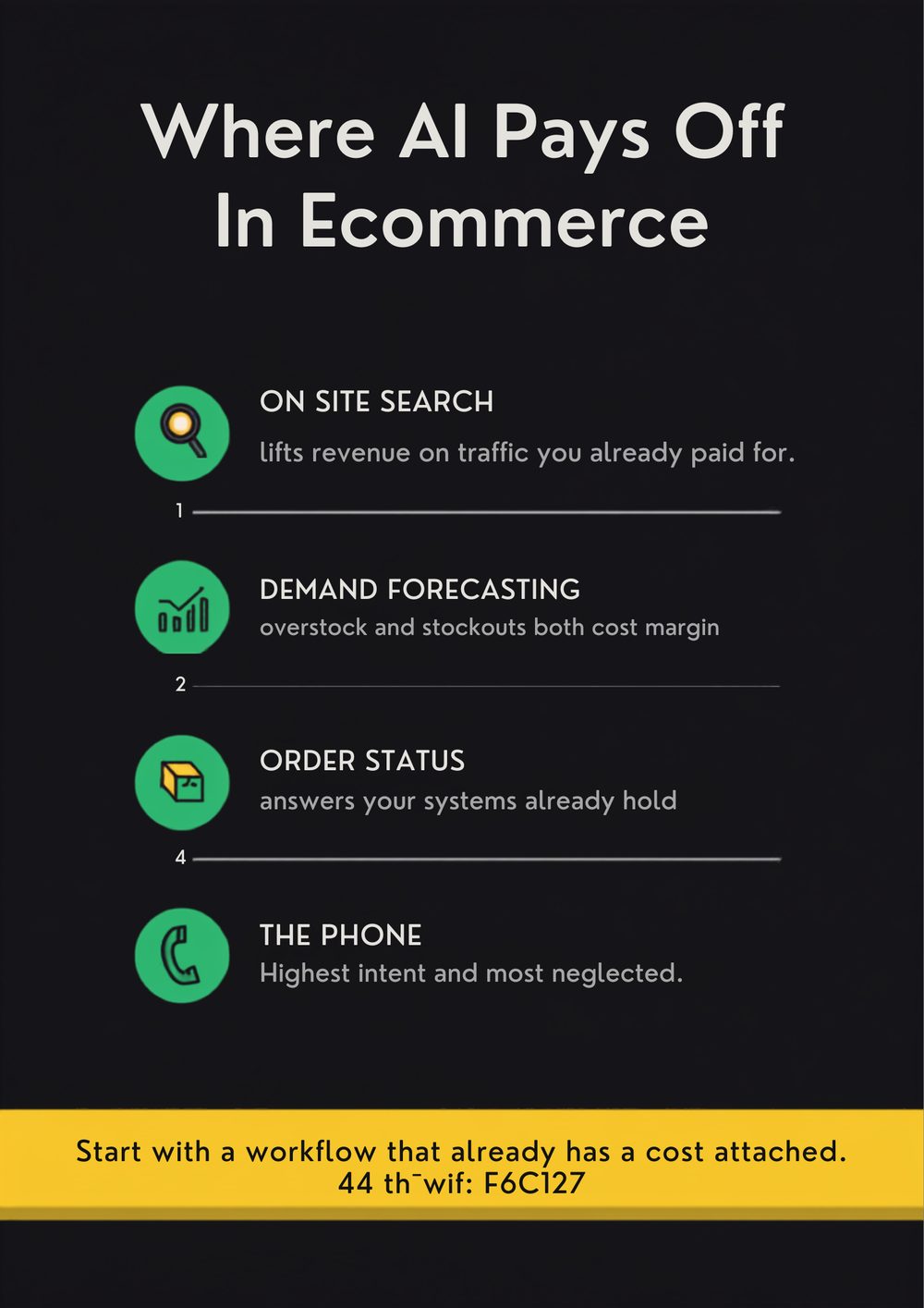
- The highest return from AI in ecommerce comes from search and product discovery, because it lifts revenue on traffic you have already paid for.
- Demand forecasting is the least glamorous use and often the most profitable, since overstock and stockouts both come straight off margin.
- Support automation works well for order status and returns and works badly for anything involving an exception or an upset customer.
- The phone is the channel most stores leave manual, and it carries the highest cost per contact and the highest intent.
- Start with one workflow that has a number attached to it. Stores that begin with a platform rather than a problem tend to end up with an unused platform.
Table of contents
- Where AI actually earns its keep
- The channel most stores automate last
- What to automate first
- What AI still gets wrong in ecommerce
- A realistic ninety day rollout
- Key takeaways
- AI for ecommerce FAQ
- The bottom line
Where AI actually earns its keep
Three areas produce most of the measurable return. The rest tends to be interesting rather than valuable.
Product discovery and on-site search
Most store searches are still keyword matching. A shopper types “warm jacket for a toddler” and gets nothing, because your catalog says “insulated infant parka.” That shopper leaves, and you already paid to acquire them.
Semantic search closes that gap by matching intent rather than strings. It is the single change we see move revenue fastest, for an unglamorous reason. You are not buying more traffic. You are failing fewer of the visitors you already have. Compare the revenue per session for people who use search against those who browse, and you will usually find search users convert at several times the rate. Anything that stops them hitting a dead end is worth doing first.
Demand forecasting and inventory
This is the use case nobody puts in a case study and the one your CFO will care about. Overstock ties up cash and ends in markdowns. Stockouts hand the sale to a competitor and cost you the customer’s next order too.
Forecasting models are good at this because the problem is genuinely statistical. Seasonality, promotion lift, lead time variability, and returns rates are all patterns in data you already have. You do not need anything exotic. You need someone to actually act on the output.
Support and post-purchase
A large share of contacts after checkout are the same handful of questions. Where is my order, can I change the address, how do I return this? When will the refund land?
Those are worth automating because the answer is deterministic and lives in a system you already own. What does not automate well is the exception. A damaged item, a delivery that went to the wrong state, and a customer on their third contact about the same problem. Route those to a person quickly, because an automated loop on an already frustrated customer costs more than the labor you saved.
The channel most stores automate last
Email and chat get automated first because they are easy and asynchronous. The phone gets left alone, which is odd, because it is usually the most expensive contact you handle and the one with the clearest intent. Nobody calls a store casually.
Order status calls
The industry calls these WISMO contacts, short for where is my order. They are high volume, low complexity, and almost entirely answerable from your order management system. A voice agent that can look up an order and read back a real tracking status resolves them on the first call without a queue.
The reason this matters more than the equivalent chat automation is time of day. Order anxiety peaks in the evening and over weekends, which is exactly when most stores have nobody on the phone.
Abandoned checkout, by phone rather than by email
Most stores recover abandoned carts with a sequence of emails and accept the open rate they get. For low-value orders, that is the right call, because the economics do not support anything else.
For higher-value or considered purchases, a call within minutes of abandonment performs differently, because you can answer the actual objection. Shipping cost, delivery date, sizing, and whether the thing is in stock in the color they wanted. That is a conversation, not a discount code. Our own AI calling platform exists for this pattern, and the honest boundary is that it is worth the setup only if your order values justify a phone touch. Below is roughly the cost of a call, stay on email.
What to automate first
Pick the workflow where you can already state the cost of doing it manually. If you cannot put a number on it, you cannot tell whether the automation worked, and you will end up defending a subscription instead of reporting a result.
A reasonable order of operations for most stores looks like this.
- Fix on-site search first, because it affects revenue on existing traffic and needs no new headcount.
- Automate order status across every channel you already staff, including the phone if you answer it.
- Add forecasting once you have clean sales and returns data, not before.
- Layer in outbound contact for high-value abandonment, where a conversation can beat a coupon.
- Leave anything involving a refund dispute or a damaged item with a human.
What AI still gets wrong in ecommerce
Being specific about the failure modes is more useful than another list of benefits.
Product descriptions generated at scale read like product descriptions generated at scale. Shoppers notice, and so does search. If you generate them, treat the output as a first draft for a human, not as a finished copy.
Personalization gets creepy faster than teams expect. Referencing something a shopper did not tell you reads as surveillance rather than service. The test is simple. If you would not say it out loud to their face in a store, do not put it in an email.
Forecasting fails quietly when the data is dirty. A model trained on a period that included a stockout will learn that demand was low, when in fact you simply could not sell anything. Somebody has to know that.
Support bots fail when they cannot hand off. The measure of a good automated support layer is not the containment rate. It is how fast a customer who needs a person actually reaches one.
A realistic ninety-day rollout
- Weeks one and two. Pick one workflow. Write down the current cost, the current volume, and the outcome you want. Get agreement on the number before anyone buys anything.
- Weeks three to six. Run the automation alongside the manual process rather than instead of it. You want a comparison on your own data, not a vendor benchmark.
- Weeks seven to ten. Review where it failed, not where it worked. Every failure is either a data problem, a handoff problem, or a scope problem, and each has a different fix.
- Weeks eleven and twelve. Decide to scale it or stop it. A pilot with no kill criteria is not a pilot.
For context on how large the channel you are optimizing has become, the US Census Bureau publishes quarterly ecommerce retail sales, which is a steadier reference point than any vendor projection.
Key takeaways
- Start with a problem that already has a cost attached, not with a platform.
- On site search is usually the fastest measurable win because it works on traffic you already bought.
- Forecasting is the least exciting use and often the most profitable one.
- Automate the deterministic contacts and route the exceptions to a person quickly.
- The phone is the most neglected channel in ecommerce and the one with the highest intent per contact.
- Judge any pilot on your own numbers, with kill criteria agreed in advance.
AI for E-commerce FAQ
What is AI for e-commerce?
AI for ecommerce means using machine learning to run parts of an online store that were previously manual, including product search, recommendations, demand forecasting, pricing, customer support, and outbound contact. The term covers a wide range of tools, so the useful question is always which specific workflow you are trying to change.
Which AI use case gives the fastest return for an online store?
On-site search and product discovery, in most cases. It improves revenue from traffic you have already paid to acquire, it does not require new headcount, and the effect shows up in weeks rather than quarters.
Can AI handle ecommerce customer service on its own?
It can handle the repetitive, deterministic contacts well, such as order status, address changes, and return instructions. It should not handle exceptions, disputes, or an already frustrated customer. The quality of the handoff to a person matters more than how many contacts get contained.
Does AI work for small ecommerce stores or only large ones?
Search, recommendations, and support automation are available at small store pricing and are worth it early. Forecasting needs enough order history to be meaningful, and phone automation needs order values high enough to justify a call. Scale changes, which tools make sense, not whether AI is useful.
What are WISMO calls, and can they be automated?
WISMO stands for “where is my order,” and it describes the order status contacts that make up a large share of post-purchase support. They automate well because the answer already exists in your order management system, and a voice agent can look it up and read back a real status without putting the caller in a queue.
Should we recover abandoned carts by phone or by email?
Email for low-value orders, because the economics do not support anything else. A phone call makes sense for higher-value or considered purchases, where the shopper has a specific objection about shipping, sizing, or availability that a conversation can resolve and a discount code cannot.
Will AI-generated product descriptions hurt our search rankings?
Generated descriptions published without editing tend to read as generic, which affects conversion as much as ranking. Treat the output as a first draft, have a person add the specifics only you know about the product, and you avoid most of the risk.
How much data do we need before demand forecasting is useful?
Enough history to cover your seasonal cycle, plus clean records of promotions, stockouts, and returns. Clean matters more than large. A model trained through a stockout will read the missing sales as weak demand unless somebody flags the gap.
How do we know whether an ecommerce AI pilot worked?
Decide the metric and the kill criteria before you start, then run the automation alongside the manual process so you are comparing on your own data. If you cannot state what result would make you stop, you are not running a pilot.
The bottom line
Most disappointing AI projects in ecommerce start with a tool and look for a use. The ones that work start with a workflow somebody can already price, and they get compared against the manual version on the store’s own numbers.
Fix search, automate the answers you already have, forecast once your data is honest, and treat the phone as a channel worth automating rather than one worth avoiding. If your order values justify a call and you want to see what that sounds like on your own catalog, book a demo or read how AI inbound calling handles support and lead calls.