Customers’ expectations are increasing day by day. Some of the top-notch businesses and apps have set the bar very high by providing smooth ordering, real-time updates, and easy, immediate support to their customers. So, customers expect this agility from everyone else, too.
Businesses are now competing for the same customers in a saturated market. So, customers have more choices. If they feel neglected at one place, they easily switch to another brand.
Moreover, because of social media platforms, customers have become more vocal and they can share their experiences. A single negative online experience can reach thousands of people. This puts pressure on businesses to respond quickly and resolve issues properly.
The success of businesses depends on their ability to provide customers with quality service that not only meets stated commitments but also exceeds customer service expectations.
If companies are unable to provide customers with quality customer support, they could face customer dissatisfaction, a dilution of the brand, a weakening of the main market differentiator, and a loss of revenue.
In addition to it, inability to meet customer service expectations may damage a brand’s reputation and could consequently limit their ability to retain existing customers and attract new customers.
Humanized customer service centers have lots of bottlenecks that hinder businesses from providing consistent, round-the-clock, easily accessible services to their local as well as international customers.
In this post, we will discuss how these bottlenecks can be overcome with the help of AI autoresponders and AI call centers. We will also explore how these solutions can enhance customer experiences and boost retention rates.

What Are AI Autoresponders?
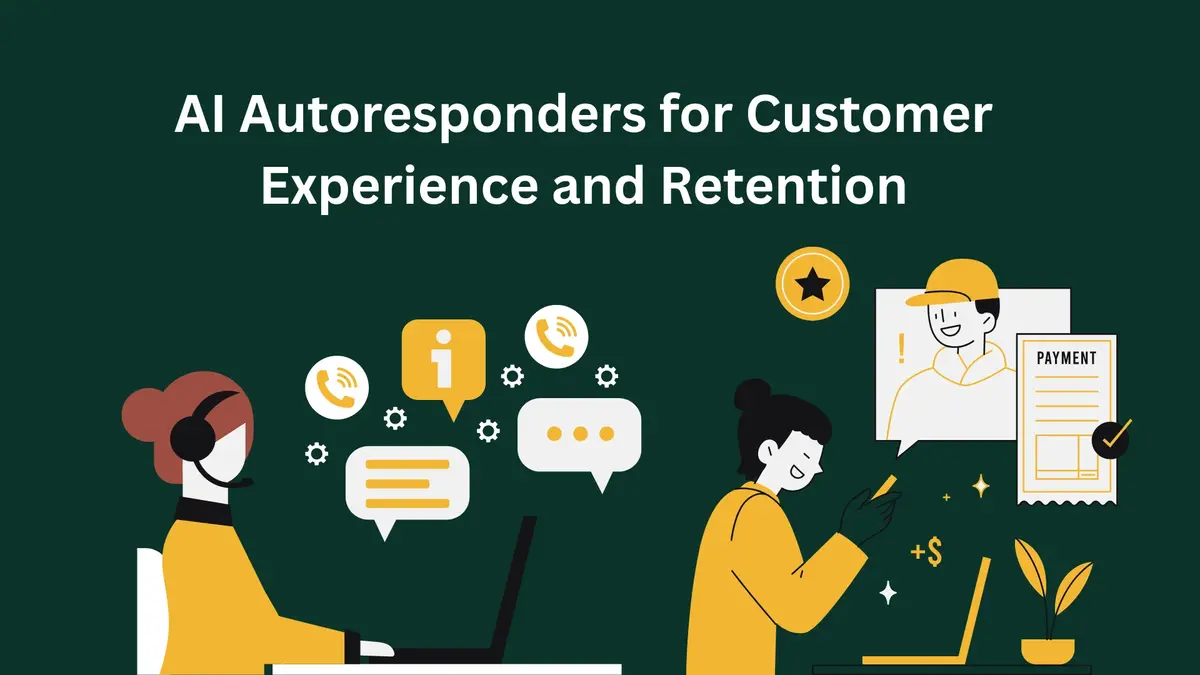
AI autoresponders are software that can send automatic replies to customer queries via email, chat, messaging apps, and support systems. These programs are powered by AI and use a combination of technologies like machine learning and natural language processing to interpret customer queries and generate intelligent, context-based, and personalized replies.
Why Customer Experience Has Become a Retention Battlefield
Customer experience has become a retention battlefield because customers today have many choices and very little tolerance for poor treatment. No one wants to do business with a company or buy products or services from brands that mistreat them or leave a negative impression. This fact is evident from research too, as American Express claims that 33% of customers say they’ll consider switching to another company immediately after a poor experience.
There are many brands and businesses that are competing for the same product and services. Due to this increased competition, customer experience has turned into a major differentiator. Now, businesses have realized that agile and well-designed customer experience strategies help build loyalty, create brand advocates, and directly increase revenue
Customer loyalty is not just based on price and product; rather, it is driven more by how the customer feels. If customers feel valued, they stay connected to you even if they have to pay more. Studies prove that 56% of loyal customers spend more even when an inexpensive option is available. This shows that loyalty is extremely valuable, especially in markets where products and pricing are similar.
When a customer leaves and chooses your competitor over you, it severely damages growth and profitability. But strong experiences encourage customers to stay. According to Harvard Business Review, a 5% increase in customer retention increases profits by 25%-95%. This is proof that keeping your current customer pool satisfied and happy is far more profitable than constantly acquiring new ones.
Moreover, when we shop, we mostly rely on other people’s opinions. Oftentimes we decide not to buy any product or service just because of adverse reviews. This means one good or adverse experience can strongly influence whether others buy from a business or not.
Customer experience builds trust, which is essential for long-term success. Businesses stand out in crowded markets when they combine trust with positive experiences.
We can conclude that customer experience has become a competitive battlefield, as companies that succeed in this arena are able to retain their customers. Deploying AI autoresponders in customer experience and care centers improves the overall experience and determines loyalty, retention, trust, reputation, and growth.
How AI Autoresponders Improve Customer Experience and Customer Retention
Traditional customer support centers do not provide 24/7 services. Non-automated contact centers often face data silos, due to which customers often get frustrated or approach brands’ competitors that are providing better services. These issues can be resolved with the help of an AI auto responder and they can improve customer experience in the following way:
1. Faster Response Times due to Round-the-Clock Availability
AI autoresponders can work 24/7 without any break or rest time. Therefore, they are available all the time to respond to customers’ queries without any delay. By deploying AI autoresponders, companies can win the trust of not only local but also international customers.
This immediate engagement not only shows brands’ commitment to serve their customers but also sets them apart from competitors who may be slower to react.
2. Consistent and Reliable Communication
Most people approach customer service centers when they come across problems that they have never expected related to products or services. So, most of the time, customers either blame the agents or talk to them rudely and even yell.
Due to frustrated customers, long working hours, and performance pressure, agents won’t provide uniform responses every time. Moreover, due to communication through multiple channels and data silos, agents don’t have accurate and up-to-date information. So they won’t give customers good and reliable service.
AI systems, on the other hand, consistently deliver uniform responses, ensuring consistency in messaging across all channels. This improves clarity, reduces errors, and helps build trust because customers receive accurate information without variation or fatigue-based mistakes.
3. Personalized Interactions
AI autoresponders remember their past interactions with customers and don’t forget about their needs and preferences.
Suppose you have purchased solar panels from ABC Company; now they have your information. If you contact them for service, their AI responder will already have access to your information, and it can provide you personalized service.
AI autoresponders treat customers as individuals rather than as part of a general audience. It makes customers feel important and valued and can turn them into a repeat buyer.
4. Proactive Support and Anticipation of Needs
Advanced AI can analyze customer data and past behavior to predict their needs. So, your autoresponders provide relevant suggestions, reminders, or preemptive guidance.
Suppose you have a pet dog and you order its food every month from an online shop. Next time, you might receive a reminder from an online shop’s autoresponder to buy dog food before it finishes.
Moreover, AI autoresponders can analyze customer behavior to identify dissatisfaction or churn risk. AI autoresponders intervene proactively and address problems earlier. This feature keeps customers loyal over time and improves lifetime value.
The result makes customers feel like the company understands their needs and builds the relationship of loyalty between the two.
5. Improves Self-Service and Reduces Friction
There are some customers who want an immediate solution without any delay. So, companies provide self-service options to them.
AI autoresponders integrated with self-service resources like FAQs or knowledge bases guide customers to solutions quickly. This reduces delays and empowers users to help themselves when appropriate.
6. Post-Purchase Support and Customer Confidence
Customer service doesn’t end after checkout. Autoresponders can support FAQs, product setup, returns, and troubleshooting after purchase. This improves the post-purchase experience, reduces frustration, and builds confidence in the brand.
7. Automated Follow-Ups to Re-Engage Customers
Cart abandonment is a critical challenge for e-commerce. Usually, when customers view anything they like, they add it to the cart. But after some time they forget about it because of their busy routines.
AI auto responders can send follow-ups automatically to customers who have left something in the cart. This action re-engages users before they disengage and helps businesses recover the potential lost revenue and keeps customers connected to your brand.
Conclusion
So, AI autoresponders make the overall customer service center efficient and effective. Efficient customer service improves customer experiences and makes them loyal. Autoresponders reduce customer churn rate, improve purchase frequency rate, and increase customer lifetime value and repeat customer rate. In short, we can say that AI autoresponders overall increase the revenue of businesses by both retaining the current customer pool and attracting more customers.
FAQs about AI Autoresponders for CX and Retention
Are AI autoresponders suitable for small businesses?
Yes, AI autoresponders are suitable for small businesses because their team size is small. AI autoresponders can deal with customers having simple queries without burdening the team. Therefore, it’s better for them to use their team for complex tasks that require cognitive abilities.
Can AI autoresponders replace human agents?
No, AI responders cannot replace human agents; they can only assist them by taking over simple and repetitive tasks, leaving complex tasks that require empathy and cognitive abilities to human agents. They are for the betterment of human agents as they reduce their workload. Using both agents is more effective than using either one alone.
Do customers prefer AI or human responses?
Customers experience pain when they encounter problems. As long as they are getting solutions promptly and efficiently, it does not matter whether they are provided by a human or an AI agent. But still, there are some people who have complex queries or have issues that require human empathy. In such cases, AI autoresponders route them to appropriate human agents.
Are AI autoresponders expensive to implement?
No, overall they are very economical and affordable because they improve the customer experience, efficiency, and retention rate, and in most cases the profit increases from 25% to 95% due to their implementation. Moreover, they are scalable and can be scaled up and down when needed without hiring or firing. So, overall, it’s a very affordable option for businesses.
Is AI autoresponder communication legally compliant?
Yes, if used correctly. AI responders are legally safe to use when businesses take proper consent, take care of data privacy, and use software compliant with regulations like GDPR or TCPA.