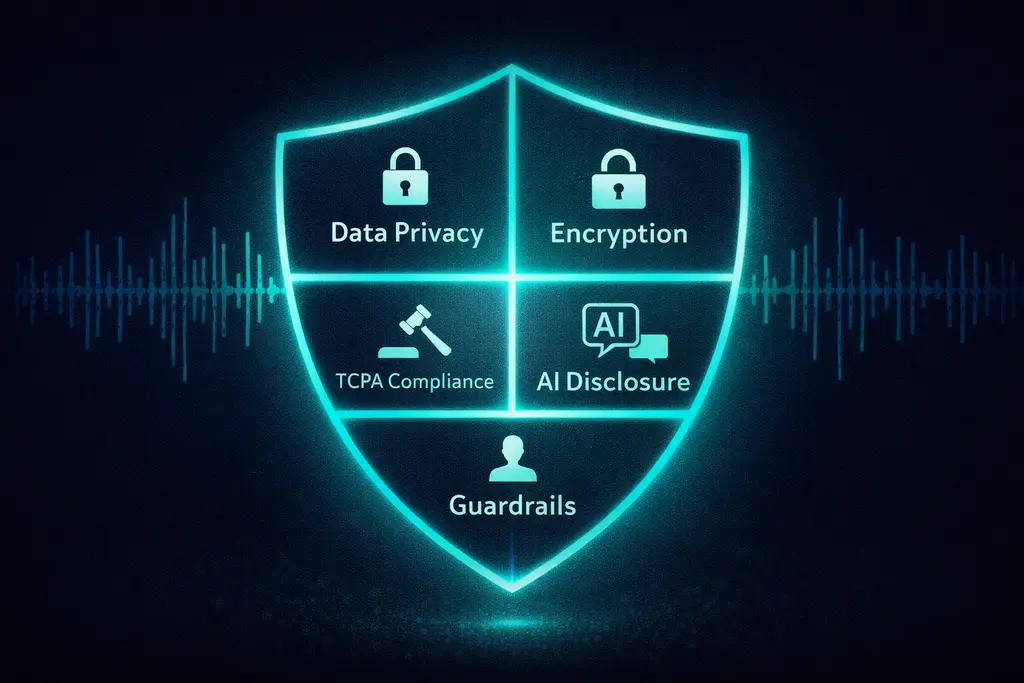


Voice AI is safe to use for business calling when it runs on compliant, secure infrastructure. Reputable platforms encrypt call data in transit and at rest, follow TCPA and privacy requirements, and disclose the AI clearly to callers. The risk is not the technology itself. The risk is deploying it on a platform that treats compliance and security as your problem instead of theirs.
Call centers, sales teams, and support operations are deploying AI calling at scale to run outbound campaigns, qualify leads, and manage inbound inquiries. For the decision maker evaluating the technology, the safety question is practical, not abstract. What happens to your customers’ call data. Whether you are legally protected. Whether the system can be exploited. What you must disclose.
This guide answers those questions directly, organized around the five concerns that matter most to businesses deploying the technology in 2026.
TL;DR
Voice AI is safe for business use when the platform encrypts call data, enforces TCPA and privacy rules automatically, and discloses the AI at the start of every call. The biggest legal risk is calling with an artificial voice without prior express written consent, which carries statutory damages of $500 to $1,500 per call.
Vet vendors on documented data retention, SOC 2 Type II certification, and automated compliance before price or voice quality. Skip the technology entirely if you cannot document consent for your call list, because no platform makes an unlawful campaign safe.
Key takeaways
- Voice AI is safe when deployed on compliant infrastructure, and a liability when compliance is manual.
- Call recordings and transcripts are personal data under GDPR and CCPA, so retention and deletion policies matter.
- The FCC has confirmed AI generated voices count as artificial under the TCPA, requiring prior express written consent.
- TCPA damages run $500 to $1,500 per call, and high volume campaigns multiply a single gap into thousands of violations.
- Look for SOC 2 Type II, encryption in transit and at rest, and documented incident response before signing.
- Disclose the AI at the start of every call. It is both the regulatory standard and better for trust.
- Guardrails, human escalation, and full call transcripts are the safety net for AI mistakes.
Table of contents
- What voice AI is
- Will customer call data be stored or sold
- Is AI calling legal, TCPA and consent requirements
- Can the system be hacked or a voice cloned
- Will customers know they are talking to AI
- What happens if the AI says something wrong
- How Bigly Sales approaches safety
- Who should not use voice AI
- Voice AI safety FAQ
- The bottom line
What voice AI is
Voice AI is software that holds spoken phone conversations with people, using speech recognition to understand what a caller says and a synthetic voice to respond in real time. In a business context it answers inbound calls, places outbound calls, qualifies leads, books appointments, and hands conversations to human agents when needed.
Because the system speaks with customers and records what they say, it touches three regulated areas at once. It processes personal data, it places automated calls, and it represents your business in conversations you do not personally supervise. Each of those areas has its own safety questions, which the rest of this guide works through one at a time.
Will customer call data be stored or sold
This is the most common concern and the one with the most variation between vendors.
Call data typically includes recordings, transcripts, qualification answers, disposition outcomes, and metadata such as duration, time stamp, and phone number. That information can sit on vendor servers, on customer controlled cloud infrastructure, or both, depending on the platform and its configuration.
The General Data Protection Regulation (GDPR) applies to any business handling personal data of individuals in the European Union, wherever the business is headquartered. Under GDPR, recordings and transcripts containing identifiable information count as personal data, and a voice itself is identifiable. Businesses must establish a lawful basis for processing, notify individuals, honor deletion requests, and avoid transfers outside the EU without adequate protections.
The California Consumer Privacy Act (CCPA) applies to businesses meeting certain thresholds that collect personal data from California residents. It gives consumers the right to know what is collected, to delete it, and to opt out of its sale. Call recordings of California residents fall within its scope.
The practical implication is straightforward. Before deploying, confirm exactly where call data is stored, how long it is retained, whether it trains third party models, and whether it can be deleted on request. A vendor that cannot answer these questions clearly cannot meet GDPR or CCPA obligations on your behalf.
Reputable platforms do not sell call data to third parties. They process it to deliver the service, and any model training use should be addressed explicitly in the data processing agreement you sign.
Is AI calling legal, TCPA and consent requirements
Legality is the most consequential safety concern for outbound focused businesses, and it is where risk concentrates in 2026.
The Telephone Consumer Protection Act (TCPA) governs automated outbound calling in the United States. The FCC has confirmed that AI generated voices fall within the definition of an artificial voice under the statute. Calls placed with an artificial or prerecorded voice without prior express written consent carry statutory damages of $500 per call and up to $1,500 for willful violations. A high volume operation with a compliance gap does not produce one violation. It produces thousands simultaneously.
The framework is demanding. Consent must be obtained before calling, must be clear and conspicuous, and should specifically cover AI generated voice communications. Do Not Call registry compliance is mandatory. State rules layer additional requirements on top, with different dialing windows, velocity caps, and disclosure obligations by state. For the full breakdown, see our TCPA compliance guide for AI calling.
The evaluation question that matters most is whether the platform enforces compliance automatically or leaves it to your team. Manual processes, where staff check DNC lists and track state rules by hand, introduce human error into a zero tolerance legal framework. Automated, continuously enforced compliance removes that exposure.
| Framework | What it covers | Who it applies to | Key requirement |
|---|---|---|---|
| TCPA | Automated and artificial voice calls | Anyone calling US phone numbers | Prior express written consent, DNC compliance |
| GDPR | Personal data of EU individuals | Any business processing EU data | Lawful basis, deletion rights, transfer limits |
| CCPA | Personal data of California residents | Businesses over certain thresholds | Disclosure, deletion, opt out of sale |
| SOC 2 Type II | Vendor security controls over time | Voluntary vendor certification | Audited controls for data security |
| HIPAA | Protected health information | Healthcare and their vendors | Safeguards plus a business associate agreement |
Can the system be hacked or a voice cloned
Infrastructure security and voice cloning are two distinct concerns that both fall under this question.
Infrastructure security covers the platform itself, meaning the servers, APIs, data pipelines, and call routing that make the product work. For enterprise deployments the relevant markers are SOC 2 Type II certification, which verifies that a vendor’s security controls operate effectively, and HIPAA compliance for healthcare adjacent use cases, overseen by HHS. Encryption in transit using TLS 1.2 or higher and at rest using AES-256 or equivalent is the baseline expectation.
API security matters in particular because calling platforms connect to CRMs, lead sources, and data pipelines. Poorly secured endpoints expose call data, lead records, and customer information. Confirm penetration testing practices, API authentication standards, and incident response procedures before signing. Our security page shows what those answers should look like.
Voice cloning is a separate and growing threat that operates outside any platform. A short audio sample from a voicemail, a social video, or a recorded call can be used to generate a convincing replica of a real person’s voice, then used to impersonate executives or authorize fraudulent transactions. The defenses are procedural. Do not rely on voice recognition alone for high stakes authorizations, train staff to verify unusual requests through a second channel, and audit which calls are recorded and where recordings live.
Safety built in
See compliant AI calling on your own leads
Bigly Sales runs consent checks, DNC suppression, and disclosure on every call automatically. Watch it handle your real lead flow in a 20 minute demo.
Will customers know they are talking to AI
Disclosure is an area where the rules are actively evolving and where businesses face real risk if they do not stay current.
The FTC has stressed that deceptive practices involving AI generated voices, especially impersonating real people or denying the AI nature when asked directly, violate Section 5 of the FTC Act. Several states have enacted or proposed specific disclosure requirements for AI voice in commercial contexts, and the FCC ruling described above already subjects these calls to the consent rules for artificial voices.
The safe operational standard in 2026 is clear disclosure at the start of any outbound AI call. A short statement that the call is made by an AI system, with an immediate opt out option, meets both the letter and the spirit of current rules. Platforms that let you configure disclosure language and enforce it on every call are meaningfully safer than platforms that leave it to discretion.
Disclosure is also a trust mechanism, not just a legal one. Customers who discover mid conversation that they were not told tend to distrust the brand afterward. Transparent disclosure up front produces better outcomes than trying to pass the system off as human.
What happens if the AI says something wrong
Liability for AI errors on calls is an area where the legal framework is still developing, but the operational implications are already clear.
These systems can and do make mistakes. They misunderstand statements, give incorrect information, fail to escalate, or say things that conflict with regulatory requirements. In regulated industries such as insurance, mortgage, healthcare, and financial services, an AI that makes unauthorized representations on a call creates genuine legal exposure.
The primary safeguards are architectural. Guardrails in the prompt structure stop the AI from making claims outside defined parameters. Escalation triggers route calls to humans when the conversation exceeds the AI’s scope, including complex objections and sensitive situations. Recording and transcript logging create an audit trail for reviewing every conversation.
Post call review is how responsible operators catch problems before they compound. A platform that pushes full transcripts and structured call data to your CRM after every call makes that review possible. A platform that only reports aggregate dial metrics does not. Businesses that deploy without these safeguards are accepting risk they may never have formally assessed.
How Bigly Sales approaches safety
For call centers and outbound teams evaluating AI calling, safety is infrastructure, not a checklist item. Here is how Bigly Sales addresses each concern in this guide.
- Data security and retention. Recordings, transcripts, and structured call data are stored securely and pushed to your CRM after every call. Handling is governed by your data processing agreement, and customer call data is not used to train third party models.
- TCPA compliance. Enforced automatically at the system level, including federal dialing rules, state by state windows and velocity caps, holiday restrictions, real time DNC suppression, and consent validation through TrustedForm before each call. Opt outs propagate across voice and SMS immediately.
- Infrastructure security. Enterprise grade infrastructure with encryption in transit and at rest. Number registration and carrier whitelisting are managed proactively, which reduces spam labeling risk and shrinks the attack surface of unmanaged telephony.
- Disclosure. Every call can open with clear disclosure language, built into the call flow design process rather than left as an option.
- Guardrails and escalation. The AI operates within defined conversation parameters. When a call needs human judgment, it transfers to an agent with full context so the customer never repeats themselves.

Who should not use voice AI
The honest caveat is that this technology is not safe for every operation, because safety depends on inputs the platform cannot fix.
Skip it if you cannot document consent for the numbers you plan to call, because the consent gap, not the voice, is what creates liability. Skip it if your use case involves high stakes advice in a regulated field and you are not prepared to build guardrails, escalation, and transcript review. And skip it if your team will not maintain the data hygiene the privacy laws assume, since retention and deletion obligations do not go away because a vendor holds the recordings.
For teams that can meet those conditions, the technology is as safe as any other well governed business system, and considerably safer than an undocumented manual calling operation.
Voice AI safety FAQ
Is voice AI safe to use for business?
Yes, when it runs on compliant infrastructure. A safe deployment encrypts call data in transit and at rest, enforces TCPA consent and DNC rules automatically, discloses the AI at the start of calls, and keeps transcripts for review. The technology itself is not the risk. Deploying it without documented consent or on a vendor with weak controls is.
Is voice AI legal for outbound calls in the United States?
Yes, with proper consent. The TCPA requires prior express written consent before placing outbound calls with an artificial or AI generated voice, and the FCC has confirmed AI voices count as artificial. Consent must be clear, specific, and documented, and state rules add requirements in many jurisdictions. Legal when enforced automatically, a major liability when it is not.
How is call data protected in a voice AI system?
Reputable platforms encrypt data in transit with TLS and at rest with AES-256 or equivalent, store recordings in controlled environments with access logging, and sign data processing agreements. GDPR and CCPA compliance requires clear retention policies, deletion on request, and limits on using personal data beyond its stated purpose. Request the DPA before deployment.
Do businesses have to disclose that a call uses AI?
Current FCC and FTC positions strongly indicate yes, especially when a caller asks directly whether they are speaking to a human. Several states are enacting explicit requirements. The 2026 operational standard is a brief disclosure at the start of every outbound AI call, which protects against regulatory risk and measurably improves customer trust.
Can a voice AI platform be hacked?
Any connected system can be attacked, which is why vendor security posture matters. Look for SOC 2 Type II certification, encrypted data in transit and at rest, authenticated APIs, regular penetration testing, and documented incident response. The API layer deserves particular scrutiny because calling platforms connect directly to your CRM and lead data.
What is voice cloning and should I worry about it?
Voice cloning uses a short audio sample to generate a convincing replica of a real person’s voice, which criminals use for impersonation and fraud. It happens outside any calling platform, so the defenses are procedural. Never authorize high value actions on voice alone, verify unusual requests through a second channel, and audit where call recordings are stored.
What security certifications should a vendor have?
SOC 2 Type II is the baseline for enterprise deployments, since it verifies security controls are operating effectively over time. Healthcare use cases require HIPAA compliance and a business associate agreement. Beyond certificates, confirm encryption standards, penetration testing, and incident response. A vendor that cannot produce these on request is unsuitable for regulated work.
What happens if the AI makes an error on a call?
Well designed systems restrict the AI to defined conversation parameters and escalate to a human when a call exceeds them. Full transcripts and recordings create the audit trail for catching errors. In regulated industries these safeguards separate an operational hiccup from a regulatory incident, so review transcripts regularly and refine the AI’s parameters from what you find.
Does voice AI record every call?
Most platforms record and transcribe calls by default because the transcript drives CRM updates, quality review, and compliance audits. Recording itself is regulated, and several states require all party consent, so confirm how the platform handles recording notices. You should also know the retention period and how to delete recordings on request.
Is voice AI safe for regulated industries like healthcare or finance?
It can be, with stricter conditions. Healthcare requires HIPAA compliant handling and a business associate agreement. Financial services and insurance need tight guardrails so the AI never makes unauthorized representations. If a vendor cannot demonstrate industry specific controls, keep those call types with trained humans until it can.
The bottom line
Voice AI is safe when you treat safety as infrastructure. The platforms worth using encrypt call data, enforce consent and DNC rules automatically, disclose the AI on every call, and hand you the transcripts to prove all of it. The platforms to avoid make compliance your job and hope you never get audited.
Evaluate vendors on data handling, automated compliance, and security certifications before price or voice quality. Get the data processing agreement in writing, confirm the consent your list actually has, and start with call types where an error is recoverable.
Talk to us
Deploy AI calling without the legal guesswork
Bigly Sales handles consent validation, disclosure, and opt outs for you at the infrastructure level. Book a walkthrough and get answers to every safety question in this guide.