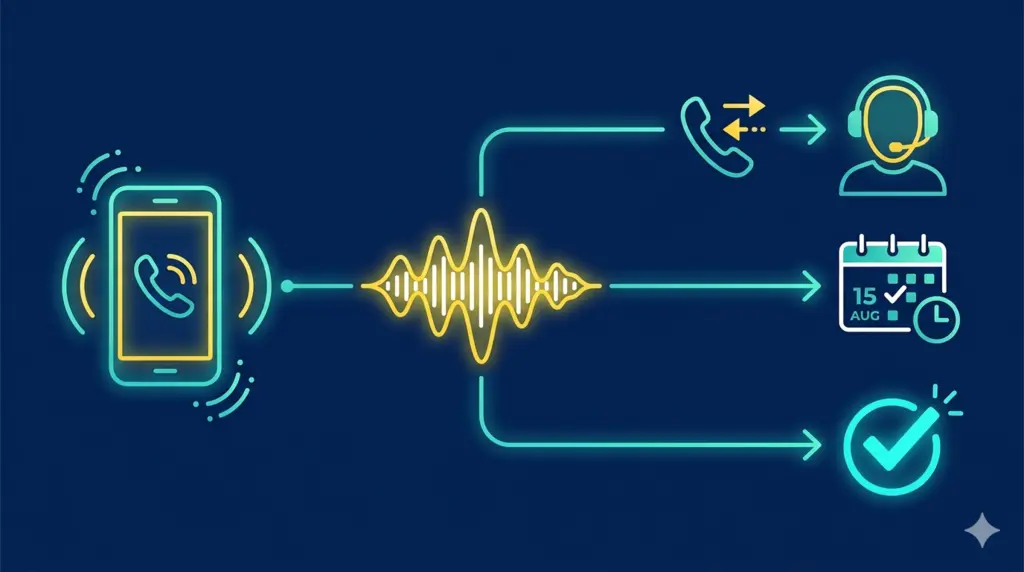


AI inbound calling is a setup where an AI voice agent answers your incoming phone calls, holds a real conversation with the caller, and either resolves the request or transfers the person to the right rep with the full context attached. There is no menu, no hold queue, and no voicemail greeting in the middle of it.
Most coverage of voice AI focuses on outbound, where the system dials your leads, qualifies them, and routes the good ones to closers. That side is real and we cover it in the guide to AI voice agents for outbound call centers. The inbound half gets far less attention and is often worth more.
Consider the calls you are already paying for. A prospect who saw your ad at lunch rings the office at 7:30 PM and reaches a recording. A homeowner finally calls about solar on Saturday morning and gets nothing. Worst of all, a lead your own campaign dialed an hour ago sees the missed call, rings back, and lands in voicemail. This guide covers what inbound calling with AI actually does, where it fits, and where it does not.
TL;DR
AI inbound calling answers the phone within one ring, identifies why the person called, and either handles it or hands off to a human with the conversation attached. It covers three call types that most operations fumble, which are new leads calling in, existing customers with routine requests, and callbacks from missed outbound attempts.
The callback case is the one worth the most. A lead who returns a call from an unfamiliar number within the hour is the highest-intent contact of your day, and routing that call to voicemail wastes the entire cost of the original campaign.
Inbound is lighter on compliance than outbound because the caller initiated the contact, but disclosure and opt-out handling still apply. If you receive a handful of calls a day, or your callers expect a named account manager to pick up, keep a human on the phone and skip this.
Key takeaways
- AI inbound calling replaces the IVR menu and the voicemail box with a conversation that resolves or routes the call.
- Three call types matter most, which are new leads, routine customer requests, and callbacks from missed outbound dials.
- Callbacks carry the highest intent of any inbound call and are the most commonly wasted.
- It runs on your existing numbers through SIP, so callers dial exactly what they always dialed.
- Compliance is lighter than outbound because the caller initiated contact, but disclosure and opt-out logging still apply.
- Escalation quality decides whether this works, since a handoff without context is just a slower IVR.
- Low call volume or relationship-led selling makes this the wrong purchase.
Table of contents
- What AI inbound calling is
- Why inbound calls get wasted without it
- How it compares to an IVR, voicemail, and an answering service
- How AI inbound calling works step by step
- The three inbound call types AI handles
- Why the callback is the most valuable inbound call
- What it looks like in insurance, mortgage, solar, and debt relief
- Compliance rules that still apply on inbound
- Managed compared with self-serve for inbound
- Where inbound calling with AI is the wrong fit
- AI inbound calling FAQ
- The bottom line
What AI inbound calling is
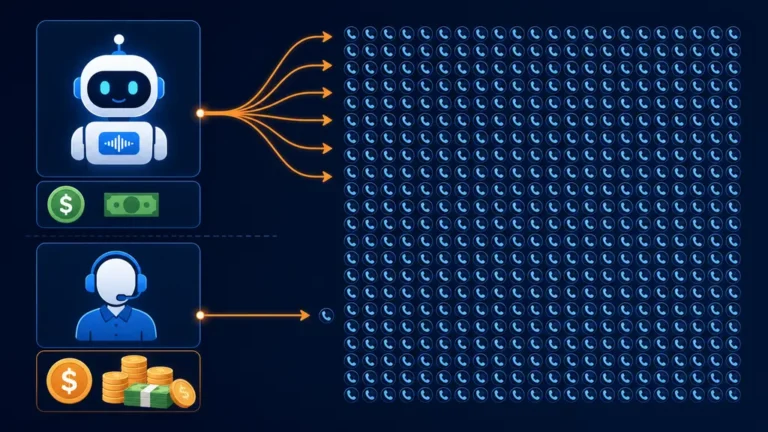
AI inbound calling is the practice of putting a conversational voice agent in front of your incoming call flow so that every call is answered immediately, classified by intent, and either resolved on the spot or transferred to a person with a written summary attached. It is the inbound counterpart to automated outbound dialing and it runs on the same phone numbers you already publish.
The gap between this and what most businesses run today is wider than it sounds. Inbound calls at most companies are met by one of three things. An IVR that reads a menu and waits for a keypress. An answering service that takes a message and promises a callback. Or nothing at all, meaning the phone rings out to voicemail.
None of those help the caller in the moment. An IVR does not have a conversation, it reads options and hopes one matches. Plenty of callers never get past the second menu and either press zero or hang up. An answering service produces a message, but the moment of intent has already passed by the time anyone returns the call.
Inbound calling with AI works differently. The agent answers on the first ring, the caller says what they need in ordinary language, and the system decides what to do with it. Because it connects through SIP to your existing numbers, nothing changes for the person dialing. Definitions for the terms in this section are collected in the AI calling glossary.
Why inbound calls get wasted without it
A large share of business inbound calls never reach a person. Some go to voicemail, some die inside an IVR, and some simply ring out. Published answer-rate benchmarks vary widely by industry and none of them are worth quoting as gospel, but every operator who has audited their own call logs finds the same pattern. The calls you paid to generate are the ones you are missing.
For a business spending on advertising, SEO, and purchased leads, that is a hole in the bottom of the bucket. You are funding demand and then failing to receive it.
The after-hours gap makes it worse. A business open ten hours a day, five days a week, is unreachable for roughly two thirds of the week. Prospects do not stop calling during those hours. They stop calling you. Carrier-side issues explain some of the outbound problem, and we cover those in the piece on why calls do not get answered. Inbound is usually the simpler side to fix, because nobody is filtering a call that a customer chose to place.
How it compares to an IVR, voicemail, and an answering service
| Option | Answers after hours | Qualifies the caller | What the caller experiences |
|---|---|---|---|
| Voicemail | Yes, in name only | No | Leaves a message and waits, often calls someone else |
| IVR menu | Yes | No, it only sorts | Presses numbers, repeats the menu, frequently hangs up |
| Answering service | Usually | Rarely beyond name and number | Speaks to a person who cannot answer the actual question |
| AI inbound calling | Yes | Yes, on your own criteria | Has a conversation, gets an answer or a warm transfer |
One clarification is worth making before that table gets read as a product comparison. Bigly Sales does not sell a phone system, a PBX, or a CRM. This is a comparison of what answers the call, not of the telephony you already own, and inbound calling with AI sits on top of whatever numbers you have today.
How AI inbound calling works step by step
Here is the sequence from the moment someone dials to the moment the call is closed out.
- The caller dials your published number. Nothing changes on their end and no new number is advertised.
- The agent answers within one ring. No hold music, no menu, and no recorded assurance that the call is important.
- The caller explains in their own words. Requests such as a quote, a reschedule, or a returned missed call are understood as natural language rather than keywords.
- The system identifies intent. New lead, existing customer, support question, billing issue, or callback from a missed outbound attempt. Each intent has its own flow.
- The agent acts. A new lead gets qualifying questions and either a live transfer or a booked appointment. A support question gets answered or escalated. A callback resumes the outbound conversation that was interrupted.
- Escalation carries context. When a human is needed, the transfer includes who is calling, what they asked, and what has already been covered, so the rep does not restart the conversation.
- Everything is logged. Recording, transcript, disposition, and any action taken are written to the CRM without manual entry.
Most inbound calls run from pickup to resolution in a couple of minutes. Callbacks tend to be faster still, because the context from the original outbound attempt is already attached to the record.
Hear it answer
Call our agent and judge it yourself
We will point a test number at your own intake script and let you call in as a lead, a customer, and a callback. It takes about twenty minutes.
The three inbound call types AI handles
AI inbound calling covers three distinct call types. Each one follows a different flow and solves a different problem, and mixing them into a single script is the most common configuration mistake.
New leads calling in
Somebody saw an ad, read a page, or took a referral, and then picked up the phone. This is the easiest conversion in the building because the person already acted. The agent answers instantly, asks what they are looking for, what the timeline is, and whether they meet the basic criteria, then either transfers to a closer or books the appointment. Speed is the entire advantage here, since a caller who reaches a recording is one dial away from a competitor who picked up.
Existing customers with routine requests
Billing questions, appointment changes, policy inquiries, document requests, and status checks are structured and repetitive, which is exactly what a voice agent handles well. The agent looks up the account, answers, and logs the resolution. Anything genuinely complex, such as a complaint, a dispute, or a question that needs a licensed person, goes to a human with a summary. Support teams that route this way spend noticeably less time on repeat questions and more on exceptions.
Callbacks from missed outbound attempts
Your campaign dialed a lead, the lead missed it, and now they are ringing the number back. This call is worth more than the other two and is the one most often thrown away.
Why the callback is the most valuable inbound call
Somebody who returns a call from a number they do not recognize has already done the hard part. They noticed, they were curious, and they are on the line right now. That is the strongest intent signal available in outbound.
If the callback reaches voicemail, the lead is gone. If it reaches an IVR menu, it is probably gone. If a receptionist answers, says hold on, and the transfer drops, it is certainly gone. Inbound calling with AI picks it up immediately, matches the number against the earlier outbound attempt, and opens with a line that references the original reason for the call. The person is not being cold called. They are continuing a conversation they started.
On a managed deployment this ties directly into the speed-to-lead system, so the agent has the earlier attempt’s notes rather than starting from a blank record. It is worth auditing your own setup on this single point. Call your main line from an unknown mobile after hours and see what happens.
What it looks like in insurance, mortgage, solar, and debt relief
The flow is the same across regulated verticals. What changes is the qualifying questions, the routing rules, and the escalation triggers.
- Insurance. A prospect calls after a quote comparison email. The agent qualifies on coverage type, policy expiration, and eligibility, then transfers to an agent licensed for that state and line. After hours it books a morning appointment and confirms by text. Existing policyholders asking about a claim or renewal get an answer or a routed transfer. The outbound counterpart is covered in AI outbound calling for insurance agents.
- Mortgage and lending. A borrower calls about an advertised rate. The agent qualifies on loan type, credit range, property type, and timeline, then transfers to an officer licensed in the caller’s state. Speed matters more here than almost anywhere else, because rate shoppers are comparing several lenders inside the same hour.
- Solar. A homeowner rings back after missing a follow-up on a quote request. The agent recognizes the number, resumes the qualifying conversation, checks home ownership, roof condition, monthly bill, and timeline, then books the consultation. Solar leads are among the most expensive in consumer marketing, which is what makes a dropped callback so costly.
- Debt relief. Marketing calls arrive at all hours and the caller often needs to speak to somebody now rather than Monday. The agent answers immediately, qualifies on debt amount and hardship, and books a consultation with a specialist. After-hours coverage carries most of the value in this vertical.
Compliance rules that still apply on inbound
Inbound is lighter than outbound because the caller initiated the contact, which removes the consent question that governs marketing dials. It does not remove everything.
Disclose that the caller is speaking with an automated system. The FCC confirmed in February 2024 that AI-generated voices are treated as artificial voices under the TCPA, and several states have moved toward requiring disclosure when a person is interacting with AI. Clear disclosure at the top of the call costs almost nothing and removes an argument you do not want later. The underlying statute and its damages provisions sit in 47 U.S.C. 227, and the FTC’s Telemarketing Sales Rule guidance covers the disclosure and record keeping obligations that reach inbound calls generated by advertising.
Two points get stated incorrectly often enough to correct here. The one-to-one consent rule, which would have required separate consent for each individual seller, was vacated by the Eleventh Circuit in January 2025 and never took effect. Prior express written consent under the existing TCPA standard remains the operative requirement for outbound marketing calls, and any vendor citing one-to-one consent as binding law is working from stale material. Adopting it as internal policy is still reasonable, since it produces a cleaner record.
The requirement that is genuinely landing concerns revocation of consent, which has to be honored promptly and across channels, with the remaining pieces phasing in through 2026. That matters on inbound because an opt-out spoken to your AI agent has to suppress your outbound campaigns too, immediately, not at the next nightly sync.
Log the opt-out, log the recording, and keep the transcript. Our compliance approach is described on the TCPA-compliant AI calling page. None of this is legal advice, so have counsel review your program.
Managed compared with self-serve for inbound
The real difference is who builds the routing, the compliance handling, and the escalation logic.
On a self-serve platform you get the engine. You build the inbound flows, configure the routing rules and escalation triggers, wire the CRM, and add the compliance checks yourself. With a development team that is a legitimate path, and it gives you more control than a managed service will.
On a managed deployment those pieces arrive configured. Routing matches callers to reps by your own rules, including state licensing, product line, and availability. Disclosure and opt-out handling run on every call. CRM logging happens automatically. For an after-hours operation, that difference matters most at 2 AM, when nobody on your side is watching the queue.
The honest summary is that inbound is easier to deploy than outbound, since the consent question largely disappears, but the routing and escalation logic still has to be right on day one. A handoff that arrives without context is just a slower IVR, and callers notice.
Where inbound calling with AI is the wrong fit
Three situations argue against it. If your total inbound volume is a handful of calls a day, a person answering the phone is cheaper and better. If your buyers expect a named account manager to pick up, putting an agent in front of that relationship costs more goodwill than it saves in labor. And if your escalation path is undefined, meaning nobody knows which rep receives which transfer, automation will surface that problem at speed rather than fix it.
There is a fourth honest caveat. Voice AI is weakest on emotionally loaded and unstructured conversations. A furious customer, a disputed charge, or a claim denial should reach a person quickly, and your configuration should make that the default rather than something the caller has to fight for.
AI inbound calling FAQ
What is AI inbound calling?
It is a system in which an AI voice agent answers your incoming calls, holds a real conversation with the caller, and either handles the request directly or transfers the person to the right rep with full context attached. It is not an IVR and it does not read a menu. The caller talks normally and the system works out what they need, then resolves it or routes it. It runs on the phone numbers you already publish.
How is it different from an IVR?
An IVR presents a menu and waits for a keypress, which means it can only sort callers into buckets somebody defined in advance. AI inbound calling has an actual conversation, so the caller states the problem in plain language and the system interprets it. The practical difference shows up in abandonment. People routinely hang up during a second or third menu level, while a conversational answer keeps them on the line long enough to be helped or transferred.
Can AI handle support calls or only sales?
Both, though it is strongest on the structured end of support. Billing questions, appointment rescheduling, policy inquiries, document requests, and account lookups are all repetitive and rule-based, which is where a voice agent performs well. Anything emotionally charged or genuinely ambiguous, such as a complaint or a disputed charge, should route to a person quickly with a summary of what has been said so far.
What happens when the AI cannot answer the question?
It transfers to a human, and the quality of that transfer is what separates a good deployment from a bad one. The handoff should carry the caller identity, the reason for the call, and everything already covered, so the rep does not restart the conversation. A transfer that drops somebody into a hold queue with no context delivers a worse experience than the IVR it replaced, so test this path before you go live.
Does it work after hours and on weekends?
Yes, and for many operations that is the main reason to deploy it. A call arriving at 9 PM on a Friday or 7 AM on a Sunday is handled the same way as one at 2 PM on a Tuesday. The agent answers, qualifies, and either books an appointment or takes the support action. The realistic constraint is that live transfers need somebody available to receive them, so after-hours flows usually end in a booked appointment rather than a warm transfer.
Is inbound calling with AI compliant with the TCPA?
Inbound carries a lighter burden than outbound because the caller initiated the contact, which removes the prior express written consent question that governs marketing dials. Disclosure that the caller is speaking with an automated system is still the right practice, and several states have moved in that direction. Opt-out requests captured on an inbound call must be logged and enforced across your outbound campaigns as well. Have counsel review your specific setup.
Do I need new phone numbers?
No. The agent connects to your existing numbers through SIP, so callers dial exactly what they always dialed and your printed materials, ads, and listings stay valid. This is a meaningful difference from replacing a phone system, since the telephony you already pay for stays where it is. What changes is only what happens after the ring.
What is the single highest-value inbound call?
A callback from someone who missed an outbound attempt. That person noticed an unfamiliar number, decided to return the call, and is on the line at that moment, which is the strongest intent signal in outbound work. Sending that call to voicemail wastes the entire cost of generating and dialing the lead. If you audit one thing this week, call your own main line from an unknown mobile after hours and see where it lands.
How long does it take to deploy?
A managed inbound deployment is usually answering live calls within days, because the work is configuration rather than construction. The part that takes longer is agreeing on the routing map, which means deciding which intents reach which reps, what triggers an escalation, and what happens when nobody is available. Teams that have those answers ready move quickly. Teams that do not spend the first two weeks writing them down.
Will callers know they are talking to an AI?
Many will, and a well-configured deployment tells them at the start of the call anyway. Trying to pass a voice agent off as a person creates a compliance exposure and a trust problem, and people are considerably better at spotting synthetic speech in 2026 than vendor demos suggest. Disclosure early costs very little in completion rate. What actually determines caller satisfaction is whether the call got resolved, not whether a human said the words.
The bottom line
AI inbound calling is worth deploying when you already spend money to make the phone ring and you cannot answer all of it. It covers new leads, routine customer requests, and the callbacks that outbound campaigns generate and then discard, and it does so at 9 PM on a Friday without anybody on your side awake.
The deployment is straightforward. The routing map is the real work, and a handoff without context will undo everything else. If your call volume is small, or your buyers expect a specific person to answer, keep the phone human and spend the budget elsewhere.
Stop losing callbacks
Every call answered, including the 2 AM ones
We configure the routing, disclosure, escalation, and CRM logging on your existing numbers. Most inbound deployments are answering live calls within days.