

Automated lead handling is a system that contacts, qualifies, and routes every new lead by phone and text within seconds of the form submission, without a person doing anything. It sits on top of your CRM and acts on the record instead of just storing it. The work that used to wait for Monday morning happens at 9 PM on a Friday.
Leads do not care what time it is. Someone submits a quote request at midnight. Another comes in Sunday during breakfast. By the time your team logs in Monday, half of those people have already talked to a competitor who called them back first. That gap between arrival and first contact is where most sales operations quietly lose revenue every week.
This guide explains how automated lead handling works step by step, what the compliance layer has to do on every call and text, how managed and self-serve models differ, and when the whole approach is the wrong fit for your business.
TL;DR
Automated lead handling calls a new lead within about 30 seconds of form submission, asks 3 to 5 qualifying questions, then either warm transfers to a closer, books an appointment, or drops into an SMS follow-up. The compliance layer runs on every touch, because TCPA statutory damages start at $500 per violation and reach $1,500 for willful violations.
It pays off when you buy shared leads in a regulated vertical and lose them to whoever dials first. It is a poor fit if you take fewer than roughly 100 leads a month, sell a relationship-heavy product with a long consultative cycle, or cannot produce clean written consent records for the numbers you plan to call.
Key takeaways
- Automated lead handling contacts leads by phone and text within seconds of submission, at any hour, on any day.
- Speed is the whole advantage, and shared leads in insurance, mortgage, and solar usually go to whoever calls first.
- Voice and SMS run as one system, so the AI calls first and texts only when the call goes unanswered.
- Consent checks, disclosures, opt-outs, DNC scrubs, and state calling windows have to be enforced automatically on every touch.
- Managed platforms own the compliance and number reputation work, while self-serve tools hand all of it to your engineers.
- Reps should only pick up conversations that are already qualified, which is the point of the whole system.
- Low-volume teams and long consultative sales cycles usually do better with a human calling and a simple alert.
Table of contents
- What automated lead handling is
- Why leads die without a fast first call
- How AI lead handling works step by step
- The AI voice and SMS combination
- Compliance built into every touch
- Managed, self-serve, and in-house compared
- How to evaluate an AI calling platform
- What to avoid when you automate
- Who this approach is wrong for
- Automated lead handling FAQ
- The bottom line
What automated lead handling is
Automated lead handling is the layer that captures a new lead, contacts it, qualifies it, and routes it to the right person or the right sequence, with no human involvement until the conversation is worth having. The lead arrives, the system acts, and a rep only sees the ones that matter.
Here is what it is not. It is not your CRM. A CRM stores lead records and waits for someone to work them. It does not dial anyone at 9 PM.
It is also not a basic auto-dialer. A dialer connects calls to your reps, but a rep still has to be sitting there, still has to ask the qualifying questions, and still has to decide what happens next. On a Friday night there is no rep.
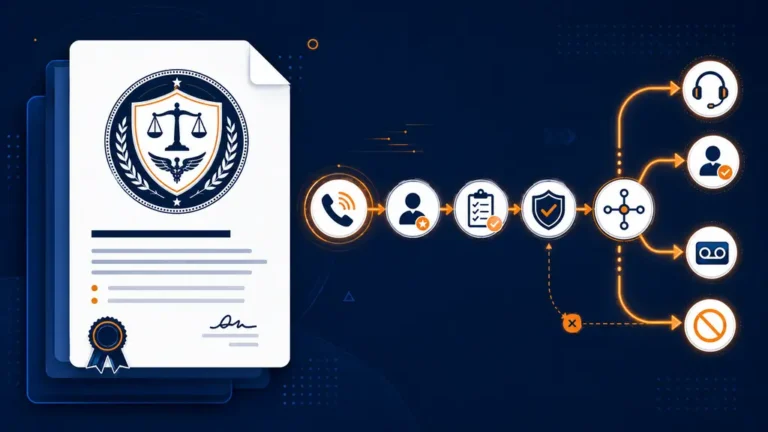
Automated lead handling is the full cycle. A form comes in. The system calls within about 30 seconds. An AI voice agent opens with the required disclosure, asks the qualifying questions, and picks the next step. Qualified and ready to talk means a warm transfer or a booked appointment. Interested but not ready means an SMS follow-up and a scheduled callback. Opted out means suppressed immediately and logged.
Why leads die without a fast first call
Most leads go cold for a boring reason. Nobody called them fast enough.
The lead response research is old, widely cited, and directionally consistent even where the exact figures vary by study. The best known finding, from lead response management research popularized by InsideSales, is that contact attempts made within the first five minutes qualify leads at a dramatically higher rate than attempts made even ten minutes later. Separate industry benchmarking of B2B response times has repeatedly found average first-response times measured in hours or days rather than minutes, with a large share of companies taking more than a full day to make first contact. Treat the specific multipliers as vendor research rather than peer-reviewed fact. The direction is what matters, and the direction has never reversed.
In insurance, mortgage, solar, and debt relief, the pressure is sharper because the same consumer usually submits their information to three to five companies in the same sitting. The company that calls first almost always wins that lead. Not because the product is better. Because they were the one who showed up while the person was still on the page.
Then add the after-hours gap. A lead that arrives at 7 PM Thursday is more than twelve hours from the next business morning. A Saturday lead can sit for two days. Every hour is another chance for a competitor to get there first or for the person to lose interest entirely. Good lead handling closes that gap by removing the requirement that a human be awake.
How AI lead handling works step by step
Here is the actual sequence from form submission to a closer picking up the phone.
Step 1. The lead submits a form
A homeowner requests a solar quote. A shopper submits their details on an insurance comparison site. A borrower asks for a rate check. The submission posts into your system through a webhook or a native CRM integration.
Step 2. The AI calls within about 30 seconds
The system dials the number, opens with the disclosure that the call is automated, and starts the conversation while the person is still sitting at their computer. Nobody on your team did anything.
Step 3. The AI asks the qualifying questions
Three to five questions, written for your vertical. For solar that might be home ownership, roof condition, average monthly electric bill, and purchase timeline. For mortgage it might be loan purpose, approximate balance, and credit range. The script is yours, not a generic template.
Step 4. Qualified and ready means transfer or booking
If the person qualifies and wants to talk now, the AI warm transfers to a human closer and passes the full context of the conversation. If they qualify but would rather talk later, the AI books the appointment directly on the calendar and confirms it by text.
Step 5. Interested but not ready means SMS and nurture
The AI sends a follow-up text and adds the record to a nurture cadence with spaced callbacks over the following one to two weeks. The lead stays warm without a rep chasing it manually.
Step 6. Opted out means suppressed permanently
If the person says stop calling, the system recognizes the intent, logs the opt-out, and suppresses the number across every campaign you run, not just the one that placed the call.
The full flow from submission to warm transfer can complete in under 90 seconds, and the system runs it in parallel across hundreds of leads at once. That parallelism is the second reason this model beats a phone room, after speed.
The AI voice and SMS combination
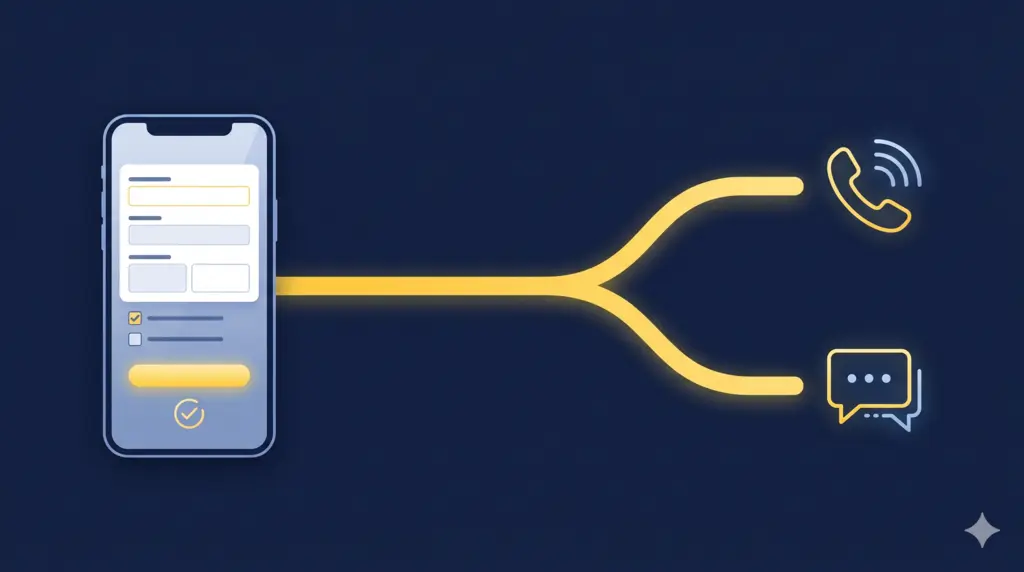
Voice alone misses people who never answer unknown numbers. Text alone misses people who ignore texts. Running both as one system covers far more of your list than either channel does by itself.
The AI calls first, because a live conversation with fresh intent converts better than anything else you can send. If the person answers, the qualifying flow runs and they get transferred, booked, or nurtured.
If the call goes unanswered, the AI sends an SMS within about a minute. The message is short and specific to what they submitted, not a generic acknowledgment. Something closer to a named reference to their quote request plus one clear reply instruction. Reply YES and we call you back inside a minute.
If they text back, the same system re-engages. It can schedule a callback for a time they choose, answer a simple question by text, or hand the thread to a human on request. This is one system choosing a channel per lead, not two tools running side by side and duplicating each other. Anecdotally, teams report that the fast text recovers a meaningful share of the no-answer pool, which is exactly the segment a voice-only program writes off.
See it live
Watch AI call a test lead in 30 seconds
We will run your own qualifying script against a live test number and show the transfer and the compliance log. It takes about 20 minutes.
Compliance built into every touch
Automated lead handling only works if every call and every text follows the rules. Under the Telephone Consumer Protection Act, statutory damages run to $500 per violation and up to $1,500 for a willful violation, and those figures are per call, not per campaign. Nothing about this post is legal advice, and you should have counsel review your specific program.
- Consent verification. Prior express written consent is required before placing automated marketing calls or texts to a cell phone. The FCC confirmed in February 2024 that AI-generated voices count as artificial voices under the same rule. The platform should check consent status on every number before it dials.
- Disclosure. Every AI-initiated call opens with a clear statement that the call is automated. Several states require it and it is the right default everywhere.
- Opt-out enforcement. Stop on a call or STOP in a text suppresses the number immediately and permanently, across every campaign, not after a nightly batch job.
- DNC suppression. Numbers get scrubbed against the federal and applicable state Do Not Call registries before contact.
- Calling windows. Federal rules limit calls to 8 AM through 9 PM in the recipient local time. Some states are tighter. The system reads the number and applies the correct window automatically.
On a managed platform this is infrastructure your team never touches. On a self-serve platform every item on that list becomes an engineering ticket and a maintenance burden that never ends. For a small program that is workable. For a call center pushing thousands of dials a day it is an incident waiting to happen. Our guide to TCPA-compliant AI calling platforms goes deeper on what to demand in writing.
Managed, self-serve, and in-house compared
Three delivery models exist, and the honest answer is that the right one depends on your volume, your engineering bench, and how much regulatory exposure you carry.
| Factor | Managed platform | Self-serve tool | Build in-house |
|---|---|---|---|
| Time to first live call | Days | Two to six weeks | Three to nine months |
| Who owns compliance | Vendor, contractually | You | You |
| Number registration and reputation | Managed and monitored | Your responsibility | Your responsibility |
| Engineering required | Almost none | One developer, ongoing | A team, permanently |
| Best fit | Regulated, high volume | Technical team, light exposure | Unique workflow, deep budget |
A small operation with a developer can do well on self-serve. You control every detail and you accept the maintenance. A high-volume outbound operation in a regulated vertical usually needs the managed model, because compliance enforcement, number rotation, and routing rules all have to keep working while nobody is watching. Building in-house makes sense only when your workflow is genuinely unusual and you have budget to staff it for years, not months.
How to evaluate an AI calling platform
Most demos look the same. These are the questions that separate the platforms that survive contact with a real call center from the ones that do not.
- Ask for the compliance artifacts. Request a sample consent log, an opt-out audit trail, and the DNC scrub schedule in writing. If the vendor cannot produce them in a demo, they do not exist.
- Test the transfer, not the conversation. Anyone can demo a smooth chat. Ask to hear a live warm transfer with context passed to the receiving rep, since that handoff is where most systems fall apart.
- Check the barge-in and interruption handling. Real people talk over the agent. Ask what happens when they do.
- Ask who owns the phone numbers. If you cannot port them out, you are renting your caller reputation.
- Get the connect rate baseline in writing. Ask what connect rate they see on your specific vertical and lead source, then ask what happens if the number gets spam labeled.
- Confirm the CRM write-back. Call recordings, transcripts, disposition, and consent status should land on the lead record automatically, not in a separate portal your reps never open.
- Price the whole program. Per-minute rates hide the cost of numbers, integrations, and script work. Compare on total program cost, not the headline rate.
What to avoid when you automate
The failure modes here are predictable, and almost all of them come from moving too fast on the wrong part of the program.
Do not point the system at an aged list you cannot document consent for. Old purchased data is the fastest way to turn a productivity project into a legal problem, and the fact that a lead once filled out a form somewhere is not the same as written consent naming your company.
Do not let the AI pretend to be a person. It fails the disclosure requirement in several states and it destroys trust the moment a prospect figures it out, which they usually do.
Do not run all your volume through a single phone number. Carriers label heavy single-number traffic as spam, and your connect rate collapses with no warning. Number rotation and registration is not optional at scale, and it is one of the main reasons teams choose managed over self-serve.
Do not skip the human review of the first week of transcripts. The qualifying script that reads perfectly in a document usually needs two or three rounds of edits once you hear real people answer it. Budget for that.
Who this approach is wrong for
This approach is a bad fit for several kinds of business, and it is worth saying so plainly before you spend money.
If you take fewer than roughly 100 leads a month, a simple SMS alert to a rep and a habit of calling back in five minutes will get you most of the benefit at none of the cost. The economics do not favor automation until the volume is high enough that people cannot keep up.
If you sell a high-touch, relationship-driven product with a long consultative cycle, an AI qualifying call can feel jarring and cost you more in first impressions than it saves in labor. Enterprise sales is not the use case.
If you cannot produce clean written consent for the numbers you want to call, fix that first. No platform, managed or otherwise, makes non-compliant data safe to dial. Our overview of the industries we serve gives a clearer read on which verticals this fits.
Watch
Too many leads, not enough meetings
When lead volume rises and booked meetings do not, the bottleneck is almost never the number of leads.
Automated lead handling FAQ
What is automated lead handling?
Automated lead handling is a system that contacts new leads by phone and text within seconds of submission, asks qualifying questions, and routes only the qualified ones to a human. Your CRM stores the record and the handling layer acts on it. No rep touches the lead until the conversation is worth having, which is usually a warm transfer or a booked appointment rather than a cold dial.
How fast does AI contact a lead after form submission?
On a managed platform the first call typically goes out within about 30 seconds of the form posting, including evenings, weekends, and holidays. If the call goes unanswered, an SMS follows inside roughly a minute. The speed matters most on shared leads, where the same consumer submitted their information to several companies at once and the first caller usually wins the conversation.
Is automated lead handling legal?
Yes, when it runs on proper consent. The TCPA requires prior express written consent before automated marketing calls or texts to a cell phone, and the FCC confirmed in February 2024 that AI-generated voices fall under the artificial voice rule. A compliant program verifies consent before dialing, discloses that the call is automated, honors opt-outs immediately, and scrubs against Do Not Call registries. This is general information, not legal advice.
What happens if the lead does not answer the call?
The system sends a short SMS tied to what the person submitted. If they reply, the AI re-engages and can book a callback, answer a simple question, or route the thread to a human. If there is still no response, the lead enters a spaced follow-up cadence over the next one to two weeks rather than being dialed repeatedly on the same day.
Does automated lead handling replace my sales team?
It replaces the work your reps should not be doing. Cold dials, voicemails, first-pass qualifying questions, after-hours coverage, and follow-up texts move to the system. Closers keep the conversations that require judgment, negotiation, and relationship building. Most teams end up redeploying reps rather than cutting them, because the qualified conversation volume goes up.
What is the difference between lead handling and a CRM?
A CRM is a database. It stores the lead, the notes, and the pipeline stage, and it waits for a person to act. Automated lead handling is the action layer that sits on top and actually calls and texts the lead, then writes the recording, transcript, disposition, and consent status back to the CRM record. You need both, and the handling layer is useless without clean CRM data underneath it.
How is this different from an auto-dialer?
An auto-dialer places calls and connects the answered ones to available human agents, so it still depends on reps being staffed and on shift. An AI lead handling system holds the conversation itself, asks the qualifying questions, and only involves a human when the lead is ready. The practical difference shows up at 9 PM and on weekends, when a dialer has nobody to connect a call to.
How much does automated lead handling cost?
Pricing usually combines a platform fee with per-minute call charges, and the total depends on your call volume, average handle time, and how many phone numbers you need registered. Compare total program cost rather than the per-minute rate, because number provisioning, CRM integration work, and script development are often quoted separately and can outweigh the difference in call rates.
Will the AI sound like a robot to my leads?
Current voice models handle interruptions, pauses, and natural phrasing well enough that most people carry a normal conversation, but the call still opens with a disclosure that it is automated. That disclosure is a legal requirement in several states and a trust decision everywhere else. Expect some people to hang up on the disclosure, and treat that as the honest cost of doing it correctly.
What happens to leads that opt out?
The number is suppressed immediately and permanently across every campaign in the account, not just the one that generated the call. The opt-out gets logged with a timestamp so you can prove it later. Good platforms recognize opt-out intent in natural speech, not only the literal word stop, because most people say something closer to take me off your list.
The bottom line
The reason to automate lead handling is not that AI is interesting. It is that the person who calls first usually wins the shared lead, and no human phone room covers Friday at 9 PM, Sunday at 7 AM, and a Tuesday spike of 400 submissions at the same time. Speed and parallelism are the entire argument.
The reason to be careful is that everything downstream of the call depends on consent you can document and a compliance layer you can audit. Get that part wrong and the speed advantage turns into liability faster than it turned into revenue. Start with your consent records, then pick the delivery model that matches your volume and your engineering bench.
Talk to us
Stop losing weekend leads to faster callers
We will review your current response times and lead sources and tell you honestly whether automation is worth it for your volume. No obligation.