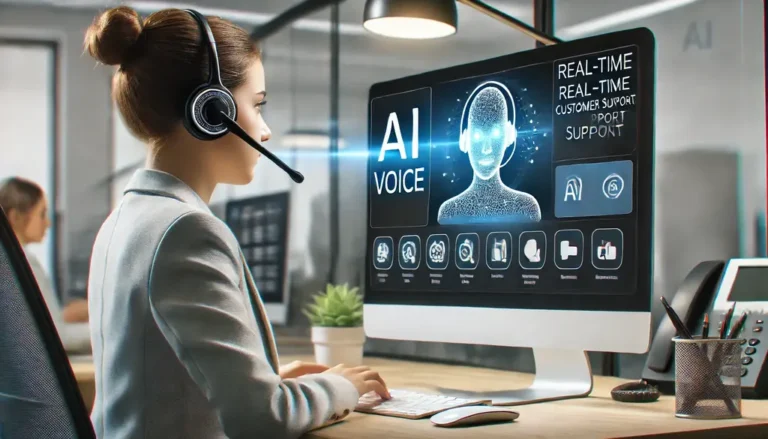
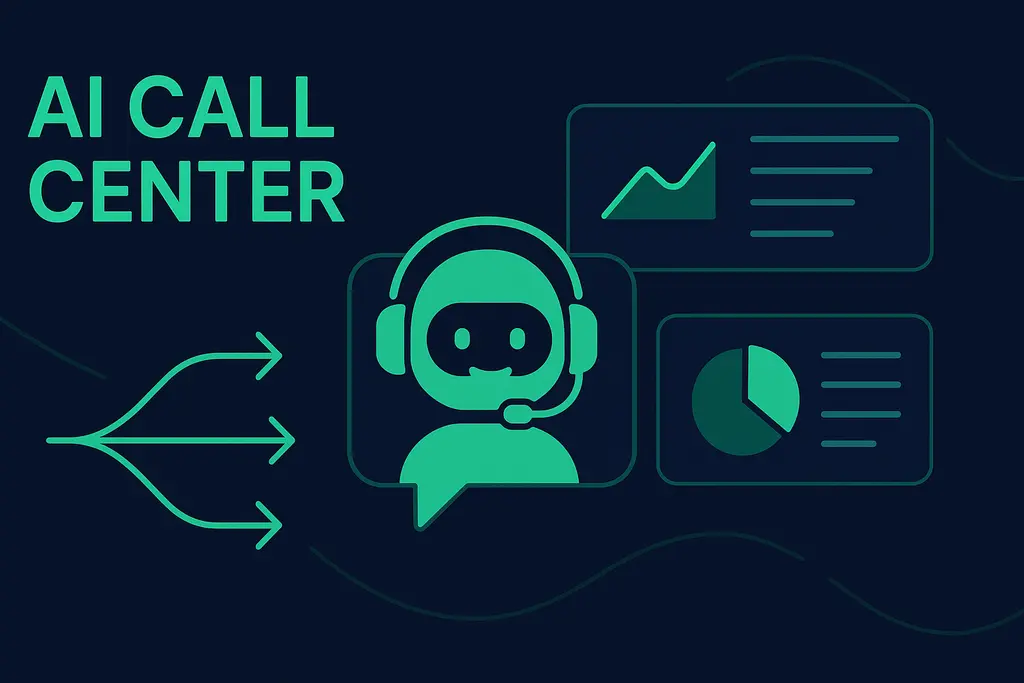
An AI call center is a customer service or sales operation where artificial intelligence (AI) handles voice calls in real time, either independently or alongside human agents.
It works by using speech recognition, natural language understanding, and automated decision logic to answer calls, qualify callers, resolve routine requests, or transfer conversations to humans when needed.
Unlike traditional call centers, AI call centers operate continuously, follow predefined compliance rules, and scale call volume without adding human staff.
How an AI Call Center Works (Simple Overview)
An AI call center follows a consistent workflow that applies to both inbound and outbound calls.
-
The system answers or places a call automatically.
-
Speech-to-text converts the caller’s voice into text.
-
Natural language processing determines intent and context.
-
Business rules decide the next action.
-
The AI responds using natural-sounding voice synthesis or transfers the call to a human agent.
This process happens in seconds and repeats consistently across thousands or millions of calls.
Core Technologies Behind an AI Call Center
Let’s now explore the core technologies behind an AI call center:
AI Voice and Conversational Intelligence
AI call centers do not rely on prerecorded menus. They use conversational AI to hold dynamic, two-way conversations that adapt to how a person speaks.
The system listens, interprets intent, and responds in natural language, making the interaction feel conversational rather than scripted.
Natural Language Processing (NLP)
Natural Language Processing allows the AI to understand what the caller is saying and what they want.
When a customer speaks, the system:
-
Converts speech into text
-
Identifies intent, keywords, and context
-
It matches the request with predefined business actions.
For example, a request such as “I want to confirm my account balance” is classified as a balance inquiry and routed to the appropriate data source.
Machine Learning and Continuous Training
AI call center systems improve through ongoing training.
They are initially trained on historical conversations, approved scripts, and known customer scenarios. After deployment, every call becomes feedback data. Successful interactions reinforce behavior, while failed or escalated calls help refine responses.
Human supervisors review edge cases and update logic to improve accuracy over time.
Text-to-Speech (TTS) Voice Synthesis
After deciding how to respond, the AI converts text into spoken language using neural text-to-speech models.
Modern TTS systems generate voices with realistic pacing, tone, and inflection. This prevents robotic-sounding responses and helps maintain caller trust during longer conversations.
Inbound AI Call Center Workflow
Inbound AI call centers focus on answering incoming calls efficiently.
A typical inbound flow includes:
-
Greeting and intent detection: The AI answers instantly and identifies why the caller is calling.
-
Authentication and context loading: The system verifies the caller and retrieves relevant account data.
-
Self-service resolution: The AI resolves common requests such as order status, appointment confirmation, or basic billing questions.
-
Live transfer when needed: If the request is complex or high value, the AI transfers the call to a human agent with a summary of the conversation.
This approach reduces wait times while preserving human involvement for sensitive cases.
Outbound AI Call Center Workflow
Outbound AI call centers handle proactive calling tasks such as lead qualification, follow-ups, and reminders.
The outbound process includes:
-
List screening and compliance checks: Numbers are verified against DNC rules and calling hours before dialing.
-
Call initiation and qualification: The AI places calls and asks structured questions to determine interest or eligibility.
-
Appointment booking or live transfer: Qualified prospects are scheduled or transferred to a human agent in real time.
-
Call logging and transcription: Every interaction is recorded, transcribed, and stored for reporting and follow-up.
Outbound AI calling allows large-scale outreach without overwhelming human teams.
Key Benefits of Using an AI Call Center
Now, let’s explore some top-rated benefits of using an AI call center:
Continuous Availability
AI call centers operate 24/7 without breaks, holidays, or staffing limitations. Customers receive immediate responses regardless of time zone or call volume.
Lower Cost Per Interaction
By automating the first layer of conversations, AI reduces the number of calls requiring human handling. This significantly lowers cost per contact while maintaining service consistency.
Consistent Quality and Compliance
AI systems follow the same approved language, logic, and compliance rules on every call. This reduces risk in regulated industries and creates a reliable audit trail for every interaction.
The Role of Human Agents in an AI Call Center
AI call centers do not eliminate human agents. They change how humans are used.
High-Value Conversations
Human agents focus on:
-
Complex problem resolution
-
Emotional or sensitive conversations
-
Negotiation and relationship building
AI handles repetitive tasks so humans can concentrate on work that requires judgment and empathy.
AI Supervision and Improvement
Human teams monitor AI performance, review escalated calls, and refine conversation flows. This oversight ensures the AI remains accurate, compliant, and aligned with business goals.
Implementing an AI Call Center System
Now that you understand how the AI call center system works and its key benefits, it is time to start implementing it.
Platform Selection and Integration
Successful AI call centers require deep integration with existing systems such as CRMs and internal databases. Integration enables the AI to personalize conversations and retrieve accurate data in real time.
Scripting and Data Mapping
Before launch, businesses define:
-
Common caller intents
-
Approved responses
-
Escalation rules
Accurate data mapping ensures the AI knows where to retrieve information when responding to specific requests.
Frequently Asked Questions
Lastly, here are some quick FAQs for your understanding:
Is an AI call center the same as an IVR system?
No. IVR systems rely on fixed menus and keypad input. AI call centers understand natural speech and adapt responses dynamically.
What happens if the AI cannot understand a caller?
The system transfers the call to a human agent and provides a summary of the conversation to ensure continuity.
How do AI call centers handle compliance?
They automatically enforce calling rules, consent requirements, and data access controls while logging every interaction for audit purposes.
Can AI call centers support multiple languages?
Yes. Modern systems support multiple languages and accents using trained speech and language models.
Do AI call centers replace human teams?
No. They automate high-volume tasks and allow human agents to focus on complex and high-value interactions.