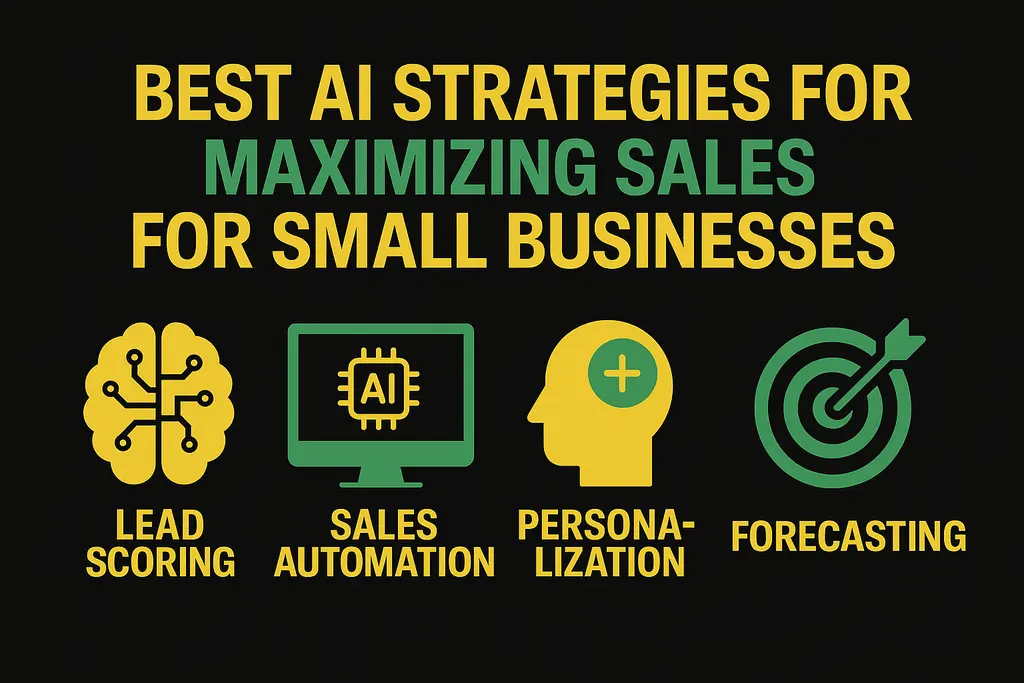


AI strategies for maximizing sales are the specific ways a business applies artificial intelligence to find better leads, engage them faster, and keep the customers it wins. For small businesses they matter more than for anyone else, because a five person team cannot outwork an enterprise competitor, but it can out-time and out-target one.
Small businesses put in the long hours, know their customers, and pivot faster than any large rival. Yet many hit a ceiling when the sales team becomes overloaded. One rep cannot follow up with every lead. One founder cannot personalize every pitch. One marketer cannot build tailored content for every buyer.
Applied correctly, AI removes that ceiling. This guide walks through nine practical AI strategies for small business sales in 2026, covering lead targeting, personalized engagement, and revenue protection. Each one puts humans back where they win, with AI handling volume and repetition while people handle relationships and closing.
TL;DR
AI strategies for sales fall into three groups. Pipeline strategies score and qualify leads so reps only work real opportunities. Engagement strategies personalize pricing, coaching, and content at scale. Protection strategies catch churn, clean CRM data, and sharpen forecasts.
The working rule is to automate the first touch and the follow up, never the close. Start with one strategy, usually predictive scoring or AI qualification, and expand after it proves itself. Skip AI entirely if you have fewer than a few dozen leads a month, because the data will be too thin to help.
Key takeaways
- Small teams scale by working smarter, and AI supplies the capacity a large sales department would.
- Predictive scoring focuses reps on the leads most likely to close instead of static guesswork.
- Intent signals such as hiring, funding, and job changes tell you when to reach out, not just who.
- Conversational AI handles first touch qualification so closers spend their time selling.
- Churn prediction, pipeline hygiene, and forecasting protect the revenue you already won.
- Start with one strategy, connect it to your CRM, and review the numbers weekly before adding more.
- AI amplifies a working sales motion. It does not fix a weak offer or thin lead flow.
Table of contents
- What AI strategies for sales are
- Why AI matters for small business revenue
- The nine strategies at a glance
- Pipeline strategies that find real buyers
- Engagement strategies that win trust at scale
- Protection strategies that keep revenue
- How to implement AI in a small sales team
- What AI will not fix
- AI strategies FAQ
- The bottom line
What AI strategies for sales are
AI strategies for sales are repeatable plays where software analyzes customer and market data, then acts on it or tells a human to act. That covers scoring leads by their real likelihood to buy, triggering outreach when a buying signal appears, holding first qualification conversations, tailoring prices and proposals, coaching reps during live calls, and predicting which customers are about to leave.
The common thread is that data replaces guesswork. Instead of a rep deciding whom to call based on gut feel, the system ranks the list by evidence. Instead of a founder discovering churn in the cancellation email, the model flags the account weeks earlier. None of this requires an enterprise budget in 2026, which is exactly why it has become the great equalizer for small teams.
Why AI matters for small business revenue
Small teams cannot scale by working harder. They scale by working smarter. AI collects large volumes of customer data points, finds buying signals inside them, and guides action with predictive intelligence.
When small businesses adopt AI strategies, they gain more pipeline coverage without extra headcount, faster response to real buyer intent, higher close rates from better timing, personalized engagement that builds trust, stronger retention through prediction, and forecasts solid enough to plan hiring and cash flow around.
The competitive math is simple. Your enterprise rivals already run this playbook with big teams attached. Small business agility plus AI execution is the counter, and it is available at small business prices. You can sanity check that claim against our published pricing rather than taking it on faith.
The nine strategies at a glance
| Strategy | What it does | Effort to start | Best first for |
|---|---|---|---|
| Predictive scoring | Ranks leads by real close probability | Low | Teams drowning in unranked leads |
| Intent prospecting | Times outreach to buying signals | Medium | Outbound heavy teams |
| AI qualification | Holds first touch discovery calls | Low | Closers short on selling time |
| Smart pricing | Tailors offers and add-ons per buyer | Medium | Deals lost to discounting |
| Live call intelligence | Coaches reps during the call | Medium | Fast growing rep teams |
| Content generation | Builds tailored proposals in minutes | Low | Slow proposal turnaround |
| Churn detection | Flags at risk customers early | Medium | Recurring revenue businesses |
| Pipeline hygiene | Keeps CRM data current and honest | Low | Unreliable dashboards |
| Revenue forecasting | Predicts revenue timelines | Medium | Planning hires and cash flow |
Pipeline strategies that find real buyers
A healthy pipeline is not about volume. It is about quality. Without smart prioritization, reps waste hours chasing prospects who will never convert.
1. Predictive opportunity scoring
Traditional lead scoring relies on static criteria and guesses at fit rather than analyzing behavior. Machine learning models improve on that by weighing engagement history, industry signals, budget indicators, timing patterns, and sales cycle velocity, then assigning every lead a closing probability.
Reps then spend their time only on top opportunities. The results small teams see are higher win rates, lower acquisition costs, and less burnout, because nobody is grinding through a list where nineteen of twenty names were never going to buy.
2. Intent based prospecting
Cold outreach fails when it lacks context. Intent based prospecting watches external buying signals instead, such as job changes, funding announcements, technology upgrades, regulation shifts in the buyer’s industry, and content interactions.
When a signal appears, the system triggers a personalized sequence. A company suddenly hiring support staff, for example, is a natural prospect for AI voice tooling. Sales moves from interrupting to helping, prospects feel understood, and response rates improve because the timing is right.
3. AI driven qualification
Closers lose their most valuable hours qualifying leads that show little intent. Conversational AI takes the first touch instead, asking discovery questions that capture budget, urgency, decision role, and pain point depth.
Qualified opportunities route straight to the closer with the context attached. Since the AI answers new leads in seconds rather than hours, this play also fixes speed to lead, which is where most small teams silently lose deals. Humans stay in the real selling conversations and early pipeline friction disappears.
First touch, automated
Let AI qualify your leads while you close
Bigly Sales calls new leads in seconds, asks your discovery questions, and books the qualified ones on your calendar. See it on your own lead flow in 20 minutes.
Engagement strategies that win trust at scale
Personalization used to demand human hours. AI now delivers it to every prospect without delay, which is how small teams earn trust at a pace that used to require a marketing department.
4. Real time smart pricing
Not every buyer responds to price the same way. AI analyzes past purchases, competitor movement, urgency, and stated preferences, then recommends tailored packages and add-ons that fit the specific buyer.
Measured results include larger average deal sizes, less discounting pressure, and higher upsell acceptance. Pricing becomes a strategic tool instead of a guessing game. Keep a human approval step on any price the model proposes, both for margin control and for accuracy.
5. Live call intelligence
Managers normally review calls after they happen, which wastes the moment. Live sentiment and intent analysis listens during the call and feeds the rep suggestions in real time, such as better follow up questions, stronger value statements, competitor responses, and tone adjustments when hesitation appears.
This real time coaching compresses skill development. New hires improve in weeks instead of quarters, and veteran reps sharpen their precision on every call.
6. Personalized content generation
Buyers respond to content that speaks to their role and market. AI drafts tailored case studies, pricing sheets, demo decks, and proposals, adjusted for industry challenges, the buyer’s job title, the pain points they described, and the outcomes they care about.
A personalized proposal arrives in minutes instead of days, and sales cycles shorten accordingly. One honest warning applies. Review every AI drafted claim before it ships, because the FTC advertising rules are explicit that unsubstantiated performance claims are still your responsibility, whoever or whatever wrote them.
Protection strategies that keep revenue
Sales performance is not only about new deals. Durable small businesses keep the customers they win and forecast growth honestly. AI makes both practical.
7. Early churn detection
Many businesses lose more revenue to churn than to lost deals. AI monitors signals such as declining product usage, slower response times, rising support issues, billing delays, and negative survey sentiment.
When the model flags risk, the account team can act while the relationship is still saveable. Solving a problem before the customer starts shopping elsewhere is the cheapest retention work you will ever do.
8. Automated pipeline hygiene
Dirty CRM data quietly ruins everything downstream. Deals age out unnoticed, contacts go stale, and forecasts become fiction. AI keeps the system truthful by flagging stalled opportunities, filling missing information, identifying invalid contacts, and translating fresh intent signals into updated stages.
Leaders get dashboards that reflect reality, and every decision built on them gets better.
9. High accuracy revenue forecasting
Budgets, hiring, and inventory all depend on knowing what revenue is actually coming. AI forecasting models combine pipeline data with historical patterns to predict revenue timelines with far more clarity than a spreadsheet average.
Teams use that confidence to hire at the right time, manage cash flow, plan expansion, and support funding conversations with evidence. Risk drops because growth stops being a guess.

How to implement AI in a small sales team
You do not need to overhaul your tech stack to put AI strategies to work. The smartest path starts with one targeted improvement and compounds from there.
- Pick one strategy, usually predictive scoring or AI qualification, and run it for a full sales cycle before judging it.
- Connect the tool to your existing CRM so data flows both ways and nothing is retyped.
- Deploy conversational AI on first touch to buy back human selling hours immediately.
- Review the metrics weekly, refine the inputs, and kill anything that is not moving a number.
- Shift human roles toward negotiation and closing as automation absorbs the repetitive work.
The pattern that works is AI as the engine that moves leads forward and humans as the final step that wins the deal. This holds across sectors, from home services to real estate to insurance, and you can see how it maps to your vertical on our industries page.
What AI will not fix
An honest caveat belongs in every guide like this. AI strategies amplify a sales motion that already works. They do not create one.
If your offer has never closed consistently through any channel, fix the offer first. If you receive only a handful of leads a month, most predictive tools will not have enough data to score anything, and your money is better spent on lead generation. And if your team will not keep the CRM updated, automation will faithfully scale the mess.
AI also does not replace sales professionals. Machines take the repetitive work while humans build trust, read emotion, and handle objections. Teams that try to automate the close itself usually lose deals a person would have saved.
AI strategies FAQ
What are AI strategies for maximizing sales?
They are repeatable plays where AI analyzes customer and market data and then acts on it, such as scoring leads by close probability, timing outreach to buying signals, qualifying leads conversationally, tailoring pricing and proposals, coaching reps live, and predicting churn. The goal is replacing guesswork with evidence at every stage of the funnel.
What is the main benefit for small businesses?
Capacity. AI gives a small team the reach of a large sales department, so it can respond to every lead in seconds, personalize outreach at scale, and manage more pipeline with the same headcount. The practical result is higher win rates and lower acquisition costs without new hires.
Which AI strategy should a small business start with?
Start with predictive scoring if you have plenty of leads but no ranking, or AI qualification if your closers are buried in first touch conversations. Both are low effort to deploy, show results within one sales cycle, and generate the clean data that later strategies such as forecasting depend on.
Do AI sales tools require technical expertise?
Not anymore. Modern platforms connect directly to CRMs like Salesforce or HubSpot, and setup is configuration rather than coding. A non technical founder can typically launch a scoring model or an AI qualification flow in days. The real work is defining your qualification questions and keeping the underlying data clean.
How much do AI sales tools cost for a small business?
Pricing varies widely by category, from modest monthly software fees for scoring and hygiene tools to usage based pricing for AI calling. The better question is payback. If a tool books meetings or saves selling hours that close even one extra deal a month, it usually covers itself. Compare published pricing pages before committing.
How do AI strategies prevent churn?
The system watches usage trends, support activity, billing behavior, and sentiment, then warns the team when a customer shows risk patterns. That early alert lets support or account managers step in weeks before a cancellation would land, which protects recurring revenue at a far lower cost than replacing the customer.
Can AI personalization actually feel human?
Yes, when it is grounded in real buyer data. The prospect sees information tailored to their industry, role, and stated needs, which reads as attentiveness rather than automation. It fails when teams fake familiarity the data does not support, so keep personalization tied to signals you genuinely have.
What is an intent signal?
An intent signal is an action or event that indicates active buying interest, such as a demo request, a hiring spree, new funding, a technology change, or repeated visits to your pricing page. AI turns these signals into timing, triggering outreach when the prospect is most likely to engage.
Will AI replace my sales reps?
No. AI absorbs the repetitive work of dialing, qualifying, data entry, and follow up, while people handle trust, objections, and negotiation. Small teams that pair the two outperform either alone. The role of the rep shifts toward higher value conversations rather than disappearing.
How long until AI strategies show results?
Expect meaningful signal within one full sales cycle. Fast payback plays like AI qualification improve response times on day one, while scoring models sharpen as they accumulate outcomes. Churn and forecasting models need a few months of history. Judge each tool on a defined metric, not on general impressions.
The bottom line
AI strategies for sales give small businesses what they have always lacked, which is capacity. Scoring, intent timing, and AI qualification fill the pipeline with real buyers. Personalized pricing, live coaching, and instant proposals win their trust. Churn detection, clean data, and honest forecasts keep the revenue you earn.
Start with one play, wire it into your CRM, and measure it for a full cycle. Keep humans on the close, keep your claims honest, and let the machines do the repetition. That combination is how a small team competes with a big one in 2026.
Grow without hiring
Turn more of your leads into booked meetings
Bigly Sales gives small teams AI calling, texting, and scheduling in one system. Most customers launch their first campaign inside a week.