


A TCPA class action is a lawsuit in which one named plaintiff sues on behalf of everyone who received the same allegedly non-compliant call, which turns a single 500 dollar statutory claim into exposure measured across an entire campaign. That structure is why the Telephone Consumer Protection Act produces more class filings than almost any other consumer statute.
Filing volume has climbed for two straight years. Litigation trackers that follow federal consumer filings recorded roughly 1,807 TCPA class actions in 2025, and March 2026 set a single-month record with about 220 class actions filed. First quarter 2026 filings ran around 19 percent above the same quarter in 2025, which itself was a record year.
Most call center directors do not know what their exposure looks like until a demand letter arrives. This article covers what the filing data shows, why the surge is structural rather than temporary, which industries are drawing the filings, what a case actually costs, and the seven controls that close the gaps these cases are built on.
TL;DR
TCPA class actions are running at record volume, with roughly 220 filed in March 2026 alone and first quarter filings about 19 percent above the prior year. Statutory damages of 500 dollars per call, rising to 1,500 dollars for willful violations with no aggregate cap, are what make a single campaign worth suing over.
Nearly every filing traces back to the same operational failures. Consent that cannot be documented, do-not-call scrubs that run on a schedule instead of at dial time, retry logic without frequency caps, opt-outs that never reach the dialer, and reassigned numbers nobody aged out.
None of this is legal advice, and no platform eliminates the risk. Consent quality and lead sourcing decide most cases, so confirm your program with counsel before you scale it.
Key takeaways
- TCPA class actions hit an all-time monthly record in March 2026 at roughly 220 filings, with about 283 total TCPA cases that month.
- Litigation trackers put 2025 at roughly 1,807 class filings, more than double 2024, and first quarter 2026 about 19 percent higher again.
- Class actions make up the large majority of TCPA filings because statutory damages carry no aggregate cap.
- Insurance, debt collection, and legal services draw roughly two thirds of the cases, with financial services close behind.
- The FCC’s one-to-one consent rule was vacated in January 2025 and never took effect. Prior express written consent remains the standard.
- The cross-channel revocation requirement is the item with a 2026 compliance date, and it is what suppression logic should be built for.
- Every recurring failure behind these filings is a system setting, which means it can be enforced before the dial rather than trained after the fact.
Table of contents
- What a TCPA class action is
- The 2026 filing numbers
- Why TCPA class actions are surging
- Which industries are being targeted
- What a case actually costs
- The operational failures behind the filings
- Seven controls that prevent TCPA class actions
- What Bigly Sales does, and what it does not
- TCPA class actions FAQ
- The bottom line
What a TCPA class action is
TCPA class actions are civil suits brought under the Telephone Consumer Protection Act by one or more named plaintiffs on behalf of a class of people who received the same category of allegedly unlawful call or text. The statute sits at 47 U.S.C. 227 and gives consumers a private right of action, which is the feature that makes the plaintiffs’ bar rather than a regulator the main enforcement pressure.
Two design details drive the volume. Damages are statutory, so a plaintiff does not have to prove any actual harm or dollar loss. And there is no aggregate cap, so damages multiply by the size of the class instead of settling at a ceiling. A class of 100,000 consumers who each received one non-compliant call implies a theoretical range between 50 million and 150 million dollars before any negotiation begins.
That arithmetic is the whole business model. It is also why the same operational gap that produces one complaint produces a class claim, because automated campaigns apply the same misconfiguration to every record in the list.
The 2026 filing numbers
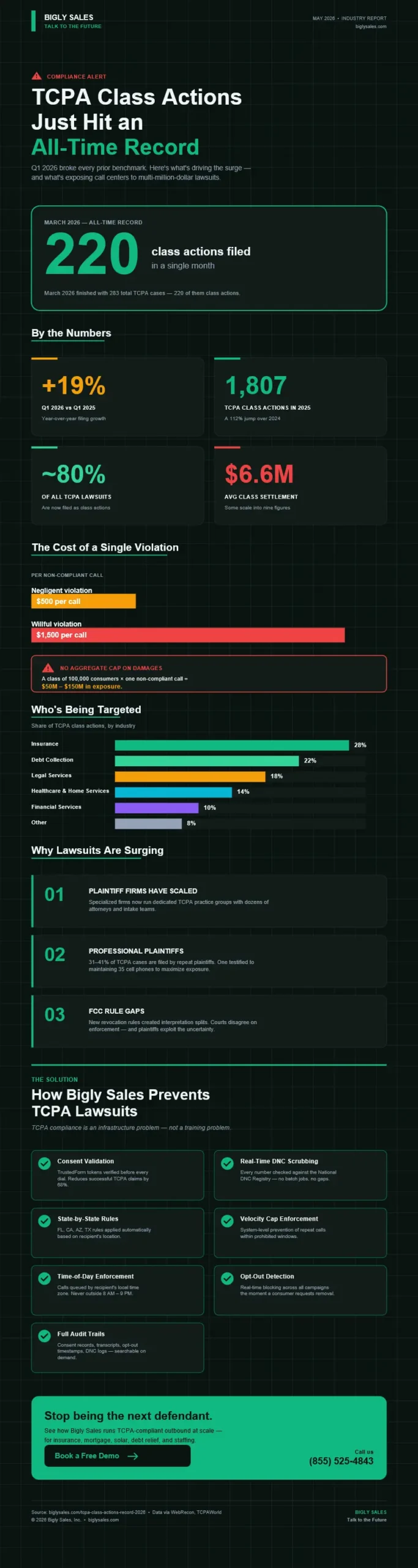
The figures below come from filing data compiled by litigation trackers that follow federal consumer cases and are widely cited by TCPA defense counsel. Treat them as directional counts of filings rather than audited statistics.
- Roughly 1,807 TCPA class actions were filed in 2025, more than double the 2024 count.
- September 2025 recorded about 224 class filings, a large jump against the same month a year earlier.
- March 2026 finished with about 283 total TCPA cases, of which roughly 220 were class actions. Both set records.
- First quarter 2026 filings ran about 19 percent above first quarter 2025.
Class actions account for the large majority of TCPA filings in this period. That share is unusual among consumer statutes, and it follows directly from the uncapped statutory damages rather than from anything about the industries being sued.
Why TCPA class actions are surging
Three structural factors are behind the increase, and none of them look temporary.
Plaintiffs’ firms have industrialized
Several firms now run dedicated TCPA practice groups with intake teams, paralegals, and attorneys working these cases exclusively. The model is repeatable, the economics are favorable, and the investment has followed. Filing a TCPA class action is no longer opportunistic work. It is a production line with a supply chain behind it.
Repeat plaintiffs generate the raw material
Industry analysis of filing records suggests roughly a third of TCPA suits are brought by individuals who have filed before. Some maintain multiple numbers across several carriers specifically to widen the surface area for receiving non-compliant calls. Courts have not treated that as a bar to recovery in most cases, so the practice continues.
Legal uncertainty creates openings
Changes to the FCC’s consent and revocation rules have left interpretation gaps. Compliance teams read them one way, plaintiffs’ firms argue another, and courts have split. Uncertainty itself becomes a filing opportunity, because a defensible reading is still a reading somebody can sue over.
Two points deserve a plain statement here, because both are widely misreported. The FCC’s one-to-one consent rule was vacated by the Eleventh Circuit in January 2025 and never took effect, so prior express written consent under the existing TCPA standard remains the operative test. Many teams adopt one-to-one consent as internal policy anyway, which is a reasonable way to cut litigation risk even though it is not required. Separately, the requirement that a consumer’s revocation of consent applies across channels rather than only the channel where it was given is the item carrying a 2026 compliance date, and that is what your suppression logic should be built for.
Which industries are being targeted
Filing analyses consistently show the same concentration. If your outbound program sits in one of these verticals, treat a TCPA class action as a foreseeable event rather than an unlucky one.
| Industry | Reported share of cases | Why it draws filings |
|---|---|---|
| Insurance | About 28 percent | Heavy reliance on purchased and aggregated lead data |
| Debt collection | About 22 percent | High outbound contact volume and existing regulatory scrutiny |
| Legal services | About 18 percent | Mass tort and claims marketing at scale |
| Financial services | Significant remainder | Wireless contact on accounts with aging consent records |
| Healthcare and home services | Balance of filings | Appointment and quote campaigns using third-party lists |
Insurance leads because the vertical runs on aggregated leads. Aggregators frequently package consent records that do not meet the prior express written consent standard. The buyer assumes the leads are clean, the plaintiffs’ firm argues otherwise, the aggregator is rarely named, and the buyer pays. Debt collection ranks next on contact volume alone, which is why every debt relief outbound program should assume its campaigns will be examined line by line.
What a case actually costs
The settlement figure is rarely the whole bill in TCPA class actions. Discovery is disruptive on its own, because it demands consent records, call detail records, scrub logs, script versions, and vendor contracts on a court timetable rather than yours.
| Stage | Reported range | What drives it |
|---|---|---|
| Pre-suit demand letter | 3,000 to 5,000 dollars | Offered before filing to settle a single claim quickly |
| Individual settlement | 5,000 to 12,000 dollars | One plaintiff, small call count, early resolution |
| Defense costs through discovery | 50,000 to 150,000 dollars | Document production, depositions, expert work |
| Class settlement | Commonly reported above 6 million dollars | Class size multiplied by uncapped statutory damages |
A large share of cases open with a demand letter rather than a filing. Paying resolves that claim but signals that your program answers demands, which tends to attract more. Refusing raises the cost if the case is filed but can deter repeat claimants. Neither choice fixes the underlying gap, and the gap is what determines whether the next letter arrives.
Compliance review
See where your outbound program breaks
We will walk your consent, suppression, and record trail and show what a plaintiff’s firm would find. The session takes about 30 minutes.
The operational failures behind the filings
Almost every TCPA class action filed this year traces back to the same short list of failures. Plaintiffs’ firms look for these specifically because they are easy to prove from your own records.
Consent that does not meet the prior express written consent standard, usually because the form language was vague or named a different seller. Registry numbers that were not scrubbed before dialing. Repeat calls that exceed federal expectations or explicit state frequency limits. Calls placed outside the 8 a.m. to 9 p.m. local window, or outside a narrower state window such as Florida’s 8 p.m. cutoff. Opt-out requests acknowledged verbally but never enforced in the dialer. Reassigned numbers still carrying consent from a previous subscriber. State rules in Florida, Washington, and Oklahoma applied inconsistently or not at all.
None of these are agent errors. They are infrastructure gaps. Manual processes fail under volume, spreadsheet scrubs fall behind, and training decays. The plaintiffs’ firms know the rules better than most compliance teams do, and they file accordingly.
Seven controls that prevent TCPA class actions
Each control below maps to one of the failures that TCPA class actions are built on. The point of all seven is the same, which is to move enforcement from a person remembering to a system refusing.
1. Validate consent before the dial
Check the consent record at dial time rather than at list load. The record should tie a specific number to specific form language, a timestamp, and an identifiable source. If it cannot be verified, the call should not be placed.
2. Scrub at dial time, not on a schedule
The FTC’s Telemarketing Sales Rule requires covered sellers and telemarketers to update calling lists by removing National Do Not Call Registry numbers at least every 31 days, and the FTC compliance guide sets out that duty alongside calling-hour limits. Treat 31 days as the floor and check suppression against both the federal registry and your internal list immediately before each call.
3. Cap frequency per number and per state
Retry logic tuned to maximize contact attempts is what produces the six-calls-in-a-week fact pattern that reads badly in a complaint. Set caps per campaign and per state, and make them settings that campaign configuration cannot override. Florida, for example, limits commercial telephonic sales calls to three within a 24 hour period on the same subject matter.
4. Enforce calling windows by recipient location
Queue calls against the recipient’s local time, not the call center’s, and let the narrower state window win any conflict. Area code is a weak proxy for location on mobile numbers, so use the best location data available and default to the conservative window when sources disagree.
5. Detect and suppress opt-outs during the call
An opt-out is only honored when the number stops being dialed. Capture the request in the call itself, suppress the number across every active campaign immediately, and extend that suppression across channels rather than only the one the request arrived on.
6. Check reassignment and age out stale consent
Consent records decay silently. Numbers are disconnected and reissued, and the new subscriber never agreed to anything. Check numbers against reassignment and disconnect data before dialing, record the date each consent was captured, and retire records that have aged past your own policy.
7. Keep one searchable audit trail
You win or lose these cases on documents. Store consent records, call detail records, transcripts, recordings where permitted, opt-out timestamps, scrub logs, and script versions together and searchable by phone number. Records spread across a vendor portal, a dialer export, and an inbox cannot be assembled on a discovery timeline.
What Bigly Sales does, and what it does not
Bigly Sales runs managed outbound programs, which means the seven controls above are configured into the calling workflow rather than left as instructions for your team. That covers consent validation before the dial, suppression against the federal registry and your internal list, state-aware calling windows applied by recipient location, frequency caps agents cannot override, opt-out detection with immediate cross-campaign suppression, reassignment checks, and a single audit trail. The wider approach is set out in our guide to TCPA compliance for managed AI sales and on the legal and compliance page.
Here is what it does not do. It does not eliminate the risk of TCPA class actions, and any vendor telling you otherwise should worry you. A platform enforces the rules you configure. It cannot validate consent that was never properly obtained, pick your lead vendors, or approve your script language. If your lead sourcing is the weak point, fix that before you scale volume, because dial-time enforcement cannot repair a consent record that was defective at the source. None of this is legal advice, and your consent language, calling windows, and state obligations should be confirmed with counsel.
Watch
$500 per call, with a four year lookback
Why TCPA math gets frightening fast once you multiply a routine campaign by the statutory damages and the limitation period.
TCPA class actions FAQ
How many TCPA lawsuits were filed in 2025?
Litigation trackers that follow federal consumer filings recorded roughly 1,807 TCPA class actions in 2025, more than double the 2024 total, with total TCPA cases for the year in the region of 2,600. These are counts of filings rather than outcomes, so they measure litigation pressure rather than proven violations. The trend has continued into 2026 at a higher rate again.
What was the record month for TCPA class actions?
March 2026, with roughly 220 class actions filed under the Telephone Consumer Protection Act out of about 283 total TCPA cases that month. Both figures set records in the published filing data. First quarter 2026 as a whole ran approximately 19 percent above first quarter 2025, which had itself been the highest year on record for TCPA class actions.
How much do TCPA violations cost?
Statutory damages are 500 dollars per violation and up to 1,500 dollars where the violation is willful or knowing. There is no aggregate cap, which is why class exposure scales with the size of the calling list rather than stopping at a ceiling. Defense costs through discovery are commonly reported between 50,000 and 150,000 dollars, separate from any settlement paid.
Which industries are sued most often under the TCPA?
Published filing analyses put insurance at roughly 28 percent of cases, debt collection at about 22 percent, and legal services at about 18 percent. Financial services, healthcare, and home services account for most of the remainder. Insurance leads because the vertical depends heavily on purchased and aggregated leads, where consent records often fail the prior express written consent standard.
Why are so many TCPA suits filed as class actions?
Because damages are statutory and uncapped. A plaintiff does not need to prove actual loss, and the same misconfiguration that produced one non-compliant call usually produced it across an entire list. That makes commonality easy to argue at certification. The result is that TCPA class actions make up the large majority of filings under the statute, a much higher share than most consumer protection laws see.
Is the FCC one-to-one consent rule in effect?
No. The rule would have required a consumer to consent to each identified seller separately, but the Eleventh Circuit vacated it in January 2025 and it never took effect. Prior express written consent under the existing TCPA standard remains the operative requirement. Adopting one-to-one consent as internal policy is still worthwhile, because it produces documentation that removes any argument about which company the consumer agreed to hear from.
What changes in 2026?
The compliance item with a 2026 date is the requirement that a consumer’s revocation of consent applies across channels rather than only the channel where the request was made. In practice that means an opt-out given on a text or a web form has to suppress calls too. Build suppression to propagate across every campaign and channel now rather than treating each channel separately.
Can a platform guarantee we avoid a TCPA class action?
No, and a vendor claiming otherwise is a warning sign. A platform can block calls that fail a consent or suppression check, apply state rules per recipient, and produce records in discovery. It cannot validate consent obtained through a defective form, choose your lead sources, or approve your script. Exposure stays shared between your operation, your lead vendors, and your counsel.
What should we do first if we have never audited our program?
Pull a random sample of 50 recently dialed numbers and try to produce the full consent record for each one, including form language, timestamp, and source. Whatever percentage you cannot document is the shape of your exposure. Then check whether opt-outs captured on one campaign actually suppress the number on the others. Those two tests find most of the risk quickly.
The bottom line
TCPA class actions are at record volume because the statute rewards them and because the failures they rely on are still common. Nothing in the filing data suggests plaintiffs’ firms are running out of material. The variable you control is not the litigation rate. It is whether your own records would survive a discovery request.
Start with the two tests above, close the gaps you find, and move enforcement to the moment before the dial. A program where consent is checked at dial time, suppression is instant and cross-channel, and records live in one searchable place is a poor target, and being a poor target is the only defense that scales.
Managed outbound
Controls enforced on every single dial
We run consent checks, suppression, calling windows, and audit trails as part of the deployment. Most programs go live within weeks.