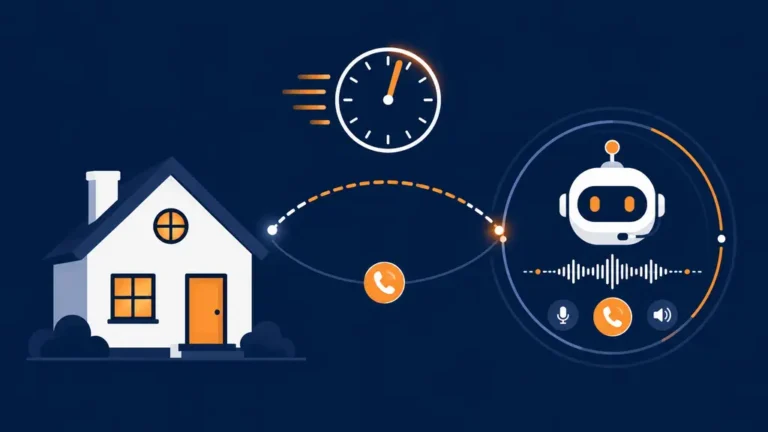



The average number of calls a human outbound agent can handle is 50 to 100 dials per day, while an AI calling system can place thousands in the same window. Scale a strong 20-seat human team and you top out near 2,000 dials a day, a volume AI platforms can clear before lunch.
Raw capacity is only the start of the story. The number of calls you place matters less than what each live conversation costs you, how many calls actually get answered, and how much compliance risk rides along. This guide breaks down the 2026 benchmarks for humans and AI, the real cost math, and where each one still wins.
TL;DR
A human outbound agent handles roughly 50 to 100 dials per day, which turns into about 15 to 50 live conversations depending on answer rates and call complexity. Managed AI calling systems place 2,000 to 50,000 calls per day per campaign depending on call length, number pool size, and carrier velocity limits, at a cost per live conversation of roughly $0.05 to $0.50 versus $6 to $13 for a human.
The crossover point sits around 1,000 to 2,000 dials per day. Below roughly 500 daily calls in a simple sales motion, a small human team can still be the cheaper option, and complex, high-consideration closes still belong with people.
Key takeaways
- Human agents average 50-100 dials and 15-50 live conversations per 8-hour shift.
- The number of calls an AI campaign can place ranges from 2,000 to 50,000 per day, set by call length and carrier limits.
- Cost per live conversation is the metric that matters, roughly $6-$13 for humans versus $0.05-$0.50 for managed AI at scale.
- Answer rate is the hidden lever. Dedicated, whitelisted numbers avoid spam labels that suppress pickups.
- AI capacity is not unlimited. Number inventory, carrier velocity rules, and platform infrastructure cap it.
- The cost crossover for most operations lands near 1,000-2,000 dials per day.
- The winning 2026 model is hybrid, AI qualifies the volume and humans close the qualified leads.
Table of contents
- What the number of calls per agent really measures
- Human agent benchmarks per day
- AI calling capacity per day
- The real comparison, cost per conversation
- Where AI wins and where humans still win
- Factors that set AI capacity in practice
- Which is right for your operation
- How Bigly Sales maximizes calling capacity
- Calls per agent FAQ
- The bottom line
What the number of calls per agent really measures
The number of calls an agent can handle is a capacity benchmark, usually counted as dials per day, and it is only useful when you split it into dials and live conversations. A dial is any attempt. A conversation is a prospect who picked up, engaged, and heard the pitch. Two teams with identical dial counts can produce wildly different revenue because their answer rates and call quality differ.
Keep both figures in view as you read the benchmarks below. Dials measure effort. Conversations measure what you can actually sell against, and every cost figure later in this guide is anchored to conversations rather than attempts.
Human agent benchmarks per day
The honest answer is that it depends on call type, industry, and list quality, but industry benchmarks are fairly consistent. Here is what a human agent typically produces in outbound sales.
| Call type | Dials per day | Live conversations | Notes |
|---|---|---|---|
| Simple qualification calls | 80–100 | 40–60 | Short scripts, fast wrap-up |
| Complex sales calls | 40–60 | 20–35 | Insurance, mortgage, debt relief |
| Follow-up and nurture calls | 60–80 | 30–50 | Warmer lists, higher pickup |
These figures assume a standard 8-hour shift with breaks, admin time, and CRM logging built in. Repetitive dialing is also cognitively tiring, and most floors see per-hour output slide in the back half of a shift, so afternoon production rarely matches the morning.
The team-level math is worse than the per-agent math. Sick days, turnover, ramp time for new hires, and the reality that some share of any team is underperforming all mean your real-world capacity runs meaningfully below what headcount multiplied by benchmarks suggests.
AI calling capacity per day
AI does not work on a per-agent, per-shift model, so the useful question is what the number of calls looks like at the campaign level. These are practical planning ranges for a managed platform in 2026.
| Scenario | AI daily capacity | What sets the limit |
|---|---|---|
| Simple qualification, single question | 10,000–50,000 calls | Number inventory and carrier velocity rules |
| Multi-question qualification | 5,000–20,000 calls | Average call duration |
| Complex sales conversations | 2,000–8,000 calls | Longer calls with more nuanced handling |
| Follow-up and re-engagement | 10,000+ calls | High speed and short duration |
Unlike human agents, AI does not fatigue, does not need breaks, and delivers the same quality on call number one and call number 10,000. Monday mornings do not exist for it.
That said, AI capacity is not unlimited in practice. Three constraints govern it, the phone numbers available in your pool, carrier-enforced velocity limits built to stop spam behavior, and the platform’s infrastructure. A well-run system operates inside those limits by registering many dedicated numbers, respecting each number’s allowed pace, and spreading volume across the pool instead of burning individual numbers.
The real comparison, cost per conversation
Raw volume is the wrong metric. The number of calls you place matters far less than what each live conversation costs, meaning a prospect who picked up, engaged, and heard your pitch. Here is what that math typically looks like.
| Metric | Human agent | Managed AI calling |
|---|---|---|
| Dials per day | 80 | 5,000+ |
| Answer rate | 15–25% | 45–65% with whitelisted numbers |
| Live conversations per day | 15–20 | 2,000–3,000+ |
| Cost per day | $120–$200 fully loaded | A fraction of that at scale |
| Cost per live conversation | $6–$13 | $0.05–$0.50 |
Exact results vary with list quality and industry, but the answer rate gap is the critical and underappreciated line in that table. An agent dialing from a standard business number reaches a prospect 15 to 25 percent of the time at best. A managed AI system with dedicated, whitelisted numbers and local-presence dialing avoids showing up as Spam Likely before the prospect even decides whether to answer, which is why its pickup rates run so much higher.
That one variable, answer rate, is often worth more than any other optimization you can make to an outbound program.
Run your numbers
See your cost per conversation with AI calling
Bring your current dial and answer-rate numbers and we will map the AI equivalent for your industry. The free setup session takes 30 minutes.
Where AI wins and where humans still win
AI outbound calling is not a full replacement for human agents in every scenario, and pretending otherwise is how teams get burned. Knowing where each performs best is how you build an efficient hybrid model.
Where AI wins
- High-volume initial outreach and qualification
- Re-engagement campaigns on cold or dormant lists
- After-hours and weekend calling without staffing costs
- Consistent compliance enforcement, same rules on every call with no exceptions
- Immediate lead response, reaching a new lead within seconds of form submission
Where humans still win
- Complex, high-consideration closes such as large insurance policies and mortgage decisions
- Emotionally charged conversations that call for genuine empathy
- Relationship-driven accounts where the prospect knows the rep
- Situations that demand unscripted judgment
The most effective outbound operations in 2026 use AI for the volume work, qualifying, sorting, and warming leads, while human agents close the qualified ones. AI handles the first 80 percent of the funnel and humans own the last 20.
Factors that set AI capacity in practice
Not every AI calling platform delivers the same throughput in the real world. Five variables determine what your actual number of calls looks like.
Number pool size and health
Systems that share number pools across customers, or run small pools of unregistered numbers, hit carrier velocity limits fast. Dedicated, registered numbers with active spam monitoring are the difference between healthy answer rates and a pool full of flagged lines nobody picks up.
Call complexity and handling time
A 45-second qualification call processes about eight times faster than a 6-minute consultative conversation. Daily capacity is directly tied to how long your average call runs, which is why the campaign-type table above spans such a wide range.
CRM integration speed
When AI results push into your CRM in real time, your closers act on qualified leads while interest is fresh. Manual or delayed syncing bleeds conversion momentum, and momentum is most of what outbound buys you.
Compliance enforcement overhead
A system that checks do-not-call lists, validates consent, and enforces state-by-state dialing windows in real time adds minimal latency and prevents the TCPA violations that can shut a campaign down entirely. The FTC’s Telemarketing Sales Rule guidance is the primary reference for what outbound programs must get right. Our guide to TCPA-compliant AI calling platforms covers how to evaluate vendors on this.
Continuous optimization
Campaigns that monitor results, A/B test scripts, and refine qualification logic consistently outperform campaigns that run day-one scripts for months. Capacity without iteration just produces more mediocre calls.
Which is right for your operation
The answer depends on your volume, your industry, and where you sit in the sales cycle.
If you place fewer than 500 calls per day in a low-complexity motion, a small human team may still be cost-effective, especially if your closes depend on relationships. If you operate in a regulated, high-volume industry such as insurance, mortgage, solar, debt relief, real estate, or staffing, and you place thousands of calls per week, the math on managed AI calling becomes very hard to argue against.
The tipping point for most operations sits around 1,000 to 2,000 dials per day. Below that, human agents with strong oversight can compete on cost per conversion. Above it, the overhead of running a large human team, hiring, training, turnover, compliance monitoring, and CRM logging, grows significantly pricier than a well-managed AI system delivering the same daily number of calls.
How Bigly Sales maximizes calling capacity
Bigly Sales is built for high-volume outbound calling in regulated industries. Rather than only providing AI voice technology, it manages the infrastructure that determines real-world capacity.
- Hundreds of dedicated phone numbers purchased, registered, and whitelisted with carriers
- Continuous spam monitoring, with flagged numbers pulled and replaced immediately
- Local presence dialing to lift answer rates by geography
- Automated TCPA enforcement at the federal and state level without manual oversight
- Full CRM integration with structured post-call data pushed after every call
- Ongoing optimization of prompts, qualification logic, and transfer triggers
The result is not just a bigger number of calls. It is more conversations, more qualified leads, and a lower cost per conversion than a comparable human operation at the same volume. Plans and volume tiers are listed on our pricing page. If your pipeline runs on a handful of high-touch relationships rather than volume, this is not the tool for that motion, and a hybrid setup will serve you better than full automation.
Calls per agent FAQ
What is the average number of calls an agent can handle per day?
A human outbound sales agent typically handles 50 to 100 dials per day, which produces 15 to 50 live conversations depending on answer rates and call complexity. Agents in high-consideration industries such as mortgage or insurance sit toward the lower end because each call runs longer and requires more wrap-up time.
How many calls can an AI agent handle per day?
A managed AI calling system can place thousands to tens of thousands of calls per day depending on call duration, number pool size, and carrier velocity limits. Simple qualification campaigns can exceed 10,000 daily dials, while longer, more complex conversations typically run 2,000 to 8,000 calls per day per campaign.
Why do AI calling systems get Spam Likely labels?
Spam labels appear when phone numbers build poor behavioral profiles with carriers through too many calls per hour, low answer rates, or recipient complaints. A labeled number can see answer rates fall sharply, which wrecks cost-per-conversation economics. Managed systems avoid this with dedicated, registered, continuously monitored number pools that get replaced when flagged.
What does a live conversation cost with AI versus a human agent?
Human agents typically produce live conversations at $6 to $13 each once fully loaded labor costs are counted. Well-managed AI calling systems can produce them at roughly $0.05 to $0.50 each at scale. The gap comes from both the volume difference and the higher answer rates that dedicated, whitelisted numbers achieve.
At what volume does AI calling become cheaper than human agents?
For most operations the crossover lands around 1,000 to 2,000 dials per day. Below that, a small, well-managed human team can compete on cost per conversion. Above it, the overhead of hiring, training, turnover, and compliance monitoring for a human floor usually exceeds the cost of a managed AI solution.
Can AI handle complex sales calls, not just qualification?
Modern AI calling systems manage multi-step qualification, objection responses, and live transfer triggers. They are strongest at the front of the funnel, qualifying, sorting, and warming leads at volume. High-consideration closes and emotionally sensitive conversations still convert better with a human, which is why hybrid setups outperform.
What industries benefit most from high-volume AI calling?
Regulated, high-volume industries with strong conversion values see the best returns, including insurance, mortgage and lending, solar, debt relief, real estate, home services, staffing, and legal services. These sectors combine expensive leads, strict compliance requirements, and deal values large enough to justify the infrastructure.
Does AI outbound calling replace human sales reps entirely?
No, and the most effective operations are not trying to. AI absorbs the volume, compliance, and qualification work that consumes most of a rep’s day, while humans focus on high-value conversations, complex closes, and relationship management. That hybrid model consistently outperforms either approach on its own.
Does the number of calls matter more than the number of conversations?
No. Dials measure effort, conversations measure opportunity, and revenue follows conversations. A team placing fewer calls with a strong answer rate routinely beats a team placing more calls that go unanswered. Track dials for capacity planning, but judge performance and cost on live conversations and conversions.
How do carrier velocity limits affect calling capacity?
Carriers cap how fast any single number can place calls to curb spam behavior, so total capacity depends on how many healthy registered numbers a platform holds and how well it paces them. Exceeding the limits gets numbers flagged or blocked, which is why disciplined pacing across a large pool beats raw speed.
The bottom line
The benchmarks are clear. A human agent delivers 50 to 100 dials and a few dozen conversations a day, an AI campaign delivers thousands, and the cost per live conversation differs by one to two orders of magnitude. Past roughly 1,000 to 2,000 daily dials, managed AI is the stronger economic choice for volume work.
Capacity alone does not close deals. The teams winning in 2026 put AI on volume and qualification, keep humans on judgment and relationships, and measure both on cost per conversation rather than the raw number of calls.
Scale the volume
Put thousands of daily calls behind your closers
Watch a managed AI campaign qualify leads and transfer the hot ones live. Setup takes days, not months.