
Insurance sales is a volume business with a compliance problem built into the middle of it.
An average insurance agent needs to contact 50 to 100 leads to write one policy. Those leads arrive from digital forms, aggregators, referrals, and campaigns, often simultaneously, often outside business hours, and almost always with a short attention window before the prospect moves on to the next carrier. The agent who calls first, qualifies fastest, and follows up most consistently wins the account.
That math does not work at human speed without cutting corners somewhere. And in 2026, the corner most agencies are cutting, manual TCPA compliance carries statutory penalties of $500 to $1,500 per call. For a 10,000-call campaign, a single compliance gap becomes a $15 million exposure.
AI outbound calling solves the speed problem and the compliance problem simultaneously. This guide explains exactly how and what it means specifically for insurance operations.
Why Insurance Lead Follow-Up Breaks Down
Every insurance agency running outbound lead follow-up faces the same sequence of failures.
A homeowner submits a quote request online. Within seconds, that same lead has been submitted to three other carriers. The first agency to have a meaningful conversation wins the opportunity in the large majority of cases. Industry data consistently shows the first meaningful contact has an 85% higher chance of winning the account.
But the average insurance agency’s response time is measured in hours, not seconds. SDRs have call lists to work through. Managers have other priorities. Leads submitted outside business hours sit untouched until the next morning. By the time a human agent dials, the prospect has already spoken to a competitor or has tuned out entirely.
The second failure is qualification. When agents do reach a lead, they spend the first several minutes of every call gathering information that AI could have collected before the conversation started, including ownership status, coverage type, current provider, budget range, and timeline. That time is expensive when an agent is working a 50-to-1 lead-to-policy ratio.
The third failure is follow-up consistency. Research shows that most conversions require multiple contacts, yet most sales teams abandon leads after one or two unanswered attempts. The leads that would have converted with the fifth or sixth follow-up simply never receive a call back.
AI outbound calling addresses all three failures with the same infrastructure.
How AI Outbound Calling Works for Insurance Agents
AI outbound calling for insurance is not a robocall. It is a voice AI system that initiates outbound calls, conducts natural language conversations, qualifies leads against your defined criteria, and routes only the right prospects to your licensed agents in real time.
Here is how the workflow operates in practice.
- Step 1 — Instant speed-to-lead. The moment a lead enters your pipeline, from a web form, a lead aggregator, or a campaign, the AI initiates a call within seconds, regardless of time of day. No queue, no shift dependency, no delay.
- Step 2 — Natural language qualification. The AI conducts a real conversation, not a rigid menu. It gathers the information your agents need: coverage type of interest, current provider, homeownership or vehicle ownership status, approximate budget, and timeline. It listens for intent signals and hesitation, not just keyword responses.
- Step 3 — Compliance enforcement. Before any call is placed, the system verifies prior express written consent for the specific lead. State-specific dialing windows are enforced automatically. DNC suppression runs in real time. If a prospect says “don’t call me again,” the AI detects the opt-out intent and propagates the suppression immediately across all channels, voice and SMS, without any manual intervention.
- Step 4 — Live transfer or appointment booking. When a lead meets your qualification criteria, the AI either transfers the call live to a licensed agent, with the full conversation context already attached, or books a consultation directly into your calendar. Your agents receive only qualified, ready-to-engage prospects, never cold leads.
- Step 5 — CRM sync. Full call transcript, recording, qualification answers, and disposition are pushed to your CRM automatically after every call. No manual logging, no data gaps.
The TCPA Problem Insurance Agencies Cannot Ignore
The insurance industry operates at the intersection of high call volume and strict regulatory oversight, which makes TCPA compliance not a legal formality but an operational requirement.
The FCC’s February 2024 Declaratory Ruling confirmed that AI-generated voices are classified as “artificial or prerecorded voice” under the TCPA. This means every AI outbound call to a consumer requires prior express written consent for marketing purposes, the same standard that applies to traditional robocalls. State attorneys general gained explicit enforcement authority against AI robocalls under the same ruling.
For insurance agencies, the specific compliance requirements are:
- Prior express written consent. Every lead must have explicitly consented, in writing, to receive automated or AI-generated calls from your agency specifically. The FCC’s one-to-one consent rule, effective January 27, 2026, eliminated the previous practice of bundled consent through lead generators. A single lead form authorizing multiple sellers is no longer sufficient. Each seller must obtain individual consent.
- AI identity disclosure. The FCC requires that businesses using AI agents for outbound calls disclose the use of AI agents at the beginning of every call, before any sales content. The disclosure must be clearly audible, not buried in a rapid disclaimer.
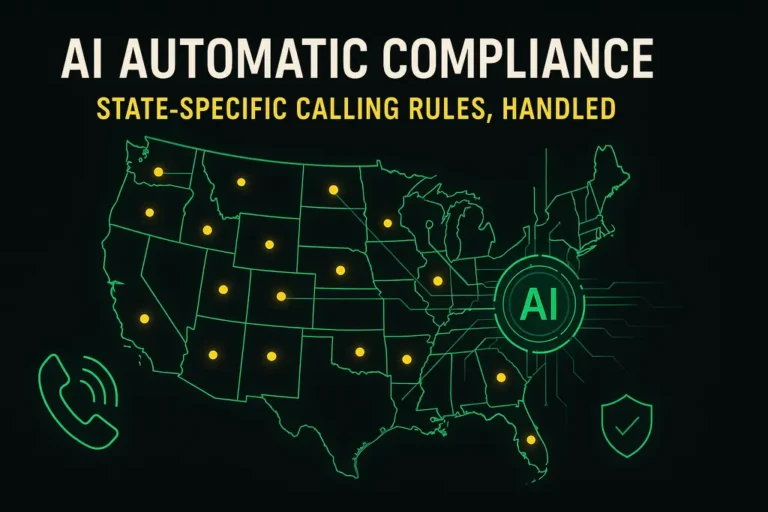
- Dialing window enforcement. Federal rules restrict outbound calls to between 8 AM and 9 PM in the recipient’s local time zone. States add their own restrictions. For instance, Florida, Oklahoma, and Washington have stricter versions of these rules with additional requirements around call frequency and consent standards.
- Real-time DNC suppression. Both the National DNC Registry and internal suppression lists must be enforced before every call, rather than checked periodically.
- Opt-out propagation. When a prospect revokes consent, by any reasonable means, including saying “stop calling me” in natural language, the system must suppress that contact immediately across all channels.
Manual compliance management cannot reliably enforce all of these requirements at scale. A single distracted agent who fails to verify consent, misses a state-specific dialing window, or does not properly log an opt-out creates legal exposure that scales with call volume. In an agency making thousands of calls per month, that exposure is not theoretical.
Automated compliance infrastructure enforces every requirement on every call, without exception, regardless of volume.
Residential vs. Commercial Insurance: Qualifying Differently
Not all insurance leads qualify the same way, and AI outbound systems need to reflect that distinction.
Residential insurance leads, including homeowners, renters, auto, and life insurance prospects, make decisions emotionally and quickly. The primary qualification signals are ownership status, current coverage gaps, and timeline. Speed matters most here. A residential homeowner who submitted a quote request is comparison shopping across multiple carriers simultaneously. The first meaningful conversation almost always wins.
AI qualification for residential leads should open with the two fastest intent signals: ownership status and coverage type of interest. From there, the system gathers the utility cost range or current premium, roof condition for home insurance, or driving history for auto. Whatever your agents need to make a swift, accurate recommendation. If the prospect qualifies, the call transfers live within seconds of the qualification threshold being met.
Commercial and business insurance leads operate differently. A small business owner evaluating general liability or workers’ compensation coverage is running an ROI analysis, not responding to urgency. Decision timelines are longer, purchase authority may require multiple stakeholders, and the qualification questions are more complex, such as business type, employee count, current carrier and renewal date, and coverage history.
AI qualification for commercial leads should prioritize decision-maker identification and business profile before routing. A commercial lead that has not been properly qualified before reaching a licensed agent wastes expensive agent time and often results in a poor first impression. Taking an extra 90 seconds in AI qualification to gather the right context produces a significantly better human conversation on the other end.
What Happens to Aged Insurance Leads
Most insurance agencies have a database of leads that did not convert the first time. These aged leads represent a significant revenue opportunity that manual teams almost never fully exploit.
A prospect who submitted a homeowners insurance inquiry 18 months ago may not have converted because they were not ready, but they were qualified. Circumstances change. Renewals come up. Life events trigger new coverage needs. Utility rate increases make previously rejected quotes look attractive again.
AI outbound calling allows agencies to re-engage aged lead databases at scale. The system can contact thousands of aged leads over a weekend at a fraction of the cost of one SDR’s monthly salary. Even a 2–3% reactivation rate on a database of 20,000 aged leads produces 400–600 new qualified conversations from prospects who already expressed interest in your products.
The economics of reactivation versus acquisition are not comparable. A reactivated aged lead costs a fraction of a newly purchased lead, with no lead generation fees and a pre-existing expression of interest. For insurance agencies spending $50–$150 per new lead, the ROI on systematic aged lead reactivation through AI calling is straightforward.
How Bigly Sales Approaches Insurance Outbound Calling
Bigly Sales is a fully managed AI outbound calling platform built specifically for regulated industries, including insurance agencies and call centers operating in health, life, auto, and property and casualty lines.
The distinction between Bigly and self-serve AI calling tools is the managed infrastructure that operates before and around every call, not just the voice technology inside it.
Before a single call is placed on your behalf, Bigly purchases and registers dedicated phone numbers with carriers and whitelists them with the analytics engines: Hiya for AT&T, TNS for Verizon, and First Orion for T-Mobile, which determine whether your calls are answered or labeled as spam. Hundreds of numbers are deployed with local presence matching your target geographies, and velocity is distributed across the pool to keep per-number call volume within carrier thresholds. This is why Bigly clients see answer rates of 40–65%, while unmanaged outbound operations typically see 10–20%.
TCPA compliance is enforced automatically at the system level. Consent is validated through TrustedForm before every call. State-by-state dialing windows, velocity caps, and holiday restrictions are applied without manual oversight. DNC suppression runs in real time. Opt-out detection in natural language propagates immediately across voice and SMS. Your team does not manage these rules; Bigly does.
Every call generates a full transcript, recording, and structured qualification data pushed directly to your CRM. Campaign optimization is continuous, with Bigly’s team actively refining qualification logic and transfer triggers based on real call outcomes.
This managed infrastructure keeps performance steady and reduces operational risk for insurance agencies in health and life, final expense, auto, home, and commercial lines—where compliance risk is highest and speed-to-lead is most important.
Book a Free Demo to see what AI outbound calling looks like for an insurance operation at your volume.
Frequently Asked Questions
Q1: Is AI outbound calling legal for insurance lead follow-up?
Yes — when deployed with proper compliance infrastructure. The FCC’s February 2024 ruling confirmed that AI-generated voices are classified as “artificial or prerecorded voice” under the TCPA, meaning they require prior express written consent for marketing calls to consumers. Insurance agencies must obtain this consent individually for each lead, enforce state-specific dialing windows, maintain real-time DNC suppression, and disclose AI identity at the start of every call. Platforms that enforce these requirements automatically at the system level make compliant AI outbound calling operationally viable at scale.
Q2: How quickly can AI contact a new insurance lead?
A properly configured AI outbound calling system initiates contact within seconds of a lead entering the pipeline, regardless of time of day, agent availability, or call queue depth. Industry data shows that the first meaningful contact with an insurance lead has an 85% higher probability of winning the account. Every minute of delay after form submission reduces that advantage.
Q3: What qualification information can AI gather before transferring to a licensed agent?
AI can gather all the information your agents need to open a productive conversation: coverage type of interest, ownership status (home, vehicle, business), current provider and renewal date, approximate budget or current premium, and timeline. For commercial lines, AI can also identify the decision-maker, gather business type and employee count, and assess coverage history. The licensed agent receives this context before the conversation begins, eliminating redundant discovery questions.
Q4: How does AI handle TCPA opt-out requests during a call?
A properly designed AI outbound system detects opt-out intent in natural language, not just the specific word “stop.” If a prospect says “don’t call me again,” “I’m not interested, please remove me,” or any equivalent phrasing, the AI ends the call, records the opt-out, and propagates suppression immediately across all outreach channels. This real-time, language-aware opt-out detection is much more reliable than manual agent compliance, which relies on consistent human behavior under pressure from high volume.
Q5: Can AI outbound calling work for policy renewals as well as new lead qualification?
Yes, renewal outreach is one of the highest-ROI applications of AI outbound calling for insurance. AI contacts policyholders at 60, 30, and 14 days before expiration, confirms renewal intent, identifies coverage changes needed, and routes complex situations to agents. Simple renewals can be confirmed entirely through AI without agent involvement. Agencies using AI for renewal outreach consistently report 25–35% improvements in retention rates compared to manual follow-up programs.