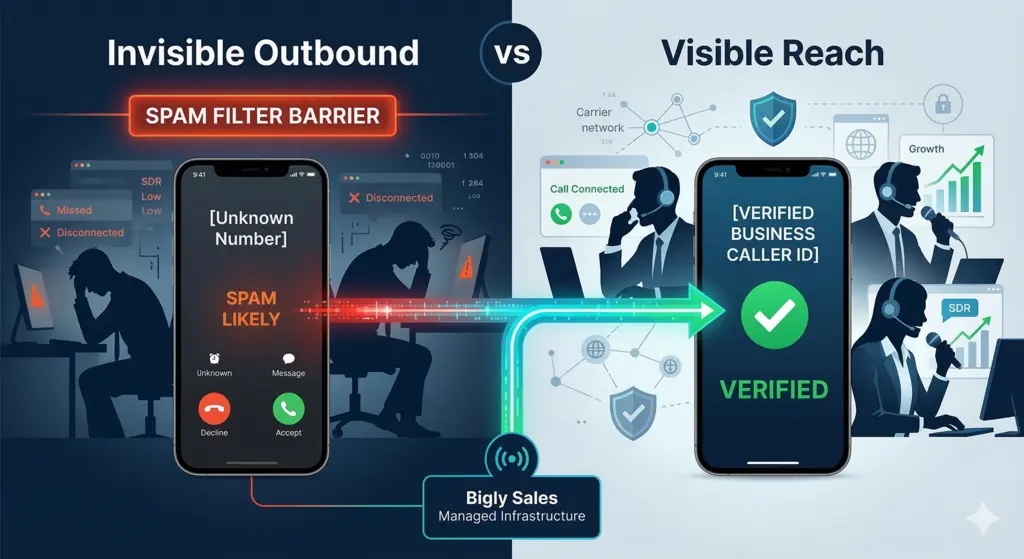


“Spam Likely” is a warning label that a carrier’s analytics partner attaches to your caller ID before the phone in your prospect’s pocket ever rings. It is not a block, it is not a court order, and it is not permanent. It is a reputation score, and scores can be appealed.
That matters because the label is reversible through a defined process. Three analytics companies supply the reputation data that Verizon, AT and T, and T-Mobile display, and all three accept the remediation requests you use to fix Spam Likely on a number you own. Most teams never file one. They buy fresh numbers instead, burn those in a week, and repeat.
This page is the remediation playbook. It covers how to fix Spam Likely labels at the source, what evidence each provider expects, how long clearing actually takes, and the point at which a number is cheaper to retire than to rehabilitate.
TL;DR
A flagged number is cleared by registering the number with the three analytics providers behind the carriers, Hiya, TNS, and First Orion, then filing a reputation dispute for each one. The Free Caller Registry submits a single form to all three at once and costs nothing. Expect roughly one to two weeks per provider before handset labels refresh, and plan on a full 30 days before you judge the result.
Remediation only holds if the dialing behavior that caused the flag has changed. If your number is still averaging hundreds of dials a day with an eight second average duration, the label comes back, and no amount of paperwork will stop it.
Key takeaways
- To fix Spam Likely you file with the scorers, not the carriers. Hiya, TNS, and First Orion each hold a separate score and each is disputed separately.
- Registration and dispute filing are free through the Free Caller Registry, which forwards to all three providers.
- Evidence beats argument. Legal business name, EIN, call purpose, consent source, and expected daily volume decide the review.
- Plan on one to two weeks per provider and 30 days before the change shows up consistently on handsets.
- Retire the number instead of trying to fix Spam Likely when it carries a long complaint history or was bought secondhand.
- Clearing is temporary unless call duration, answer rate, and daily volume per line improve at the same time.
- Buying replacement numbers without changing behavior reflags them, often within days.
Table of contents
- What a Spam Likely label is
- Confirm the label before you try to fix Spam Likely
- The three providers that control the label
- How to fix Spam Likely in seven steps
- What evidence to submit with a remediation request
- Realistic timelines when you fix Spam Likely
- When to retire a number instead of trying to fix Spam Likely
- How to keep a cleared number clean
- Mistakes that undo the work
- Fix Spam Likely FAQ
- The bottom line
What a Spam Likely label is
A Spam Likely label is a display string that a mobile carrier renders on the incoming call screen when its analytics partner scores the calling number as probable unwanted traffic. The wording differs by network. T-Mobile shows “Scam Likely,” AT and T shows “Spam Risk,” and Verizon shows “Potential Spam.”
The label is separate from two other things people confuse it with. It is not STIR/SHAKEN attestation, which is a cryptographic signature your voice provider applies to say it knows who you are. It is not a block, which silently drops the call. A labeled call still connects. It just arrives pre-judged, and most people decline it.
Attestation and reputation interact. A number signed with A-level attestation and a clean reputation displays normally. A number with A-level attestation and a poor reputation score still gets labeled, which is why teams that fixed their attestation and saw no change assume the process is broken. It is not broken. Attestation and the reputation dispute are two different filings.
Confirm the label before you try to fix Spam Likely
Do not start a remediation filing on a hunch. Confirm which numbers are actually labeled and on which networks, because the fix is per number and per provider.
Check the number on real devices
Keep one active handset on each major network in the office. Call each from every outbound number in your pool and photograph the incoming call screen. This is the only evidence that reflects what your prospects see. Software reporting tells you the score. A handset tells you the label.
Run the free reputation lookups
All three analytics providers publish a lookup where you can enter a number and see its current standing. Run every number in your pool, record the result, and date the record. You will usually find that the problem is concentrated in a handful of lines rather than spread across the pool.
Separate a label problem from a list problem
If your connect rate fell but the label checks come back clean, the cause is somewhere else, usually data decay or call timing. Our breakdown of what spam likely calls do to pipeline and answer rates walks through how to tell the two apart before you spend a week on paperwork you did not need.
The three providers that control the label
Hiya, TNS, and First Orion supply call analytics to the major US carriers and to several handset makers. Each maintains its own score for your number, so a number can be clean on one network and flagged on another. Clearing one provider does not clear the others.
| Provider | Where its labels show up | How to check a number | How to file | Typical wait |
|---|---|---|---|---|
| Hiya | AT and T call protection, plus Samsung devices and several international carriers | Free reputation lookup on the Hiya business site | Free business number registration, then a labeling dispute per number | About 3 to 10 business days |
| TNS | Verizon and other carriers using TNS Call Guardian | Free number reputation portal | Registration form plus a correction request with business documentation | About 5 to 15 business days |
| First Orion | T-Mobile and Metro, which is where “Scam Likely” appears | Free lookup on the First Orion caller site | Free caller registration, then a remediation request | About 5 to 14 business days |
| Free Caller Registry | Not a labeler, a shared intake form | Not applicable | One form that forwards your registration to all three providers | Adds a few days on top of each provider |
The Free Caller Registry is the fastest starting point because it removes three separate account setups from your first day of work. It is a registration channel rather than an appeals channel, so a number with an active dispute usually still needs a direct filing with the provider that flagged it.
How to fix Spam Likely in seven steps
The sequence below is the order that works. Skipping ahead to the dispute before the registration is why many filings come back with no change.
1. Inventory every outbound number
List each number, the campaign that uses it, the carrier or provider it was purchased from, its daily dial count, and its average call duration. You cannot argue that a number is legitimate business traffic if you cannot describe what it does.
2. Fix the underlying behavior first
Reduce dials per line per day, tighten your list so you are calling people who expect the call, and give agents a reason to stay on the line past the first ten seconds. A filing submitted while the bad pattern continues buys you a few clean days at most.
3. Register the business, not just the number
Submit your legal entity name, EIN, physical business address, website, and a contact who can answer questions. Providers score unregistered numbers more harshly because they have nothing to weigh against the complaint data.
4. Set the branded caller name
Register the CNAM display name you want shown and keep it identical across every number in the pool. Inconsistent display names read as number churn, which is exactly the behavior the models look for.
5. File the dispute with each flagged provider
Submit a separate remediation request to Hiya, TNS, and First Orion for each number that their lookup shows as flagged. Reference the registration you already completed. There is no single filing that will fix Spam Likely across all three providers at once.
6. Confirm attestation with your voice provider
Ask your carrier or platform in writing what attestation level your calls carry. If it is B or C, ask what is required to move to A. Attestation will not remove an existing label on its own, but a clean attestation record makes the next review go faster.
7. Re-check on handsets after two weeks
Repeat the device test with dated photographs. If a number is still labeled after 30 days and two filings, treat it as a retirement candidate rather than filing a third time.
Number remediation
Get your flagged numbers reviewed and cleared
We audit your outbound pool, file with all three analytics providers, and monitor the labels afterward. The initial review takes about 20 minutes of your time.
What evidence to submit with a remediation request
Reviewers are deciding whether your traffic is wanted. Give them the material that answers that question directly, in the order below.
Identity documents
Legal entity name exactly as registered, EIN, physical address, corporate website, and the name and direct line of a responsible contact. A generic support inbox weakens the file.
Call purpose and consent basis
State in one paragraph what the calls are for and how the recipient came to be on your list. Name the source, such as an inbound web form, an existing customer relationship, or a purchased list, and say so honestly. Attach a screenshot of the opt-in language if you have one.
Traffic profile
Provide dials per day per number, average call duration, answer rate, and the hours you dial. Numbers that look like a human sales team get treated like one.
Complaint handling
Describe your do-not-call process, how quickly you honor a removal request, and how you suppress across channels. The Federal Trade Commission’s Telemarketing Sales Rule guidance is the reference reviewers assume you have read.
A note on consent rules
The federal standard for regulated outbound calls is prior express written consent under the Telephone Consumer Protection Act, codified at 47 U.S.C. 227. The widely discussed one-to-one consent rule was vacated by the Eleventh Circuit in January 2025 and never took effect, so it is not binding law. Adopting one-to-one consent as internal policy is still sensible because it reduces litigation exposure and produces exactly the documentation a reputation reviewer wants to see. The requirement that is genuinely in force for 2026 is cross-channel honoring of revocation, meaning an opt-out on one channel must suppress the others.
Realistic timelines when you fix Spam Likely
None of the three providers publishes a guaranteed turnaround, so treat every number below as a planning estimate rather than a promise.
The clock starts at submission, not at the moment you decide to fix Spam Likely, so file early in the week. Registration acknowledgment usually arrives within a few business days. Score changes follow within roughly one to two weeks per provider. Handset display lags behind the score because devices and carrier systems cache label data, so allow another week after the score changes before you expect a clean call screen everywhere.
Plan a 30 day window end to end. Judge the outcome on device photographs and connect rate across a few hundred dials, not on the first ten calls after a filing lands. A single answered call proves nothing either way.
If a provider responds with no change and gives a reason, read it literally. “Insufficient information” almost always means the traffic profile section was thin. “Consistent with unwanted traffic” means the behavior has not changed yet and a resubmission will fail the same way.
When to retire a number instead of trying to fix Spam Likely
Rehabilitation is not always the cheaper path. Some numbers carry more history than a filing can overcome, and the honest answer is to stop spending on them.
| Situation | Recommended action | Why |
|---|---|---|
| Flagged on one provider, registered, clean history | Rehabilitate | A single dispute usually resolves it and the number keeps its local presence value |
| Flagged on all three providers | Rehabilitate once, then decide | Broad flagging points at behavior. Fix the behavior, file once, and retire if nothing moves in 30 days |
| Bought secondhand with unknown history | Retire | You cannot document a history you do not have, and reviewers weigh prior complaints |
| Two filings and 30 days with no change | Retire | Further filings rarely succeed and the pipeline cost of waiting exceeds the cost of a new line |
| Number appears in consumer complaint databases | Retire | Public complaint volume feeds the models directly and is not something a filing erases |
Retiring a number is not the same as churning numbers. Churn means replacing lines on a schedule to stay ahead of the filters, which the models detect and punish. Retirement means removing one line with a documented, unrecoverable history and registering its replacement properly before the first dial.
How to keep a cleared number clean
A cleared number goes back into the same environment that flagged it. The habits below are what keep the label off.
Cap volume per line
Set a per line daily ceiling and hold to it. Spread volume across a registered pool rather than pushing one line harder. Every number in the pool should be registered before it takes its first call.
Watch average call duration
Short calls are the strongest signal the models use. If your average duration is under 15 seconds, the score will drift back down no matter how good the paperwork is. Faster, more relevant openings and better routing raise duration, which is one reason responding to inbound leads within seconds protects reputation as well as conversion.
Monitor monthly, not quarterly
Re-run the provider lookups on a monthly schedule and keep the dated records. Catching a score slide at month one is a single filing. Catching it at month four is a retirement.
Keep registrations current
Update the providers when your address, entity name, contact, or call volume changes materially. A registration that no longer matches reality is treated as an unregistered number.
Mistakes that undo the work
Four patterns account for most repeat flagging, and all four are self-inflicted.
Buying a batch of fresh numbers and dialing them at yesterday’s volume is the most common. The new lines get flagged inside a week, and now you have a wider reputation problem than you started with.
Rotating aggressively through unregistered local numbers is the second. Local presence dialing is legal, but a pool of unregistered numbers with matching area codes and short calls is close to the textbook description of the traffic these systems exist to catch.
Filing once and never checking is the third. Scores move, and a number cleared in March can be flagged again by June with nobody noticing until the pipeline reports show it.
Treating this as a purely technical problem is the fourth. The deeper diagnostic view in our guide to the six reasons outbound numbers get flagged covers the list quality and consent issues that sit underneath most flags. If those are unresolved, remediation is a repeating expense rather than a fix.
Watch
Why your calls show up as Spam Likely
Sixty seconds on what the carriers are actually scoring, and why the label lands on legitimate teams as often as on scammers.
Fix Spam Likely FAQ
How do I fix Spam Likely on my business number?
Register the business and the number with Hiya, TNS, and First Orion, then file a separate reputation dispute with any provider whose lookup shows the number flagged. The Free Caller Registry submits your registration to all three at once at no cost. Before filing, reduce dials per line and improve average call duration, because a filing submitted during the behavior that caused the flag will not hold.
How long does it take to remove a Spam Likely label?
Plan on one to two weeks per provider for the score to change and roughly 30 days before handsets consistently show a clean caller ID. None of the providers publishes a guaranteed turnaround. Device caching adds several days after the score itself updates, which is why the first few calls after a filing tell you almost nothing about whether the request succeeded.
Is it free to dispute a Spam Likely label?
Yes. Business number registration and reputation disputes with Hiya, TNS, and First Orion are free, and the Free Caller Registry that forwards to all three charges nothing. Paid services exist that manage the filings for you, which buys time and monitoring rather than access, since anyone can fix Spam Likely through the free channels. Be cautious with any vendor that claims a guaranteed removal, because no vendor controls the providers’ decisions.
Will buying new phone numbers fix Spam Likely faster?
No. New numbers start with a neutral score, so they work briefly, then get flagged again within days if the dialing pattern is unchanged. Analytics providers score behavior, not just history, and rapid number replacement is itself a flagged pattern. Replacing numbers is a legitimate step only after you have changed the volume and duration profile that caused the original label.
Does STIR/SHAKEN attestation remove the label?
Not by itself. Attestation is a signature from your voice provider confirming it knows who is placing the call. The label comes from a separate reputation score held by the analytics providers. A-level attestation makes reviews go more smoothly and prevents additional penalties, but a number with poor reputation data stays labeled until you file the dispute and change the behavior.
Why is my number flagged on T-Mobile but not Verizon?
Because different carriers use different analytics vendors. T-Mobile labels come from First Orion, Verizon uses TNS, and AT and T uses Hiya. Each vendor keeps its own score, built from its own complaint and behavior data, so a number can be clean on one network and flagged on another. You have to check and file with each provider separately.
Can a customer complaint alone get my number flagged?
A single complaint rarely does it, but complaints carry heavy weight in the scoring models and accumulate. In-app spam reports, carrier complaint channels, and public complaint databases all feed the vendors. A number with steady complaint volume will keep getting flagged after every successful dispute, which is why fixing consent and list quality has to come before the paperwork.
How many calls per day per number is safe?
There is no published threshold, and any vendor quoting an exact number is guessing. What the models actually weigh is the combination of volume, average duration, answer rate, and complaint rate. A line making a moderate number of dials with three minute average conversations is far safer than one making the same volume with eight second calls that end in hang-ups.
Do I need a lawyer to file a remediation request?
No. These are commercial reputation reviews, not legal proceedings, and the forms ask for business documentation rather than legal argument. Counsel is worth involving separately if your consent practices are unclear, since consent problems tend to be the reason numbers get flagged in the first place. The filing itself is administrative work your operations team can handle.
Should I stop calling while a dispute is pending?
Do not stop, but do reduce. Continuing at the volume that caused the flag will produce fresh negative signal during the exact window the reviewer is looking at your traffic. Cutting daily dials per line and prioritizing your warmest, most consent-documented contacts gives the reviewer a better recent sample and improves the odds the request is approved.
The bottom line
The label is a score, and scores are appealable. Register the business, file with Hiya, TNS, and First Orion, submit a real traffic profile, and give it 30 days. That is the entire process to fix Spam Likely on a number worth saving.
The part that decides whether it lasts is not the paperwork. It is whether your outbound behavior after the filing looks like a sales team or a machine. Teams that only file are back in the same position within a quarter. Teams that change volume, duration, and consent quality at the same time stay clean and stop thinking about this.
Outbound that connects
Stop losing dials to a label you can clear
See how registered numbers, monitored reputation, and AI calling work together on live traffic. A working session takes 20 minutes.