

Conversational AI is software that holds a real two-way spoken conversation with a person by understanding what was said and answering in context, in real time. On a sales call that means an agent which listens to a prospect, works out what they meant, and speaks back with a relevant reply instead of reading a fixed script.
Most people picture a robocall when they hear the phrase AI sales call. A flat recorded voice grinding through a message no matter what the person on the other end says or does. That is close to the opposite of how conversational AI works.
This guide covers the definition, the five processing stages behind every call, how the technology differs from IVR and prerecorded dialers, where it earns its keep in cold outreach, and where it is the wrong tool.
TL;DR
Conversational AI runs a spoken sales call through five stages, speech recognition, language understanding, dialogue management, response selection and speech synthesis. In a well built system the full cycle from the moment a prospect stops talking to the moment the agent answers lands under one second, and anything past 1.5 seconds reads as awkward to the person on the line.
The payoff for outbound teams is consistent qualification at volume plus live transfer, so a human rep only picks up calls where interest is already established. It is the wrong buy if your list is small, your sale is long and highly consultative, or you cannot document prior express written consent for every number you dial.
Key takeaways
- Conversational AI is not a robocall, it processes what a prospect actually says and generates a contextual answer while the call is live.
- The chain runs speech recognition, natural language understanding, dialogue management, response generation, then text to speech.
- The difference from IVR and scripted dialers is adaptation, the agent follows the conversation rather than a fixed decision tree.
- On cold outreach it can qualify a lead, work an objection, and transfer a ready buyer to a human rep inside the same call.
- Target under one second of end to end latency, and test it on real calls rather than a vendor demo.
- Consent, calling windows, opt-outs and DNC scrubbing decide your legal exposure, not the label on the software.
- Small lists, complex consultative deals and unverified contact data are all reasons to skip it.
Table of contents
- What conversational AI is
- How the technology works on a sales call
- Comparison against IVR and robocalls
- Where the calling rules actually stand
- Why it works for cold outreach
- What a real call sounds like
- Platform capabilities that matter
- Where this is the wrong tool
- How Bigly runs it as a managed service
- Conversational AI FAQ
- The bottom line
What conversational AI is
Conversational AI is software that carries a natural spoken or written dialogue with a human by interpreting the meaning of what was said and producing a contextually relevant response. In a sales call it takes the form of a voice agent that hears a prospect, understands the intent behind the words, and answers out loud within a normal conversational pause.
That definition rules out several things people lump into the same bucket.
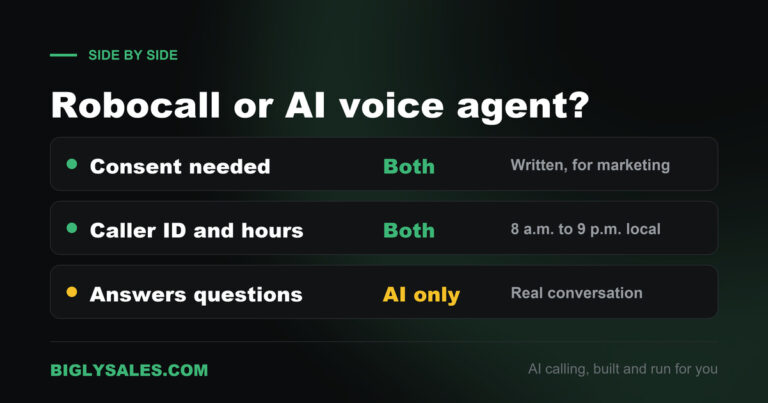
- A prerecorded robocall plays a fixed audio file. It does not listen and it does not respond. If the prospect asks a question, nothing happens. The message plays to completion regardless.
- An IVR system, short for interactive voice response, reacts to keypad presses or narrow spoken commands such as press 1 for sales. It still walks a rigid decision tree. Say something outside the expected options and it asks you to repeat or drops you on hold.
- A voice agent built on this technology handles open-ended answers. Told “I am already working with someone but I have been thinking about switching,” it reads a qualified lead showing interest rather than a flat rejection, and asks a relevant follow-up.
That distinction is the whole reason the category exists for sales. A sales call is not a predictable exchange. Prospects say unexpected things, ask unscripted questions, and reveal buying intent in phrasing no decision tree will ever anticipate. This software is built for that unpredictability. If you want the surrounding vocabulary in one place, the AI calling glossary defines the terms used throughout this guide.
How the technology works on a sales call
Five stages run in sequence on every turn of the conversation. Each one completes in fractions of a second, which is what keeps the call feeling like a call.
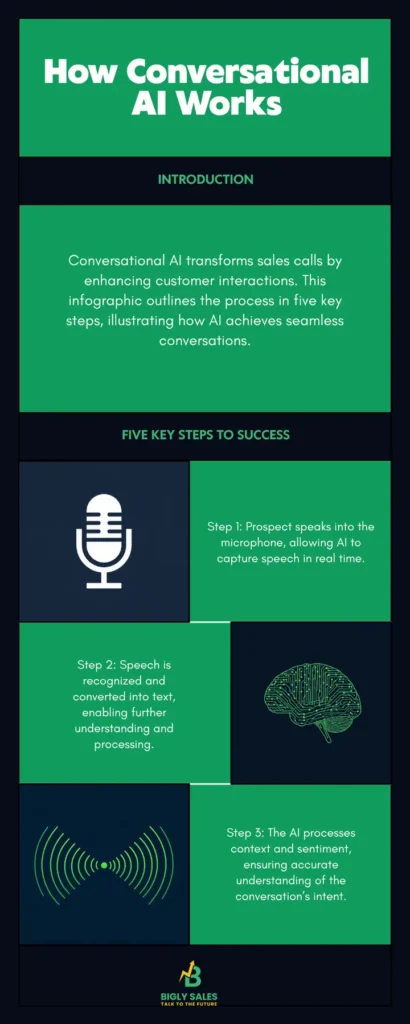
Step 1. The prospect speaks
The call connects and the prospect hears the agent’s voice. When they start speaking, the telephony layer captures the audio in real time. That stream is the raw input for everything downstream, which is why line quality and carrier routing affect performance in ways a demo environment never exposes.
Step 2. Speech recognition converts voice to text
The captured audio goes straight into an automatic speech recognition engine, usually shortened to ASR. It turns spoken words into a text transcript in near real time. Current ASR models are trained on large volumes of spoken English across accents, speech patterns and telephone audio quality, which is why they hold up far better than the recognition built into phone systems ten years ago.
The transcript is not perfect. Proper nouns and industry terms get mangled. Well built systems expect that and correct downstream at the understanding layer instead of treating the transcript as ground truth.
Step 3. Language understanding extracts meaning and intent
The transcript passes to the natural language understanding layer, or NLU, where meaning gets pulled out of the words. It does three jobs at once.
It identifies intent. “I am not interested right now” and “call me back next month” both express current unavailability, but they signal different things. The first is a soft rejection. The second is a timing objection from someone who may still buy.
It extracts entities, the concrete details such as names, company names, timeframes and product references, then records or acts on them.
It reads sentiment, whether the prospect sounds positive, frustrated, rushed or engaged. That feeds directly into what the next stage decides to say.
This layer is the most complex part of the chain and the part that decides whether the agent sounds intelligent or infuriating. An agent that answers “actually I already use a different provider” with a feature pitch is failing here. One that answers “Got it. What has your experience with them been like?” is working.
Step 4. Dialogue management picks the next move
Once intent is classified and the key details are captured, a dialogue manager decides what to do next. This is the strategic part of the system.
It has the full conversation history, the call objective such as qualifying a lead or setting an appointment, whatever the CRM knows about this contact, and a set of rules or a model trained on past calls. It weighs all of that and picks an action. Ask a follow-up. Work a specific objection. Offer a transfer to a human rep. Log the facts and close out politely.
This is where a chatbot and a real voice agent part ways. A chatbot walks a flowchart. A dialogue manager holds context across the whole call and responds to where the conversation has actually gone, not just the last sentence.
Step 5. The agent answers in a natural voice
The chosen response text goes through a text to speech engine, or TTS, which renders it as audio. Neural speech synthesis produces voices with believable pitch variation, pacing and emphasis, and the tone can be tuned to the type of call.
The audio returns down the same phone line. From the prospect’s side, they spoke, there was a short natural pause, and a voice answered. The loop repeats until the objective is met or the call ends.
End to end, from the prospect finishing a sentence to the agent starting its reply, a well tuned system lands under one second. That sits inside the range of an ordinary conversational pause.
Comparison against IVR and robocalls
These three technologies get described with overlapping language, so here is the clean version.
| Capability | Robocall | IVR | Conversational AI |
|---|---|---|---|
| Listens to the prospect | No | Keypad or keyword only | Yes, open-ended |
| Adapts to what was said | No | No | Yes |
| Handles objections | No | No | Yes |
| Needs a fixed script | Yes | Yes | No, works from an objective |
| Qualifies a lead | No | No | Yes |
| Transfers to a human | No | Yes, cold | Yes, live with context |
Where the calling rules actually stand
Outbound calling to consumers sits under the Telephone Consumer Protection Act. The operative standard for marketing calls placed with an autodialer or an artificial or prerecorded voice is prior express written consent from the person you are calling. That has not changed.
One point causes constant confusion in this market. The so-called one-to-one consent rule, which would have required separate consent for each individual seller named on a lead form, was vacated by the Eleventh Circuit in January 2025 and never took effect. Anyone still telling you it is binding law is working from stale material. It remains a sensible internal policy, because collecting consent per seller narrows the arguments a plaintiff’s attorney can make against you, but it is a risk-reduction choice rather than a legal requirement.
The change that did land is the cross-channel treatment of revocation. A consumer who revokes consent through any reasonable method has revoked it for the calls and texts tied to that consent, and the revocation must be honored promptly across channels. Build the plumbing so an opt-out spoken on a call kills the SMS sequence too.
For primary sources, the Federal Trade Commission publishes plain-language guidance on the Telemarketing Sales Rule at ftc.gov, and the statutory text of the TCPA is available through govinfo.gov. None of this is legal advice, and state rules add their own disclosure and consent requirements on top, so confirm your specific program with counsel. Platforms that treat TCPA compliance as infrastructure document consent, hold calling windows, process opt-outs and scrub against the National Do Not Call Registry as part of the service rather than handing that work back to you.
See it live
Hear an AI agent qualify a real lead
We will walk you through a live call flow built for your offer and show the transfer handoff end to end. Twenty minutes, no build work on your side.
Why it works for cold outreach
Cold outreach is where conversational AI shows the widest gap against both human teams and traditional autodialers.
- Qualification at volume. A human SDR works through roughly 50 to 80 dials a day and has meaningful conversations with maybe 8 to 15 people. A voice agent runs many conversations at once, applies the same qualification framework to every one, and returns structured data to the CRM without drift in how the questions were asked.
- Objections without a script. Cold calling produces predictable pushback. Not the right person. We already have something. Send me an email. Bad time. A well trained agent treats each of those as a branch rather than a wall, probing timing, learning what the incumbent solution is, or asking for a warmer stakeholder.
- Live transfer while intent is hot. When a prospect shows genuine interest the agent can connect them to a human rep inside the same call and pass the context across, so the rep does not restart the conversation. The gap between expressed interest and a human voice is measured in seconds. That is the same principle behind speed to lead, applied to outbound.
- Traceability. Every call is recorded, transcribed and dispositioned the same way, which makes both coaching and audit far less painful than reconstructing what a rep said from memory.
What a real call sounds like
An example is more useful than a diagram.
The agent dials. After the greeting it identifies itself as an AI assistant calling on behalf of the company and gives the reason for the call in one sentence. That disclosure is both an ethical baseline and, in a growing number of states, a legal requirement.
It asks a qualifying question. The prospect says something off-script, something like “we had a bad experience with AI calling last year.” The agent acknowledges it directly, asks what happened, and listens. The prospect describes a specific problem. The agent notes the concern, explains one concrete difference in how calls are handled, and asks whether that addresses it. The prospect says “maybe, I would want to talk to someone who knows the details.” The agent confirms contact details, asks for a preferred time, and offers to connect them now. The prospect agrees. The agent says one moment and the call moves live to a rep who already has a summary on screen.
None of that was scripted. Every line was generated against what the prospect actually said, which is the whole distinction from any other calling technology.
Platform capabilities that matter
If you are evaluating vendors, these six things predict real-world performance better than anything on a feature grid.
- Understanding accuracy and training data. Ask how the models are trained and whether they can be tuned on your industry’s vocabulary. Generic models mishandle product names and sector jargon.
- End to end latency. Past 1.5 seconds between a prospect finishing a sentence and the agent replying, calls start to feel wrong. Measure it on live calls, not in a demo.
- Live transfer with context. The platform should route to a human in real time and carry the transcript across. A system that can only end the call and fire a notification is a different product.
- CRM integration and logging. Intent, extracted entities and disposition should write back automatically. Manual logging erases the efficiency you bought.
- Compliance infrastructure. Consent records, DNC scrubbing, calling windows and opt-out handling belong in the platform. For the wider category view, see the overview of what AI outbound calling involves.
- Time to first call. Anything that needs months of custom development before a single dial is not practical for most sales teams. Days is a reasonable expectation from a managed provider.
Where this is the wrong tool
Plenty of teams should not buy conversational AI, and the honest cases are easy to name.
If your total addressable list is a few hundred named accounts, the economics do not work. The advantage of the technology is consistency across large volumes, and at small volumes a good rep with research time beats it outright. If your sale is long, technical and relationship-led, the first conversation is not a qualification exercise and automating it costs you more than it saves.
If your contact data is old, purchased without clear provenance, or lacking documented consent, adding automation multiplies your legal exposure rather than your pipeline. Fix the data first. And if you need a predictive dialer to make human reps more efficient rather than an agent to replace the first call, that is a different category of product and Bigly does not sell it.
How Bigly runs it as a managed service
Bigly Sales runs conversational AI for outbound calling as a fully managed service. Clients do not build or configure the voice agent themselves. It is deployed complete, fitted to the sales use case, set up against current calling rules, and live within a few days of onboarding.
The service operates across insurance, financial services, multiple industries including home services and debt resolution. Calls are placed by Bigly’s agents, with live transfer to the client’s team once a prospect is ready for a human.
For cold outreach teams the practical gain is that the qualification layer runs at a volume and consistency a human SDR bench cannot match, so reps spend their hours on conversations that already passed a filter.
Conversational AI FAQ
Is conversational AI the same thing as a robocall?
No. A robocall plays a prerecorded message regardless of what the person says or asks. This technology listens to the prospect, interprets the intent behind the words, and generates a relevant spoken response while the call is still running. The two share almost nothing beyond both arriving over a phone line, and they are treated differently in how you plan consent and disclosure.
What is the difference between conversational AI and an IVR system?
An IVR reacts to keypad presses or a short list of spoken commands inside a fixed decision tree. Anything outside that list fails, and the caller gets asked to repeat or sent to hold. A voice agent handles open-ended natural language, keeps the context of everything said so far, and adapts its next reply to where the conversation has gone rather than to a preset branch.
How fast does an AI voice agent respond during a call?
In a well tuned system the full cycle from the prospect finishing a sentence to the agent beginning its reply runs under one second, which falls inside a normal conversational pause. Above roughly 1.5 seconds the delay becomes noticeable and people start talking over the agent. Measure this on real calls over real carrier routes, because demo environments hide network conditions.
Does the prospect know they are talking to an AI?
They should, and increasingly they must. Disclosing that the caller is an automated agent at the start of the conversation is a baseline ethical practice and a legal requirement in a growing number of states. Vendors that leave the disclosure out create regulatory and reputational exposure for the business whose name is on the call. Confirm the specific wording your program needs with counsel.
How does conversational AI handle sales objections?
Instead of reading a prewritten rebuttal, the agent treats the objection as input, classifies its type and severity at the understanding layer, then selects a response that fits. It can probe the objection, acknowledge it and move on, supply a specific piece of information, or switch to a different qualification path. The response is generated against what was actually said rather than pulled from a numbered list.
What is a live transfer in an AI calling workflow?
A live transfer is the moment the agent detects enough buying intent and connects the call directly to a human rep in real time. The rep receives a summary of the conversation so the prospect does not get re-qualified from scratch. It is the handoff point between automated qualification and human-led closing, and it is the single capability most worth testing before you sign anything.
Which industries use AI cold calling most actively?
Insurance, financial services, mortgage, home services, solar, legal lead generation and debt resolution are the highest-volume users. These are sectors where outbound qualification is core to revenue and where lead volume makes human-only outreach hard to staff economically. They are also heavily regulated, so consent handling and calling-window discipline matter more in these verticals than almost anywhere else.
Is the FCC one-to-one consent rule in effect?
No. That rule was vacated by the Eleventh Circuit in January 2025 and never took effect, so any material presenting it as binding law is out of date. Prior express written consent under the TCPA remains the operative standard for marketing calls. Collecting consent on a one-seller-per-form basis is still worth adopting as internal policy because it narrows litigation arguments, but treat it as risk reduction rather than compliance.
How does an AI calling platform handle TCPA compliance?
Compliance comes from the infrastructure, not the product category. A properly built platform records prior express written consent before dialing, respects state and federal calling windows, processes opt-out requests immediately and across channels, and scrubs against the National Do Not Call Registry before each cycle. Handling this at the platform layer takes the burden off the sales team, but the calling party still carries the legal responsibility.
Can conversational AI be trained on a specific company’s product language?
Yes. Serious platforms tune the understanding layer on domain-specific terminology so product names, sector jargon and the objections common to that market are handled correctly. A generic model performs noticeably worse on specialized conversations. Ask any vendor for a sample transcript from an account in your industry rather than a curated demo recording, since that is where vocabulary gaps show up.
How long does deployment take?
For a fully managed service, three to five business days is a realistic figure. That covers building the conversation objective and flow, connecting the CRM, configuring the compliance layer, and running test calls before any live dialing. Platforms that expect the client to build and tune the agent themselves take considerably longer, often measured in months rather than days.
The bottom line
Conversational AI is worth understanding as a pipeline of five stages rather than a product name. Recognition, understanding, dialogue management, response and speech. When each stage is tuned and the whole loop stays under a second, prospects have a normal conversation and a human rep only gets involved once interest is real.
Conversational AI does not fix a bad list, a weak offer, or a consent trail you cannot produce. It multiplies whatever process you already have. Get the fundamentals right first, then automate the first call.
Talk to a human
Find out if your list is worth automating
Bring your volume, offer and consent setup and we will tell you honestly whether this fits. If it does not, we will say so.