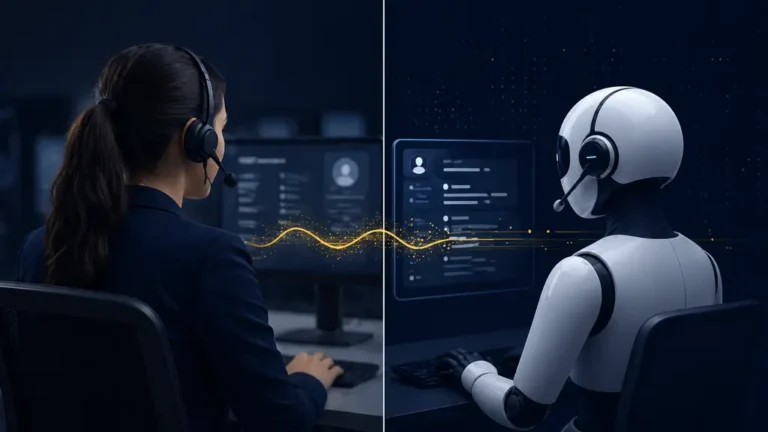



An AI voice agent is software that answers or places phone calls, understands what the caller says in ordinary speech, and then resolves the request or hands it to a person with the full context attached. An IVR is the older approach. It plays recorded prompts, waits for a keypad press, and routes the call down a fixed branch of a menu tree.
For twenty years the IVR was the default answer to high call volume. Press 1 for sales, press 2 for support, press 3 for billing, press 0 for an operator. That worked when the caller’s problem fit neatly into one of five boxes. It stops working when the caller says “I was charged twice for something I canceled” or “I need to move my appointment, but only after 5 p.m.” Those are not keypad problems. They are intent problems.
This guide covers what each system actually does, how to measure whether your IVR is costing you money, which call flows to move first, where IVR is still the right tool, and what the compliance rules require when an AI voice agent places outbound calls instead of answering them.
TL;DR
An AI voice agent handles calls through natural speech instead of menu presses, so it can capture the reason for the call, ask follow-up questions, and transfer to a human with a written summary attached. IVR is still cheaper and simpler for fixed numeric tasks such as PIN entry and payment confirmation, and most teams should keep it there.
The clearest signals that your IVR is costing money are a zero-out rate above roughly 20 percent and a repeat-call rate that stays flat no matter how many prompts you add. Replace the highest-friction flow first, not the whole tree.
This does not suit every buyer. If your phone system has two or three simple paths and callers rarely complain, an AI voice agent is an expense without a payback, and you should leave the IVR alone.
Key takeaways
- IVR still works for simple, predictable, numeric tasks such as PIN entry, payment confirmation, and basic routing.
- An AI voice agent understands unscripted speech, identifies intent, asks clarifying questions, and routes or resolves with context a menu cannot capture.
- Replacement rarely means ripping out the phone system. Most platforms connect to existing telephony, CCaaS, and CRM through APIs, SIP trunking, or a managed build.
- Build the business case from your own numbers, starting with IVR abandonment, zero-out rate, repeat-call rate, escalation rate, and total time to resolution.
- Financial services, insurance, healthcare, home services, and high-volume support teams gain the most because their calls are routine but still need natural language.
- Outbound use carries far more legal risk than inbound. The TCPA treats AI-generated voices as artificial or prerecorded voices, so consent rules apply before you dial.
- The strongest strategy is hybrid. Keep IVR for fixed inputs, add an AI voice agent for conversation, and reserve humans for judgment and escalation.
Table of contents
- What an AI voice agent is
- What an IVR actually does
- Why legacy IVR breaks down
- IVR compared to an AI voice agent
- The real cost of keeping a poor IVR
- How to measure whether your IVR is costing you money
- Where an AI voice agent creates the most value
- Where IVR still makes sense
- A six step IVR replacement roadmap
- Compliance rules for outbound AI voice calls
- How to compare AI voice agent platforms
- How Bigly Sales helps teams move beyond IVR
- AI voice agent FAQ
- The bottom line
What an AI voice agent is
An AI voice agent is a phone-based system that converts caller speech to text, works out what the caller wants, decides the next step, and speaks a response back in real time. It does not ask the caller to pick from a list. It asks an open question and works from the answer.
Instead of “press 1 for billing,” the opening line is closer to “what can I help you with today.” The caller can answer in their own words.
- “I got charged twice for a subscription I canceled.”
- “I need to reschedule my appointment.”
- “I want to check the status of my loan application.”
- “I missed a call from your sales team yesterday.”
- “I need to speak to someone about a fraud alert.”
From there the system can answer directly, look the customer up in the CRM, book an appointment, qualify a lead against defined criteria, take dispute details, or transfer to a human with a summary. An IVR routes on menu selection. An AI voice agent routes on meaning. For definitions of the surrounding terms, from dialer types to deliverability, see the AI calling glossary.
What an IVR actually does
IVR stands for interactive voice response. It is a phone system that interacts with callers through prerecorded prompts, keypad inputs, and sometimes a short list of accepted spoken commands.
A basic IVR flow plays a menu, waits for a number, and routes on the match. If the input does not match, the system repeats the prompt, drops the caller into a fallback queue, or ends the call. That model is rigid by design, and the rigidity is the point. It is predictable, cheap to run, and easy to audit.
Traditional IVR assumes the caller will adapt to the system. The caller listens to the options, decides which is closest to their problem, and hopes the routing logic agrees. That is a fair assumption when the task is simple. It falls apart when the issue is specific, urgent, or hard to categorize. That is when customers press zero, repeat the word “representative,” or hang up. They are not rejecting automation. They are rejecting automation that does not understand them.
Why legacy IVR breaks down
The weakness of IVR is not its age. It is that the system was built around menu logic instead of caller intent. Callers do not think in departments. They think in problems.
- They do not call because they want billing. They call because they were charged twice.
- They do not call because they want account services. They call because they cannot log in.
- They do not call because they want loan support. They call because they need to know whether their application was approved.
- They do not call because they want sales. They call because they filled out a form and want to know what happens next.
Forcing those situations into fixed categories creates four predictable failures. Menu navigation adds friction before anyone gets help, and every extra prompt raises the chance of abandonment. Calls arrive at agents without context, so the agent starts by asking what the caller already told the machine. Misrouted calls turn into repeat contacts. And the reporting hides all of it, because a call can look successfully routed in the dashboard while the customer had a poor experience getting there.
IVR compared to an AI voice agent
The table below sets the two side by side on the dimensions that matter operationally rather than on feature lists.
| Area | Legacy IVR | AI voice agent |
|---|---|---|
| Input method | Keypad press or a short command list | Natural, unscripted speech |
| Caller experience | Caller adapts to the menu | System adapts to the request |
| Conversation ability | Limited or none | Two-way conversation |
| Off-script handling | Repeats, fails, or drops to fallback | Asks a clarifying question or escalates |
| Routing logic | Based on menu selection | Based on caller intent and context |
| Context capture | Minimal | Reason for call, details, and next step |
| Human handoff | Usually a cold transfer | Warm transfer with a written summary |
| Appointment booking | Confirm or cancel only | Conversational scheduling and rescheduling |
| Lead qualification | Not built for it | Qualifies against defined criteria |
| Availability | 24/7 | 24/7 |
| Compliance controls | Depend on the connected dialer | Can be built into a managed outbound workflow |
| Audit trail | Often fragmented | Transcript, recording, disposition, and CRM update |
The real cost of keeping a poor IVR
The cost of an IVR is not the software license or the phone bill. The real cost shows up as operational waste that never appears on the telecom invoice.
A caller abandons the menu and calls back later. A caller presses zero and reaches the wrong queue. An agent spends the first two minutes working out why the person called. A customer repeats the same issue to three people. A sales lead gives up before reaching anyone. A support issue becomes a cancellation because a simple answer was too hard to get.
This is why IVR replacement should not be scoped as a technology project. Scope it as a customer experience, revenue, and labor-efficiency project. The weak question is how to improve the IVR. The useful question is how much work the IVR is pushing back onto customers and agents. If the system routes calls but agents still start from zero every time, the business has not saved the money it thinks it has. It has moved part of the work onto the caller.
How to measure whether your IVR is costing you money
The strongest replacement case comes from your own call center data, not from a vendor deck. Pull the last full quarter and start with five numbers.
IVR abandonment rate
This measures how many callers hang up while navigating the menu, before finishing the task or reaching a destination. A high rate usually means the menu is too long, too slow, or not aligned with why people actually call. Do not stop at the total. Break it down by menu path so you can see which prompts create the most exits and which queues collect the most abandoned calls. That breakdown is where automation pays back fastest.
Zero-out rate
The zero-out rate measures how many callers press zero or ask for a representative to escape the menu. A high rate is a direct statement that callers do not trust the system to solve their problem. Some press zero immediately because experience taught them the menu wastes time. Others try the menu, fail, and force their way to a human. Either way the message is the same. The caller wants a conversation.
Human escalation rate
This measures how often calls that enter the IVR still end with a human. Escalation is not automatically bad, because some calls should reach a person. The problem is unnecessary escalation. If a caller navigates three menu levels and the agent who answers still has to ask what the call is about, the IVR did not reduce work. It delayed the real conversation by ninety seconds.
Repeat-call rate
Repeat calls are the strongest sign that the first interaction failed. If customers call back about the same issue, the first contact did not resolve, route, or reassure. Speech-driven handling reduces repeat calls when the system captures intent accurately the first time and transfers with context when escalation is needed.
Total time to resolution
Most teams measure average handle time from the moment the agent picks up. That hides the part of the call the customer resents most. If the menu adds two minutes before the agent starts helping, the customer still lived through those two minutes. Measure the whole path instead, including menu navigation, queue time, agent time, transfer time, and follow-up. That is the number replacement should move, and speed matters most on inbound sales calls, which is the same reason speed to lead drives outbound conversion.
Free walkthrough
See your worst call flow rebuilt
Bring one high-friction menu path and we will show you how an AI voice agent would handle it end to end. The session takes about 30 minutes.
Where an AI voice agent creates the most value
The best use cases share one shape. The caller needs to explain something, but the underlying task is still structured enough to automate or route reliably.
Lead qualification
The system can answer or place calls to leads, ask qualifying questions, capture urgency, and pass warm prospects to human sellers. A mortgage lead needs loan type, property location, timeline, credit range, and availability confirmed before a closer is worth booking. A human closer should not spend the day asking unqualified leads the same five questions. The agent handles the first layer and only qualified conversations move forward.
Appointment booking
Scheduling is the clearest replacement case. Instead of pressing through options, the caller says what they need, the system checks availability, confirms a time, and writes the result to the CRM or calendar. This applies across healthcare, home services, insurance, financial consultations, and demo booking. It also covers the harder half of scheduling, which is rescheduling, where IVR has almost nothing to offer.
Billing and account questions
Billing calls follow predictable patterns but arrive in unpredictable words. “I was charged twice.” “I canceled last month.” “My payment did not go through.” “I need a copy of my invoice.” “I want to update my card.” None of those map cleanly to one menu option. A speech-driven system can classify the issue, ask for the missing detail, and either resolve it or transfer with the details already collected.
Status updates
Loan status, application status, delivery status, claim status, and payment status calls are high volume and highly repetitive. They are expensive when a human handles them and frustrating when an IVR does. Automation can verify identifying information, check the right system, and give a structured update or route the call when the situation is sensitive.
Warm transfers
The warm transfer is the single biggest advantage. A legacy IVR sends the caller to a queue and the agent starts over. An AI voice agent can pass the caller name, the reason for the call, the intent, the qualification answers, the urgency, the relevant account data, a conversation summary, and a recommended next step. The agent no longer starts from scratch. They join a conversation that is already organized.
Where IVR still makes sense
IVR is not useless. It is overused. The remaining good use case is the interaction where the caller’s input is numeric, predictable, and fixed.
PIN and code entry
If the caller only needs to enter a PIN, a verification code, or the last four digits of an account number, IVR is fine and often better. There is no reason to run natural language processing over a six-digit code, and keypad entry keeps sensitive digits out of a transcript.
Payment confirmation
Some payment workflows remain well suited to IVR, especially when the caller only confirms an amount, enters card details, or approves a transaction. In those cases IVR is usually cheaper and easier to keep within scope for card data handling.
Simple confirmation calls
A reminder call that accepts only “press 1 to confirm” or “press 2 to cancel” still works through IVR. The moment the caller wants to reschedule, ask a question, or change the location, the flow needs a conversational system or a person.
Low-complexity routing
A small business with two or three call paths and no complaints does not need to change anything. Once the menu grows past four options, volume climbs, or callers start bypassing the system, the economics shift.
A six step IVR replacement roadmap
Replacement should not begin with software selection. It should begin with call flow analysis.
Step 1. Identify the highest-volume call reasons
Pull the top reasons people call. Do not stop at department labels such as sales, billing, and support. Break them into actual caller intents, in the caller’s language. “I need pricing.” “I want to reschedule.” “I missed your call.” “I need a refund.” “I want to check my application.” Those intents are the specification your AI voice agent has to satisfy.
Step 2. Find the highest-friction paths
Look at abandonment, zero-outs, repeat calls, and transfers by menu path. The right starting point is the flow with high volume and high friction at the same time. Do not start with the most complex workflow. Start with the one that is repetitive, painful, and easy to measure.
Step 3. Decide what the system resolves and what it routes
Not every call should be automated. Write the rules before launch. The system can reasonably answer account-status questions, qualify leads, book appointments, and collect dispute details. It should transfer legal complaints, distressed callers, and high-value opportunities immediately. It must suppress opt-outs and must not make claims outside the approved script.
Step 4. Write for conversation, not for menus
A bad script recreates the old problem in a new voice. Turning “press 1 for sales” into “say sales for sales” is not progress. A strong flow opens with an open question, asks one thing at a time, confirms important details back to the caller, and never sounds like a menu in disguise.
Step 5. Connect the system of record
The system gets much more valuable when it writes structured data into the tools your team already uses. For sales that means lead status, appointment records, call notes, transcripts, and dispositions. For support it means ticket creation, issue category, customer ID, and follow-up state. The goal is to make the call usable after it ends.
Step 6. Monitor and adjust
Deployment is not a one-time setup. Track containment rate, escalation rate, call completion, opt-out rate, transfer quality, average call length, conversion, booking rate, repeat-call rate, and agent feedback. Read a sample of transcripts every week for the first month. The systems that improve are the ones where somebody is reading where callers got stuck.
Compliance rules for outbound AI voice calls
There is a large legal difference between inbound and outbound. Inbound AI voice starts when the customer calls you, which carries little regulatory risk. Outbound starts when your business calls the customer, and that is where the rules bite.
In February 2024 the FCC confirmed that AI-generated voices count as artificial or prerecorded voices under the Telephone Consumer Protection Act. Covered calls therefore sit under the same consent rules as any other prerecorded telemarketing call, which for marketing calls to wireless numbers means prior express written consent before you dial. The statutory damages sit at 500 dollars per violation and up to 1,500 dollars for a willful violation under 47 U.S.C. 227, with no aggregate cap.
The FTC’s Telemarketing Sales Rule adds its own duties. Covered sellers and telemarketers must scrub calling lists against the National Do Not Call Registry at least every 31 days, must observe calling-hour limits, must make required disclosures promptly, and must avoid the abusive practices the rule names. The FTC publishes plain guidance in its Telemarketing Sales Rule compliance guide.
Two points are worth stating plainly because they are widely misreported. The FCC’s proposed one-to-one consent rule was vacated by the Eleventh Circuit in January 2025 and never took effect, so prior express written consent under the existing TCPA standard remains the operative test. Many outbound teams still adopt one-to-one consent as internal policy, which is a reasonable way to reduce litigation exposure even though it is not a legal requirement. Separately, the requirement that a consumer’s revocation of consent applies across channels rather than only to the channel where it was given is the item with a 2026 compliance date, and it is the one worth building for now.
Automation scales mistakes. A human agent makes an error slowly. An outbound system repeats the same error across thousands of calls in an hour if the controls are not in the workflow. That is why the useful question about any platform is not whether it can make calls, but what it prevents before a call is placed. Bigly’s approach to those controls is described on the legal and compliance page. None of the above is legal advice. Confirm your own consent language, calling windows, and state obligations with counsel before launching a campaign.
How to compare AI voice agent platforms
Three delivery models exist, and they suit very different teams. The table below is the honest version.
| Factor | Legacy IVR | Self-serve voice API | Managed deployment |
|---|---|---|---|
| Who builds the call logic | Telecom vendor or admin | Your engineering team | Provider, with your input |
| Time to first live flow | Days to weeks | Weeks to months | Days to weeks |
| Internal skills needed | Phone admin | Engineers plus compliance staff | Ops owner and a subject expert |
| Outbound compliance controls | Whatever the dialer provides | You build and maintain them | Configured into the workflow |
| Ongoing tuning | Rarely touched | Your team owns it | Provider monitors and adjusts |
| Best fit | Fixed numeric tasks | Teams with in-house engineering | Sales and support teams without one |
Beyond the delivery model, judge conversation quality by whether the system handles interruptions and asks a clarifying question rather than repeating itself. Judge integration depth by whether it writes to your CRM, calendar, and help desk rather than exporting a CSV. Judge reporting by whether you can see dispositions, transcripts, escalation trends, and conversion in one place. The best platform is rarely the one with the most impressive demo. It is the one that survives contact with your actual CRM, your actual call mix, and your actual compliance review. Industry fit matters too, which is why the industries we support differ in script structure and escalation rules.
How Bigly Sales helps teams move beyond IVR
Bigly Sales runs managed AI voice deployments rather than selling a self-serve tool. For sales teams that means qualifying leads, booking appointments, following up quickly, and routing warm prospects to closers. For support teams it means capturing intent, answering routine questions, and transferring with context so agents stop starting from zero.
For outbound campaigns the managed workflow can include consent checks before dialing, do-not-call and internal suppression logic, calling-window controls by recipient location, opt-out detection, call records, transcripts, recordings where permitted, CRM updates, and reporting. We do not claim this removes legal risk. Campaign legality still depends on your lead source, consent quality, call purpose, script language, and applicable state law.
Bigly is a poor fit in three situations, and it is better to say so up front. If your call volume is low enough that one person handles the phone comfortably, the payback is not there. If your compliance team requires everything to run inside your own infrastructure, a managed service is the wrong shape. And if you want a dialer or a CRM, that is a different category of product and we do not sell one. We sell managed conversations that plug into the dialer and CRM you already run.
AI voice agent FAQ
What is an AI voice agent?
An AI voice agent is software that handles phone calls using natural speech instead of keypad menus. It converts what the caller says into text, identifies the intent behind the request, decides the next step, and responds in a synthesized voice. It can answer questions, look up records, book appointments, qualify leads, and transfer the call to a person with a summary of everything collected so far. The difference from IVR is that the caller explains the problem instead of choosing from a list.
What is IVR replacement?
IVR replacement is the process of retiring a legacy interactive voice response menu in favor of a call handling workflow that understands speech. It can be full or partial. Most companies do partial replacement, keeping IVR for numeric tasks such as PIN entry and payment confirmation while moving conversational flows such as scheduling, intake, and lead qualification to a speech-driven system. Partial replacement carries less operational risk because you can measure one flow before committing to the rest.
Is IVR still useful in 2026?
Yes, for a narrower set of tasks than most companies use it for. IVR remains a good fit for PIN entry, verification codes, payment confirmation, and simple appointment confirm or cancel prompts. It stops being a good fit as soon as the caller needs to explain a situation, ask a question, change a detail, or provide context. Those interactions belong with a speech-driven system or a human, because a menu cannot ask a follow-up question.
Does IVR replacement require new phone hardware?
Usually not. Most modern platforms connect to existing telephony, CCaaS platforms, CRMs, and help desks through APIs, SIP trunking, or a managed integration. The exact setup depends on your current phone system and the platform you pick. Some legacy on-premise systems need a SIP gateway in front of them, which is a small project rather than a rebuild. A full infrastructure replacement is rarely necessary just to change how calls are handled.
How long does an AI voice agent deployment take?
A single managed call flow can usually go live in a few weeks, with the timeline driven by integrations and compliance review rather than by the voice technology itself. Custom builds on a raw voice API take longer because your team designs the call logic, connects telephony, handles suppression rules, and maintains the whole thing. Scope the first flow narrowly. One high-volume, high-friction path proves the case faster than a full menu migration.
What happens when the AI cannot resolve a call?
It should escalate to a person, and the escalation should not be a cold transfer. A well-configured system passes a summary of what the caller said, what was collected, and what the caller needs next, so the human agent opens the conversation already informed. Set explicit rules for mandatory escalation as well, covering legal complaints, distressed callers, fraud reports, and high-value opportunities that should never be handled by automation.
Is an AI voice agent allowed under the TCPA for outbound calls?
It is allowed, but covered campaigns must follow the same rules as other artificial or prerecorded voice calls. In February 2024 the FCC confirmed that AI-generated voices fall under the TCPA’s artificial or prerecorded voice provisions, so marketing calls to wireless numbers generally require prior express written consent before dialing. Do-not-call scrubbing, calling-window limits, disclosure requirements, and state telemarketing rules also apply. No platform removes that risk, so confirm your campaign with counsel.
How often must outbound teams scrub against the National Do Not Call Registry?
The FTC’s Telemarketing Sales Rule requires covered sellers and telemarketers to update their calling lists by removing registry numbers at least every 31 days. That is the legal floor rather than the operational target. High-volume outbound teams generally apply suppression checks much closer to the moment of dialing, because a 31-day window still leaves room to call a number that registered three weeks ago.
What should happen when someone says stop calling me?
The number should be suppressed immediately across every active campaign. Under the FCC’s revocation rules a consumer can revoke consent by any reasonable means, and callers must honor do-not-call and revocation requests within a reasonable time not exceeding 10 business days. The practical standard for an automated system is faster than that, because the system can suppress the number during the call itself rather than waiting for a batch job.
Which is cheaper, IVR or an AI voice agent?
Per minute, IVR is cheaper. Per resolved interaction, that often reverses, because the cost of a poor IVR sits in abandoned calls, repeat contacts, misroutes, and agent time spent rediscovering why someone called. Compare total cost per resolved interaction rather than per minute. If your zero-out rate is low and your repeat-call rate is stable, IVR is genuinely the cheaper option and you should keep it.
The bottom line
IVR was built for a world where automation meant routing a call down a branch of a tree. That assumption no longer matches how customers talk or how sales and support teams are measured. An AI voice agent solves the part IVR was never designed for, which is the conversation itself.
The smart move is not wholesale replacement. Keep IVR where the input is numeric and fixed. Move the conversational flows to an AI voice agent, starting with the one path that carries the most volume and the most friction. Keep humans for judgment, escalation, and anything sensitive. Measure total time to resolution before and after, and expand only when that number moves.
Managed deployment
Replace one call flow, not your phone system
We build, connect, and monitor the first flow for you, then expand once the numbers hold. Most teams go live within weeks.