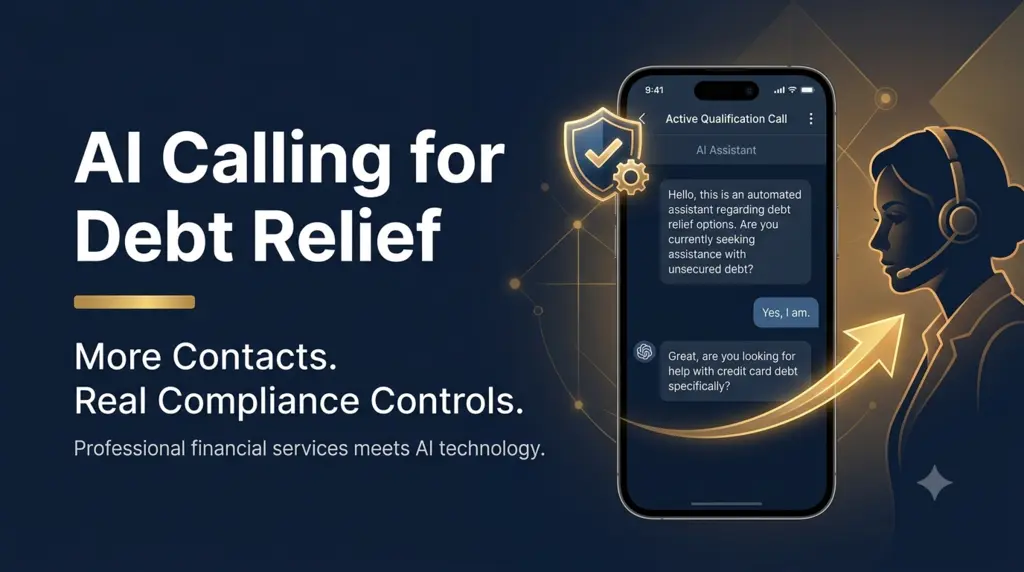


Debt relief AI calling is the use of AI voice agents to call back inbound web leads within seconds, run a structured qualification conversation, and transfer only the people who meet program criteria to a human counselor. It exists because debt relief has a timing problem and a compliance problem at the same time, and human callback queues solve neither one well.
A consumer who fills out a debt help form at two in the afternoon is usually contacting three to five companies in the same sitting. The company that calls back first and sounds competent gets the appointment. The companies that call back an hour later get voicemail. That is the whole competitive dynamic in one sentence.
The complication is that this is one of the most heavily regulated verticals in outbound calling. The Telemarketing Sales Rule carries provisions written specifically for debt relief sellers, the Consumer Financial Protection Bureau watches settlement practices, and the TCPA governs every call placed to a cell phone. Speed cannot come at the cost of the record you have to produce if a dispute lands.
TL;DR
AI voice agents call back debt relief web leads in under 90 seconds, ask the same qualification questions every time, document consent on every call, and live-transfer only qualifying prospects to a counselor. That combination fixes the two things human queues cannot do at once, which are responding within the five-minute window and keeping a consistent compliance record at volume.
The regulatory floor is fixed. Prior express written consent tied to debt-related communication, calling only between 8am and 9pm local time with stricter state rules layered on, DNC scrubbing before every campaign, and no fee collected before at least one debt is settled. If your operation takes fewer than roughly 50 leads a week, a disciplined human callback process will serve you better than this and cost less.
Key takeaways
- The qualification conversation in debt relief is structured and repeatable, which is exactly the work AI handles well.
- Callback speed is the single highest-leverage variable, and the practical target is 60 to 90 seconds from form submission.
- Prior express written consent must be specific to debt-related communication, not carried over from an unrelated marketing form.
- The Telemarketing Sales Rule adds an advance fee ban and mandatory disclosures that generic outbound platforms are not built around.
- Calling windows have to be enforced per contact by local time zone, because a multi-state list has no single correct window.
- Compliance built into the platform holds up at volume in a way that agent checklists do not.
- AI qualification does not replace counselors or legal counsel, it just stops both from spending time on unqualified leads.
Table of contents
- What debt relief AI calling is
- The debt relief calling problem
- The lead qualification workflow, step by step
- TCPA-aware calling workflows
- The FTC Telemarketing Sales Rule
- Three ways companies handle inbound leads
- What the best AI calling software includes
- How AI changes the unit economics
- Questions to ask any vendor
- When this is not the right fit
- Debt relief AI calling FAQ
- The bottom line
What debt relief AI calling is
Debt relief AI calling is an outbound workflow in which an AI voice agent places the first call to a consumer who requested help with unsecured debt, asks a fixed set of qualification questions, records the answers and the consent trail, and hands qualifying prospects to a human enrollment counselor on a live transfer.
It is not an autodialer with a better voice. The difference that matters operationally is where the human enters. In a traditional setup, a counselor spends the first two minutes of every call finding out whether the person has enough qualifying debt to enroll. In this model, the counselor picks up a call that has already cleared that bar, with the answers summarized before they say hello.
It is also not a compliance product. The platform enforces the operational mechanics, which are consent capture, calling windows, DNC scrubbing, opt-out propagation, and recording. What those mechanics need to capture in your specific program is a question for counsel who knows both the TSR and your state rules.
The debt relief calling problem
Two forces pull in opposite directions here. The business model requires reaching financially distressed consumers quickly, because leads from web forms, lead partners, and paid ads decay within minutes. The regulatory environment requires that every one of those contacts be consented, timed correctly, scrubbed, disclosed, and documented.
Traditional call centers pick one. Fast shops cut corners on documentation and discover the gap during litigation. Careful shops build heavy checklists, slow their callback time, and lose the lead to whoever dialed first. Class action activity in this space has produced some of the largest settlements in the history of the TCPA, which is why the careful shops exist.
The AI approach resolves the tension by making the fast path and the documented path the same path. The callback fires automatically, the consent record attaches automatically, and the calling window check runs before the dial rather than in an agent’s head.
The lead qualification workflow, step by step
A well-designed workflow runs from form submission to live counselor conversation in under five minutes for a qualifying lead. Five steps.
Step 1. Immediate callback on form submission
The AI initiates the callback the moment the form posts. Response measured in seconds rather than minutes usually puts you first, before competitors relying on a human queue clear their backlog. This is the same speed-to-lead principle that governs every inbound-lead business, applied to a vertical where it happens to be worth the most.
Step 2. Identity confirmation and consent acknowledgment
The AI confirms the person’s name and that they submitted the form. That confirmation doubles as a natural point to reaffirm the consent captured at submission. An opening along the lines of “You reached out to us today about help with your debt, is this a good time for a few quick questions” sets context and gives the consumer a clean exit.
Step 3. Structured qualification questions
The core questions run in a conversational sequence. Total unsecured balance. Debt types, since credit cards, personal loans, and medical bills typically qualify for settlement programs while student loans and secured debt typically do not. Current payment status. Income situation. Ability to fund a monthly deposit. Delivered conversationally, this takes 60 to 90 seconds.
Step 4. Qualification determination
The AI applies your program’s minimum criteria to the answers. People who do not qualify get a polite close and a referral where one is appropriate. People who qualify move straight to transfer without a callback gap.
Step 5. Live transfer with context
The qualifying prospect reaches a counselor live, with the qualification answers already summarized. The counselor starts with context, the consumer does not repeat themselves, and the conversation opens on the program rather than on discovery.
TCPA-aware calling workflows
The TCPA is not a checkbox that gets ticked at launch. It is an operating requirement on every dial, and compliance that depends on agent training degrades as volume rises and pressure builds. Building it into the platform makes it consistent at call one and call ten thousand.
Prior express written consent
The TCPA requires prior express written consent before placing calls using an artificial or prerecorded voice to a cell phone. For debt relief the consent must be specific to debt-related communication. A general marketing consent captured on an unrelated form does not cover a settlement outreach call, and that mismatch is a common source of claims.
Every lead entering the workflow should carry documented consent captured at form submission. Consent certification tools such as TrustedForm record the exact submission, timestamp, IP address, and page URL, producing a record you can hand to a regulator or opposing counsel without reconstructing anything.
Calling windows enforced per contact
Federal rules permit calls between 8am and 9pm in the recipient’s local time. Several states narrow that further. An operation dialing California, New York, and Florida in the same hour has three different correct answers, and the only reliable way to get it right is enforcement at the contact level based on the destination number rather than a campaign-wide setting.
DNC scrubbing before every campaign
Scrub the list against the National Do Not Call Registry before every run, and log the date of the scrub. This is a federal requirement under the TSR, and in this sector it applies broadly enough that treating inbound web leads as automatically exempt is a mistake worth avoiding.
Immediate and permanent opt-out
Anyone who asks to be removed during a call comes off the list immediately. The opt-out has to be logged, written back to the CRM, and enforced on every future attempt across channels, including text and email where you use them. A revocation honored in one system and ignored in another is the failure mode regulators have been most focused on recently.
Disclose the artificial voice
Say plainly at the start of the call that the consumer is speaking with an automated assistant. Existing rules already require identifying the business at the outset of an artificial or prerecorded voice call, several states have their own AI disclosure requirements, and further federal rulemaking on AI-generated voice has been under consideration. Treat disclosure as standard practice rather than waiting for the final shape of a rule. A consumer who feels misled is far more likely to complain.
The FTC Telemarketing Sales Rule
The Telemarketing Sales Rule carries provisions that apply specifically to sellers of debt relief services and go beyond what other industries face. Three of them shape how a calling workflow has to be built.
The advance fee ban. Debt relief companies cannot collect fees before they have settled, reduced, or otherwise modified at least one of the consumer’s debts. Any call flow that moves toward enrollment must not include a payment mechanism that fires before that condition is met.
Required disclosures before enrollment. Consumers must be told how long the program is expected to take, how much it will cost, that participation may bring negative consequences including creditor lawsuits and credit damage, and that they may withdraw without penalty before a debt is settled. The Consumer Financial Protection Bureau publishes plain-language guidance on settlement programs that is worth reading alongside the rule.
Written authorization before fees. The rule requires written authorization from the consumer before fees are assessed. A workflow that collects agreement to program terms by phone has to document that agreement in a form that satisfies the requirement.
None of these are things a calling platform decides for you. The platform gives you the call flow tooling, the recording, and the record. Counsel familiar with both the TSR and the TCPA decides what the flow must say.
Faster first contact
Call every lead back in 60 seconds
We will map your current callback time, consent trail, and transfer path against what an AI-first workflow does. Twenty minutes, no deck.
Three ways companies handle inbound leads
Most debt relief operations run one of three models. The comparison below is about where the human sits and what that costs in speed and consistency.
| Model | Typical callback time | Compliance record | Main limitation |
|---|---|---|---|
| Counselors calling from a queue | 15 minutes to several hours | Depends on each agent’s discipline | Evenings and weekends go uncovered |
| Outsourced call center qualifying first | 5 to 30 minutes | Vendor-controlled and hard to audit | Script drift and inconsistent qualification |
| AI qualification with live transfer | Under 90 seconds | Captured automatically on every call | Setup work and less improvisation on the call |
The honest trade in the third row is flexibility. An experienced counselor hears hesitation in a voice and changes course. An AI agent runs the flow it was given. That is why the model works best as qualification plus transfer rather than as end-to-end enrollment.
What the best AI calling software includes
Evaluation criteria for debt relief differ from generic outbound sales. The stakes are higher and the rules are more specific, so features that are conveniences elsewhere are requirements here.
- Consent documentation by default. Records captured and stored for every call, not bolted on through a separate tool your team has to remember to run.
- Contact-level calling window enforcement. Time zone rules applied automatically from the destination number, without per-campaign configuration.
- DNC integration with logged scrubs. Automatic scrubbing before each run, with the scrub date recorded as part of the audit trail.
- Call flow tooling that accommodates disclosures. The ability to place required language at fixed points and prove it was delivered.
- Real-time live transfer. Qualified prospects reach a person immediately. Routing a warm, qualified lead into a callback queue wastes the qualification entirely.
- Full recording, transcription, and logging. The audit trail is the asset that protects the company when an inquiry arrives.
- Number health management. High volume on small number pools is the exact pattern that triggers carrier spam labels, so rotation and registration matter. Our guide to why outbound calls get flagged as spam covers the mechanics.
- CRM write-back. Qualification answers, outcomes, and consent records land in the lead system without manual entry, which is both an efficiency and a compliance issue.
If you want the general version of this checklist outside this vertical, our overview of TCPA-compliant AI calling platforms covers the same ground for other regulated industries.
How AI changes the unit economics
Traditional settlement telemarketing runs into a fixed constraint at the qualification stage. A human agent working a lead queue places somewhere in the range of 50 to 80 dials a day and completes perhaps 15 to 25 real qualification conversations. Only a portion of those meet program criteria, and only a portion of those enroll. Ranges vary widely by lead source and program, so use your own numbers rather than these.
The constraint is not counselor skill. It is that expensive people are doing cheap, repeatable screening work, and they are unavailable exactly when a large share of financial distress inquiries arrive, which is nights and weekends. A meaningful percentage of the leads you paid to generate never receive a real qualification conversation before they go cold.
AI changes the math at that stage specifically. Every lead gets called back immediately. Every lead gets the same structured screen. Only qualifying prospects reach a counselor. The same counselor headcount absorbs a larger volume of qualified conversations, cost per enrolled client falls, and the screen itself is more consistent because the AI does not have a bad afternoon or skip a question on call forty.
What it does not do is improve your close rate on qualified prospects. That still comes down to the counselor, the program terms, and the consumer’s situation. Anyone promising that automation lifts enrollment conversion is selling you something.
Questions to ask any vendor
Platforms built for generic outbound sales often lack the consent infrastructure and audit tooling that regulated verticals require. Put these questions in writing and keep the answers.
- How does the platform document prior express written consent for each call, and can you show me sample records?
- Are calling windows enforced at the contact level from the destination number, or configured manually per campaign?
- Is DNC scrubbing automatic before each run, and is the scrub date logged in a retrievable form?
- How long are recordings and transcripts retained, and in what format are they exported for an audit?
- How does live transfer work technically, and what is the median time from qualification to counselor connection?
- Do you have current clients in debt relief or adjacent financial services who will speak to their compliance experience?
- What happens to an opt-out captured on a call, and which downstream systems receive it automatically?
Bigly Sales assigns dedicated account management to each client, and debt relief clients work with a representative familiar with the TSR and TCPA requirements that apply to it. Deployment runs about three business days. The deeper technical walkthrough lives on our AI outbound calling for debt relief page.
When this is not the right fit
Two situations where you should not buy this. If your operation takes fewer than roughly 50 inbound leads a week, a counselor with a disciplined callback habit will beat any platform on both cost and quality, and the setup work will not pay back. If your lead source is purchased aged data rather than consented inbound inquiries, the problem you have is a consent problem, and adding automation on top of a weak consent trail increases exposure rather than reducing it.
There is also a category error worth naming. AI calling is not a compliance program and it is not legal advice. It enforces the mechanics you configure. If the configuration is wrong, it will execute the wrong thing perfectly, at scale, with a complete record of having done so.
Debt relief AI calling FAQ
What is AI calling for debt relief?
It is the use of AI voice agents to handle first-contact qualification for settlement and debt relief companies. The AI calls an inbound web lead back within seconds, asks a fixed sequence of questions about balance, debt type, payment status, and income, then live-transfers people who meet program criteria to a human counselor with the answers already summarized.
How do debt relief companies use AI to qualify leads?
The callback triggers the moment a form posts. A 60 to 90 second conversation covers total unsecured balance, the types of debt involved, current payment status, and ability to fund a monthly deposit. Qualifying prospects transfer live to a counselor. People who do not qualify get a polite close and a referral where appropriate, with the whole exchange recorded and logged.
What are the TCPA requirements for these calls?
Prior express written consent is required before placing artificial or prerecorded voice calls to a cell phone, and in this sector that consent must be specific to debt-related communication. Calls run between 8am and 9pm in the recipient’s local time, with stricter limits in some states. Scrub the National Do Not Call Registry before every campaign and honor opt-outs across every channel you use.
Does the Telemarketing Sales Rule apply to AI calls?
Yes. The TSR applies to telemarketing activity in debt relief regardless of whether a human or an automated voice places the call. The provisions that shape workflow design are the advance fee ban, the required pre-enrollment disclosures about timeline, cost, risks, and withdrawal rights, and the requirement for written authorization before any fee is assessed.
How fast should a company call back a web lead?
Aim for 60 to 90 seconds from submission. Consumers in this situation typically contact several companies in one sitting, and the first competent conversation usually wins the appointment. Speed matters most in the evenings and on weekends, when a large share of these inquiries arrive and most human callback queues are closed until the next business morning.
Can AI deliver the required enrollment disclosures?
An AI agent can deliver fixed disclosure language reliably and prove it was delivered on every call, which is an advantage over agents reading from memory. The sequence and wording still need to be set with counsel who knows the TSR and your state rules. Treat the platform as the delivery mechanism, never as the source of the language itself.
Does AI calling make an operation TCPA compliant?
No. It makes the operational mechanics consistent, which is a large part of staying compliant in practice. Consent records attach to every call, calling windows are enforced per contact, scrubs run before each campaign, and opt-outs propagate in real time. Compliance itself still depends on your consent sources, your disclosures, and your legal review being correct in the first place.
What happens to leads who do not qualify?
They receive a courteous close and, where appropriate, a referral to a service better suited to their situation such as credit counseling. The call is still recorded and logged, and the contact is marked so it does not re-enter the dialing pool. Handling non-qualifying leads well matters because those consumers are the most likely to file a complaint if they feel pressured.
Why do these calls get flagged as spam?
Debt relief companies historically push high call volume through small pools of numbers, which is the exact pattern carrier filters look for. Complaints from distressed consumers accelerate it. The fix is rotation across a larger registered pool, matching area codes to the destination, warming new numbers gradually, and retiring flagged numbers within a day of noticing them.
What does deployment involve?
Expect to supply your qualification criteria, your consent capture method, your CRM connection details, and the transfer destination for qualified prospects. From there a managed deployment typically runs a few business days before live traffic. Budget additional time for your own legal review of the call flow, which is usually the longest item in the schedule rather than the technical setup.
The bottom line
The winning move in this vertical is not a better pitch. It is being the first competent voice a consumer hears after they ask for help, with a record clean enough that speed never becomes a liability. AI qualification with live transfer does that consistently, and it frees counselors to spend their hours on people who can actually enroll.
Treat it as infrastructure, not as a compliance program. Get the consent sources right, have counsel review the call flow, and then let the platform run the mechanics on every single dial without variation.
Built for regulated calling
See the qualification flow end to end
We will walk your team through consent capture, calling window enforcement, and live transfer on a real call flow. Bring your criteria and we will configure them live.