

Synthflow alternatives are worth a look when the platform that was easy to start turns out to be hard to run. Synthflow is a no-code builder for AI voice agents. Plenty of teams pick it because nobody has to write code, and that part works. The trouble shows up later, in support, in billing and in the features that sit behind the top tier.
This guide covers seven Synthflow alternatives, from no-code builders to developer platforms to fully managed services. We sell in this market, so you should know our bias up front. Every price and rating below was checked against the vendor’s own page or its Trustpilot profile on September 30, 2026. Where we could not check something, we say so.
TL;DR
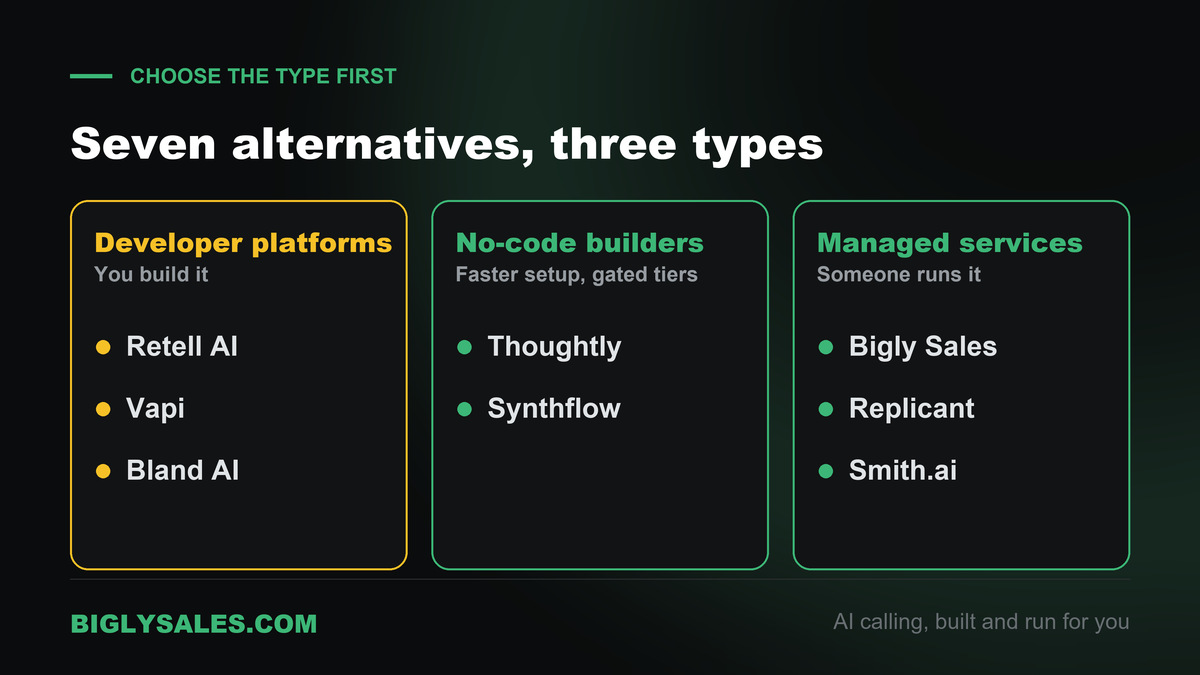
The seven Synthflow alternatives in this guide fall into three groups. Developer platforms (Retell AI, Vapi, Bland AI) start at $0.05 to $0.14 per minute and leave the build to you. A no-code builder (Thoughtly) starts at $500 a month. Managed services (Bigly Sales, Replicant, Smith.ai) run the calling for you, from $99 a month at Bigly and $300 a month at Smith.ai. Synthflow itself now shows only an Enterprise plan from $30,000 a year. Pick the group first, then the vendor. Do not switch if Synthflow is working and you have no complaints.
Key takeaways
- Synthflow’s public pricing page showed one plan on September 30, 2026, Enterprise from $30,000 a year. Everything else is quoted by sales.
- Its Trustpilot profile holds 4.1 out of 5 from 215 reviews, with repeat complaints about support, billing after cancellation and integrations.
- The best Synthflow alternatives are not one type of product, which is the main finding of this comparison. They are three different purchases, so decide which one you need before you compare.
- Developer platforms are cheap per minute and expensive in engineering time, and several public review records are thin.
- On outbound sales calls in the United States, the business placing the call can be held liable whichever vendor dials it.
- Run the same ten-call pilot on every shortlisted vendor and compare the logs, not the demos.
Table of contents
- Why teams look for Synthflow alternatives
- The comparison table
- The seven alternatives, one by one
- How to choose in one decision
- Compliance on outbound calls
- Moving off Synthflow without breaking production
- Synthflow alternatives FAQ
- The bottom line
Why teams look for Synthflow alternatives
Synthflow is a no-code platform for building AI voice agents, and it has a real following. On Trustpilot it holds 4.1 out of 5 from 215 reviews, and the profile was claimed in August 2024. Reviewers praise natural voices, easy setup and a wide feature set.
The complaints are just as consistent. Reviewers describe slow support, including one who waited four days for a reply. Several say they were charged after cancelling. Others report integrations that fail, agents that hallucinate, and white-label setups that still show Synthflow branding. One reviewer wrote that half the platform is crippled unless you are on enterprise.
Pricing is the newest reason. When we checked on September 30, 2026, Synthflow’s public pricing page listed a single Enterprise plan starting at $30,000 a year. Volume, concurrency, telephony and integrations are scoped on a sales call. That is fine for an enterprise buyer. It is a problem for a small team that wants to know the price before booking a meeting.
None of this means Synthflow is a bad product. It means the people who leave it are usually leaving for one of three reasons. They want a price they can see, support they can reach, or someone else to run the calling. Those reasons point to three different kinds of alternative.
The comparison table
| Vendor | Type | Published pricing | Public reviews | Best for |
|---|---|---|---|---|
| Bigly Sales | Managed service | Plans from $99 a month with included minutes | 3 Product Hunt reviews, none on Capterra yet | Sales teams that want calls run for them |
| Retell AI | Developer platform | $0.07 to $0.31 per minute | 4.9 out of 5, 810 Trustpilot reviews | Teams with engineers |
| Vapi | Developer platform | $0.05 per minute hosting plus components | 2.4 out of 5, 15 Trustpilot reviews | Teams that want full control |
| Bland AI | Developer platform | $0.14 per minute, or $0.12 plus $299 a month | 2.9 out of 5, 2 Trustpilot reviews | Developers who want one per-minute rate |
| Thoughtly | No-code builder | Flex from $500 a month | 4.0 out of 5, 7 Trustpilot reviews | Teams without developers |
| Replicant | Managed enterprise platform | By quote | Not checked | Large contact centers |
| Smith.ai | Human and AI receptionists | From $300 a month for 30 calls | 4.4 out of 5, 374 Trustpilot reviews | Small inbound call volume |
Here are the seven Synthflow alternatives side by side. Read the review column with care. A high rating from a few hundred reviews means more than a high rating from seven, and a vendor that has claimed its profile and invites customers will usually look better than one that has not.
The seven alternatives, one by one
Each of these Synthflow alternatives gets the same treatment. What it is, what it lists for price, what reviewers say and who it fits.
Bigly Sales
Bigly Sales is a managed AI calling service. We set up the phone numbers and registration, build the prompt to your specs with A/B testing, provide local presence numbers at $2 each, and check litigant lists and state and federal calling rules before each dial. A dedicated account manager handles the campaign on the Hunter plan and up.
Plans start at $99 a month for 500 minutes on Scout, with Prospector at $500 for 3,000 minutes, Hunter at $2,999 for 25,000 minutes, Closer at $4,999 for 50,000 minutes and Rainmaker at $9,999 for 125,000 minutes. Every plan covers outbound and inbound calling, and extra minutes run from $0.20 down to $0.08. See the pricing page for billing terms.
It fits sales teams with real lead volume that want calls handled and qualified leads passed to a rep. It is not the pick if you want to build and tune everything yourself. For a direct comparison of the two models, see Bigly Sales vs Retell.
Retell AI
Retell AI is a developer platform for voice agents and the most reviewed name on this list. Its Trustpilot profile holds 4.9 out of 5 from 810 reviews, though the profile is claimed and carries a paid Trustpilot plan. Reviewers praise ease of use and voice quality. The criticisms are support responsiveness, latency during conversations, undocumented country calling restrictions and setup complexity for outbound.
Pricing is assembled from parts. Voice agents run from $0.07 to $0.31 per minute depending on the voice and model you pick. Retell’s own infrastructure is $0.055 per minute, text-to-speech runs $0.015 to $0.040, the language model adds roughly $0.08 and US telephony adds about $0.015. New accounts get $10 in free credits, 20 concurrent calls are included and extra concurrency is $8 per line per month. HIPAA and BAA terms sit on the Enterprise plan.
It is a strong pick for teams with engineers who want flexibility and a big community. The cost to forecast is the blend of components, which takes a calculator once volume grows. For the full comparison, see our post on Retell AI alternatives.
Vapi
Vapi is a developer platform that charges a hosting fee and bills the parts separately. Hosting is $0.05 per minute. Transcription runs about $0.01, language models $0.008 to $0.045, voices $0.015 to $0.024, and Twilio outbound is $0.014 per minute. Plans run from a free tier with $5 in credits to Core at $29 a month and Pro from $999 a month. Extra concurrency is $10 per line per month and the HIPAA add-on is $2,000 a month.
Public reviews are mixed and few. Vapi’s Trustpilot profile shows 2.4 out of 5 from 15 reviews and is unclaimed. Reviewers describe long pauses of several seconds, slow support and hidden charges, while a couple praise responsive technical help. Fifteen reviews is too small to call a verdict.
Vapi fits teams that want full control and will own the plumbing. It is a poor fit for anyone who wants a price they can predict from a single number. See Bigly Sales vs Vapi for more.
Bland AI
Bland AI is a developer platform with the simplest published pricing on this list. Start is $0.14 per minute with no platform fee. Build is $0.12 per minute plus $299 a month. Enterprise is custom. The rate bundles the language model, speech-to-text and voice, and telephony is billed separately through Twilio or your own provider.
The limits matter. Start caps you at 10 concurrent calls and 100 calls a day, so real volume means Build or Enterprise. Bland’s Trustpilot page shows two reviews with a 2.9 out of 5 average and is unclaimed, which is not enough to judge support.
It suits developers who want one per-minute number and control of the stack. The homepage lists SOC 2 Type II, HIPAA and PCI DSS v4.0 and does not mention TCPA, so outbound compliance is yours to build. Read our full Bland AI review or the Bigly Sales vs Bland AI comparison.
Thoughtly
Thoughtly is the closest like-for-like swap for a Synthflow buyer, because it is also a no-code platform. Flex starts at $500 a month with 10 concurrent calls and, per its pricing page, unlimited voice minutes, SMS and email. Scale and Enterprise are quoted.
The gating is worth reading before you commit. Auto-QA and evaluations start at Scale. A dedicated customer success manager starts at Scale. HIPAA and BAA compliance and 24/7 support are Enterprise only, and SOC 2 Type II reports are Enterprise, with Scale on request. The page does not list per-minute rates or a free trial.
Thoughtly’s Trustpilot profile holds 4.0 out of 5 from seven reviews and was claimed in October 2025. Six of the seven praise call volume handling and CRM integration. The one negative review cites unclear pricing and an agent that drifted off script. Seven reviews is a thin record, so test it yourself.
Replicant
Replicant is a managed enterprise platform for large contact centers. It sells on an outcome basis and by quote, with no public price list, and we did not re-check its reviews for this guide. If your operation is enterprise scale with a procurement process, it belongs on the shortlist next to Bigly. The main differences are deployment weight and market focus. See Bigly Sales vs Replicant.
Smith.ai
Smith.ai pairs AI with human receptionists and is built mainly for inbound calls. Plans are priced by call count. Starter is $300 a month for 30 calls with $11.50 per extra call. Basic is $810 for 90 calls. Pro is $2,100 for 300 calls with $8.50 per extra call. It runs month to month and offers a 30-day money-back guarantee of up to $1,000.
Its Trustpilot profile holds 4.4 out of 5 from 374 reviews. Reviewers praise professional staff and 24/7 coverage. Complaints include slow support replies, uneven quality over time, one refund dispute and one client who said the AI was not a favorite.
It is a good fit for small businesses with modest inbound volume. Per-call pricing gets expensive as volume grows, and it is not built for outbound sales campaigns. See Bigly Sales vs Smith.ai.
Skip the build
Get a managed AI calling team
Bigly sets up the numbers, scripts, compliance checks and CRM hand-off for you. A short call shows you what that looks like for your leads.
How to choose in one decision
Choosing between Synthflow alternatives is easier than it looks. Do not start by comparing seven vendors. Start with one question. Who do you want doing the work?
If you want to build it yourself and you have developers, look at the developer platforms, Retell AI, Vapi and Bland AI. You get control and low per-minute rates, and you take on the build, the testing, the number reputation and the compliance.
If you want to build it yourself but you have no developers, look at the no-code builders, Thoughtly and Synthflow. Setup is faster. Read the plan gating first, because the features you need tend to sit on the higher tiers.
If you want calls run for you, look at managed services, Bigly Sales, Replicant and Smith.ai. You give up some control and you get a person accountable for results. The right one depends on your volume and whether you call out or take calls in.
Then compare price by what it includes. A per-minute rate and a monthly plan are not the same unit, and neither shows the cost of the people who keep the system running. Put every shortlisted vendor on one sheet at your real monthly volume.
Compliance on outbound calls
If you only take inbound calls, skip this section. If you place outbound sales calls in the United States, read it twice.
The FCC ruled in 2024 that AI-generated voices count as artificial voices under the TCPA. You need prior express consent before an AI calls a cell phone, you must honor opt-outs right away, and calls must stay inside 8 a.m. to 9 p.m. in the recipient’s time zone. Statutory damages run from $500 to $1,500 per call with no cap on the total. The FCC’s one-to-one consent rule was vacated by the Eleventh Circuit in January 2025 and never took effect, so ignore pages that still treat it as current law.
The business that places the call can be held liable whichever vendor dialed it. The FTC’s telemarketing rule guidance is a good baseline. On every platform in this guide except the managed ones, the compliance build is yours. Ask each vendor in writing what it checks before each dial and what it leaves to you. Our comparison of TCPA-compliant AI calling platforms goes deeper.
Moving off Synthflow without breaking production
Moving to any of the Synthflow alternatives is where good plans go wrong. Teams pick a new vendor, turn off the old one and then find out what the old one was quietly doing. Do it in order.
1. Write down what you built
List every agent, every integration, every phone number and every workflow. If a flow only exists in the Synthflow dashboard, export or screenshot it now.
2. Decide platform or managed before comparing vendors
Settle the build-or-buy question first. Comparing a developer API against a managed service on price alone is a category error.
3. Check your cancellation terms
Read the notice period and the billing date before you cancel. Synthflow reviewers describe being charged after cancelling, so get written confirmation of the end date and screenshot the final invoice.
4. Port phone numbers carefully
Numbers with a good reputation are an asset. Ask whether you can port them or whether you will start fresh, and expect a dip in answer rates while a new number builds trust.
5. Re-test on your own calls
Run the ten-call pilot on the new vendor with your real script. Call from your own phones, interrupt the agent, ask something off script and log how long each reply takes.
6. Run both in parallel for two weeks
Send a slice of traffic to the new system and keep the old one running. Compare connect rate, transfer rate and cost per booked appointment before you cut over.
7. Re-check compliance on the way across
Confirm consent records, calling windows and opt-out handling moved with you. A new platform does not inherit the old platform’s settings.
Synthflow alternatives FAQ
What is the best alternative to Synthflow?
It depends on who you want doing the work. Retell AI, Vapi and Bland AI suit teams with developers. Thoughtly is the closest no-code swap. Bigly Sales, Replicant and Smith.ai suit teams that want calls run for them. Choose the type first, then compare vendors inside it.
How much does Synthflow cost?
When we checked on September 30, 2026, Synthflow’s public pricing page listed one plan, Enterprise, starting at $30,000 a year. Other pricing is quoted on a sales call based on volume, concurrency, telephony and integrations. Ask for a written quote before you commit.
Is Synthflow good?
Synthflow has 4.1 out of 5 on Trustpilot from 215 reviews. Reviewers like the voices and the no-code setup. They complain about slow support, charges after cancellation and integration failures. It can work well for the right team, so test it on your own calls.
What is the cheapest Synthflow alternative?
On published rates Vapi is lowest per minute at $0.05 for hosting, but you pay for speech, models and telephony on top. Smith.ai starts at $300 a month for 30 calls. The cheapest option is the one whose total fits your volume, so price each at your real monthly minutes.
Do any Synthflow alternatives include TCPA compliance?
Developer platforms and no-code builders leave compliance configuration to you. Managed services such as Bigly Sales check consent, calling hours and state rules before each dial. Whatever you choose, ask in writing what is checked and what is yours, since the calling business can be held liable.
Is there a Synthflow alternative without a contract?
Smith.ai runs month to month with a 30-day money-back guarantee of up to $1,000. Bland AI and Vapi have entry tiers with no monthly fee or a low monthly fee. Always read the cancellation terms first, because billing after cancellation is a recurring complaint in this category.
Can I switch from Synthflow without rebuilding everything?
Partly. Prompts and call logic usually need to be rebuilt on the new platform, while phone numbers and CRM integrations can often move. Write down what you built, run both systems in parallel for two weeks and compare results before you cancel the old one.
Which Synthflow alternative is best for a small business?
For a small business taking inbound calls, Smith.ai or Thoughtly are the closest fit for budget and setup. For a small team running outbound sales with real lead volume, a managed service is usually faster to launch. Start with a pilot before any contract.
The bottom line
There is no single best pick among Synthflow alternatives, and the shortlist is shorter than seven once you know your type, because the seven are really three different purchases. Developer platforms give you control and hand you the work. No-code builders give you speed and hide the cost in plan tiers. Managed services give you an outcome and ask you to trust a partner.
Pick the type, put every one of the Synthflow alternatives on one sheet at your real volume, and run the same ten-call pilot on each. Synthflow alternatives only matter if the pilot numbers back the choice, so let them decide and keep Synthflow if it still wins.
See it on your leads
Try Bigly on your own call volume
Start with a plan and see how a managed AI caller handles your leads. You can check plans and pricing in a few minutes.