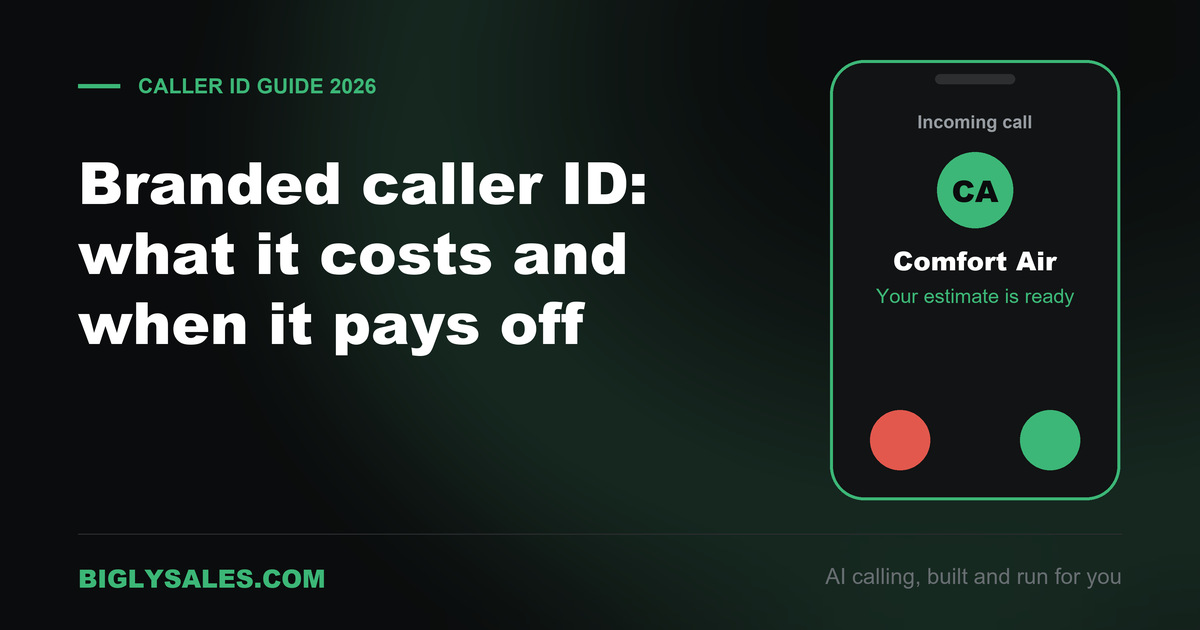


Branded caller ID shows your business name on the phone of the person you are calling, often with your logo and a reason for the call.
Instead of an unknown 10 digit number, they see who you are before they decide.
That matters because most people do not answer numbers they do not know. In a 2026 survey by Hiya, a caller ID company, 86% of more than 12,000 consumers in six countries said they don’t answer unknown calls. That is a vendor survey, but anyone who runs a phone team has seen the pattern.
This guide covers what branded caller ID is, what people actually see, what it costs, which carriers show it, how to set it up and the one thing it cannot fix.
Key Takeaways
- Branded caller ID sends a verified business name, logo and call reason with each call.
- It only works on calls signed with A level STIR/SHAKEN attestation.
- Published prices run from about 7.5 to 14 cents per branded call as of November 2026.
- You usually pay only when the brand actually shows on the phone.
- It does not remove a Spam Likely label. Clean numbers come first.
- CNAM is still worth setting because landlines and many phones rely on it.
Table of contents
- What branded caller ID is
- What people actually see on their phone
- Branded caller ID vs CNAM, STIR/SHAKEN and local presence
- How branded calling works behind the scenes
- Which carriers and phones show it
- What branded caller ID costs
- Who offers branded caller ID
- What you need to get approved
- How to get your business name on caller ID in 7 steps
- Does branded caller ID stop Spam Likely
- Does branded calling raise answer rates
- The rules on caller ID that apply to you
- Branded calling for AI and high volume calls
- When branded caller ID is not worth it
- Branded caller ID FAQ
- The bottom line
What branded caller ID is
Branded caller ID is a service that displays a business’s verified name, and often its logo and reason for calling, on the screen of the phone being called. It is also called branded calling, Branded Calling ID or rich call data.
The key word is verified. A third party checks that your business is real and that you have the right to the numbers you call from. Then each call is signed so the carrier can trust it.
That is different from typing a name into your phone system. Anyone can type a name. Not everyone can pass vetting.
What people actually see on their phone
There are three levels of what shows up when your call rings.
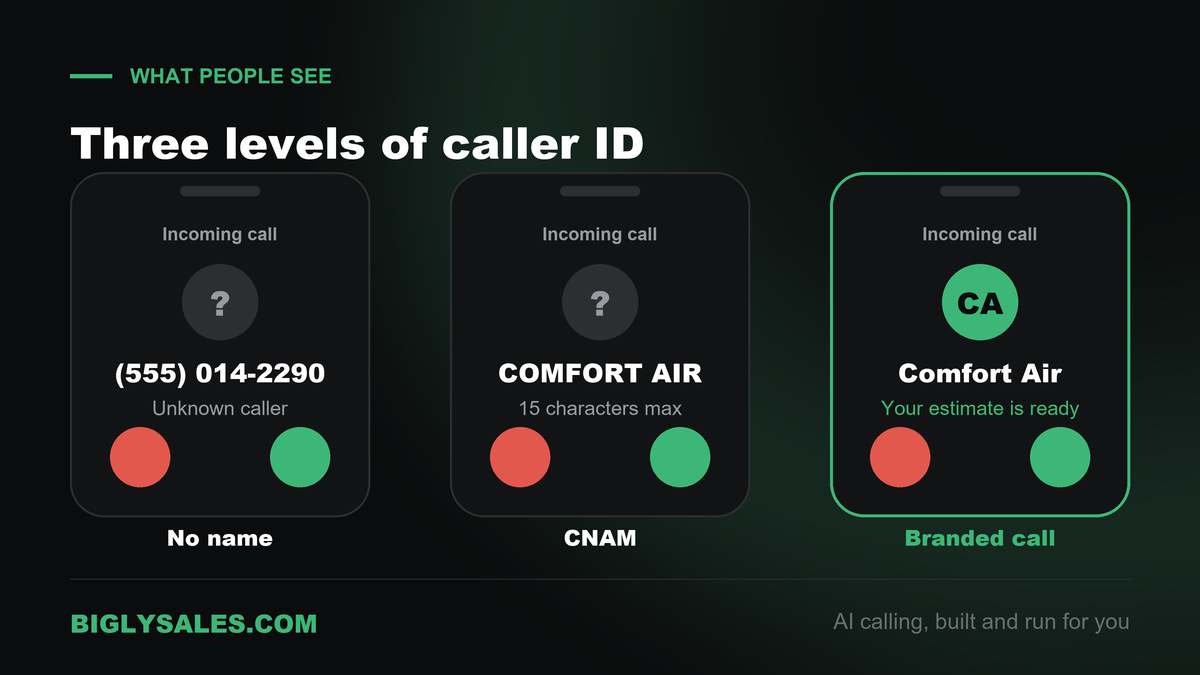
No name at all
Just the number, maybe a city. This is what most business calls look like on a mobile phone.
A CNAM name
A short text name, up to 15 characters with most providers. Landlines usually show it. Many mobile phones do not.
A branded call
Your full business name, your logo and a short reason such as “Appointment reminder” or “Your quote is ready.” Under the industry guidelines, the reason can be up to 35 characters.
Where the logo shows depends on the phone. AT&T says its branded display shows the logo while the phone rings on Android. On other systems it shows when the phone is unlocked or uses face recognition.
Branded caller ID vs CNAM, STIR/SHAKEN and local presence
These four get mixed up all the time. They do different jobs.
| Tool | What it does | What the person sees | Typical cost |
|---|---|---|---|
| CNAM | Stores a text name for each number in a database | Up to about 15 characters, mostly on landlines | Free to low |
| STIR/SHAKEN | Signs the call to prove the number is not spoofed | Sometimes a check mark, often nothing | Included by most voice providers |
| Local presence | Calls from a number with the person’s area code | A local looking number | Cost of the extra numbers |
| Branded caller ID | Sends a vetted name, logo and reason with each call | Business name, logo and reason | About 7.5 to 14 cents per branded call |
They stack. Branded calling needs STIR/SHAKEN underneath it. CNAM covers the phones branded calling does not reach. If you use local presence dialing, every local number has to be registered to your brand too.
We explain the attestation levels in our STIR/SHAKEN guide.
How branded calling works behind the scenes
The industry program is called Branded Calling ID, or BCID. It was set up by CTIA, the wireless industry group. Here is the path of one call.
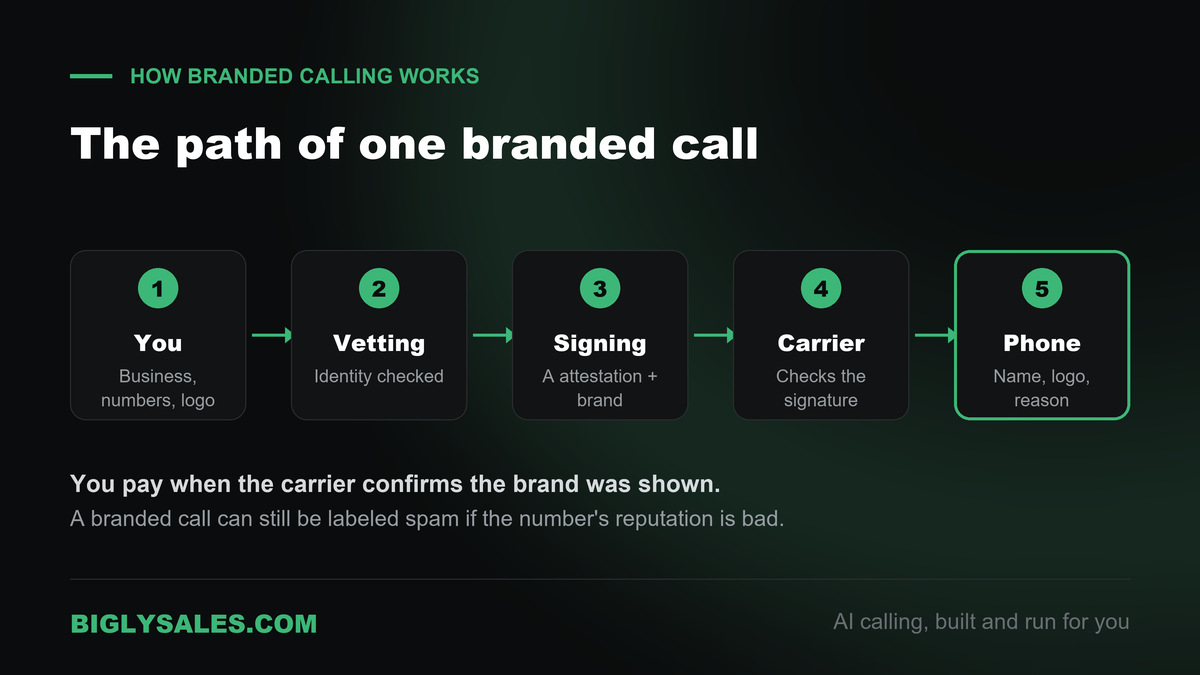
- Vetting. A vetting agent checks your business identity, your numbers and your logo.
- Signing. When you call, a signing agent attaches your brand to the call. The call must carry A level attestation.
- Delivery. The carrier on the other end checks the signature and shows your brand on the phone.
- Billing. You pay when the carrier confirms the brand was shown.
Some carriers and analytics companies also run their own programs alongside BCID. The steps are similar. The vendor in the middle changes.
Which carriers and phones show it
| Carrier or platform | Program | Status | Notes |
|---|---|---|---|
| AT&T | Branded Call Display with TransUnion | Live since January 2024 | Name and logo, no app needed |
| Verizon | BCID calls and Verizon Business Branded Calling | BCID live since November 2025 | Name, logo and reason, reason depends on the device |
| T-Mobile | Branded calls through First Orion | Live | First Orion says it reaches nearly 400 million US phones |
| Apple iPhone | Business Caller ID | Beta in 2026 | US only, through approved partners |
| Verified Calls | Ended | Google has shut it down |
No program shows your brand on every phone. Providers say so plainly. One pricing page we checked states that not every outbound call will be branded.
What branded caller ID costs
Most pricing is per branded call, meaning a call where the brand actually showed. Here is what public pricing looked like when we checked in November 2026.
- Hiya lists monthly plans from $99 for 750 branded calls up to $835 for 10,000, or about 8 to 13 cents a call. Pay as you go starts at 14 cents.
- Telnyx lists 7.5 cents per branded call, plus $50 one time and $50 a month per brand.
- First Orion charges a $25 one time certification fee. Its plan prices are not public.
- An industry paper from TransNexus says published prices reach 10 to 12 cents a call on low volume packages. For tens of thousands of calls a month, it calls 3 cents a call a good planning number.
Here is the math for a team placing 20,000 calls a month.
| Price per branded call | Monthly cost | Who might pay this |
|---|---|---|
| 3 cents | $600 | Large programs with negotiated rates |
| 7.5 cents | $1,500 | Published per call pricing |
| 12 cents | $2,400 | Smaller plans and pay as you go |
Your real bill is usually lower, because you only pay when the brand displays. Ask every provider how they count a branded call before you compare quotes.
Number health
Get clean, registered lines from day one
Bigly Sales runs your AI calls on registered lines with the caller name kept the same on every number. A short setup call shows you how it would work for your volume.
Who offers branded caller ID
You buy branded caller ID from one of a handful of companies that register your brand with the carriers, or through your phone or dialer provider, which resells one of them. Coverage is the main difference. No single provider shows your name on every US phone yet.
| Provider | Program | Where your brand shows | Public pricing |
|---|---|---|---|
| TransUnion | Branded Call Display | Runs the AT&T in-network program. TransUnion says it also reaches Verizon and T-Mobile. | Not public |
| First Orion | INFORM Branded Calling | Runs T-Mobile’s branded calls and lists support on other major carriers | $25 one time certification, plans not public |
| Hiya | Hiya Connect Branded Call | Samsung phones and partner networks. Hiya says display depends on the network and device. | From $99 a month for 750 branded calls |
| Numeracle | Verified identity with Branded Calling ID | An authorized partner for the industry BCID program, which shows on T-Mobile and Verizon | Not public |
| TNS | Enterprise Branded Calling | Name and logo with no app needed. Ask which networks it covers today. | Not public |
| Your phone or dialer provider | Resold from one of the above | Same as the program it resells | Often billed per branded call on top of your calling plan |
Three questions narrow the list fast.
- Which carriers do your customers use? A provider that misses AT&T or Verizon misses a large share of US phones.
- Do you pay per call placed or per call branded? Paying only when the brand actually shows is the fairer deal.
- Who does the vetting? Every program checks that you own the brand and the numbers, so ask how long approval takes before you plan a campaign around it.
What you need to get approved
The CTIA branded calling best practices list what vetting agents check. Have these ready.
- Your legal business name, website and type of business.
- An EIN or a DUNS number.
- A billing contact and an authorizer with a work email address.
- The full list of numbers you call from, and proof you have the right to use them.
- Proof of authorization if an agency or vendor registers for you.
- A logo registered with the US Patent and Trademark Office, if you want a logo shown.
A few rules catch people out.
- The display name has to be your legal name, brand name or d/b/a, registered in at least one US state.
- No links in the name or reason.
- Content tied to sex, hate, alcohol, firearms or tobacco is not allowed.
- If you fail vetting, you get a notice and a chance to fix it.
Most of this overlaps with the know your customer checks carriers already run. Our outbound calling requirements checklist covers those.
How to get your business name on caller ID in 7 steps
- List every outbound number. Include numbers in dialers, AI tools and local presence pools.
- Put every number under your own company. Numbers registered to a vendor’s name will fail vetting.
- Set CNAM on every number. Use the same name everywhere, within 15 characters.
- Confirm A level attestation. Ask your voice provider what level your calls get today.
- Pick a branded calling provider and submit vetting. Use the documents above.
- Write your call reasons. Keep each under 35 characters, such as “Your estimate is ready.”
- Test on real phones. Call an AT&T, a Verizon and a T-Mobile phone, iPhone and Android, and screenshot what shows.
Does branded caller ID stop Spam Likely
No. This is the most common misunderstanding about branded calling.
Spam labels come from the analytics engines that watch your call behavior. Too many calls from one number, too many short calls and too many complaints all push a number toward a label. TransNexus says there is no guarantee a branded call won’t be labeled spam.
So the order matters.
- Fix the behavior and the reputation of your numbers.
- Clear existing labels.
- Add branding so a clean call also looks trustworthy.
Our guide on how to fix Spam Likely walks through the dispute steps. The carrier labeling breakdown explains which signals trigger a label.
Does branded calling raise answer rates
Probably, but be careful with the numbers you read.
Every answer rate figure we found came from a company that sells branded calling. Published case studies range from about a 14% lift to more than 100%. One widely shared figure covers calls in the UK, Canada and Germany, not the US. We found no independent study.
The honest way to know is to test it yourself.
- Split your numbers into two groups with the same list quality and call times.
- Brand one group. Leave the other on CNAM only.
- Run both for at least two weeks.
- Compare answer rate, conversations and booked appointments. Pickups alone can mislead you.
If the lift does not cover the per call cost, stop.
The rules on caller ID that apply to you
You must send caller ID on sales calls
FCC rules require telemarketers to transmit caller ID. You may show the seller’s name and a customer service number instead of the number you dialed from. That number has to accept do not call requests during business hours. Blocking caller ID is not allowed.
Your caller ID cannot mislead
The Truth in Caller ID Act bans knowingly sending misleading or inaccurate caller ID to defraud, cause harm or wrongly get something of value. Branded calling helps here because a third party has verified the name.
A caller name rule may be coming
In October 2025 the FCC proposed that phone companies pass a verified caller name, or other caller identity information, to the phone on every call with A level attestation. It also asked whether to require rich call data to carry that name. The proposal was published in the Federal Register on December 5, 2025. As of November 10, 2026 there is no final rule.
Branded calling for AI and high volume calls
Branded calling works the same for calls placed by an AI voice agent. The carrier checks the number and the signature, not who or what is talking.
Three things change at high volume.
Number pools need to be registered
Every number that dials needs to be on your vetted list. Apple’s Business Caller ID also requires a clear, explicit link between each number and your brand.
The name must match the call
If your AI agent says it is calling from your business, the screen should say the same name. A mismatch kills trust faster than no name at all.
Disclosure still applies
A branded screen does not replace saying the call uses AI where the law or good practice calls for it. See our AI disclosure laws guide.
When branded caller ID is not worth it
Branded calling is not for everyone. Skip it, or wait, if any of these fit.
- You place a few hundred calls a month. Set CNAM and save the money.
- Your numbers are already labeled Spam Likely. Fix that first.
- Most of your calls go to landlines or businesses with desk phones.
- You call people who have never heard of you and your brand means nothing to them yet.
- You rotate numbers often and cannot keep a stable list registered.
It pays off most when people already know your name. Think callbacks on quote requests, appointment reminders and follow-ups with existing customers.
Branded caller ID FAQ
What is branded caller ID?
Branded caller ID is a service that shows your verified business name on the person’s phone when you call, often with your logo and a short reason for the call. It replaces an unknown number or a bare city name. You register your business and numbers with a provider, the call is verified, and the carrier shows the brand on supported phones.
How much does branded caller ID cost?
Most providers charge per call that actually shows your brand. Published prices checked in November 2026 run from about 7.5 cents to 14 cents per branded call, with monthly plans that work out lower at volume. Some add a setup or monthly brand fee. Industry papers suggest planning around 3 cents a call for large programs, so get quotes at your real volume.
How do I get my business name to show up on caller ID?
Start with CNAM, the 15 character name your phone carrier can attach to each number for free or close to it. For a name that shows on most mobile phones with a logo, register for branded calling through a provider that vets your business, signs your calls with A level attestation and passes the brand to the carriers.
Does branded caller ID work on iPhone?
Yes on the carriers that support it, but the details differ. AT&T says its branded display shows logos while ringing on Android and on other systems only when the phone is unlocked. Apple’s own Business Caller ID is still listed as a beta in its 2026 developer docs and works through approved partners in the US.
Which carriers support branded calling?
All three major US wireless carriers show some form of branded calling. AT&T launched branded display with logos in January 2024. Verizon began showing calls branded through the industry BCID program in November 2025 and also sells its own Business Branded Calling. T-Mobile shows branded calls through First Orion’s program. Coverage still depends on the phone and app.
Does branded caller ID stop Spam Likely labels?
No. Branded calling and spam labeling are separate systems. A carrier can still label a branded call as spam if your numbers show spam like behavior, such as high volume, short calls or complaints. Fix the number reputation first, then add branding on top so a clean call also looks trustworthy.
What is the difference between CNAM and branded caller ID?
CNAM is a text name of up to 15 characters stored in a database that the receiving carrier may or may not look up. Many mobile phones never show it. Branded caller ID is newer. It sends a verified name, logo and call reason with the call itself, and it only works when the call carries A level STIR/SHAKEN attestation.
How long does branded caller ID registration take?
Plan on a few days to a few weeks. The time goes into vetting your business, confirming you have the right to your numbers and approving your logo and call reasons. There is no official timeline. Teams with an EIN or DUNS number, a registered trademark and numbers already under their own company name move fastest.
Is it legal to change the name on my caller ID?
Yes, as long as it is accurate. Federal rules require telemarketers to send caller ID and allow them to show the seller’s name and a customer service number. The Truth in Caller ID Act bans knowingly sending misleading caller ID to defraud or cause harm. Your branded name must be your legal, brand or d/b/a name.
Does branded caller ID work for text messages or landlines?
Branded calling is a voice feature for mobile phones. It does not brand your text messages, which use separate registration programs. Landlines and most home phones still rely on CNAM, so set a clear CNAM name on every number even if you also buy branded calling for mobile.
The bottom line
Branded caller ID puts your verified name, logo and reason on the screen. It costs roughly 7.5 to 14 cents per branded call at public prices and works on the major US carriers, though not on every phone.
It is a finishing layer, not a fix. Get your numbers registered, attested and clean first. Then test branding against a control group and keep it only if the extra answers pay for it.
Talk to our team
Make more of your calls worth answering
Bigly Sales runs fully managed inbound and outbound AI calling on 200+ whitelisted lines, with compliance controls built in. Most teams go live within 24 hours of a free setup call.