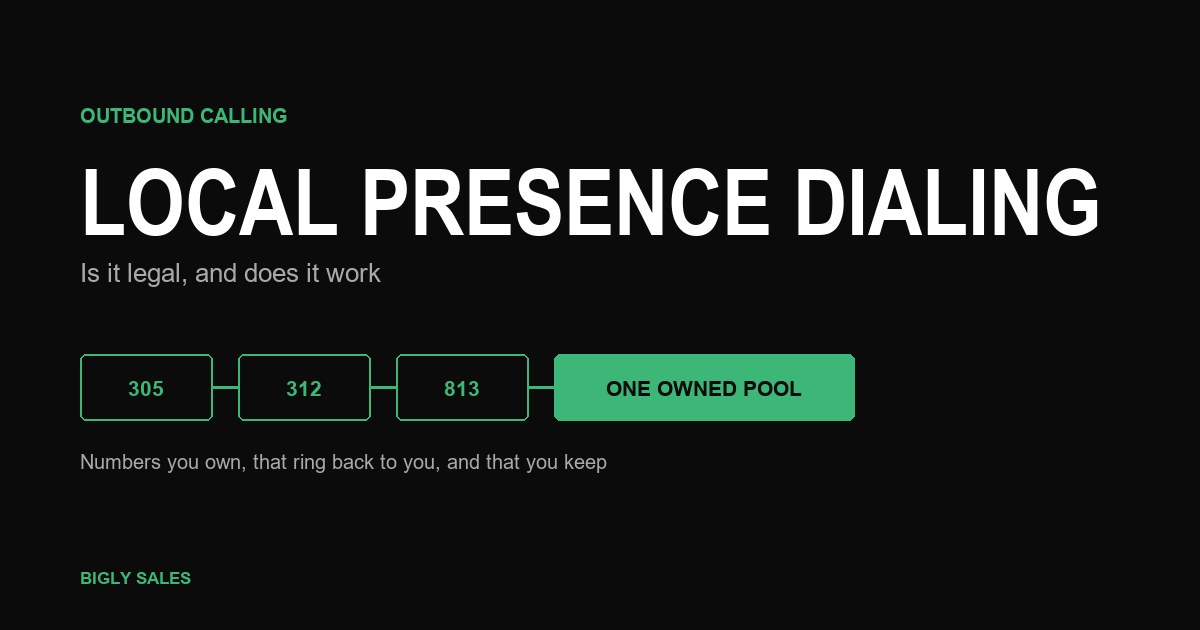


Local presence dialing means showing a caller ID that shares the recipient’s area code, so a prospect in Tampa sees an 813 number rather than one from your head office in another state. Answer rates go up, sometimes sharply.
It is also the outbound tactic most likely to get a team into trouble, because the version that works and the version that is illegal look similar from the outside. The difference comes down to whether you actually control the number and whether you intend to mislead.
This guide covers how it works, where the legal line sits, why it degrades if you run it carelessly, and how to set it up so it keeps working.
TL;DR
Local presence dialing shows a caller ID sharing the recipient’s area code, which lifts answer rates because an unfamiliar area code is one of the strongest reasons people ignore a call. It is lawful in the United States when you own the number and a returned call reaches you, because the Truth in Caller ID Act at 47 USC 227(e) prohibits misleading caller ID transmitted with intent to defraud or cause harm. The practice that gets teams into trouble is rotating disposable numbers to dodge spam labeling, which burns numbers faster than it helps. It changes who answers, though, not whether your offer is any good.
Key Takeaways
- Local presence matches your caller ID to the recipient’s area code, which raises pickup rates.
- It is lawful when you own the number and it is answerable. Intent to deceive is what the law prohibits.
- Telemarketing rules separately require caller ID that lets the recipient identify and call back the seller.
- Rotating disposable numbers to dodge labeling is what burns numbers fastest.
- Authentication rewards a small stable pool over a large churning one.
- It changes who answers, not whether the offer is any good.
- Local presence displays a caller ID matching the recipient’s area code, which lifts answer rates because unfamiliar area codes get ignored.
Table of contents
- What local presence dialing is
- Why it lifts answer rates
- Where the legal line sits
- How it goes wrong
- How to run it properly
- When to skip it
- Local presence dialing FAQ
- The bottom line
What local presence dialing is
Local presence dialing is a feature of outbound calling software that picks the outbound caller ID based on where the person you are calling lives. Call a 305 number, and your caller ID shows a 305 number. Call a 312 number, and it shows 312.
To do it, you need a pool of numbers across the area codes you call into and logic that matches one to each contact before dialing.
The important structural question, and the one that separates a legitimate setup from a risky one, is what those numbers are. Numbers your business actually owns, that ring back to you when someone returns the call, are a completely different proposition from arbitrary numbers displayed for effect.
Why it lifts answer rates
The mechanism is not complicated. People screen unknown numbers, and an unfamiliar area code is one of the strongest signals that a call is not worth answering. A local area code removes that signal.
There is a second effect that matters more for callbacks than for the initial pickup. A local number looks like a business someone could visit or reach, which makes returning the call feel lower risk than dialing an unfamiliar out-of-state number.
Worth being clear about what it does not do. Local presence changes whether someone picks up. It does nothing about whether your offer is relevant, whether the list is any good, or whether the conversation goes anywhere. An increase in answer rate without a corresponding increase in conversion usually means you are now reaching more of the wrong people, and doing so faster.
Where the legal line sits
This is the part worth reading properly, because the internet is full of confident and wrong answers in both directions.
In the United States, caller ID practices are governed by the Truth in Caller ID Act, codified at 47 USC 227(e). The prohibition is on transmitting misleading or inaccurate caller ID information with the intent to defraud, cause harm, or wrongfully obtain anything of value. The statutory text sits in 47 USC 227 on govinfo.gov.
Intent is the hinge. Displaying a local number that your business owns, that a recipient can call back and reach you on, and that identifies you honestly when you speak, does not carry that intent. That is why the practice is widespread and lawful.
What crosses the line is using caller ID to deceive. Displaying a number belonging to someone else. Displaying a number that goes nowhere so nobody can trace or return the call. Mimicking a government agency or a local institution. Rotating numbers specifically so recipients and carriers cannot identify who is calling.
Two other obligations sit alongside this and are not optional. Telemarketing rules require that you transmit a caller ID that allows the recipient to identify and call back the seller. And state law can be stricter than federal, so a practice that is fine nationally may not be in every state you dial. Our guide to TCPA compliance for AI outbound calling covers the consent and state law layer.
None of this is legal advice. If you are dialing at scale across many states, have somebody qualified look at your specific setup.
How it goes wrong
The failure mode is almost always the same, and it comes from treating numbers as disposable.
A team starts local presence dialing, answer rates improve, and volume increases. Carriers score the numbers, the numbers get labeled, and answer rates fall. The team responds by rotating in fresh numbers. Those get labeled too, faster, because high volume from brand-new numbers is itself a spam signature. Within months the team is burning through numbers to stand still.
Call authentication has made this worse for the people doing it cheaply. Numbers you can properly attest to as your own get treated better than numbers you cannot, so a large churning pool now performs worse than a small stable one. We cover that mechanic in how STIR SHAKEN affects your outbound answer rates.
There is a customer facing failure too, and it is the one that generates complaints. Someone answers a local number, hears a company from three states away, and feels tricked. That reaction is not about the law. It is about the gap between what the caller ID implied and what the call turned out to be, and the fix is disclosing who you are in the first sentence rather than waiting to be asked.
| Approach | Numbers used | Answer rate effect | Durability | Legal position |
|---|---|---|---|---|
| One consistent number | A single owned number | Lowest for cold contacts | Highest reputation builds | Straightforward |
| Small-owned local pool | A few owned numbers per region, kept long-term | Strong | Good, if the volume is sensible | Lawful when answerable |
| Large rotating pool | Many numbers churned often | Strong at first, then falls | Poor, numbers burn quickly | Risky, looks like evasion |
| Numbers you do not own | Someone else’s number displayed | Irrelevant | None | Unlawful |
How to run it properly
- Own every number you display. No borrowed numbers, no numbers you cannot prove are yours.
- Make every number answerable. A returned call must reach a real queue. A local number that rings nowhere is the single clearest indicator of bad practice.
- Keep the pool small and stable. Reputation accrues to numbers you keep. Churn destroys it. Fewer, older, authenticated numbers beat a large rotating pool.
- Say who you are immediately. The local area code gets you the pickup. The first sentence has to earn the rest of the call.
- Watch labeling per number, not in aggregate. By the time your overall answer rate drops, specific numbers have been degrading for weeks. Monitoring at the number level catches it early. See number health when outbound calls get flagged as spam.
- Do not pair it with maximum volume dialing. Aggressive pacing from local numbers is the fastest way to burn them. See our guide to the predictive dialer for why.
Bigly Sales runs local presence across more than 200 whitelisted lines that are owned, monitored, and answerable rather than rotated, which is the version of this that keeps working.
Owned and answerable
Stop burning through phone numbers
We run local presence across more than 200 whitelisted lines that are owned and monitored rather than rotated. Book a 30-minute walkthrough and we will show you how the pool is managed and what your answer rates look like on it.
30 minutes · screen shared · no obligation
When to skip it
Local presence is not always the right answer.
If you sell nationally to businesses that expect a national vendor, a consistent recognizable number can outperform a local one, because familiarity beats locality once a brand is known.
If your problem is that the list is poor or the offer is weak, local presence will get more people to answer a call they did not want. That is not progress, it just moves the failure one step later.
And if you cannot commit to owning and answering the numbers, do not do it. A half-implemented local presence setup is worse than dialing from one honest number, both for your reputation and your exposure.
Number reputation, authentication and dialing terms are defined together in the AI calling glossary if you want the vocabulary in one place.
Local presence dialing FAQ
What is local presence dialing?
Local presence dialing is an outbound calling feature that selects a caller ID matching the area code of the person being called, so the call appears local. It requires a pool of numbers across the area codes you dial into and logic that matches one to each contact.
Is local presence dialing legal in the United States?
Yes, when done properly. The Truth in Caller ID Act prohibits misleading caller ID transmitted with intent to defraud, cause harm, or wrongfully obtain something of value. Displaying a local number your business owns, that recipients can call back and reach you on, does not carry that intent. State rules can be stricter, so check the states you dial.
Is local presence the same as caller ID spoofing?
No, though they are often confused. Spoofing in the illegal sense means displaying misleading information to deceive, including numbers you do not control. Local presence using numbers you own and answer is a different practice, which is why it is lawful and widely used.
Does local presence dialing actually improve answer rates?
Usually yes, because an unfamiliar area code is one of the strongest reasons people ignore a call. The size of the lift varies by audience. It affects whether someone picks up and has no effect on whether your offer is relevant to them.
Why did our local presence numbers stop working?
Almost always carrier labeling. Numbers get scored, and high volume from numbers with no established reputation looks like spam behavior. Rotating in fresh numbers accelerates the problem, because a brand new number dialing heavily is itself a flag. Monitor labeling per number rather than watching your overall answer rate, which moves too late to act on.
How many local numbers do we need?
Fewer than most teams assume. Reputation builds on numbers you keep, so a small stable pool covering your main regions outperforms a large rotating one. Add numbers because you started dialing a new region, never to escape a labeling problem, because the replacement numbers will degrade the same way and faster.
Do we have to tell people where we are actually calling from?
Telemarketing rules require caller ID that lets the recipient identify and call back the seller, and identifying yourself early is both good practice and the thing that prevents complaints. Someone who feels misled by a local area code will react to the mismatch regardless of what the law requires.
Does local presence affect call authentication?
Yes. Numbers you can properly attest to as your own are treated better than numbers you cannot, so a large churning pool tends to perform worse than a small owned one. Authentication has reduced the advantage of cheap number rotation considerably.
Should B2B teams use local presence dialing?
Sometimes. It helps when you are unknown to the person you are calling. Once a brand is recognized, a consistent number can outperform a local one, because familiarity beats locality. Test it against a single stable number rather than assuming.
The bottom line
Local presence dialing works, and it is lawful when you own the numbers, answer them, and identify yourself honestly on the call. The version that gets teams into trouble is the version built on disposable numbers nobody can trace.
Treat your numbers as assets that accumulate reputation rather than consumables you burn through. Keep the pool small, keep it answerable, watch labeling per number, and do not pair it with the most aggressive pacing your dialer allows.
If you would rather not manage your own health numbers, book a free setup session, and we will show you how the whitelisted line pool works in practice.
Number health included
Let someone else manage the pool
Monitoring labeling per number and keeping lines clean is ongoing work most teams do not want to own. We will show you what that looks like handled for you, using your own calling pattern.