

Bland AI is a platform developers use to build AI phone agents that make and take calls. You write the logic, you connect your tools, and you pay by the minute. That is the whole idea, and it is a good one for the right buyer.
This Bland AI review is for the person who has to decide whether to use it. We sell in the same market, so you should know the bias up front. We checked every number against the source, and where we could not check something we say so. Nothing in this Bland AI review is a hit piece. Bland is a real product. It just is not the right one for everybody, and most reviews skip the part about who it is wrong for.
TL;DR
The short verdict from our Bland AI review is this. Bland AI charges $0.14 per minute on Start and $0.12 per minute plus $299 a month on Build, with phone lines billed separately. It advertises 400ms response time, while independent write-ups report 700ms to 1,500ms on real calls. Public reviews are too thin to judge its support, since its Trustpilot page holds two reviews. It fits a team with engineers who want to build and run their own calling system. It is a poor fit if you want someone else to run the campaign and own compliance on outbound calls.
For a side by side view of these models against managed calling, see AI pricing for contact centers.
Key takeaways
- Our Bland AI review found published rates of $0.14 per minute (Start) and $0.12 per minute plus $299 a month (Build).
- The per-minute rate is the smallest part of the real cost. Telephony, engineering time and compliance work sit on top.
- The 400ms latency claim is Bland’s own. Independent tests we found put real calls at 700ms to 1,500ms.
- Bland’s Trustpilot page shows two reviews and an unclaimed profile, so there is not enough public evidence to rate its support.
- Synthflow has far more public reviews (215 on Trustpilot) and a pattern of billing and support complaints.
- On outbound sales calls in the United States, the business placing the call can be held liable, whichever vendor dialed it.
- Run a ten-call pilot before you sign anything, which is the main lesson of this Bland AI review.
Table of contents
- What Bland AI is
- How a Bland call works and who handles each layer
- What Bland AI costs in 2026
- The cost nobody puts on the pricing page
- Latency in real calls
- Compliance on outbound calls
- What buyers say about support
- Where Synthflow differs
- Bland, Synthflow and a managed service side by side
- Five questions to ask any voice AI vendor
- How to run a ten-call pilot
- Who Bland AI is right for
- Where Bigly fits
- If you already use Bland
- Bland AI review FAQ
- The bottom line
What Bland AI is
Bland AI is a voice AI platform that lets developers build, run and monitor AI phone agents at scale. Bland says it has resolved more than 693 million calls. Its homepage lists SOC 2 Type II, HIPAA and PCI DSS v4.0 certifications and points at regulated industries like healthcare, insurance, financial services and logistics.
It does not mention TCPA on that page. That matters if you plan to make outbound sales calls in the United States, and we will come back to it.
The product is infrastructure. You get the voice, the speech-to-text and the language model in one bill. What you do not get is a finished calling operation. Somebody on your side writes the prompts, tests the flows, connects the CRM and watches the results every day.
For a company with engineers, that is a feature. You get control and you can build something nobody else has. For a sales manager who wants leads called within a minute of filling out a form, it is a project with a payroll line attached.
How a Bland call works and who handles each layer
Before you weigh any Bland AI review against your own needs, it helps to see how a call works. Every AI phone call runs through the same chain. The caller speaks, software turns the audio into text, a language model decides what to say, software turns the answer back into a voice, and a phone carrier moves all of it across the network. Each link adds delay and each link can break.
Bland bundles three of those links. The language model, the speech-to-text and the voice are all in the per-minute price. Telephony is separate, billed through Twilio or a provider you bring yourself.
What Bland does not bundle is everything around the chain. The table shows where the work lands.
| Layer | On Bland AI | On a managed service |
|---|---|---|
| Voice, speech-to-text, language model | Included in the per-minute rate | Handled for you |
| Phone numbers and carrier | You, through Twilio or your own provider | Handled for you |
| Number reputation and registration | You | Handled for you |
| Prompts and conversation flow | You | Built to your specs and A/B tested |
| CRM connection and call logging | You | Handled for you |
| Consent, calling hours, do-not-call checks | You | Checked before each dial |
| Watching results and fixing edge cases | You | Account manager |
Neither column is wrong. They are two different jobs. One is buying parts and the other is buying an outcome.
What Bland AI costs in 2026
Bland publishes two self-serve plans and a custom enterprise tier. We checked the pricing page on September 30, 2026. Bland does not date the page, so confirm the numbers before you budget.
| Plan | Talk time | Platform fee | Limits |
|---|---|---|---|
| Start | $0.14 per minute | $0 | 10 concurrent calls, 100 calls a day, 1 voice, 10 knowledge bases |
| Build | $0.12 per minute | $299 a month | 50 concurrent calls, 2,000 calls a day, 5 voices, 50 knowledge bases |
| Enterprise | Custom | Custom | Dedicated infrastructure, VPC option, forward-deployed engineer, BAA and SSO |
Transfer time to a human is billed at $0.05 per minute on Start and $0.04 on Build. Bland says there are no token charges and no pass-through fees from model providers. Phone numbers and carrier costs run through Twilio or your own provider, and those are extra.
Here is what 20,000 talk minutes a month looks like in practice. On Start that is $2,800. On Build it is $2,400 in usage plus the $299 fee, or $2,699. At 100,000 minutes, Start comes to $14,000 and Build to $12,299. Every one of those figures excludes telephony, engineering time and the cost of anyone watching the campaign.
The limits matter as much as the rate. Start caps you at 10 concurrent calls and 100 calls a day, which is a pilot and not a campaign. Real volume means Build or a conversation with Bland’s sales team.
| Option | Price at 20,000 minutes | What is included |
|---|---|---|
| Bland AI Start | $2,800 | Platform, voice, speech-to-text and model. Telephony extra. |
| Bland AI Build | $2,699 | Same as Start with higher limits. Telephony extra. |
| Synthflow | Not published | Public page showed only an Enterprise plan from $30,000 a year on September 30, 2026. |
| Bigly Sales Hunter | $2,999 | 25,000 minutes, outbound or inbound, account manager, LLM-built scripts, local presence numbers at $2 each. See the pricing page for billing terms. |
The point of the table is not that one is cheaper. It is that the rate per minute hides most of the work. Read what each price leaves for you to build.
The cost nobody puts on the pricing page
A per-minute rate is the easy number to compare, which is why every vendor and almost every Bland AI review leads with it. The expensive part of running voice AI is the stuff that is not billed by the minute.
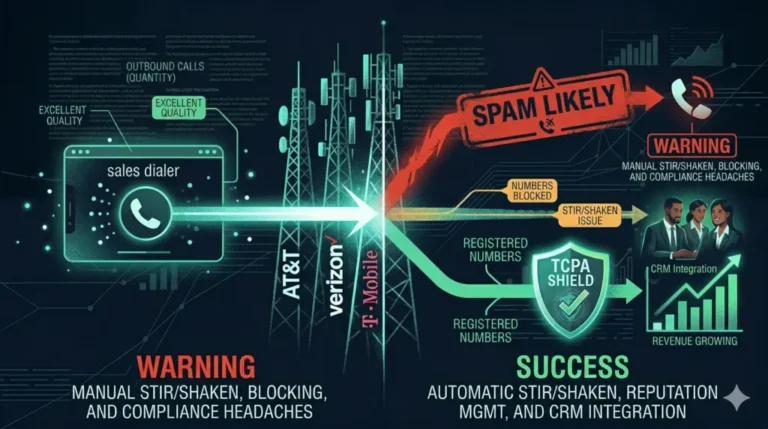
Start with telephony. Bland does not include carrier costs, so you pay Twilio or another provider on top. Then add the people. Someone has to write and test the prompts, hook up the CRM, listen to calls, and fix the edge case that shows up on a Tuesday afternoon. Then add the plumbing nobody budgets for, which is number registration, spam labeling and keeping your caller IDs trusted by carriers.
Here is a simple way to see it. Say a developer or ops person spends ten hours a week on the system, and their loaded cost is $60 an hour. That is about $2,600 a month in time, which is nearly the whole Build bill again. The figure is an illustration, so swap in your own hours and rate. The point is that the invoice from Bland is only part of what the system costs.
None of this means self-serve is a bad deal. If you already have the people, the time is partly sunk and the math works. If you would have to hire for it, run the numbers honestly before you decide the rate is cheap.
Latency in real calls
Latency is where any Bland AI review gets specific. It is the pause between a caller finishing a sentence and the agent answering. Past about a second, people start talking over the agent or hang up.
Bland’s homepage claims 400ms and compares that with a 1,240ms industry average. Write-ups we found put Bland at 700ms to 1,500ms in real calls. Several of those write-ups come from competing vendors, so treat the range as a warning and not a measurement. We did not run our own tests.
Claimed latency is a best case on a clean line with a short prompt. Real calls have long prompts, database lookups and mobile networks. That gap is normal across the whole category, and it is why you test with your own script.
There is a slower problem that hits before the first word. A call that takes too long to connect, or shows up as spam on the screen, is already lost. The person has looked at the phone, decided it is junk and moved on. Nobody hears your clever script after that. Most teams spend their energy on the conversation and almost none on the three seconds before it. Number reputation, carrier trust and connection speed decide whether the conversation ever starts.
Compliance on outbound calls
If you only take inbound calls, skip this part of the Bland AI review. If you place outbound sales calls in the United States, read it twice.
The FCC ruled in 2024 that AI-generated voices count as artificial voices under the TCPA. In plain terms, you need prior express consent before an AI calls a cell phone, you have to honor opt-outs right away, and you cannot call outside 8 a.m. to 9 p.m. in the recipient’s time zone. Statutory damages run from $500 to $1,500 per call, and there is no cap on the total. Several states add their own rules, including limits on how many times you can try a lead.
One more thing, because old articles still get this wrong. The FCC’s one-to-one consent rule was vacated by the Eleventh Circuit in January 2025 and never took effect. If a page treats it as current law, stop trusting that page.
Here is the part that catches people. The business that places the call can be held liable, whichever vendor dialed it. Buying a platform does not buy you out of the risk. The FTC’s telemarketing rule guidance is a good baseline to read.
On Bland, the compliance build is yours. The platform is capable of handling consent checks, calling windows and opt-outs, but someone has to set them up, test them and keep them current as rules change. Bland’s homepage lists security certifications and does not mention TCPA. That is not proof of a gap. It is a reason to ask Bland in writing what it checks before each dial and what it leaves to you.
We run by the book on this, and we think everyone using AI for calls should. The AI has to be honest about being an AI, it has to respect the rules on every single call, and it cannot decide on its own that a rule is optional. Our comparison of TCPA-compliant AI calling platforms goes deeper on how vendors handle this.
What buyers say about support
The honest answer in a Bland AI review is that there is not much public evidence. Bland’s Trustpilot page shows two reviews with a 2.9 out of 5 average, and the company has not claimed the profile. One review, from December 2025, is a one-star complaint about a customer service call.
Two reviews cannot tell you how support performs at scale, and a Bland AI review built on two data points would be guesswork. We found older complaints about slow responses on self-serve plans, but they came from comparison articles and not from sources we could open. We are not repeating them as fact.
What you can check is how support is sold. We did not see a support channel or a dedicated account manager listed on Bland’s homepage. The Enterprise tier includes a forward-deployed engineer, which is a real commitment. Ask the sales team in writing who answers when a campaign breaks at 9 p.m. on a Friday, and how fast. A vague answer is an answer.
Skip the build
Get a managed AI calling team
Bigly sets up the numbers, scripts, compliance checks and CRM hand-off for you. A short call shows you what that looks like for your leads.
Where Synthflow differs
Synthflow is the other name that keeps coming up next to Bland whenever someone searches for a Bland AI review. It is a no-code builder, so it suits teams without developers. It also has a much larger public review record. Want to see how other platforms stack up, check our guide to Synthflow alternatives.
On Trustpilot, Synthflow holds 4.1 out of 5 from 215 reviews, and it claimed its profile in August 2024. Reviewers praise natural voices and easy setup. The complaints repeat. Support is slow, cancelled accounts were charged again, integrations fail, and white-label customers still see Synthflow branding. One reviewer wrote that half the platform is crippled unless you are on enterprise.
Pricing is the other difference. When we checked on September 30, 2026, Synthflow’s public pricing page showed one plan, Enterprise, starting at $30,000 a year. Everything else is quoted on a sales call. You cannot compare it to Bland’s published per-minute rates until you talk to them.
The pattern across both is the same. Self-serve platforms are cheap to start and expensive to get right. The money moves from the invoice to your own team’s time, and the ones who feel it first are the people who were told setup would take an afternoon.
Bland, Synthflow and a managed service side by side
Here is the whole Bland AI review in one table, limited to what we could verify.
| Criteria | Bland AI | Synthflow | Managed service |
|---|---|---|---|
| Who builds and runs it | Your developers | Your team, no code | The vendor |
| Published pricing | Yes, per minute plus platform fee | Enterprise from $30,000 a year | Plans with included volume |
| Public review record | 2 Trustpilot reviews, unclaimed | 215 Trustpilot reviews, 4.1 out of 5 | Varies by vendor |
| Recurring complaints found | Too few reviews to say | Support, billing after cancellation, integrations | Varies by vendor |
| Outbound compliance | You configure it | You configure it | Checked before each dial |
| Best for | Teams with engineers | Teams without developers | Teams that want outcomes |
Five questions to ask any voice AI vendor
These work for Bland, Synthflow, Bigly or anyone else, and they are the checklist we would use to close any Bland AI review. Ask them in writing and keep the answers.
1. Who answers at 9 p.m. when a campaign stops?
Get a name, a channel and a response time. “Community Discord” and “account manager” are very different answers.
2. What is the measured latency on a call like mine?
Ask for numbers from a real call with a long prompt, not a demo. Then run your own test.
3. What happens when I go over my plan?
Find the overage rate, whether calls keep running, and whether rates change at renewal. Surprise bills are the most common complaint in this whole category.
4. Who owns compliance on outbound calls?
Ask what the vendor checks before each dial and what you must handle yourself. Then ask them to put it in the contract. A verbal answer will not help you in a lawsuit.
5. How do I cancel and how do I get my data out?
Read the cancellation terms before signing. Synthflow’s billing complaints make this worth asking everyone.
How to run a ten-call pilot
Every vendor demo sounds good, and the best Bland AI review is the one you run yourself. The demo is the best call that vendor has ever made. Your real leads are different, so test with yours before you sign.
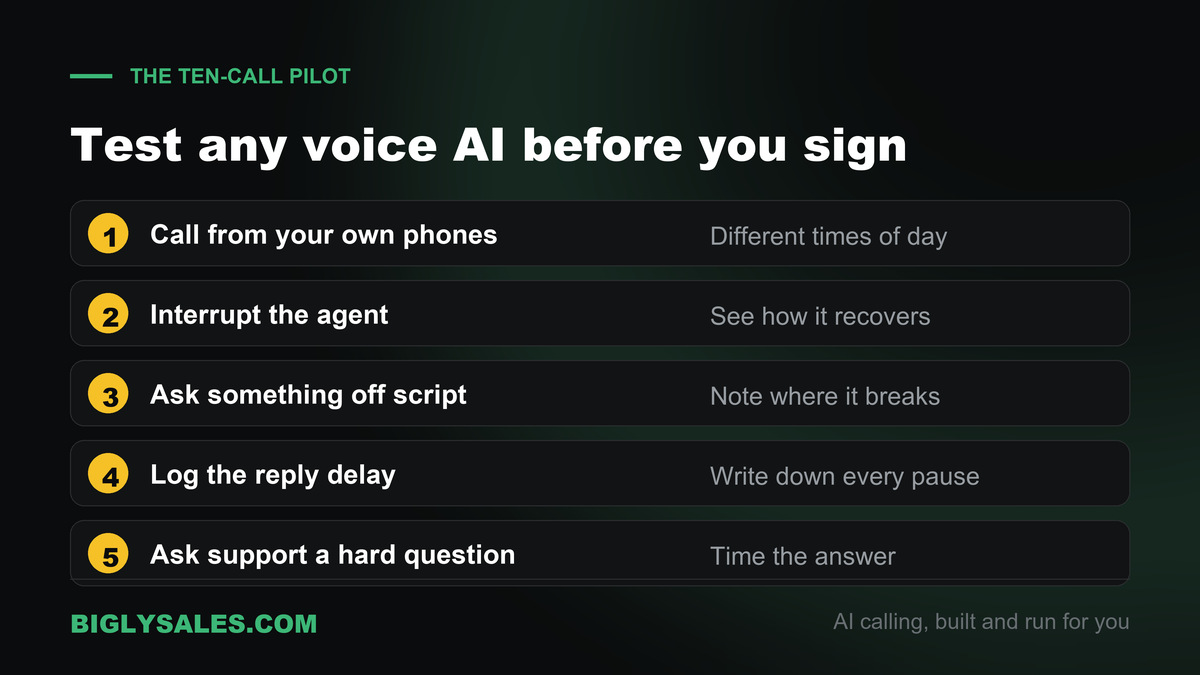
Ten calls is enough to see the pattern. Call from your own phones at different times of day, interrupt the agent, ask it something off script, and log how long it takes to reply. Then contact support with a hard question and time the answer.
Score each call so you are comparing facts and not impressions.
| What to log | How to measure it | Red flag |
|---|---|---|
| Reply delay | Count the pause after you finish speaking | Regular pauses over one second |
| Interruptions | Talk over the agent and see what it does | Keeps talking or goes silent |
| Off-script question | Ask for a repeat or a detail not in the prompt | Repeats the same canned line |
| Caller ID | Check how the number shows on your phone | Labeled spam or unknown |
| Handoff to a human | Ask to speak to a person | Transfer fails or takes too long |
| Support response | Send a hard question and time the reply | More than a business day |
Ten calls will tell you more than any review page, including this one.
Who Bland AI is right for
The fit question is where a Bland AI review should end up. Bland suits a team that has engineers and wants control, which is the fairest verdict a Bland AI review can give. If you need custom call logic, your own telephony, or a deployment in a regulated industry like healthcare, it is built for that. The Enterprise tier adds dedicated infrastructure and an engineer on Bland’s side.
Three cases where it is a good pick. You are building voice into your own product. You have a developer who likes this work and time to tune it. Or you need HIPAA or data residency and have the budget for Enterprise.
It is a weaker fit for a sales team that wants qualified leads without a build project. You would be hiring a developer, or becoming one, to keep it running. It is also a question mark for outbound sales teams in the United States, since TCPA handling is left to you and is not on the homepage.
For a side-by-side on those differences, see our Bigly Sales vs Bland AI comparison. If you are still choosing between platforms, read how to choose an AI voice agent platform first.
Where Bigly fits
Bigly Sales is a managed AI calling service, and that is the opposite end of the spectrum from Bland. We run the system for you. That means phone numbers and registration, a prompt built to your specs with A/B testing, local presence numbers at $2 each, and checks against litigant lists and state and federal calling rules before each dial. On the Hunter plan and up, a dedicated account manager handles the campaign.
The idea is simple and it comes from watching how sales floors really work. Nobody is good at follow-up. Not your best rep, not anyone. A person with forty leads calls the five that feel warm and quietly drops the rest, and the rest is where the quota went. So we built the thing to work every lead, fast, and to be honest about being an AI on every call.
Bigly describes a typical launch as three business days. That is our own number, so hold us to it in your free setup session.
It is not the right pick if you want to build everything yourself or need a custom deployment your own engineers control. It fits sales teams with real lead volume that want calls handled and qualified leads passed to a rep.
If you already use Bland
Plenty of teams start on Bland, which makes sense because it is easy to try, and a fair Bland AI review should say so. Here is when it is worth a second look.
If your developer is the only person who understands the setup, you have a key-person risk. If compliance checks live in a document and not in the system, you have a legal one. If you are spending more time fixing the agent than learning from its calls, the build has become the job.
None of that means you must leave. Start by writing down what the system costs in hours, then compare it with the invoice. Then run the same ten-call pilot on Bland and on an alternative and compare the logs. Do not switch because of a Bland AI review, including this one. Switch because your own numbers say so.
Bland AI review FAQ
Is Bland AI any good?
Bland AI is a capable platform for teams with developers who want to build their own phone agents. Its public review record is thin, with two Trustpilot reviews, so test it yourself before committing. It is less suited to sales teams that want a managed, compliance-checked calling service.
How much does Bland AI cost?
Bland charges $0.14 per minute on the Start plan with no monthly fee, and $0.12 per minute plus $299 a month on Build. Enterprise pricing is custom. Telephony is billed separately. At 20,000 talk minutes a month, expect about $2,700 to $2,800 before telephony and engineering time.
How fast is Bland AI?
Bland advertises 400ms response time. Independent write-ups report 700ms to 1,500ms in real calls, though several come from competing vendors. Run your own ten-call test using your real script, since prompt length and network quality change the result.
Is Bland AI TCPA compliant?
Bland lists SOC 2 Type II, HIPAA and PCI DSS v4.0 on its homepage but does not mention TCPA there. Under US law the business placing the call can be held liable. Ask Bland in writing what it checks before each outbound dial and what you must handle yourself.
What is the difference between Bland AI and Synthflow?
Bland is built for developers who want infrastructure and publishes per-minute rates. Synthflow is a no-code builder that now shows only an Enterprise plan from $30,000 a year, which is why a Bland AI review cannot price it head to head. Synthflow has more public reviews, with 4.1 out of 5 on Trustpilot from 215, and recurring complaints about support and billing.
Does Bland AI charge for phone numbers?
Bland says its per-minute rate covers the voice, speech-to-text and language model, with no token charges. Phone numbers and carrier costs are billed separately through Twilio or a provider you bring. Budget for those on top of the published rates.
Who should not use Bland AI?
Teams without engineering resources, and sales teams that want someone else to run outbound calling and own the compliance checks. For those teams a managed service is usually faster to launch and easier to hold accountable.
Can I test Bland AI before paying?
Bland’s Start plan has no monthly fee and no card required, so you can run a small pilot at $0.14 per minute. The plan caps you at 10 concurrent calls and 100 calls a day, which is plenty for a ten-call test but not for a real campaign.
The bottom line
Bland AI is a real product with clear published prices, and it is a good match for developer teams that want to build their own voice agents. This Bland AI review found one gap worth your attention. Almost all of the public evidence on its support and real-world speed is either thin or comes from competitors, so you have to test it yourself.
The Bland AI review in one line is test first and price the whole system. Whichever vendor you pick, run the ten-call pilot, get the support answer in writing, and price the whole system and not just the minutes. The cheap rate is never the real price. The real price is what it takes to make the thing work on a Tuesday afternoon with a live customer on the line.
See it on your leads
Try Bigly on your own call volume
Start with a plan and see how a managed AI caller handles your leads. You can check plans and pricing in a few minutes.