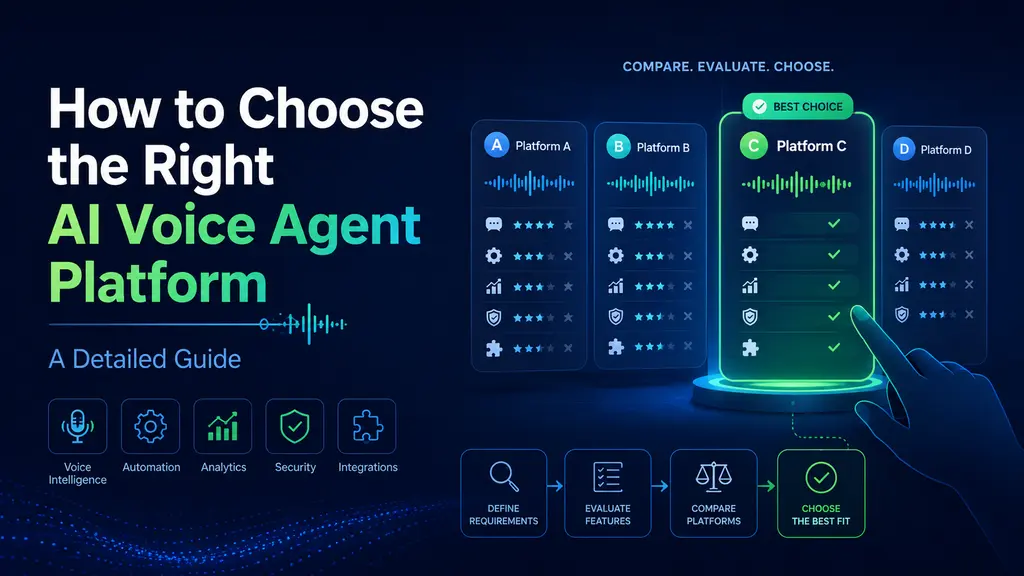


An AI voice agent platform is software that runs phone conversations on its own, placing or answering calls, understanding what the person says, replying in real time, and writing the outcome back to your systems without a human on every line. Choosing one badly is expensive, and the expensive mistake almost always happens before anyone compares features.
You can also browse every guide, definition and compliance resource in one place on the explore hub.
The market widened sharply across 2024 and 2025, and products with wildly different operating models now share the same label. Some need a developer team and months of configuration. Others go live in days with someone else running them.
This guide covers the two categories on offer, the seven criteria that separate a working system from an expensive one, the questions that expose a weak vendor, and the situations where you should not buy at all.
TL;DR
Decide category before features. A managed service goes live in roughly three to five business days and owns deployment, compliance setup and optimization. A developer API gives you building blocks and needs engineers for weeks to months, plus permanent maintenance. Switching between them mid-deployment means paying for setup twice.
Score any vendor on seven things, deployment speed, consent and calling-rule infrastructure, conversation quality, scale headroom, integration depth, pricing model and answer rates. Do not buy at all if you run fewer than a few hundred dials a day, if your list has no documented consent, or if you actually need a dialer to make human reps faster.
Key takeaways
- AI voice agent platforms come in two categories, managed services and developer APIs, and that decision outranks every feature comparison.
- Managed platforms deploy in days and carry the compliance layer. Developer tools need engineers and ongoing internal maintenance.
- Seven criteria matter, deployment speed, compliance infrastructure, conversation quality, scalability, integration depth, pricing model and answer rates.
- A vendor that says compliant without naming the mechanism is a liability rather than a solution.
- Test latency, interruption handling and the live transfer moment on real calls, never in a curated demo.
- Pricing model sets the vendor’s incentives, so read it as a statement about what they optimize for.
- Low volume, undocumented consent, or a need for human-agent dialing are all reasons to skip this category.
Table of contents
- What an AI voice agent platform is
- Managed service or developer API
- The seven evaluation criteria
- The evaluation scorecard
- Matching platform type to use case
- Questions to ask before you sign
- When not to buy one at all
- Where Bigly sits in this market
- AI voice agent platform FAQ
- The bottom line
What an AI voice agent platform is
An AI voice agent platform is software that automates phone conversations end to end, managing call initiation, the live dialogue itself through natural language understanding, and the post-call workflow of transcription, scoring and system updates. The person on the other end talks normally and gets answered in context rather than routed through a menu.
The definition earns its keep because the same label covers products that work nothing alike. A developer API that lets engineers assemble their own agent is technically a platform. It has almost nothing in common operationally with a managed service where another team deploys, monitors and tunes your campaigns. Treating those as comparable line items on a spreadsheet is how buyers end up with a contract nobody can use. For the wider category context, the overview of what AI outbound calling involves covers how these systems fit an outbound operation.
Managed service or developer API
Settle this before you look at a single feature grid.
- Managed AI voice agent platforms handle deployment, configuration, compliance setup, script work and ongoing campaign management. You supply the lead list and the qualification criteria. Time to first live call is typically three to five business days. This suits operations that need results without an internal voice AI team.
- Developer APIs hand your engineers the building blocks. They are flexible and genuinely powerful, and they require your people to build the agent, wire the compliance controls, integrate the CRM and maintain all of it as call patterns shift. Contract to first compliant campaign runs from weeks to months depending on capacity.
The deciding question is plain. Do you have engineers who can build and then keep maintaining an AI voice agent? If yes, a developer tool buys you more control. If no, or if you need to be live in days, take the managed route.
Switching categories mid-deployment is where the money goes. Teams that start on a developer API, hit a compliance or quality wall, and restart with a managed provider lose the ramp time and pay for setup twice. If the honest answer to the engineering question is maybe, treat that as a no. For the mechanics of getting a campaign live, see how to build an outbound AI campaign.
The seven evaluation criteria
1. Deployment speed and support model
A platform needing three months of onboarding before the first compliant campaign is not viable for most outbound operations. Ask for the number of days from signature to first live call, and ask what support looks like during and after. Some vendors assign a named account manager. Others send everything to a shared ticket queue.
At volume the support model matters as much as the technology. A vendor that goes quiet after onboarding creates operational risk every time a compliance question, a quality dip or an integration break appears.
2. Compliance infrastructure
Compliance with the Telephone Consumer Protection Act is not a checkbox. It is a running requirement covering prior express written consent capture and storage, calling-window enforcement by the recipient’s time zone, real-time opt-out suppression, Do Not Call registry scrubbing, and recording disclosures in states that require all-party consent.
One correction worth carrying into every vendor conversation. The so-called one-to-one consent rule, requiring separate consent for each individual seller named on a lead form, was vacated by the Eleventh Circuit in January 2025 and never took effect. Prior express written consent under the TCPA remains the operative standard, and any vendor still selling against a rule that never came into force is telling you something about how current their compliance knowledge is. Adopting one-to-one consent as internal policy is still sensible risk reduction. The requirement that did land concerns revocation, which must now be honored promptly and across channels, so an opt-out spoken on a call has to stop the text sequence too.
A vendor that prints compliant in its marketing without naming mechanisms is a liability. Ask to see consent documented per contact, opt-outs processed during a live campaign, and calling windows enforced automatically. Useful primary sources are the Federal Trade Commission guidance on the Telemarketing Sales Rule at ftc.gov and the statutory text of the TCPA at govinfo.gov. None of this is legal advice, and state rules add their own layer, so run your program past counsel. For a deeper breakdown, see the guide to TCPA compliant AI calling platforms.
3. Conversation quality
An auto-dialer with a synthetic voice on top is not the same product as an AI voice agent that works an objection, answers a question it was not expecting, and hands a qualified caller to a human without a dead pause.
Test three things specifically. Response latency, meaning the gap between a caller finishing a sentence and the agent starting, which should sit under a second and becomes noticeable past roughly 1.5 seconds. Interruption handling, meaning what happens when someone talks over the agent. And off-script routing, meaning where the call goes when the conversation leaves the qualification flow. A system that falls apart on an unexpected question will fail at scale no matter what its claimed call capacity is.
4. Scalability
A platform that performs at 5,000 calls a day can degrade badly at ten or a hundred times that. If your volume is seasonal, or you run several campaigns at once, or you plan to grow, ask for peak concurrent call capacity and for evidence of performance at your target volume rather than the vendor’s best month.
5. Integration depth
Transcripts, scores and disposition codes need to reach your CRM without anyone exporting a file. Ask which systems are supported natively and what setup looks like for your particular stack. Vendors that need custom API work for every integration are handing the technical burden back to you.
Depth matters more than the logo list. A call recording is not the same as a structured transcript plus a qualified flag plus a score mapped to a real field. Confirm exactly what data flows and in what shape before you commit.
6. Pricing model
Pricing runs per minute of talk time, per completed conversation, per qualified live transfer, or a flat monthly fee. Each one sets a different incentive.
Per-minute pricing rewards longer calls, which is not the same thing as better calls. Per-qualified-transfer pricing puts the vendor’s revenue on the same side as yours. Neither is automatically right, but you should know which one you are signing before the demo shapes your expectations. For current benchmarks across both categories, see what managed AI calling actually costs.
7. Answer rates and caller reputation
This is the criterion buyers skip and then discover in month two. The best AI voice agent on the market is worthless if nobody picks up. Ask how the vendor manages number reputation, how calls are attested under the industry caller authentication framework, what happens when a number gets flagged as spam likely by carrier analytics, and how quickly numbers are rotated or remediated. Ask for answer-rate figures from accounts with a similar dialing pattern to yours, not a headline average across all clients.
Buyer’s checklist
Run these seven criteria against us first
Bring your list size, your compliance setup and your CRM and we will answer every question on this page with specifics. Twenty minutes, no build work required.
The evaluation scorecard
Use this as the scoring sheet for every vendor on your shortlist. Score each row before the second call, not after the contract.
| Criterion | The question to ask | A strong answer | Red flag |
|---|---|---|---|
| Deployment speed | Days from signature to first live call? | A specific number, with the steps named | It depends on your requirements |
| Compliance | How is consent stored per contact and how is an opt-out suppressed mid-campaign? | A described mechanism you can see in the interface | We are fully compliant |
| Conversation quality | What is measured latency on live calls, and what happens off script? | Under a second, with named routing rules | A recorded demo instead of a live test |
| Scalability | Peak concurrent calls, and a reference at our volume? | A concrete ceiling and a comparable account | Unlimited |
| Integration | Which fields write back to our CRM automatically? | Transcript, score, disposition, mapped fields | Recordings available for export |
| Pricing | What exactly is the billable unit? | One unit, clearly defined, with overage terms | Custom quote after the demo |
| Answer rates | How is number reputation managed and remediated? | Named process, rotation policy, real figures | Answer rates depend on your list |
Matching platform type to use case
- High-volume outbound in regulated sectors such as insurance, mortgage, legal and debt relief needs compliance built into the platform rather than configured by your team. Exposure in these sectors is material, and a system without documented consent infrastructure, live DNC scrubbing and automatic calling-window enforcement adds risk to every campaign.
- Inbound qualification is a different problem from outbound dialing. Inbound callers open with their own questions and their own intent. A system tuned for structured outbound scripts often handles that badly. Confirm inbound capability separately rather than assuming one product covers both.
- Appointment setting and live transfer depends on recognizing a qualification threshold in real time and handing off warm without dropping the caller or leaving silence. That single moment decides conversion, so test it explicitly.
- Teams without engineering capacity are poor candidates for developer APIs regardless of budget. Maintenance grows with the operation and compliance obligations do not pause while your engineers work on something else.
If you are comparing a managed service against a developer-first vendor directly, the Bigly Sales and Bland AI comparison lays out how those two models differ in practice.
Questions to ask before you sign
These reveal more about operational capability than any feature list.
How is consent documented and stored for each contact the system calls? What is the process for honoring an opt-out during an active campaign? What happens if a lead’s time zone is mapped incorrectly in our CRM and a call lands outside the legal window? How many days from signed contract to first live campaign? Who owns ongoing optimization after onboarding, and what does a normal week look like? What happens when call quality drops below a defined threshold? What is the escalation path at 9pm on a Friday?
A vendor that answers with operational specifics has run compliant calls at scale. One that answers in marketing language or defers to a follow-up call has not.
When not to buy one at all
Some operations should not buy an AI voice agent at all, and the cases are easy to identify.
If you run fewer than a few hundred dials a day, the setup effort and minimum commitments rarely pay back, and a small team with good research will outperform a script. If your list lacks documented consent, or you buy shared leads whose origin you cannot trace, automation multiplies legal exposure instead of pipeline. Fix the data before adding volume.
If what you actually need is a predictive dialer to keep human reps talking, that is a different product category and Bigly does not sell it. And if your first conversation is genuinely consultative, with the qualification question unanswerable from a fixed set of facts, keep a person on it.
Where Bigly sits in this market
Bigly Sales is on the managed side of the split. Clients do not build or maintain the AI voice agent. Deployment, script work, compliance configuration and campaign management are run as a service, with live transfer into the client’s own sales team once a prospect qualifies.
That model is the right answer for a specific buyer, an operation with real outbound volume in a regulated sector and no internal voice AI engineering. It is the wrong answer for a team that wants deep custom control over every turn of the conversation, and for that buyer a developer API is a better fit even with the maintenance cost attached.
AI voice agent platform FAQ
What is the difference between a managed platform and a developer API tool?
A managed platform deploys, configures and operates the system for you, including compliance setup, script optimization and ongoing campaign management. A developer API supplies infrastructure for your own engineers to build and maintain an agent internally. The first trades control for speed and support. The second trades speed for control and permanent maintenance responsibility. Pick the category before you compare individual vendors.
How long does it take to deploy an AI voice agent platform?
Managed services typically go live three to five business days after signature, covering flow design, CRM connection, compliance configuration and test calls. Developer tools depend on your engineering capacity and run from several weeks to several months, longer if the team has not worked with real-time voice infrastructure before. Ask any vendor for the number of days rather than a range described as fast.
What compliance controls should an AI voice agent platform include?
Look for consent capture and storage per contact, calling-window enforcement based on the recipient’s time zone rather than yours, real-time Do Not Call registry scrubbing, opt-out suppression that takes effect during an active campaign, and recording disclosures for all-party consent states. Ask how each one works operationally. A general compliance claim without a described mechanism is not an answer, and the calling party keeps the legal responsibility regardless.
Can an AI voice agent handle both inbound and outbound calls?
Some do, some are outbound only, and the two require different conversation architectures. Outbound calls follow a structured qualification path the agent controls. Inbound calls are led by the caller, who arrives with unpredictable questions and varying intent. A system tuned for one often underperforms at the other, so evaluate inbound capability as a separate line item rather than assuming coverage.
Which CRM systems do AI voice agent platforms integrate with?
Most established vendors integrate natively with Salesforce, HubSpot and the major contact center systems, but depth varies enormously. Confirm whether transcripts, lead scores and disposition codes write back automatically to named fields, or whether someone on your team exports and maps them after each campaign. Integration that delivers only call recordings leaves most of the manual work in place.
How do these systems handle callers who go off script?
Better systems use language understanding to interpret unexpected questions, objections and changes of direction, then either answer from a configured knowledge base or escalate to a human under defined routing rules. Weaker ones loop or stall. Test this during evaluation using real objections from your own market, spoken naturally over a phone line, because a curated demo will never surface the failure mode.
What pricing models are used?
Per minute of talk time, per completed conversation, per qualified live transfer, and flat monthly fees are all common. The model shapes what the vendor optimizes for, so choose the one that matches your definition of a good outcome. Per-qualified-transfer pricing aligns most directly with revenue. Whichever you pick, get the billable unit defined in writing along with overage terms before signing.
Is the FCC one-to-one consent rule in effect?
No. It was vacated by the Eleventh Circuit in January 2025 and never took effect, so any vendor presenting it as binding law is working from outdated material. Prior express written consent under the TCPA remains the operative standard for marketing calls. Collecting consent on a one-seller-per-form basis is still worth adopting as internal policy because it narrows litigation arguments, but treat it as risk reduction rather than a compliance obligation.
Is an AI voice agent the same as a predictive dialer or an auto-dialer?
No. A predictive dialer places calls and connects the answered ones to a waiting human. An auto-dialer plays a recording when someone picks up. A voice agent holds a live two-way conversation, qualifies the contact from what they actually say, handles objections, and routes or logs the outcome with no human on the line. They solve different problems and are often priced against each other incorrectly.
How do I calculate the return on one of these platforms?
Compare cost per qualified conversation under automation against cost per qualified conversation with human dialing, using your real call volume, connect rate, loaded hourly cost per rep, and close rate on qualified leads. Include setup and any minimum commitment in the first-period figure. For a full worked breakdown see the ROI of AI outbound calling.
What is the minimum call volume where this makes financial sense?
The case strengthens with volume. Below a few hundred dials a day the economics turn on your pricing model and current cost per contact, and a small human team often wins. Above a few thousand dials a day across large lists, the cost per qualified conversation usually beats manual dialing inside the first month. Model it with your own numbers rather than accepting a vendor’s benchmark.
The bottom line
Picking an AI voice agent platform is a category decision first and a feature decision second. Settle whether you are buying a managed service or a set of building blocks, then score the shortlist on deployment speed, compliance mechanics, conversation quality, scale, integration, pricing and answer rates.
The vendors worth your time answer operational questions with operational detail. Everything else is a demo. Test on live calls, get the billable unit in writing, and be honest about whether your volume justifies the buy at all.
Straight answers
Bring your shortlist and your hardest questions
We will walk the seven criteria with real numbers from accounts like yours. If a developer API suits you better, we will tell you that too.