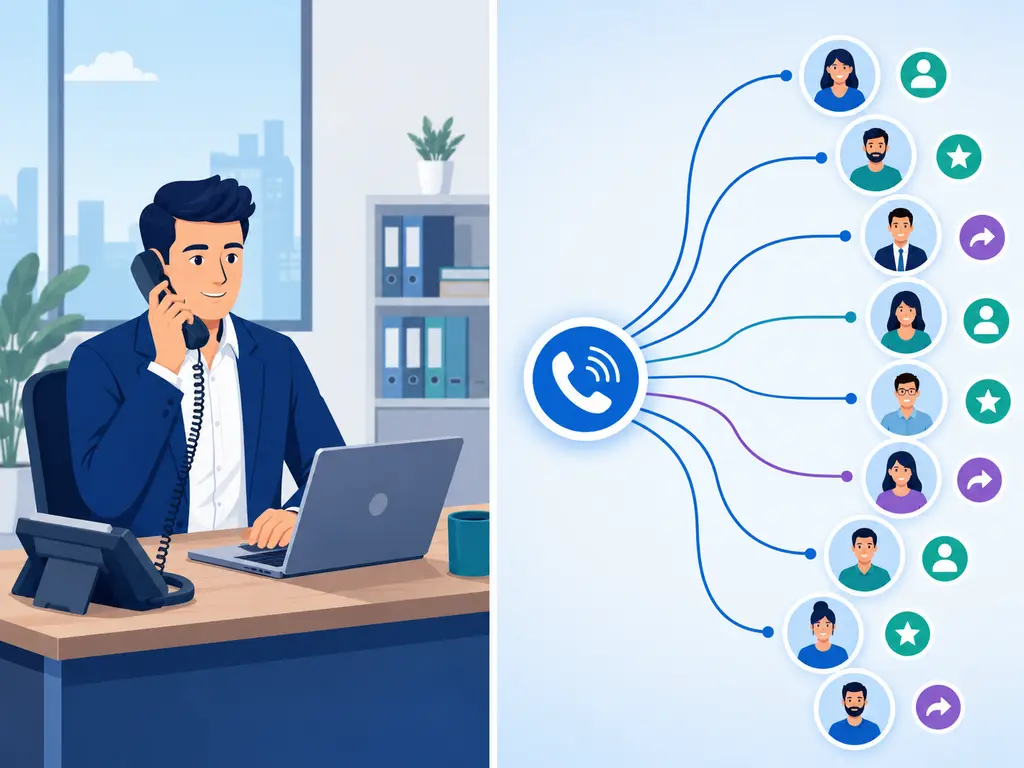


What is AI outbound calling? It is the use of AI voice agents to place outbound phone calls, hold a real conversation with whoever answers, qualify intent, and route the worthwhile conversations to human sales reps. It is not a recorded message and it is not a dialer with a voice bolted on. It is a decision layer that sits between raw lead volume and your sales floor.
Most teams still grade outbound by attempts. The dialer count climbs, thousands of dials get logged, and the pipeline looks healthy until you check how many actual conversations happened. That gap between attempts and conversations is the problem the technology was built to close.
This AI outbound calling guide covers how the workflow runs, where it earns its keep, what compliance demands in 2026, how to evaluate vendors, and where it is the wrong tool entirely.
TL;DR
AI outbound calling puts a voice agent on the first call, qualifies the prospect in conversation, and transfers or books only the people worth a rep’s time. The regulatory floor is fixed: federal rules limit telemarketing calls to 8 a.m. through 9 p.m. in the recipient’s local time, and the FCC confirmed in February 2024 that TCPA restrictions on artificial or prerecorded voice calls cover AI-generated voices.
The voice agent is the easy part. Number registration, carrier trust, local presence, spam remediation and suppression logic decide whether campaigns connect at all. Skip this if you run low-volume enterprise deals, if your consent records are messy, or if you cannot write down what a qualified lead looks like. Automation applied to a disorganized list just makes the mess move faster.
Key takeaways
- AI outbound calling uses voice agents to place calls, hold natural conversations, qualify intent, apply compliance controls, and route live buyers to reps.
- A dialer connects phone numbers. A managed system decides whether a call should happen, what to say, and what to do afterward.
- The strongest fits for AI outbound calling are high-volume, time-sensitive programs where response speed and consistent follow-up beat raw attempt counts.
- TCPA rules for artificial or prerecorded voice calls apply to AI-generated voices, so consent, identification, timing and opt-out handling all need controls.
- Most self-serve tools break at scale because they ignore infrastructure: number health, carrier attestation, local presence and state-level rules.
- Every call should return a transcript, a disposition and structured qualification answers to your CRM without manual entry.
- Wrong fit for complex enterprise sales, technical discovery calls, and teams without clean consent data.
Table of contents
- What AI outbound calling is
- How the workflow actually runs
- Compared with dialers and robocalls
- Where it creates the most value
- Compliance requirements in 2026
- How to evaluate a vendor
- Why most tools fail at scale
- When it is the wrong fit
- The role of humans
- Where Bigly fits
- AI outbound calling FAQ
- The bottom line
What is AI outbound calling
AI outbound calling is the use of AI voice agents to place outbound phone calls, speak with prospects in real time, qualify intent, capture structured data, and route qualified conversations to a human sales team. The definition matters because the term gets used loosely for anything that dials automatically.
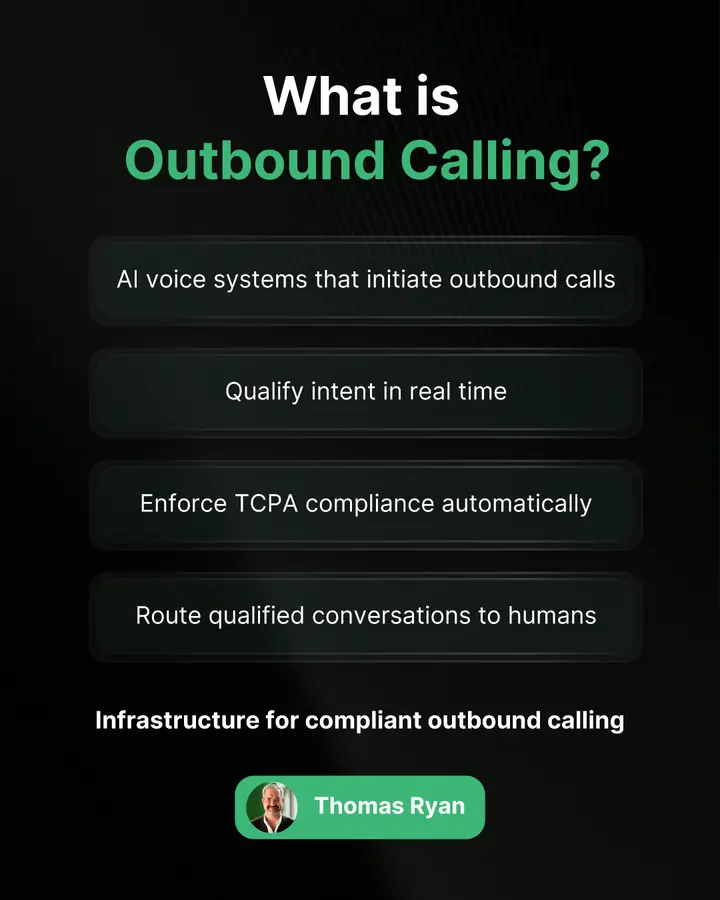
In a working sales operation this behaves like communication infrastructure rather than calling software. Calls trigger from lead forms, CRM activity, list uploads or reactivation campaigns. The system checks whether a lead should be called before it dials. It holds a live conversation, applies qualification logic, and writes the result back to your CRM.
The point is not to remove your reps from the process. The point is to remove delay, inconsistency and repetitive manual dialing from the first layer of engagement. Reps then spend their hours on people who are ready to talk. If the vocabulary here is new, our AI calling glossary defines the terms in plain language.
What it is not
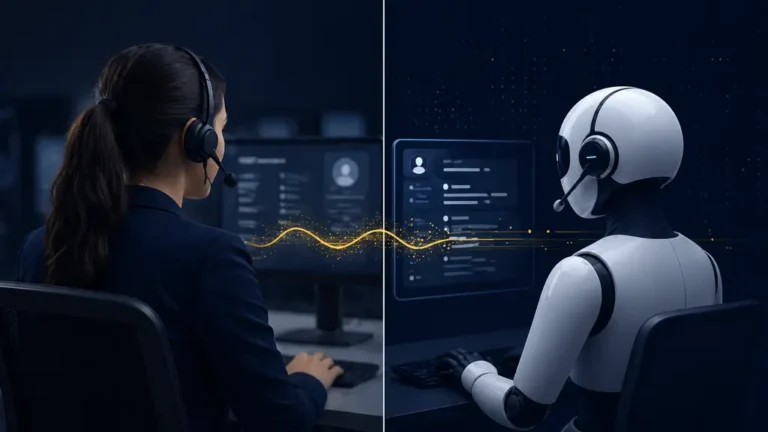
It is not a robocall. A robocall plays a fixed recording and cannot respond to what the person says. It is also not a predictive dialer, which exists to keep human agents busy by connecting them to live pickups. Both of those measure success in connections. This measures success in qualified conversations.
How the workflow actually runs
AI outbound calling works as a connected workflow, not a list upload followed by dialing. Each lead moves through a sequence that protects deliverability, applies compliance rules, qualifies intent and captures usable data.
Step 1: the call trigger and eligibility check
A call can start from a form submission, a CRM event, a campaign upload or a scheduled reactivation workflow. Before the call goes out, the system verifies that the lead is eligible to receive it. That check covers consent status, local time, campaign rules, suppression lists, attempt limits and priority.
A lead who opted out should never be called again. A lead in a time zone outside the legal calling window should wait. This is the sharpest difference between basic calling software and a managed system. One asks who to call. The other also asks whether the call should happen at all right now.
Step 2: the conversation
When someone answers, the voice agent identifies the business, states the reason for the call, and starts talking. It listens for intent, hesitation, disinterest and timing signals. It does not have to follow a script word for word, but it does stay inside approved conversational boundaries.
That flexibility matters because real calls are not linear. One person asks about price. Another asks how you got their number. A third is interested but driving. The agent has to handle all three without losing the purpose of the call.
Step 3: qualification and routing
During the call the system scores the signals the campaign cares about: urgency, interest, eligibility, budget fit, location, appointment availability, or willingness to speak with a rep.
Based on those signals it transfers the call live, books an appointment, marks the lead unqualified, suppresses future outreach, or triggers a follow-up. The decision happens inside the conversation rather than in a report the next morning.
Step 4: data capture and CRM sync
Every call should produce structured output: transcript, recording, disposition, qualification answers, outcome, and any opt-out. That data syncs back without manual entry. A rep opens the lead record and sees what happened, what the prospect said, and why the system routed the call the way it did.
This is where the channel improves operations beyond the call itself. Managers get cleaner reporting, honest lead-source analysis, and real visibility into the top of the funnel.
Compared with dialers and robocalls
Bigly does not sell predictive dialers or robocall broadcast software, so this comparison is about approach rather than a product matchup. The three technologies solve different problems and it is worth being blunt about which one you actually need.
| Capability | Robocall broadcast | Predictive dialer | AI voice agent |
|---|---|---|---|
| Two-way conversation | No | Yes, human agent | Yes, AI then human |
| Handles first contact | Yes | No, needs an available rep | Yes, continuously |
| Qualifies intent in call | No | Depends on the rep | Yes, against set criteria |
| Adapts to what is said | No | Yes | Yes, inside set boundaries |
| Eligibility check before dialing | Rarely | Usually manual | Built into the workflow |
| Structured data back to CRM | Minimal | Rep notes | Transcript and disposition |
| Cost driver | Message volume | Seats and headcount | Talk minutes and setup |
The difference shows up daily. Teams waste fewer attempts, respond to new leads faster, capture cleaner data, and give reps better conversations instead of longer call lists.
Where it creates the most value
Volume, timing and consistency are the three conditions. When all three are present, AI outbound calling pays for itself quickly.
Home services teams reach new form fills before a competitor books the job. Solar companies qualify homeowners and route serious prospects to closers. Real estate teams work buyer, seller and rental inquiries at scale. Insurance agencies follow up on quote requests and policyholder campaigns. Debt relief teams keep qualification steps identical across thousands of records. Law firms screen intake inquiries for basic case fit.
Database reactivation is the other reliable use case. Old lead files usually still hold demand, but no human team has the hours to work them by hand. An AI voice agent can touch every dormant record, find the ones with fresh intent, and put active buyers back in front of reps.
Speed is the common thread. Inbound web leads decay in minutes, not days, which is why we treat speed to lead as the primary metric rather than total dials.
See it live
Hear an AI agent qualify your leads
We will run a short call against your own lead profile and show the transcript, disposition and transfer logic. Twenty minutes, no slide deck.
Compliance requirements in 2026
AI outbound calling sits inside the same regulatory frame as every other automated calling technology. In February 2024 the FCC issued a declaratory ruling confirming that TCPA restrictions on artificial or prerecorded voice calls extend to AI technologies that generate human voices. Nothing since has narrowed that position.
The underlying statute is 47 U.S.C. 227, published on govinfo.gov. The FTC enforces the parallel Telemarketing Sales Rule, and its compliance guide is the clearest plain-English summary of the calling window, disclosure and do-not-call duties.
In practice that means five controls have to live inside the calling workflow rather than in a spreadsheet:
- Consent capture and proof, stored against the lead record with a timestamp and source.
- Caller identification and the required disclosures at the top of the call.
- Calling windows enforced in the recipient’s local time, which federal telemarketing rules set at 8 a.m. through 9 p.m.
- Opt-out handling that suppresses the record immediately across every campaign.
- Attempt frequency limits, because several states cap how often you may call.
State rules add a layer. Florida, for example, bars commercial telephone sellers from making more than three commercial solicitation calls from any number to the same person within 24 hours on the same subject, under Florida Statutes Section 501.616. Rules of that shape now exist in a growing number of states.
None of this is legal advice. Requirements vary by campaign type, audience, state and industry, so review your program with qualified counsel before launch. For a deeper walkthrough of what to demand from a vendor, see our guide to TCPA compliant AI calling platforms.
How to evaluate a vendor
Most AI outbound calling demos showcase the voice. The voice is the least differentiated part of the stack in 2026. These are the questions that separate a usable platform from a wrapper.
Infrastructure questions
Ask who registers the phone numbers and under whose brand. Ask how many numbers a campaign of your size will need, how number health is monitored, and what happens on the day a number gets flagged as spam likely. Ask whether local presence is available in the states you sell into, and how the rotation logic works.
Compliance questions
Ask where consent is stored and whether the system blocks a call when consent is missing. Ask how time zones are resolved when the area code and the physical address disagree. Ask how fast an opt-out propagates across campaigns, and whether recordings and transcripts are retained long enough to defend a complaint.
Operations questions
Ask what a live transfer actually delivers to the rep, and whether the transcript arrives with the call or an hour later. Ask which CRM fields get written, and whether a failed sync retries. Ask what reporting exists at the lead-source level, because that is where wasted spend hides. Pricing structures vary widely, and our pricing page shows how a managed program is typically scoped.
Why most tools fail at scale
Plenty of products can place one AI call. Far fewer survive AI outbound calling at sustained volume without damaging deliverability, compliance control or sales visibility. The failures are almost never about the voice model.
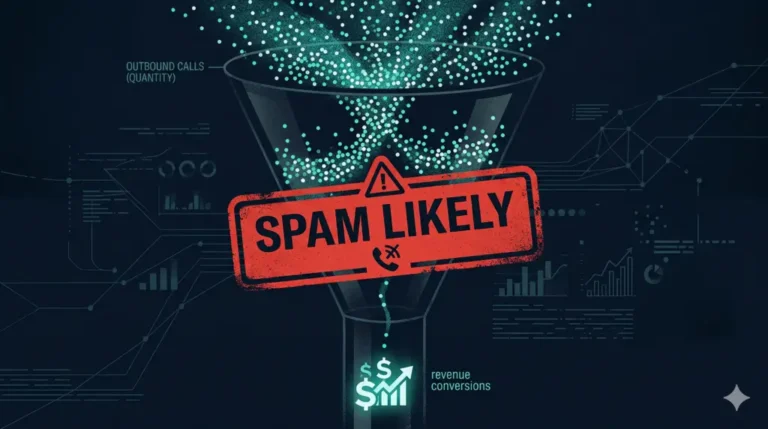
Unregistered numbers get flagged quickly. Once carriers and analytics providers associate a number with spam behavior, answer rates fall and rarely recover. Weak carrier setup limits delivery, because without proper registration, attestation and monitoring even a strong script never reaches a human ear.
Poor local presence reduces pickups. People answer numbers that look familiar. A campaign dialing forty states from one static number gives itself one narrow path to a connection.
No spam remediation leaves bad numbers in rotation. Number health changes over time, so a system has to monitor performance, detect risk signals and retire weak numbers before they drag the campaign down. No state-level controls create exposure, since federal rules are only one layer.
Weak CRM passback creates blind spots. If outcomes, recordings, transcripts and qualification answers do not sync cleanly, the value of the conversation evaporates the moment the call ends.
When it is the wrong fit
AI outbound calling is not right for every sales motion, and pretending otherwise wastes everyone’s budget.
It is a poor fit for low-volume enterprise sales where a single account justifies a researched, personal first touch. It is a poor fit for technical discovery calls that require expert judgment from the opening sentence. It is a poor fit for teams without clean lead data, documented consent, or a written definition of a qualified lead.
There is also a volume floor. Below a few thousand dials a month the setup work rarely pays for itself, and a well-run team of two reps will do better with a phone and a good list. Say no to the vendor who tells you otherwise.
The role of humans
Nobody gets removed from the sales floor. The work moves. The AI handles the repetitive layer: the first dial, the qualifying questions, the simple objections, the structured note-taking, the routing.
Humans handle the judgment layer. They work complex objections, build trust, explain nuanced offers, negotiate terms and close. The best teams do not frame this as AI against reps. They use the software to manufacture more qualified conversations and use people to convert the good ones. Skip that division of labor and you get a blind automation loop that annoys buyers.
Where Bigly fits
Bigly Sales runs AI outbound calling as a managed program rather than a self-serve tool. Campaign setup, number purchasing and registration, carrier coordination, spam monitoring, local presence, compliance workflow support, CRM integration, transcripts, dispositions and live transfer routing all sit inside the service.
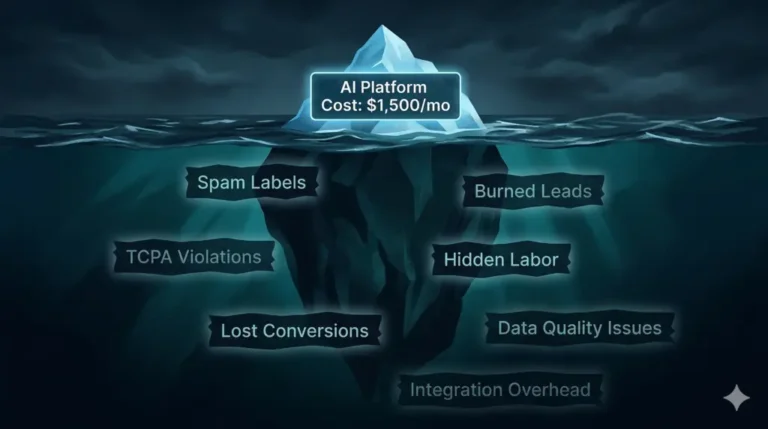
The reason for that scope is simple. Teams rarely fail because the voice sounds wrong. They fail because numbers get flagged, lead records are messy, opt-outs sync too slowly, reps receive transfers with no context, and managers cannot see which lead sources produce real conversations. Those are infrastructure problems, and infrastructure problems do not fix themselves from a settings page.
The honest caveat: a managed program takes longer to launch than signing up for a self-serve tool, and it costs more per month. If you want to test a single script against 200 records this week, buy something cheaper first.
Watch
What real AI outbound looks like
An end to end outbound call, from the first ring through qualification to a live transfer, with nothing edited out.
AI outbound calling FAQ
What is AI outbound calling?
AI outbound calling is the use of AI voice agents to place outbound phone calls, hold a real conversation with the person who answers, qualify their intent against set criteria, and route the qualified prospects to a human rep or a booked appointment. Unlike a recorded broadcast, the agent responds to what the person actually says and writes structured results back to the CRM after every call.
Is AI outbound calling the same as robocalling?
No. A robocall plays a fixed recording and cannot react to the person on the line. An AI voice agent holds an interactive conversation, answers questions, handles objections, captures qualification answers and decides what happens next. Both fall under the same TCPA rules for artificial or prerecorded voice calls, so the compliance obligations overlap even though the technology and the customer experience are very different.
Is AI outbound calling legal in the United States?
It can be, when the campaign follows applicable federal and state requirements. The FCC confirmed in February 2024 that TCPA restrictions on artificial or prerecorded voice calls apply to AI-generated voices. That means you need consent appropriate to the call type, clear caller identification, calls placed inside legal local-time windows, honored do-not-call requests, and immediate opt-out suppression. Review your specific program with qualified legal counsel.
Can an AI call transfer to a human rep?
Yes. A qualified call can transfer live based on rules you define before launch, such as stated interest, budget fit, or a direct request to speak with someone. The rep should receive the call along with the lead record, the qualification answers and a transcript of what was said, so the handoff does not force the prospect to repeat themselves.
How is it different from a predictive dialer?
A predictive dialer exists to keep human agents busy by predicting when a seat will free up and dialing ahead. It moves numbers through a queue. An AI voice agent adds a decision and qualification layer, so the software holds the first conversation itself and passes only the right prospects to a person. One optimizes agent utilization. The other optimizes what reaches the agent in the first place.
What types of businesses use AI outbound calling?
Companies with high lead volume and fast response requirements. Common fits include insurance, mortgage and lending, real estate, solar, home services, debt relief, legal intake, staffing, education and call center operations. The shared trait is not the industry but the shape of the funnel: many inbound or purchased leads, clear qualification criteria, and more records than the sales team can call by hand.
How many phone numbers does a campaign need?
It depends on daily dial volume and geographic spread, not on a fixed ratio. Concentrating heavy volume on a few numbers is the fastest way to get flagged as spam likely by carrier analytics. A serious provider will size the pool against your projected dials per state, register the numbers properly, monitor their reputation over time, and retire numbers that start showing risk signals.
Does it work for inbound calls too?
The same voice infrastructure supports inbound workflows including lead qualification, appointment routing, support triage and after-hours coverage. Many teams run both directions on one platform so that a prospect who calls back reaches the same context rather than starting over. The compliance picture is simpler inbound, since the person initiated contact.
How long does implementation take?
A self-serve tool can dial the same afternoon. A managed program typically takes longer because number registration and carrier vetting run on external timelines outside any vendor’s control, and because script design, qualification logic and CRM mapping need review before launch. Ask any vendor for a written timeline with the registration step called out separately, and treat same-day promises at volume with suspicion.
What does it cost?
Pricing generally combines a platform or program fee with usage measured in talk minutes, and managed programs add setup and ongoing campaign management. Comparing quotes on per-minute rates alone is misleading, because a cheap minute on flagged numbers that nobody answers costs more per qualified conversation than a higher rate that connects. Compare cost per qualified transfer instead.
The bottom line
The value of AI outbound calling is not calling more people. It is reaching the right people faster, qualifying intent the same way every time, protecting rep hours from unproductive dials, and giving managers real control over outbound performance.
Teams that treat AI outbound calling as infrastructure will pull ahead of teams that treat it as an app. They move faster than manual floors, stay more consistent than dialer-only floors, and end up with cleaner data than anyone relying on rep notes and disconnected tools. Teams that skip the infrastructure work will get flagged numbers, unanswered calls and a compliance file they cannot defend.
Start the build
Put a managed calling program behind your leads
We scope the numbers, registration, scripts and CRM mapping with you before a single dial goes out. Book a call and bring your current connect rate.