


Twilio alternatives are the platforms teams move to when Twilio’s programmable telephony stops matching what they can staff or afford. They fall into two very different groups, and picking from the wrong group is the most common mistake buyers make.
If you are searching for Twilio alternatives, you have probably already decided something in your current setup is not working. The invoice keeps climbing. Two engineers are maintaining voice infrastructure when they would rather ship product. Or you tried to build an AI voice agent on top of Twilio and found out how much sits between an API and a working calling operation.
This guide covers ten Twilio alternatives across both tracks. Every price quoted was checked against the vendor’s own published pricing page in August 2026.
Disclosure. This guide is published by Bigly Sales, and Bigly Sales is our platform. It appears here at number six. The entry states the cases where Bigly is the wrong choice, and the nine other options are described on their merits rather than as strawmen. Judge the methodology below and decide for yourself.
TL;DR
Twilio alternatives split into two tracks. Swapping the telephony under a working app, where Plivo publishes $0.0115 per minute outbound against Twilio’s $0.0140 and $0.50 local numbers against $1.15. Or replacing the AI voice agent you were going to build on top, where published rates run from $0.05 per minute of Vapi hosting to $0.12 to $0.14 all-in on Bland AI.
Across a realistic 100,000-minute month, building on Twilio and buying a platform land in the same range once engineering is priced honestly. So the deciding question is who does the work and who is responsible when calls stop, not the per-minute rate. Do not switch for the rate alone if telephony is under 15 percent of your true cost, because you will spend a quarter to save very little.
Key takeaways
- Twilio alternatives divide into two tracks, so the right one depends on whether you are replacing the telephony under your app or the agent you planned to build on it.
- On published rates Plivo undercuts Twilio at $0.0115 per minute outbound against $0.0140, and $0.50 local numbers against $1.15.
- Voice AI pricing runs from $0.05 per minute for Vapi hosting to $0.12 and $0.14 all-in on Bland AI, with Retell itemizing every component.
- At 100,000 minutes a month, build and buy land in a similar total once engineering time is costed properly.
- The real variable is ownership. Who runs the campaigns, and who is responsible at 2am when calls stop.
- Number porting delays more migrations than anything else, so start it before you change anything else.
- Pricing opacity is a real cost. A rate you cannot model is how teams end up shopping for alternatives in the first place.
Table of contents
- What a Twilio alternative actually is
- Why teams leave Twilio
- How we ranked these Twilio alternatives
- All ten compared at a glance
- Track 1, replacing the telephony layer
- Track 2, replacing the build
- What Twilio actually costs
- Total cost of ownership, a worked example
- How to choose, a decision framework
- Migration checklist
- Twilio alternatives FAQ
- The bottom line
What a Twilio alternative actually is
A Twilio alternative is any service that takes over one of the two jobs teams currently use Twilio for, either the programmable telephony that places and receives calls, or the foundation for a voice application built on top of that telephony. Those are separate purchases with separate buyers, separate budgets, and separate migration timelines.
That distinction is why generic lists of Twilio alternatives are so unhelpful. Comparing Plivo to Retell AI is like comparing a road to a car. One moves the packets. The other decides what to say. A few products, including ours, sell the whole trip instead.
Work out which job you are replacing before you read any further, because it removes half the list immediately.
Why teams leave Twilio
Twilio is genuinely excellent at what it is. It is the most documented and most widely adopted communications platform available, and if you have engineers who want programmable telephony, it is hard to argue against. Teams do not usually start looking at Twilio alternatives because Twilio is bad. They leave because of a mismatch between what Twilio is and what their team can staff.
The hidden line items
The per-minute rate is the number every buyer asks for first and the one that explains the least. Twilio’s published US voice rate is $0.0140 per minute outbound local and $0.0085 per minute inbound, which is competitive. The surprises arrive elsewhere, in number rental at $1.15 per month per local number, carrier surcharges, 10DLC registration for messaging, recording storage, and support that costs more once you need it to answer quickly.
None of those are hidden in a dishonest sense. They are published. They are simply easy to leave out of a forecast when you are comparing two numbers on a spreadsheet.
The engineering cost nobody budgets
A working AI calling system needs speech recognition, a language model, text to speech, interruption handling, call routing, retry logic, consent capture, do-not-call scrubbing, recording storage, disposition logging, and a CRM connection that does not silently fail overnight.
Twilio provides the telephony. Everything above it is yours to build and, more to the point, yours to maintain. Two engineers spending a quarter on voice infrastructure is a six-figure cost in most markets, and maintenance does not stop when the project ships.
How we ranked these Twilio alternatives
Most lists do not tell you how the order was chosen, which makes the order meaningless. Here is ours.
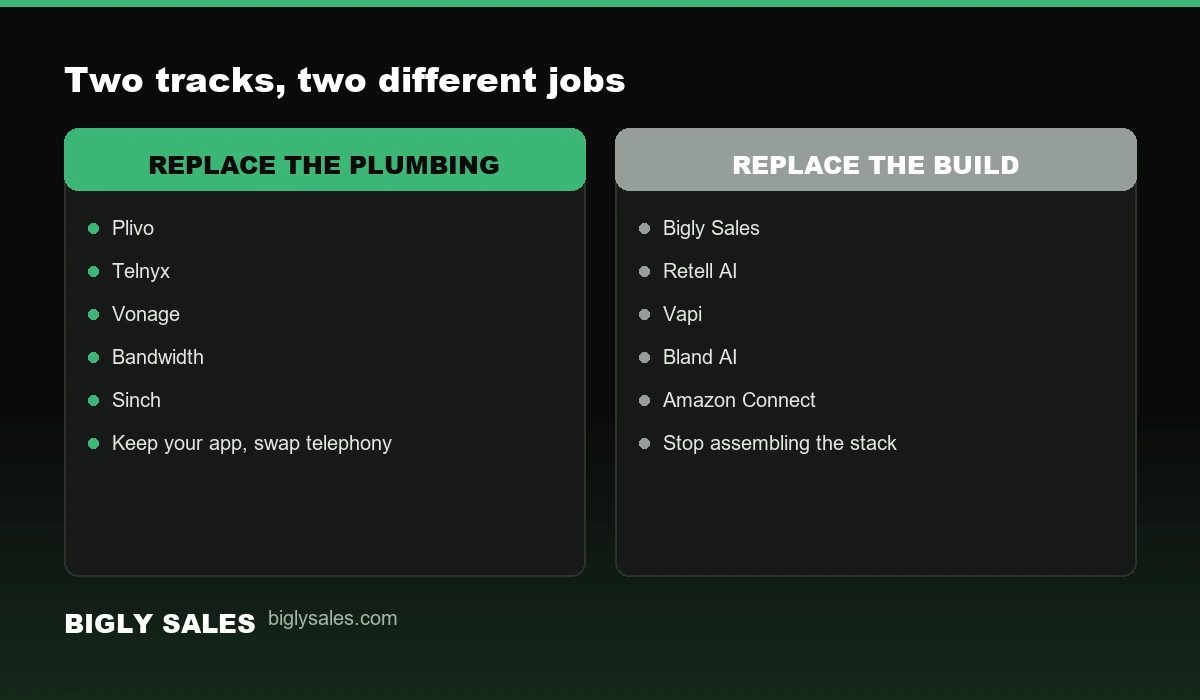
We split the list into two tracks because the search term hides two different jobs. Track 1 is for teams who want to keep their application and swap the telephony underneath it. Track 2 is for teams who were using Twilio as the foundation for a voice AI product and want something further up the stack.
Within each track we weighted five things.
- Fit for purpose, 30 percent. How well the platform performs the specific job in that track.
- Pricing transparency, 25 percent. Whether rates are published without a sales call and whether the model is forecastable.
- Time to first live call, 20 percent. Realistic elapsed time for a competent team, including integration work.
- Compliance controls, 15 percent. Whether consent, scrubbing, calling hours, and opt-outs are enforced by the platform or left to you.
- Operational depth, 10 percent. Campaign logic, list handling, live transfer, and CRM write-back.
We weight pricing transparency heavily on purpose. A vendor that will not publish rates is a vendor whose cost you cannot model, and an unmodelable cost is how teams end up looking for alternatives in the first place.
All ten Twilio alternatives compared at a glance
Rates below are each vendor’s own published figures for US usage, checked in August 2026. Where a vendor does not publish rates, the table says so rather than guessing.
| Platform | Track | Published US voice rate | Best for |
|---|---|---|---|
| Plivo | Infrastructure | $0.0115 out, $0.0055 in | The cheapest like-for-like swap |
| Telnyx | Infrastructure | Channel pricing from $0.0032 | Owned network and high volume |
| Vonage | Infrastructure | Not published without contact | Enterprise procurement |
| Bandwidth | Infrastructure | Not published without contact | Direct carrier relationships |
| Sinch | Infrastructure | Not published without contact | Global multi-channel reach |
| Bigly Sales (our platform) | Voice AI | Quoted per campaign | Teams with no engineering capacity |
| Retell AI | Voice AI | $0.07 to $0.31 per minute | Developers who want components exposed |
| Vapi | Voice AI | $0.05 per minute plus provider costs | Bring your own model keys |
| Bland AI | Voice AI | $0.12 to $0.14 per minute plus platform fee | Predictable all-inclusive per minute |
| Amazon Connect | Voice AI | $0.038 per minute plus telephony | Teams already standardized on AWS |
Track 1, Twilio alternatives that replace the telephony layer
These Twilio alternatives suit teams whose application works and who only want to change what sits underneath it. Migration here is the shortest because your code barely moves.
1. Plivo
Best for. Teams who want the Twilio model at a lower rate with minimal rewriting.
Pricing. Published at $0.0115 per minute outbound local and $0.0055 inbound, with local numbers at $0.50 per month. That undercuts Twilio on all three counts.
Pros. The closest thing to a drop-in replacement, genuinely cheaper on published rates, with clear documentation. Number rental at less than half Twilio’s price adds up quickly if you hold hundreds of numbers.
Cons. Smaller ecosystem and fewer third-party integrations. You are still building and maintaining everything above the telephony layer, so this solves cost and not effort.
2. Telnyx
Best for. High-volume calling where per-minute economics dominate.
Pricing. Published from $0.0032 per minute inbound. Telnyx also offers inbound channel pricing starting at $12 per channel per month, falling to $8 above 250 channels, which can beat per-minute billing at steady high volume. Call recording is $0.002 per minute.
Pros. It owns its network rather than reselling, which helps latency and support quality when something breaks at the carrier level. Channel pricing is a real structural advantage for predictable volume.
Cons. A larger configuration surface than Plivo. The channel model only pays off if your volume is steady, and it is worse than per-minute billing if your calling is bursty.
3. Vonage
Best for. Enterprises that want a large vendor with formal procurement and support agreements.
Pricing. Voice rates are not published without contacting sales, which costs Vonage points on our transparency weighting.
Pros. Broad API coverage across voice, messaging, and video, established enterprise support structures, and a long track record.
Cons. Opaque pricing makes forecasting hard before you are already in a sales process, and it is generally not the cheapest option once rates are quoted.
4. Bandwidth
Best for. Very high-volume operations that want to sit closer to the carrier layer.
Pricing. Quoted rather than published.
Pros. Owns network infrastructure and sells wholesale-style relationships, with a strong reputation for reliability and number management at scale.
Cons. Less developer-friendly onboarding than Plivo or Telnyx, and aimed at larger contracts, so small teams get less attention. It often sits underneath other providers, so buying direct can remove a margin layer if your volume justifies it.
5. Sinch
Best for. Global operations that need voice and messaging across many countries.
Pricing. Quoted rather than published for most products.
Pros. Very broad international reach and carrier relationships, and it handles multi-channel campaigns well.
Cons. Significant complexity, with a product surface wide enough that it can feel like several companies stitched together. Pricing opacity again. Geographic coverage is the main reason to choose it over the cheaper options above.
Skip the build
See what managed AI calling looks like
We will walk your use case through scripts, compliance workflow, and live transfer so you can compare it against a build. It takes about 30 minutes.
Track 2, Twilio alternatives that replace the build
These Twilio alternatives suit teams whose real goal was an AI voice agent, where Twilio was only ever the foundation they were going to build it on. Each option replaces part or all of that build.
6. Bigly Sales
Best for. Sales teams and call centers that need calls running now and have no engineer to spare.
Pricing. Quoted per campaign rather than per minute, because the service includes setup and operation rather than only the minutes. Our breakdown of what managed AI calling costs explains how that model compares to usage-based billing.
Pros. The calling operation is configured and run for you, covering scripts, campaign logic, list handling, compliance workflow, live transfer, and CRM write-back. Consent capture, do-not-call scrubbing, calling hour limits, and opt-out handling are enforced by the workflow rather than left to your team to remember. Qualified prospects are bridged to a human on the live call rather than dropped into a callback queue. The full feature list has the specifics.
Cons. You do not get a platform to build on. If your goal is a voice product with behavior you control at the code level, this is the wrong category and Vapi or Retell is the better read. Pricing is not published, which by our own transparency criterion is a real mark against us. And if you have engineers who want to own voice, paying for managed delivery is paying for something you do not need.
7. Retell AI
Best for. Developers who want the component stack visible and adjustable.
Pricing. Published at $0.07 to $0.31 per minute all in, and unusually the components are itemized. Voice infrastructure is $0.055 per minute, text to speech runs $0.015 to $0.040, the language model runs $0.003 to $0.32 depending which one you pick, and telephony is about $0.015. Add-ons are priced separately, including knowledge base at $0.005 per minute and PII removal at $0.01 per minute. Phone numbers are $2.00 per month.
Pros. The itemized breakdown is the most legible pricing page in this category, because it shows exactly which choice drives your bill. Swapping to a cheaper language model visibly changes your per-minute cost. Free credits to start.
Cons. That same granularity means your bill has many moving parts, and the $0.07 to $0.31 spread is wide enough that a poor model choice quadruples your cost. Twenty concurrent calls are included and additional concurrency is $8 per line per month, which matters for burst campaigns.
8. Vapi
Best for. Engineering teams who already hold model provider accounts.
Pricing. Published at $0.05 per minute for platform hosting, with speech recognition, language model, and text to speech billed at provider cost, or free if you bring your own API keys. Ten concurrent lines are included, then $10 per line per month. HIPAA support is $2,000 per month and zero data retention is $1,000 per month.
Pros. Bring your own keys is genuinely useful if you already have negotiated model rates, and it makes the platform fee the only new line item. Very flexible for developers.
Cons. The headline $0.05 is only the hosting layer, so your real cost depends entirely on model choices made elsewhere. HIPAA at $2,000 per month puts regulated use cases in a different budget bracket.
9. Bland AI
Best for. Teams who want one predictable per-minute number with nothing itemized.
Pricing. Published in tiers. Start is $0.14 per minute with no platform fee, Build is $0.12 per minute with a $299 monthly fee, and Enterprise is custom and contracted to volume. Transfer time is billed separately and more cheaply at $0.05 on Start and $0.04 on Build per minute. Language model, transcription, and premium voices are included with no token charges.
Pros. All-inclusive per-minute pricing is the easiest model to forecast in this list. No token surprises. Cheaper transfer-time billing is a sensible touch given how much of a qualified call is spent connected to a human.
Cons. The platform fee means cheaper tiers only pay off above a volume threshold, so work out your break-even before upgrading. At low volume Start beats Build despite the higher per-minute rate. Less component-level control than Vapi or Retell.
10. Amazon Connect
Best for. Organizations whose data, identity, and compliance posture already live in AWS.
Pricing. Published at $0.038 per voice minute for the service, with standard telephony rates on top. No minimums or long-term contracts, and many AI features sit in the base price rather than as add-ons.
Pros. If you are already on AWS, procurement, billing, identity, and data residency are solved problems. Contact center features are mature, with no per-agent licensing in the usual sense.
Cons. It is a platform you configure and operate, so the engineering question changes shape rather than disappearing. Telephony is charged separately, so $0.038 is not your all-in rate. Outside the AWS ecosystem the appeal drops sharply.
What Twilio actually costs
Before switching, be precise about your baseline. These are Twilio’s own published US voice rates as of August 2026.
| Item | Published rate | What to watch |
|---|---|---|
| Outbound local voice | $0.0140 per minute | Volume discounts apply automatically at scale |
| Inbound local voice | $0.0085 per minute | Toll-free inbound is far higher at $0.0220 |
| Browser or app calls | $0.0040 per minute | Cheapest path if you can avoid the carrier |
| Local number rental | $1.15 per month | Multiply by every number you hold |
| Toll-free number rental | $2.15 per month | Adds up on multi-region setups |
| Everything above the telephony | Your engineering time | Usually the largest line item of all |
Total cost of ownership, comparing Twilio alternatives properly
Per-minute comparisons are where most guides to Twilio alternatives stop, and that is exactly where they stop being useful. Take a team running 100,000 outbound minutes a month, holding 50 local numbers, and wanting an AI voice agent rather than a plain dialer.
Build on Twilio. Telephony is 100,000 minutes at $0.0140, which is $1,400. Numbers are 50 at $1.15, which is $57.50. Add speech recognition, a language model, and text to speech from third parties, realistically $0.03 to $0.08 per minute, so call it $3,000 to $8,000. Then add the build. Two engineers for one quarter at a conservative blended cost is roughly $75,000 to $100,000, amortized over the first year at $6,250 to $8,300 per month, plus ongoing maintenance.
Monthly total. Roughly $10,700 to $17,750 in year one, of which the telephony everyone compares is $1,400.
Buy a voice AI platform instead. On Bland’s Build plan at $0.12 per minute, 100,000 minutes is $12,000 plus the $299 platform fee. At Retell’s mid-range of roughly $0.15 blended, it is about $15,000. No build cost, but you own the campaign and compliance operation.
The point. These land in the same range, which means the per-minute rate is not the deciding variable. What differs is who does the work and who carries the risk when it breaks.
One honest caveat. Engineering costs vary enormously by market and by how much of the stack you genuinely need, so treat the build figures as a modeling exercise with your own salary numbers substituted, not as a quote.
How to choose between these Twilio alternatives
Work through these Twilio alternatives in order and stop at the first that describes you, then read that entry in full above.
- Your application works and only the invoice is the problem. Move to Plivo or Telnyx and keep your code. Shortest migration, smallest benefit, lowest risk.
- You have engineers who want to own voice as a product surface. Vapi if you already hold model provider keys, Retell if you want component costs itemized.
- You want one forecastable per-minute number and will run the operation yourself. Bland AI, after checking the platform fee break-even against your volume.
- Everything you run already lives in AWS. Amazon Connect, accepting that you still configure and operate it.
- Nobody on your team has spare capacity to build or run this. A managed service such as Bigly Sales, accepting that you trade code-level control for speed.
- You need global multi-country coverage above all else. Sinch or Bandwidth, and budget for a sales cycle.
Migration checklist for switching to a Twilio alternative
Whichever of these Twilio alternatives you pick, the switch itself is where things go wrong. Number porting is the step that quietly turns a two-week plan into a six-week one.
- Export call data, recordings, and dispositions from your current provider while you still have access.
- Start number porting early and never schedule a campaign launch on the porting date.
- Keep the old provider active and paid until porting fully completes.
- Rebuild consent records and do-not-call lists in the new system, then verify with test numbers before any live traffic.
- Run both systems in parallel on a small share of traffic for at least a week.
- Compare answer rate, average handle time, qualified conversations, and transfer success against your own baseline, not the vendor’s benchmarks.
- Confirm CRM write-back arrives structured and complete before you scale volume.
- Check that calling hour enforcement respects the prospect’s time zone and not your server’s.
- Document who to call when calls stop, and test that escalation path once on purpose.
Do not treat the compliance rebuild as a formality. US outbound calling sits under the Telemarketing Sales Rule and the TCPA, so work from the FTC guidance on complying with the Telemarketing Sales Rule and from 47 CFR 64.1200 before you move traffic.
Two points get misreported often enough to be worth stating plainly. The FCC one-to-one consent rule was vacated by the Eleventh Circuit in January 2025 and never took effect, so prior express written consent under the existing TCPA standard remains the operative requirement. Adopting one-to-one consent as internal policy is still sensible because it reduces litigation exposure on shared or resold lead data, but no rule compels it. The requirement that does bite is revocation, which must be honored across channels, so confirm an opt-out captured on a call reaches your email and SMS suppression lists automatically. Our guide to TCPA consent requirements for AI voice calls goes further.
Twilio alternatives FAQ
What is the best Twilio alternative?
There is no single best choice among Twilio alternatives, because the term covers two different jobs. To swap telephony underneath a working application, Plivo is the cheapest like-for-like choice on published rates. If you were using Twilio to build an AI voice agent, the answer depends on whether you have engineers. With them, Vapi or Retell AI. Without them, a managed service is the honest recommendation rather than a platform you will not staff.
Is there a cheaper alternative to Twilio?
Yes, on published rates. Plivo lists $0.0115 per minute outbound against Twilio’s $0.0140 and local numbers at $0.50 per month against $1.15. Telnyx lists inbound from $0.0032 and offers channel-based pricing that can beat per-minute billing at steady high volume. Whether those savings matter depends on whether telephony is actually your largest cost, and for most teams building voice AI it is not.
Can I keep Twilio and add AI calling on top?
Yes, and many teams do. This preserves your existing numbers, integrations, and carrier relationships while adding a conversational layer above them. You keep ownership of the workflow, the compliance logic, and the maintenance, so it reduces build effort rather than eliminating it. It is the right path when the telephony is fine and only the conversation layer is missing.
What is the difference between a CPaaS and an AI voice platform?
A CPaaS such as Twilio, Plivo, or Telnyx gives you programmable telephony, meaning the ability to place, receive, and route calls. An AI voice platform such as Retell, Vapi, or Bland adds the conversation itself, including speech recognition, response generation, and voice output. A managed service adds the operation on top of that, covering campaigns, lists, compliance workflow, and live transfer to a human rep.
How long does it take to migrate off Twilio?
Moving to another CPaaS can take days of engineering because your application mostly stays the same, but number porting can take weeks regardless of the platform. Moving to a voice AI platform is a build project measured in weeks to months. Moving to a managed service is usually the fastest route to live calls because the build is not yours to do.
Does Amazon Connect replace Twilio?
For contact center use cases it can, particularly if your systems already run on AWS. Published pricing is $0.038 per voice minute plus standard telephony rates, so it is not automatically cheaper. It remains a platform you configure and operate, so the engineering requirement changes shape rather than disappearing. Outside AWS the argument for it weakens considerably.
Which Twilio alternative is best for AI voice agents?
Among the Twilio alternatives built for developers, Vapi suits teams who already hold model provider API keys because you can bring your own and pay only the $0.05 per minute hosting fee. Retell AI suits teams who want component costs itemized. Bland AI suits teams who want a single all-inclusive per-minute number. If you do not want to build or run the agent at all, that is a managed service rather than a platform.
Will switching providers affect my phone numbers?
Numbers can usually be ported, but timelines vary by carrier and country, and porting is the single most common cause of migration delay. Begin the process before you plan anything else, keep the old provider active and paid until it completes, and expect the schedule to slip. Never book a campaign launch on the porting date itself.
How do I keep outbound calling compliant after switching?
Rebuild consent records and do-not-call lists in the new platform before any live traffic, then confirm the system enforces calling hours by prospect time zone, immediate opt-out handling, and recording disclosure automatically. Consent revocation must carry across channels. Treat every vendor compliance claim as something to test rather than accept, and work from the FTC guidance rather than a sales deck.
Is Twilio being discontinued, or is it still worth using?
Twilio is not going anywhere and remains a strong choice for teams with engineering capacity who want programmable telephony. The reason to look at Twilio alternatives is fit rather than viability. If your team can staff a voice platform and wants control at the code level, staying put is often the right answer and the cheapest one once switching costs are counted.
The bottom line
The useful conclusion from comparing these ten Twilio alternatives is that the per-minute rate rarely decides the outcome. Across a realistic 100,000-minute month, building on Twilio and buying a voice AI platform land in a similar range once engineering is priced honestly. What differs is who does the work, who maintains it, and who is responsible at 2am when calls stop.
Answer that question first. If you have engineers who want voice, pick from track two and give them the best components. If only the invoice hurts, move to Plivo or Telnyx and change nothing else. If nobody has capacity, stop evaluating platforms and evaluate services instead, because a build project cannot be staffed by hope.
For more on how the managed approach compares to specific platforms, see Bigly Sales vs Retell AI and Bigly Sales vs Bland AI. If you are reviewing how calls reach your team, our guide to warm transfer vs cold transfer covers the handoff that decides whether a qualified call converts.
Start a pilot
Find out if managed calling fits before you build
Bring your list and your target outcome and we will tell you honestly whether this suits you. If it does not, we will say so.