



Contact center AI pricing is what vendors charge to run AI voice agents on your calls, and it arrives in three very different shapes that buyers routinely compare as if they were the same product. One vendor bills per minute for an API. Another bills a monthly fee for a managed service. A third bills per seat for a full contact center suite.
Those three numbers are not comparable. A low per-minute rate looks cheap until you add the engineer who builds the workflow. A monthly managed fee looks expensive until you notice it already covers the work that engineer would have done.
This guide breaks AI pricing into three models, shows what each one includes and leaves out, gives you Bigly Sales figures in plain terms, and ends with the questions to put to any vendor before you sign.
TL;DR
AI pricing for contact centers comes in three shapes. Developer APIs bill by usage and leave you to build the workflow. Managed services bill a monthly fee that covers setup, integrations, deliverability, and compliance controls. Enterprise contact center suites bill per seat and cover far more than calling. Bigly Sales starts at $99 per month for 500 minutes and scales by plan up to $9,999 for 125,000 minutes.
The number that decides the purchase is cost per qualified conversation, not the headline rate. If you have engineers who want to own a voice stack, a managed service is the wrong buy and an API will be cheaper. If you have no one to maintain call logic after launch, the API will not stay cheap.
Key takeaways
- AI pricing splits into usage-based APIs, managed monthly services, and per-seat enterprise contact center platforms.
- Per-minute rates exclude engineering, telephony setup, CRM work, compliance workflow, and deliverability monitoring.
- Bigly Sales starts at $99 per month for 500 minutes, with plans up to $9,999.
- Federal rules require covered telemarketers to refresh lists against the Do Not Call Registry at least every 31 days.
- A managed contract still leaves lead quality, consent records, and human follow-up with the customer.
- Cost per qualified conversation is the only figure that compares fairly across all three models.
- Enterprise suites are usually overbuilt for a team that just wants outbound qualification and appointment setting.
Table of contents
- What contact center AI pricing is
- Why AI pricing is hard to compare
- The three AI pricing models compared
- What managed AI pricing includes
- What no vendor covers
- The real cost of building it yourself
- What Bigly Sales costs
- When enterprise contact center pricing fits
- Choosing the right model
- Twelve questions to ask before you sign
- Contact center AI pricing FAQ
- The bottom line
What contact center AI pricing is
Contact center AI pricing is the total charge a vendor applies for running AI voice agents against your inbound or outbound calls, covering some combination of AI usage, telephony, setup, integrations, support, and operational workflow. The variation between vendors is not mostly about margin. It is about how much of that list sits inside the price.
That is the part buyers miss. Two quotes can differ by a factor of five and both be reasonable, because one is selling software minutes and the other is selling a running operation. Comparing them on the headline number produces the wrong answer almost every time.
Our own pricing page follows the managed model, which is why it starts from a monthly figure rather than a per-minute rate.
Why AI pricing is hard to compare
Contact center AI pricing is hard to compare because vendors sell different operating models under the same category label. Search for contact center AI and you will get a developer API, a managed calling service, and an enterprise suite on the same results page, all using the same vocabulary about AI voice agents and automation.
They do not include the same things. Some publish usage rates. Some require a sales call. Some sell per seat. Some quote on call volume. Some bundle telephony. Others pass model, voice, and carrier costs through separately. Some include implementation. Others hand you documentation.
The useful question is not how much the platform costs. It is what work the price covers, and what work your team still has to pay for or do itself. Every hour your people spend building or maintaining the calling workflow is part of the price whether or not it appears on an invoice.
The three AI pricing models compared
Almost every quote you receive will fall into one of three models. Once you can name the model, the numbers start behaving.
| Model | How you are billed | Typical entry point | What you still own |
|---|---|---|---|
| Developer API | Per minute, plus separate model, voice, telephony, and concurrency charges | Pay as you go, no floor | Build, integrations, compliance workflow, deliverability, maintenance |
| Managed AI calling | Monthly service fee scaled to volume and campaign scope | From $99 per month at Bigly Sales | Lead lists, consent records, offer, human follow-up |
| Enterprise contact center suite | Per seat, per concurrent user, or custom contract, with AI often an add-on | Seat minimums and annual terms are common | Administration, seat management, internal enablement |
| Hybrid, API plus agency build | Usage bill plus a separate implementation retainer | Two invoices, two vendors | Coordination between both, and the workflow after handoff |
Model 1. Usage-based developer API
Developer-first voice platforms charge by usage. That usually means AI agent minutes, telephony, speech-to-text, text-to-speech, model calls, concurrency lines, support tiers, and any compliance or storage add-ons, each billed separately.
This works for product teams, technical founders, and companies building a custom voice experience. The tradeoff is that the customer owns the work. Your team builds the workflow, connects the CRM, configures the phone layer, designs call logic, tests edge cases, runs compliance processes, monitors performance, and maintains all of it. Usage-based billing is attractive during testing. At production volume the total is usually higher than the per-minute number suggests.
Model 2. Managed AI calling service
A managed service covers the operating workflow rather than only the minutes. A monthly fee typically includes campaign setup, conversation design, outbound and inbound handling, appointment setting, live transfer, SMS follow-up where configured, CRM-ready reporting, transcripts, dispositions, account support, deliverability review, caller identity work, and compliance-oriented controls.
This suits revenue teams, agencies, and regulated operators who do not want to run the technical side internally. This is not a software price. It is an operating model with a price attached.
Model 3. Enterprise contact center suite
Enterprise platforms price by seat, concurrent user, named user, usage, bundle, or custom quote. They may include omnichannel routing, workforce management, quality management, agent assist, analytics, enterprise security, integrations, and service-level agreements.
That breadth is real value for a large service organization. It is also weight. A team that wants AI to qualify leads and book appointments is buying a great deal of platform it will never open.
What managed AI pricing includes
Judge managed AI pricing by the operational work it covers, not by the monthly figure alone. At Bigly Sales, the managed layer around voice automation can cover the following.
- AI outbound calling. Agents contact eligible leads, ask approved qualification questions, and route the next step.
- AI inbound handling. Inbound calls answered where configured, which cuts missed leads.
- Appointment setting. Qualified prospects booked into a calendar.
- Live transfer. Qualified prospects routed to a human rep in real time.
- SMS follow-up. Reminders and confirmations where consent and campaign rules allow.
- CRM-ready records. Summaries, transcripts, dispositions, and appointment details.
- Account support. Setup, launch, performance review, and optimization.
- Deliverability support. Number health, caller identity, and answer rates.
- Compliance-oriented controls. Consent review, DNC and suppression logic, calling window controls, opt-out handling, and audit trails.
The operative words in that last line are consent review and support. No platform removes legal risk. Compliance still depends on your lead source, consent quality, campaign purpose, recipient type, state rules, script language, and configuration. Teams weighing vendors on those controls should read our overview of TCPA compliant AI calling platforms alongside any quote.
Real numbers
Get a quote built on your call volume
Tell us your monthly volume and campaign type and we will price the managed workflow against it. The call runs about 30 minutes.
What no vendor covers
Even a fully managed service needs inputs from you, and no contract transfers those to the vendor. The customer still supplies contact lists, lead source information, consent documentation, suppression files, campaign goals, qualification criteria, offer details, CRM access, calendar access, sales team availability, human follow-up coverage, legal review where needed, script approvals, and ownership of the internal sales process.
This is the part worth being blunt about. A vendor can run the calling workflow. It cannot vouch for the quality of your list, the truthfulness of your offer, the validity of your consent records, or what happens after the AI hands a warm prospect to a rep who does not call back. If your follow-up is the bottleneck, cheaper AI pricing will not fix your pipeline.
The real cost of building it yourself
The real cost of a do-it-yourself AI calling stack is the API bill plus the people, systems, and time needed to run it safely in production. Three layers get underestimated.
Engineering setup
Even with good developer tools, production deployment takes planning. A team configures agents, prompts, voice models, phone numbers, webhooks, CRM fields, appointment logic, error handling, fallback behavior, opt-out detection, and reporting. Light for a prototype. Substantial for a regulated outbound campaign.
Ongoing maintenance
APIs change. Prompts need updates. CRM fields move. Call logic evolves. Telephony problems appear. Reports break. Edge cases surface in real conversations. Someone owns the project after launch, and their time carries a cost whether they are on payroll or on contract.
Compliance and deliverability operations
For covered consumer telemarketing calls using AI-generated, artificial, or prerecorded voice, prior express written consent is generally required before dialing. Covered campaigns also need suppression processes, calling window logic, opt-out handling, records, and state-law review. Under the FTC Telemarketing Sales Rule guidance, covered sellers and telemarketers must refresh their calling lists against the National Do Not Call Registry at least every 31 days. Confirm how those rules apply to your campaigns with counsel.
Deliverability sits next to it. A campaign can have a strong script and still fail because nobody answers. Answer rates depend on caller identity, number usage, complaint patterns, and someone watching the numbers weekly. A self-managed team absorbs that work. A managed contract folds it in.
What Bigly Sales costs
Bigly Sales pricing starts at $99 per month for 500 minutes and scales by plan to $9,999 per month for 125,000 minutes, billed per minute for outbound and inbound alike.
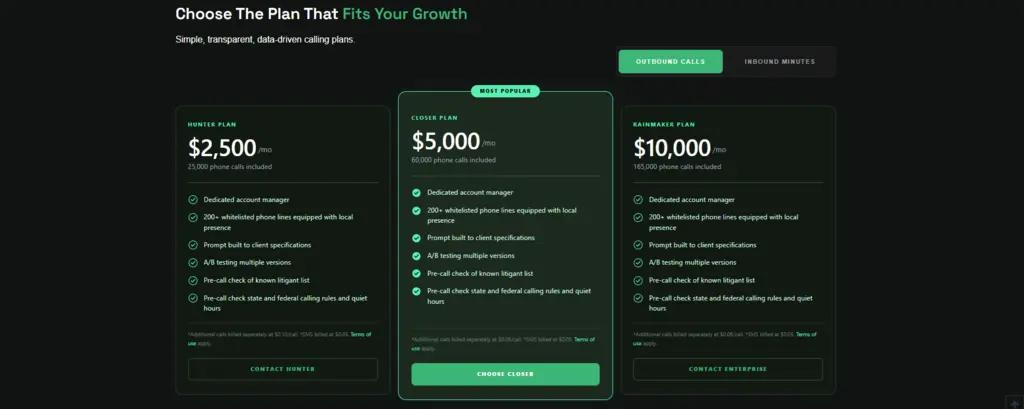
That starting range fits teams evaluating the platform or running moderate-volume campaigns. Larger accounts with higher call volume, more integrations, broader campaign needs, or heavier support move into larger monthly or annual contracts. The quote depends on monthly call volume, outbound and inbound use cases, number of campaigns, number of client accounts for agencies, CRM and calendar integration needs, live transfer requirements, SMS automation, compliance workflow needs, reporting and account management scope, contract length, and industry complexity.
A flat published number rarely tells the whole story for this reason. A mortgage campaign, a solar campaign, a staffing campaign, and a white label agency program all use AI calling and none of them need the same workflow. Inbound-weighted buyers should also look at how the AI answering service is packaged, since the cost shape differs from outbound.
One honest caveat. Bigly is not the cheapest way to place an AI call, and it is not trying to be. If your requirement is the lowest possible per-minute rate and you have the engineering capacity to run everything around it, an API will beat this on price.
When enterprise contact center pricing fits
Enterprise contact center pricing makes sense for large organizations that need customer experience infrastructure well beyond outbound calling. These platforms support service, omnichannel routing, workforce management, quality assurance, analytics, agent assist, knowledge management, and enterprise administration.
That is valuable and it is also complexity. Before committing, ask whether you need a full suite or just AI calling, how many seats are required, whether AI features are included or priced as add-ons, whether billing is by named user or concurrent user or usage, whether seat minimums apply, whether telecom is included, what implementation services are required, what contract length is required, which integrations cost extra, who manages outbound deliverability, and who optimizes campaigns after launch.
Enterprise contact center pricing is the right answer for some organizations. It is overbuilt for a revenue team that needs lead qualification, appointment setting, and warm transfers.
Choosing the right model
The right model depends on your volume, technical capacity, compliance exposure, integration needs, and appetite for operational ownership. Three short tests.
Choose a developer API when
You have in-house developers, you want deep customization, you can manage telephony, you can build integrations, you can run compliance workflows, you can monitor deliverability, you can maintain the system after launch, and you are building product infrastructure rather than running a campaign.
Choose managed AI calling when
You need a faster launch, you have no dedicated voice AI engineers, you want help with campaign setup, you need CRM-ready reporting, you need appointment booking or live transfer, you operate in a regulated or high-volume category, and you want deliverability and optimization support included in the contract rather than staffed internally.
Choose an enterprise suite when
You run a large contact center, you need omnichannel support, you need workforce management, you have enterprise procurement and security review requirements, you need broader customer service workflows, and you have internal administrators to run the platform day to day.
Twelve questions to ask before you sign
Total cost of ownership is what you are actually comparing. Put these twelve to every vendor and put the answers side by side.
- What is the base monthly or usage cost
- What usage is included before overage starts
- Are AI model, voice, and telephony costs inside the price
- Who builds the CRM and calendar integrations
- Who designs and iterates the call flow
- Who owns DNC and internal suppression setup
- Who handles opt-out logic across campaigns
- Who monitors number health and responds to spam labeling
- Who reviews performance data and optimizes after launch
- What contract length is required, and is a pilot available
- What internal labor does our team still need to supply
- What is the estimated cost per qualified conversation
The last one settles most decisions. A lower platform fee is not better when it produces fewer qualified conversations or consumes months of internal engineering.
Contact center AI pricing FAQ
How much does contact center AI cost?
It depends entirely on the model. Developer platforms charge by the minute with model, voice, and telephony billed separately. Managed AI calling services charge a monthly fee that covers setup and operations. Enterprise contact center platforms charge by seat, concurrent user, usage, or custom contract, often with AI as a paid add-on. A fair comparison has to include implementation, integrations, compliance workflow, deliverability, and support in every column.
How much does managed AI calling cost?
Managed AI calling generally starts in the low thousands per month and scales into larger monthly or annual contracts as volume, service scope, compliance requirements, integrations, and account support grow. Bigly Sales starts at $99 per month for 500 minutes. The figure moves with call volume and campaign complexity rather than with seat count, which is why most managed vendors quote rather than publish a fixed rate card.
Why is AI pricing so hard to compare across vendors?
Because vendors package different things under identical labels. One sells usage-based voice minutes only. Another includes setup, CRM integration, campaign optimization, deliverability support, account management, and compliance-oriented controls in the same monthly figure. Neither is hiding anything. They are selling different products. Normalize the comparison by listing every task the calling program requires and marking who performs it in each quote.
Is a developer API cheaper than managed AI calling?
At low volume and during testing, usually yes. In production the gap narrows or reverses once you add engineering time, telephony, model costs, CRM integration, compliance workflow, number health monitoring, and ongoing maintenance. The honest answer depends on whether you already employ the engineers. If a voice engineer is on payroll and has capacity, an API is likely cheaper. If you would hire or contract for it, run the full total.
What should be included in a cost comparison?
Include voice usage, telephony, caller ID setup, number management, campaign design, CRM and calendar integration, call records, transcripts, reporting, support, deliverability monitoring, compliance-oriented controls, and post-launch optimization. Then add your own internal labor at a real hourly cost. Most comparisons that favor the cheapest headline rate leave internal labor out, which is the single largest hidden line in a self-built stack.
Does AI calling pricing include phone numbers and carrier fees?
Sometimes. Managed services usually fold telephony, numbers, and carrier costs into the monthly fee, though high volume can trigger overage terms worth reading. Developer APIs more often keep telephony separate so you can bring your own carrier, which gives you control and one more bill to manage. Ask specifically, because this line item is a common source of surprise on the first invoice.
Is there a minimum contract for managed AI calling?
Terms vary by vendor and by deal size. Shorter pilots are common at entry-level volumes, and longer commitments usually appear alongside heavier integration work or discounted rates. Ask whether a pilot is available before an annual term, what happens to pricing at renewal, and what notice period applies. A vendor unwilling to run a scoped pilot at a moderate volume is telling you something useful.
What is cost per qualified conversation?
It is total program spend divided by the number of conversations that met your qualification bar, including platform fees, telephony, and internal labor. It is the only figure that compares a per-minute API against a monthly managed fee against a per-seat suite on equal terms. Track it from the first month of any pilot, because it is the number that tells you whether the AI pricing you chose is actually working.
Can AI calling replace our SDR team?
It replaces the first-contact function, not the sales team. AI agents handle dialing, qualification, appointment setting, and warm transfer at a consistency humans cannot match across thousands of calls. Closing, objection handling on complex deals, and relationship work stay with people. Teams that cut headcount to zero and expect the same pipeline are usually disappointed within a quarter.
Who should not buy managed AI calling?
Teams with a strong in-house voice engineering function and a desire to own the stack should buy an API instead. Organizations that need omnichannel service, workforce management, and quality assurance across a large support operation should look at an enterprise suite. And any team whose real problem is lead quality or slow human follow-up should fix that first, because no AI pricing model compensates for a broken list or an unresponsive rep.
The bottom line
Contact center AI pricing only makes sense once you sort quotes by model. Developer APIs sell usage and hand you control along with the work. Managed services sell an operating workflow at a monthly fee. Enterprise suites sell broad customer experience infrastructure by the seat. Each is correctly priced for the buyer it was built for, and badly priced for the other two.
Pick by what your team can actually run. If you have engineers and want to build, a usage-based API will serve you. If you need a full service platform, an enterprise contract will. If you want AI to qualify leads, book appointments, transfer warm prospects, and update the CRM without hiring for it, managed is the practical model, and Bigly Sales starts at $99 per month. Then measure cost per qualified conversation from month one and let that number, not the rate card, decide whether you renew.
Cost per conversation
Compare your quotes with us on one call
Bring the vendor quotes you have and we will map each one against the work your team would still own. About 30 minutes, no commitment.


I like the efforts you have put in this, regards for all the great content.
Thank you.