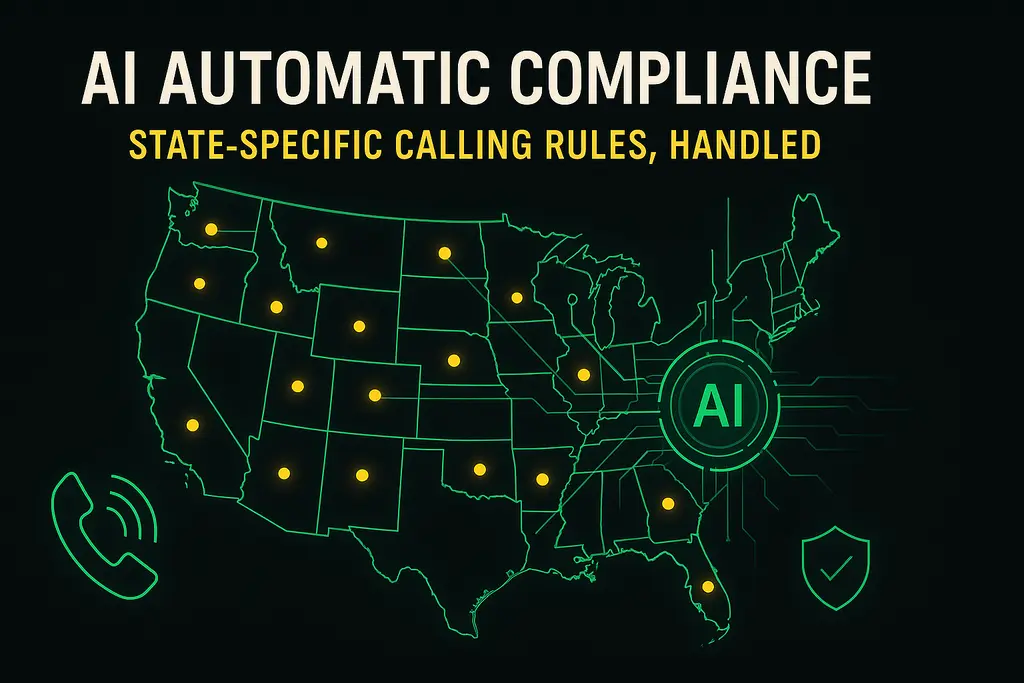


State-specific calling rules are the telemarketing requirements each state imposes on top of federal law, covering when you may dial, what consent you must hold, which do-not-call lists you must check, how fast you may dial, and what you must say when the call connects. They vary by state, they change often, and they apply based on where the person you are calling is located, not where your call center sits.
That last point is what makes manual compliance hard. A single list can span forty states, and a rep working from one desk has to apply a different rule set on every dial. AI calling agents handle this by resolving the contact’s location and time zone, checking the applicable calling rules, and either releasing or blocking the number before it ever rings.
This article walks through the five rule types that automation handles most reliably, the federal baseline they sit on top of, and the parts of state compliance that software genuinely cannot decide for you.
TL;DR
Federal law sets the floor. The Federal Trade Commission’s Telemarketing Sales Rule bars calls to a residence before 8 a.m. or after 9 p.m. local time at the called party’s location, caps abandoned calls at 3 percent of answered calls measured over a 30 day period per campaign, and requires a live rep within two seconds of the consumer’s greeting. States can and do go stricter. Florida, for example, sets an 8 a.m. to 8 p.m. window and limits repeat calls on the same subject within a 24 hour period.
Automation reliably handles five things, the calling window, consent verification, state and federal do-not-call scrubbing, dial pacing, and the opening disclosure script. It records proof of each.
Software does not give you a legal opinion. It applies the rules you configure. Nothing here is legal advice, and you should confirm the current text of any statute with your own counsel before you launch a campaign.
Key takeaways
- State calling rules follow the consumer’s location, not your office location.
- The federal floor is 8 a.m. to 9 p.m. local time, and several states are stricter.
- The Telemarketing Sales Rule caps abandoned calls at 3 percent over a 30 day period.
- State do-not-call lists operate separately from the national registry.
- Some states require telemarketer registration or a bond before you dial at all.
- Automation enforces configured rules, it does not interpret statutes for you.
- Keep a per-call audit record, timestamp, consent source, list checks and disclosure.
Table of contents
- What state-specific calling rules are
- Why state rules sit on top of federal rules
- 1. Calling windows and time zones
- 2. Consent verification before the dial
- 3. State and federal do-not-call scrubbing
- 4. Dial pacing and abandoned call limits
- 5. Mandated opening disclosures
- The five rule types compared
- Registration, bonding and the rules automation cannot fix
- What to log for an audit
- Where automated compliance stops
- State calling rules FAQ
- The bottom line
What state-specific calling rules are
State-specific calling rules are statutes and regulations enacted by individual states that govern outbound telephone solicitation to residents of that state, and they apply in addition to federal telemarketing law rather than in place of it. They typically address the same five subjects, hours of contact, consent, do-not-call lists, dialing technology, and required disclosures.
A useful way to think about it is jurisdiction by phone number, though even that is imperfect. Area code no longer reliably tells you where a person lives, since mobile numbers travel. Serious compliance programs resolve location from the record you hold on the consumer, not from the number alone, and treat the number as a fallback.
Who the calling rules actually bind
In most state statutes the obligation falls on the seller, meaning the company whose goods or services are being sold, not only on the vendor placing the call. Outsourcing your dialing does not outsource your exposure. That is worth confirming with counsel for every state you operate in, because the allocation differs.
Why state rules sit on top of federal rules
Federal law sets a national floor. The Federal Trade Commission enforces the Telemarketing Sales Rule, codified at 16 CFR Part 310, which covers hours, disclosures, abandoned calls and registry scrubbing for most commercial telemarketing. The full regulatory text is published at govinfo.gov if you need the exact wording rather than a summary.
States are generally free to be stricter, and many are. The result is two layers of calling rules that both apply at once, and compliance means satisfying whichever is tighter for the state the consumer is in. That is the two-level complexity that makes manual enforcement break down as a list grows.
The direction of travel
Several states have passed their own telephone solicitation acts in recent years, including Florida and Oklahoma, often adding private rights of action that let consumers sue directly. That changes the risk profile. Enforcement is no longer only a regulator with limited bandwidth, it is any recipient with a lawyer. Treat state calling rules as a live area and re-check them at least annually with counsel.
1. Calling windows and time zones
Calling windows are the most common source of accidental violations, and the easiest thing to automate correctly.
The federal baseline under the Telemarketing Sales Rule prohibits telemarketing calls to a person’s residence before 8 a.m. or after 9 p.m. local time at the called party’s location. Several states narrow that. Florida’s Telephone Solicitation Act sets an 8 a.m. to 8 p.m. window for telephonic sales calls to Florida residents and limits how many calls you may place on the same subject within a 24 hour period. Confirm the current wording with counsel, since these statutes have been amended more than once.
An AI calling agent resolves the consumer’s location, converts to their local time, applies the tightest applicable window, and holds the number in queue until the window opens. Nothing is released outside legal hours, which removes the whole class of errors that comes from a rep in one time zone dialing a list in another.
The edge cases worth configuring
Two situations catch teams out. The first is a consumer whose billing address and phone number disagree, where the safe configuration is the stricter of the two windows. The second is a callback the consumer requested outside normal hours, which some states treat differently from an unsolicited call. Decide both in advance and write the rule into the system rather than leaving it to the rep.
2. Consent verification before the dial
Consent requirements have tightened steadily. Some states require documented prior express consent for particular contact methods or particular industries. Others attach specific requirements to automated dialing technology. The federal and state layers here interact in ways that genuinely need a lawyer, which is the honest position rather than a hedge.
What automation does is narrower and more useful than interpretation. It stores the consent record, the source, the timestamp, the wording the consumer saw and the channel it came through, then checks that record before every dial. If consent is missing, expired under your own policy, or attached to a different phone number than the one on the record, the agent blocks the call rather than placing it.
That produces two benefits. You do not call people who never agreed to hear from you, and you hold a complete trail if a regulator or a plaintiff asks how a particular number entered a campaign. The trail is often the more valuable half.
Consent is a data problem before it is a calling rules problem
Most consent failures happen upstream, in a form that did not capture what the consumer agreed to, or in a list purchased with a vague provenance. No calling platform can repair that after the fact. If you cannot show where a number came from and what the person was told, the correct action is to stop calling it. Our notes on TCPA compliant AI calling platforms cover the record-keeping side in more detail.
3. State and federal do-not-call scrubbing
State do-not-call lists operate separately from the National Do Not Call Registry and are maintained by individual state agencies. A number can be absent from the national registry and present on a state list, and calling it is still a violation.
There are actually three lists to check, not two. The national registry, the applicable state registries, and your own internal do-not-call list of people who asked your company specifically to stop. The third is the one most often mishandled, because it depends on your own systems capturing a verbal request during a live call.
Under the Telemarketing Sales Rule, sellers and telemarketers must scrub against the national registry no more than 31 days before calling, and registrations do not expire. An AI agent integrates with the available databases, scans every record before it enters the queue, and suppresses any match automatically. It also captures a stop request spoken during a call and writes it to the internal list within the same session.
Honor the request on the first attempt
Configure opt-out recognition to fire on weak signals rather than strong ones. If a consumer says any variant of stop calling, take it, confirm it and end the call. An agent that tries one more pitch after a stop request is the single most expensive configuration mistake in outbound work, and it is entirely avoidable.
4. Dial pacing and abandoned call limits
Abandoned calls are calls that connect to a person who then hears silence because no rep is available. Both federal and several state rules constrain them, and pacing is the mechanism that keeps you inside the limit.
The Telemarketing Sales Rule provides a safe harbor with specific numbers. Connect the call to a live representative within two seconds of the consumer’s completed greeting. Allow the phone to ring for at least fifteen seconds or four rings before disconnecting an unanswered call. Abandon no more than three percent of answered calls, measured per day over a thirty day period for each calling campaign. Play a recorded message identifying the seller and providing a phone number when a call is abandoned.
Automation monitors the live abandon rate against that ceiling and slows the dial rate before the threshold is reached rather than after. Because an AI agent answers every connection itself, the abandoned-call problem largely disappears, and the relevant control becomes concurrency limits rather than predictive pacing.
Compliance review
See your calling rules configured live
Send us the states you dial and we will show you how the windows, list checks and disclosures are set up in the platform. It takes about twenty minutes.
5. Mandated opening disclosures
Disclosure requirements are the most frequently missed rule during a high-volume campaign, because they depend on a human remembering a script under time pressure.
The Telemarketing Sales Rule requires that before a sales pitch begins, the caller promptly disclose the identity of the seller, that the purpose of the call is to sell goods or services, and the nature of those goods or services. States layer additional requirements on top, and some require specific language about the consumer’s rights or about recording.
An AI agent opens every call with the script mapped to that state and stores proof that the disclosure was delivered, with a timestamp and the audio. There is no drift on call four hundred. This is the clearest example of where automation outperforms a person on compliance rather than merely matching them.
Recording notice is a separate question
Call recording consent follows its own set of state rules, distinct from telemarketing calling rules. Some states require all parties to consent to recording. If you record calls, and for an AI agent you almost certainly do, treat this as its own configuration item and confirm the requirement per state with counsel. Our security and data handling page covers how recordings and transcripts are stored.
The five rule types compared
This table summarizes what the federal floor sets, what typically varies at state level, and what an AI agent can enforce without a human in the loop.
| Rule type | Federal baseline | Typical state variation | Automated enforcement |
|---|---|---|---|
| Calling window | 8 a.m. to 9 p.m. local time | Narrower hours, day-of-week limits, call frequency caps | Full, blocks before dial |
| Consent | Prior express consent for certain call types | Written consent standards, industry-specific rules | Checks the stored record, cannot judge its validity |
| Do-not-call | National registry, scrub within 31 days | Separate state registries, differing update cycles | Full, plus internal list capture on the call |
| Dial pacing | 3 percent abandoned over 30 days, 2 second connect | Stricter caps, technology-specific restrictions | Full, throttles concurrency in real time |
| Disclosures | Seller identity, sales purpose, nature of goods | Extra required language, recording notice | Full, with stored proof of delivery |
Note the second row. Consent is the one category where automation checks a record but cannot tell you whether that record would survive a challenge. That judgment stays with your counsel.
Registration, bonding and the rules automation cannot fix
Several states require telemarketers to register with a state agency, pay a fee, and in some cases post a bond before placing any solicitation calls to residents. Exemptions exist for certain business types and certain kinds of calls, and they differ state by state.
This is a prerequisite, not a runtime check. No platform can register you. What a well-configured system can do is refuse to dial a state you have not marked as cleared, which turns a legal question into an operational gate you cannot forget. Set that up before your first campaign rather than after a letter arrives.
Build a state readiness list
Keep one row per state with four columns, registration status, bond status, the calling window you have configured, and the date counsel last reviewed it. Review it annually and whenever you enter a new state. It is a boring document that prevents the most expensive category of mistake, which is dialing somewhere you were never permitted to dial at all.
What to log for an audit
If a complaint arrives, the question will be what you knew at the moment of the dial. Log it at the record level rather than reconstructing it later.
- Resolved location and local time. The state you applied and the consumer’s local timestamp at dial.
- Consent record reference. Source, capture date, wording shown and the channel it arrived through.
- List check results. National registry check date, state registry checked, internal list result.
- Disclosure delivery. Which script version played and the audio position where it appears.
- Outcome and any stop request. Including the exact phrase the consumer used and the suppression timestamp.
- Campaign abandon rate. The running 30 day figure for the campaign the call belonged to.
Retain these for at least the period your counsel specifies for the states you operate in. The legal and compliance overview sets out how this maps onto a running program.
Where automated compliance stops
Be clear about the boundary. Software enforces the calling rules you configure. It does not read statutes, it does not track amendments on its own, and it does not tell you whether a particular consent form is adequate. Those are legal judgments and they belong with a lawyer who knows your business.
Three specific gaps are worth naming. Location resolution is probabilistic when your data is poor, so a wrong state means a correctly applied wrong rule. Consent validity depends on what the consumer actually saw, which lives in your forms rather than your dialer. And state statutes change without notifying your vendor, so somebody on your side has to own the review calendar.
Who this is not for
If you dial a single state and place a few dozen calls a week, this level of automation is more machinery than the problem needs, and a written checklist with a supervisor signing off will serve you better. If your compliance question is really about consent quality rather than call execution, fix the intake forms first, because a perfectly configured dialer calling badly sourced numbers is still calling badly sourced numbers.
One category note. Bigly Sales sells AI calling agents, not a compliance management platform and not legal services. The system enforces rules, it does not decide them. Nothing on this page is legal advice, and you should confirm every point with your own counsel before relying on it.
State calling rules FAQ
What are state-specific calling rules?
They are telemarketing requirements enacted by individual states that apply in addition to federal law. They typically cover the hours you may call, the consent you must hold, which do-not-call lists you must check, how your dialing technology may behave, and what you must disclose at the start of a call. They follow the consumer’s location, so a national campaign is subject to many rule sets at once.
What are the federal calling hours for telemarketing?
The Federal Trade Commission’s Telemarketing Sales Rule prohibits calls to a person’s residence before 8 a.m. or after 9 p.m. local time at the called party’s location. That is a floor rather than a standard. Individual states set narrower windows, and where a state rule is stricter it is the one that governs the call. Confirm the current requirement for each state you dial with counsel.
How do state do-not-call lists differ from the national registry?
State registries are maintained by state agencies and are entirely separate from the National Do Not Call Registry. A number can be missing from the national list and present on a state list, and calling it is still a violation. There is also a third list, your own internal record of people who asked your company specifically to stop, which you must maintain regardless of either registry.
How often must I scrub against the National Do Not Call Registry?
Under the Telemarketing Sales Rule, sellers and telemarketers must have accessed the registry no more than 31 days before placing a call to a given number. Registrations on the national list do not expire, so numbers stay on it until the consumer removes them. Keep the date of each scrub in your call record so you can evidence it later.
What is the abandoned call limit?
The Telemarketing Sales Rule safe harbor allows abandoning no more than three percent of answered calls, measured per day over a thirty day period for each campaign. It also requires connecting to a live representative within two seconds of the consumer’s greeting, ringing for at least fifteen seconds or four rings, and playing a recorded identification message on any abandoned call.
Does an AI agent make my campaign compliant automatically?
No. It enforces the calling rules you configure and records proof that it did. It cannot interpret a statute, judge whether a consent record would survive a challenge, or register your business in a state that requires it. Treat automation as consistent execution of decisions your counsel has already made, not as a substitute for making them.
Which state applies if the area code and address disagree?
Mobile numbers travel, so an area code is not reliable evidence of where someone lives. The safer configuration is to resolve location from the record you hold on the consumer and, when the two sources conflict, apply whichever state’s rule is stricter. Document the logic you chose, because being able to show a deliberate conservative rule matters if a call is ever questioned.
Do I need to register as a telemarketer?
Several states require registration, a fee and sometimes a bond before you place solicitation calls to their residents, with exemptions that vary by state and by call type. This is a prerequisite rather than something a platform can handle. Confirm your obligations with counsel for every state on your list, and gate those states in your system until registration is confirmed.
What should I log for every outbound call?
Record the state you applied and the consumer’s local time at dial, the consent record reference and its source, the results of each list check, which disclosure script played, the call outcome including the exact wording of any stop request, and the running abandon rate for the campaign. Retain it for the period your counsel specifies for the states you operate in.
Do calling rules apply to business-to-business outreach?
Coverage differs. Some federal and state telemarketing provisions apply mainly to calls placed to consumers at a residence, and business-to-business calling is treated differently in several respects. That does not make it unregulated, and certain categories carry their own requirements. This is a question to put to counsel rather than to assume, because the exemptions are narrower than most sales teams expect.
The bottom line
State calling rules are a data problem wearing a legal costume. The law is knowable, the difficulty is applying the right version of it to the right person at the right second, thousands of times a day. That is a job software does better than a person, provided somebody configured it correctly.
Get counsel to write down the rules for the states you dial. Configure the calling window, the consent check, the list scrubs, the pacing ceiling and the disclosure script per state. Log every one at the record level. Then review the whole thing annually, because these statutes keep moving.
Get set up
Configure your state rules before you dial
Give us your state list and your counsel’s requirements and we will map them into calling windows, list checks and scripts. You keep the audit trail.