

An AI robocall is any call where an AI-generated voice talks to a person, and the FCC treats it the same way it treats a prerecorded robocall. That surprises most people, because an AI voice agent sounds nothing like the recording that wakes you up at dinner time. The question of AI voice agents vs robocalls has a clear federal answer.
It does not mean every AI voice agent is a nuisance call. What separates a legal call from an illegal one is consent, honest caller ID and a working opt-out, not the technology. This guide to AI voice agents vs robocalls covers where the law treats them the same, where they really differ, and how to keep your calls on the right side. It is general information and not legal advice, and it was checked in October 2026.
TL;DR
On AI voice agents vs robocalls, the FCC treats an AI voice as an artificial voice, so an AI agent needs the same consent as a prerecorded call. For marketing that means prior express written consent, a clear statement of who is calling, a way to opt out, and no calls before 8 a.m. or after 9 p.m. in the called person’s time zone. A call turns illegal when consent is missing, caller ID is faked or opt-outs are ignored, not because an AI is speaking. This is general information, so check your state with counsel before you dial.
Key Takeaways
- The FCC ruled in February 2024 that AI-generated voices count as artificial voices under the TCPA.
- That makes an AI voice agent a robocall under federal rules, so AI voice agents vs robocalls is mostly a question of conversation and not of law.
- Marketing robocalls need prior express written consent before you dial.
- Calling hours, caller identification, opt-outs and the Do Not Call Registry apply to AI agents and recordings alike.
- The real difference is the conversation. An AI agent answers questions and can hand off to a person, a recording cannot.
- Illegal robocalls fail on consent, honest caller ID or opt-outs, so get those three right first.
Table of contents
- What a robocall is
- What an AI voice agent is
- How AI voice agents and robocalls differ in practice
- Why the law treats AI voice agents like robocalls
- AI voice agents vs robocalls compared
- What makes a robocall illegal
- Seven compliance checks for AI voice agents vs robocalls rules
- Who an AI voice agent is wrong for
- AI voice agents vs robocalls FAQ
- The bottom line
What a robocall is
A robocall is a call made with an autodialer or a call that plays a prerecorded or artificial voice. That is how the FCC describes it in its guidance on unwanted robocalls and texts.
The word has a bad reputation because scammers use the same tools. In legal terms though, a robocall is defined by how the call is made and not by whether the caller is honest. A reminder from your dentist and a scam call about your car warranty are both robocalls. One follows the rules and the other does not.
What an AI voice agent is
An AI voice agent is software that holds a spoken conversation, listening to what the person says and answering in real time. Our guide on what an AI voice agent is explains how they work and what they can do on a call.
For this post one detail matters most. The voice is generated by a machine. That makes it an artificial voice, and artificial voices are exactly what the robocall rules were written to cover.
How AI voice agents and robocalls differ in practice
A traditional robocall plays a recording
A traditional robocall plays the same message to everyone. If the person talks back, nothing happens. Because nothing on the line is listening, it feels like a nuisance, and people hang up fast.
An AI voice agent has a conversation
An AI voice agent listens, answers questions, handles objections and can book a meeting. It can also transfer the call to a person while the other side is still on the line. For the person who picked up, that is a very different experience.
AI voice agents vs robocalls, a real difference but not a legal one
Here is the catch. Everything that makes the AI call better for the listener is invisible to the law. A rule that covers a recording covers a conversation with a machine too, because both use an artificial voice. A smarter call earns you better results. It does not earn you fewer rules.
Why the law treats AI voice agents like robocalls
In February 2024 the FCC ruled unanimously that the TCPA’s limits on artificial or prerecorded voices cover AI technology that clones human voices. The ruling took effect immediately, and the FCC explained it in a public news release. The practical result is simple. Every consent rule for a prerecorded call now applies to an AI voice agent, which is why AI voice agents vs robocalls gets one answer under federal rules.
For marketing calls that means prior express written consent before you dial. Our guide to TCPA consent for AI voice calls walks through the details.
The FTC adds its own layer for sales calls. Before the pitch the caller has to say who the seller is, that it is a sales call and what is being sold. The FTC explains it in its guide to the Telemarketing Sales Rule. Calls are also limited to 8 a.m. through 9 p.m. in the time zone of the person you are calling.
AI voice agents vs robocalls compared
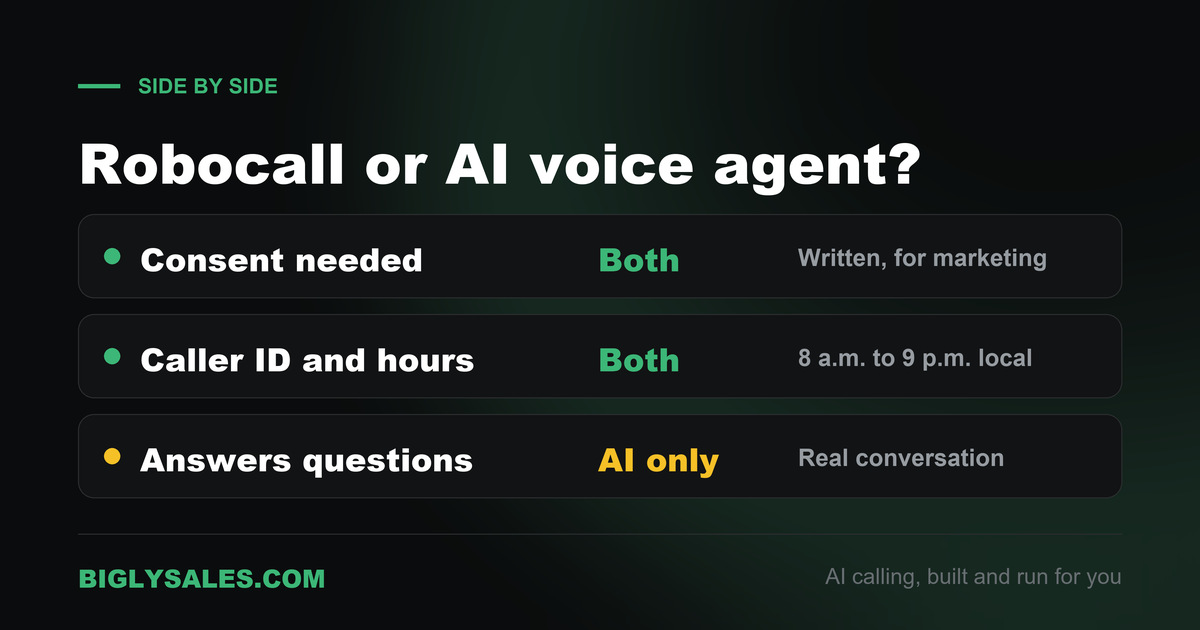
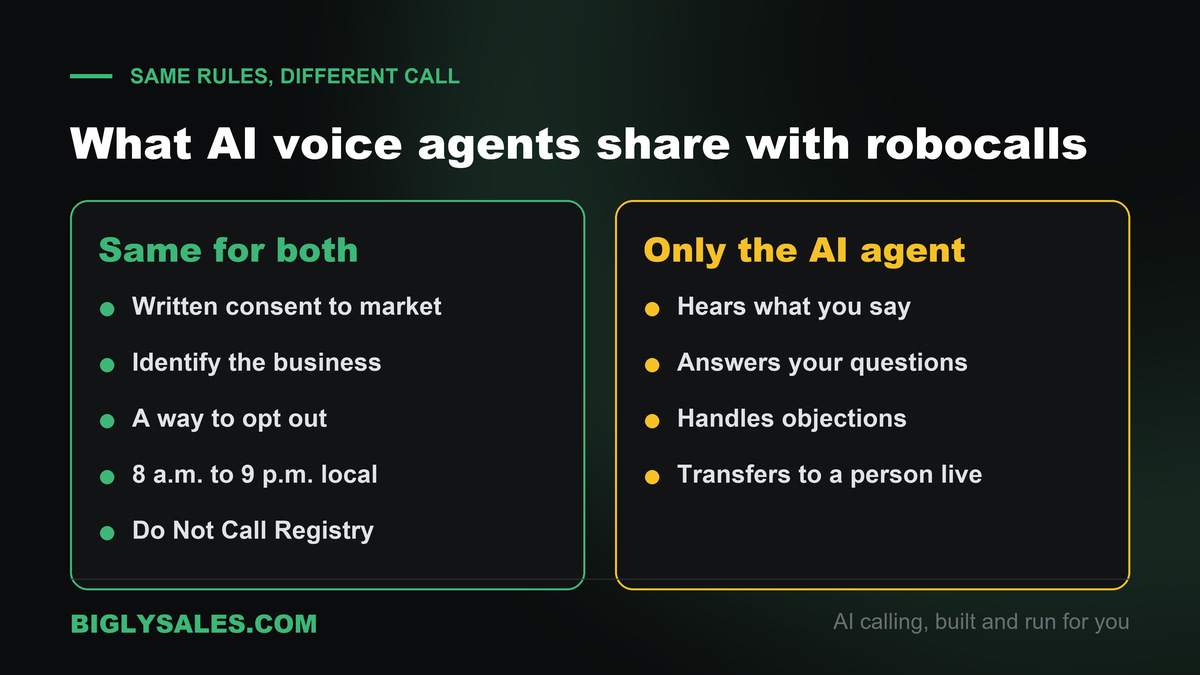
| Rule or trait | Prerecorded robocall | AI voice agent | Same? |
|---|---|---|---|
| Consent for marketing calls | Prior express written consent | Prior express written consent | Yes |
| Identify the business at the start | Required | Required | Yes |
| A way to opt out | Required | Required | Yes |
| Calling hours | 8 a.m. to 9 p.m. local | 8 a.m. to 9 p.m. local | Yes |
| Do Not Call Registry | Must honor | Must honor | Yes |
| Responds to what the person says | No | Yes | No |
| Can hand off to a person live | No | Yes | No |
What makes a robocall illegal
A robocall becomes illegal when it breaks the rules above or hides who is calling. Four failures cause most of the trouble.
No consent
Calling people who never agreed to hear from you is the most common problem. A bought list is not consent. Neither is a number someone typed into a form for a different reason.
Fake or spoofed caller ID
The number on the screen has to be real. Carriers use a signing system called STIR/SHAKEN to vouch for calls, and calls that fail it get flagged or blocked. Our post on STIR/SHAKEN and answer rates explains what it means for your numbers.
Ignoring opt-outs and the Do Not Call list
If someone asks you to stop, you stop. Telemarketing calls also have to respect the National Do Not Call Registry, with a few narrow exceptions.
Using a fake voice to deceive
In January 2024 an AI clone of President Biden’s voice told New Hampshire voters to skip their primary. The FCC fined the consultant behind the calls $6 million and fined the telecom company that sent them $1 million over caller ID failures. The technology was the AI. The offense was deceiving people and ignoring the rules around caller ID.
Calls people welcome
See an AI call that earns its answer
Book a short demo and hear how an outbound AI call opens, identifies itself and handles an opt-out. It takes about 20 minutes and there is no obligation.
Seven compliance checks for AI voice agents vs robocalls rules
- Get written consent before you dial. Keep a record of the date, where it came from and the exact wording the person agreed to.
- Name your business in the first sentence. Say who is calling before you say anything else.
- Say it is an AI. No federal rule requires those words yet, but Maine and Utah have disclosure laws and it is the safest habit. Our guide to AI disclosure laws for phone calls covers the details.
- Offer a simple way out. Make opting out easy during the call and honor it fast.
- Call inside the window. That means 8 a.m. to 9 p.m. in the time zone of the person you are calling.
- Check the Do Not Call Registry. Scrub your list before every campaign.
- Use real caller ID. Call from numbers you own, register them and watch for spam flags.
Who an AI voice agent is wrong for
If your plan is to call a purchased list of people who never agreed to hear from you, an AI voice agent makes the problem bigger. It lets you place far more calls than a human team could, so a consent gap turns into a pile of complaints much faster. In the AI voice agents vs robocalls comparison, the tool is never the real problem. Switching tools does not fix a consent gap. Getting consent does.
The same goes for any number you cannot show a consent record for. If you cannot prove they agreed, do not dial them. Our list of TCPA mistakes to avoid is a good place to check your process.
AI voice agents vs robocalls FAQ
Is an AI voice agent a robocall?
Yes, under federal rules. The FCC ruled in February 2024 that AI-generated voices are artificial voices under the TCPA, and a call that uses an artificial voice is a robocall. That does not make it illegal. It means the same consent, identification and opt-out rules that cover a prerecorded call now cover your AI agent too.
Is it legal to use an AI voice agent for sales calls?
Yes, if you follow the rules. For marketing calls you need prior express written consent, you have to identify your business at the start, offer a way to opt out, respect the Do Not Call Registry and call only between 8 a.m. and 9 p.m. in the called person’s time zone. Skip any of those and the call is a problem.
Do AI voice agents need consent to call?
For marketing calls, yes. Prior express written consent is required before an AI voice agent dials, because the FCC treats the AI voice as an artificial voice. Keep a record of when and how each person agreed and what they were told. A purchased list does not count as consent, however clean the list looks.
What is the difference between an AI voice agent and a prerecorded robocall?
A prerecorded robocall plays one message and cannot react. An AI voice agent listens, answers questions, handles objections and can transfer the call to a person. AI voice agents vs robocalls is a big difference for the person on the phone. For the law there is almost none, since both use an artificial voice and both fall under the same rules.
Can an AI voice agent call people on the Do Not Call list?
Generally no. The National Do Not Call Registry applies to telemarketing calls no matter who or what makes them, with narrow exceptions. Scrub your list against the registry before each campaign and keep your own internal list of people who told you to stop. Do not assume an exception applies without checking it.
Does an AI voice agent have to say it is an AI?
No federal rule requires those exact words yet. The FCC has proposed one, and states like Maine and Utah already have disclosure laws that reach voice. Saying it at the start is the safest habit and costs a few seconds. Never deny it if someone asks. The full picture is in our guide to AI disclosure laws for phone calls.
Can an AI voice agent call cell phones?
Yes, with the right consent. Marketing calls that use an artificial voice to a wireless number need prior express written consent, and that includes an AI voice agent. Without it the call breaks the TCPA. Keep a record of the consent for every cell number you dial, because you may have to produce it later.
What happens if an AI voice agent breaks the robocall rules?
You can face FCC enforcement and lawsuits. The TCPA lets people sue for $500 per violation, and up to three times that if a court finds the violation willful. Those numbers add up fast when an AI agent places thousands of calls. That is why consent records matter more than the technology you use.
How do I stop AI calls from being flagged as spam?
Use real numbers that you own and register them. Do not push huge volume through one number, and keep an eye on your answer rates, since a sudden drop is often a spam flag. Calls that fail carrier checks like STIR/SHAKEN get blocked or labeled. Our post on STIR/SHAKEN and answer rates explains what to watch.
The bottom line
The short answer on AI voice agents vs robocalls is that the FCC treats them alike. An AI voice agent is a robocall in the eyes of the law, and that is fine, as long as you treat it like one. The same consent, identification, opt-out and calling-hour rules apply to a recording and to a conversation with a machine.
Get written consent, say who is calling, make it easy to opt out and use real caller ID. Do that and your AI calls are legal calls. Skip it and a smarter voice just means more complaints, faster.
Start the right way
Launch AI calls that follow the rules
Tell us your industry and who you call, and we will walk through how consent, your opening and opt-outs should work. There is no obligation.