

An AI voice agent can leave a voicemail, but the law treats that voicemail as a call that uses an artificial voice. That means the same consent rules apply as for a live AI call, and a few extra rules apply to what the message says. Ringless voicemail is covered too.
This guide to AI voicemail explains what the TCPA and the FTC rule require, how ringless voicemail fits in, and what a compliant message has to include. It is general information and not legal advice, and it was checked against the federal rules and the FCC’s 2022 ruling in October 2026.
TL;DR
AI voicemail is a call under the TCPA because an AI voice counts as an artificial voice, and the FCC ruled in 2022 that ringless voicemail to wireless phones is a call too. Marketing voicemails need prior express written consent, and the FTC separately requires a written agreement for prerecorded telemarketing messages. The message must name your business first, give a callback number, and include a toll-free number that connects to an opt-out. Each violation can cost $500, or up to $1,500 if willful. If you have no consent, do not leave the voicemail, and check state law with counsel.
Key Takeaways
- An AI voice agent that leaves a voicemail is making a call with an artificial voice.
- Marketing voicemails need prior express written consent, the same as a live AI call.
- The FCC ruled in November 2022 that ringless voicemail to wireless phones is a call under the TCPA.
- The message must name the business first, give a callback number and offer a toll-free opt-out number.
- The FTC adds its own written agreement rule for prerecorded telemarketing messages.
- No consent on file means no voicemail, even if the call would otherwise go unanswered.
Table of contents
- What AI voicemail is
- Why the TCPA covers AI voicemail
- Ringless voicemail and the FCC ruling
- What the voicemail itself must say
- What the FTC rule adds
- AI voicemail types compared
- Six checks before an AI agent leaves a voicemail
- Who this is wrong for
- AI voicemail FAQ
- The bottom line
What AI voicemail is
AI voicemail is a message that an AI voice agent leaves when a call reaches voicemail instead of a person. The agent detects the greeting, waits for the tone and speaks a short message in its generated voice. Our guide on what an AI voice agent is explains how these agents work.
It is not the same thing as ringless voicemail. Ringless voicemail skips the ring and drops a recorded message straight into the person’s voicemail box. Both put a machine voice in front of someone who did not pick up, and both land in the same legal bucket.
Why the TCPA covers AI voicemail
The TCPA limits calls made with an artificial or prerecorded voice. The statute sits at 47 U.S.C. § 227, and the FCC rule at 47 CFR 64.1200. In February 2024 the FCC ruled that AI-generated voices count as artificial voices, which the FCC news release explains.
A voicemail left by an AI agent is still a call, and the voice on it is artificial. So a marketing voicemail to a cell phone needs prior express written consent, the same as a live AI call. Residential landlines are covered for artificial voice calls too. Our section on how consent differs for cell phones and landlines covers the details.
The consent has to name your business, name the number and say that signing is not a condition of buying anything. Our guide to TCPA consent for AI voice calls shows what a strong consent record looks like.
Ringless voicemail and the FCC ruling
Ringless voicemail vendors argued for years that no call takes place, because the phone never rings. The FCC ended that argument. In its November 2022 ruling the FCC found that ringless voicemail to wireless phones requires consumer consent, because it is a call made using an artificial or prerecorded voice.
The ruling speaks to wireless numbers, and the voice-agent rules above apply to residential landlines as well. The practical answer is to treat ringless voicemail like any other artificial voice call. That means written consent for marketing, the calling hours and the Do Not Call Registry.
What the voicemail itself must say
The FCC rule sets content requirements for artificial and prerecorded messages. For a voicemail, three of them matter most.
Name the business at the start
The message must clearly identify the business or person responsible for the call at the beginning. A business must also give the name under which it is registered. A voicemail that opens with a pitch and names the company late does not meet this rule.
Give a real callback number
The message must state a telephone number for the responsible party, and it cannot be the number of the dialer or message player. For telemarketing messages, that number has to let a person make a do-not-call request during regular business hours.
Offer an opt-out that works on voicemail
For telemarketing messages, the rule requires an automated opt-out option. When the message is left on voicemail, it must also give a toll-free number that lets the person call back later and connect directly to that opt-out. The opt-out has to add the number to your do-not-call list.
Messages that follow the rules
Hear how a compliant voicemail sounds
Book a short demo and listen to how an AI call opens, identifies the business and hands off or ends cleanly. It takes about 20 minutes and there is no obligation.
What the FTC rule adds
The FTC’s Telemarketing Sales Rule has its own limit on prerecorded messages. Under 16 CFR 310.4, a prerecorded telemarketing call to induce a purchase is prohibited unless the seller first has a written agreement from the person. That agreement has to show the person is willing to receive prerecorded calls from that specific seller, include their number and signature, and not be a condition of buying anything.
The same rule limits telemarketing calls to a residence to the hours between 8 a.m. and 9 p.m. in the called person’s time zone. A voicemail left after 9 p.m. is still a late call.
AI voicemail types compared
| Voicemail type | Artificial voice? | Consent for marketing | Message content rules |
|---|---|---|---|
| Live person leaves a voicemail by hand | No | Autodialer, Do Not Call and hours rules can still apply | Honor opt-outs |
| AI agent leaves a voicemail after a call | Yes | Prior express written consent | Name, callback number, toll-free opt-out |
| Prerecorded voicemail drop | Yes | Prior express written consent | Name, callback number, toll-free opt-out |
| Ringless voicemail | Yes, per the FCC | Prior express written consent | Name, callback number, toll-free opt-out |
Six checks before an AI agent leaves a voicemail
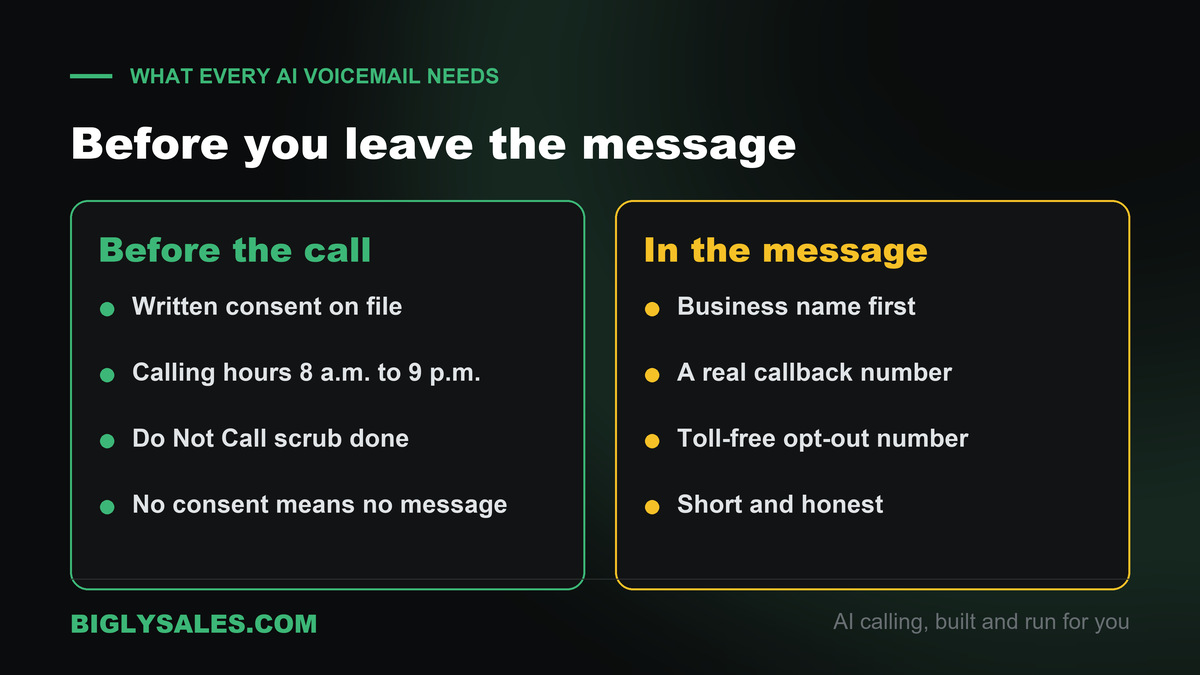
- Confirm written consent for that number. If you cannot show it, set the agent to hang up on voicemail and not leave a message.
- Name your business first. Use your registered name in the opening line.
- Give a callback number that is not the dialer. It must reach someone during business hours.
- Add a toll-free opt-out number. Make sure it adds the caller to your do-not-call list.
- Respect calling hours. Leave messages only between 8 a.m. and 9 p.m. in the called person’s time zone.
- Keep it short and honest. Say who you are, why you called and how to opt out. Our guide to AI disclosure laws covers when to say it is an AI.
Who this is wrong for
If your plan is to blast ringless voicemail to a purchased list, this is not a gray area and an AI agent will not fix it. The FCC treats those drops as calls, and a list with no consent records has no legal footing. AI only lets you send more of them faster.
It is also the wrong tool if you cannot track opt-outs across channels. A voicemail that ignores a past stop request is a revoked-consent problem. Our post on TCPA revocation of consent explains how stops have to be honored.
AI voicemail FAQ
Can an AI voice agent leave a voicemail?
Yes, but the voicemail counts as a call made with an artificial voice. That means the TCPA consent rules apply to it the same way they apply to a live AI call. If you have no consent for marketing calls to that number, you should not leave the message. Many teams set the agent to hang up instead.
Is AI voicemail legal?
It can be legal when you follow the rules. For marketing, you need prior express written consent, and the message must name your business, give a callback number and offer a toll-free opt-out. You also have to respect calling hours and the Do Not Call Registry. Without consent, an AI voicemail breaks the TCPA.
Is ringless voicemail legal?
Ringless voicemail is not banned, but it is not free of rules. In November 2022 the FCC ruled that ringless voicemail to wireless phones is a call made with an artificial or prerecorded voice, so it requires consent. For marketing, that means prior express written consent before you send it.
Do I need consent to leave an AI voicemail?
Yes, for marketing calls. The FCC treats AI voices as artificial voices, and a marketing call to a cell phone with an artificial voice needs prior express written consent. Keep a record of the date, the source and the wording the person agreed to, because you may have to show it later.
What must an AI voicemail say?
It must name your business at the start, using your registered name, and give a callback number that is not the dialer’s number. For telemarketing messages left on voicemail, it must also give a toll-free number that connects to an opt-out. Keep the message short and clear about who you are and why you called.
Can I leave an AI voicemail after 9 p.m.?
You should not. Telemarketing calls to a residence are limited to the hours between 8 a.m. and 9 p.m. in the called person’s time zone, and a voicemail is still a call. Use time zone data for each number, and remember that a cell phone owner may have moved since you collected the number.
Does the FTC have rules on AI voicemail?
Yes. The Telemarketing Sales Rule prohibits prerecorded telemarketing calls unless the seller first has a written agreement from the person. The agreement must name the specific seller, include the person’s number and signature and not be a condition of buying anything. This sits on top of the TCPA rules.
What happens if I leave AI voicemails without consent?
You can face lawsuits and regulator action. The TCPA lets a person sue for $500 per violation, and a court can raise that to as much as three times the amount if it finds the violation willful or knowing. AI agents can leave thousands of messages fast, so a small consent gap grows quickly.
Should an AI voice agent leave a voicemail at all?
Only when you have consent and a message that meets the content rules. A short, honest voicemail with a clear opt-out is fine. If your consent records are thin, set the agent to hang up on voicemail and try again later. A skipped message costs far less than a complaint.
The bottom line
An AI voicemail is a call with an artificial voice, and ringless voicemail is too. Marketing messages need prior express written consent, and the message has to name your business, give a callback number and offer an opt-out that works on voicemail.
Check consent first, set the agent to hang up when consent is missing and keep every message short and honest. That keeps voicemail a useful part of your outreach and not a source of lawsuits.
Voicemail done right
Launch AI calls with clean opt-outs
Tell us how you collect consent and what your calls say today. We will walk through how voicemail, opt-outs and calling hours should work. There is no obligation.