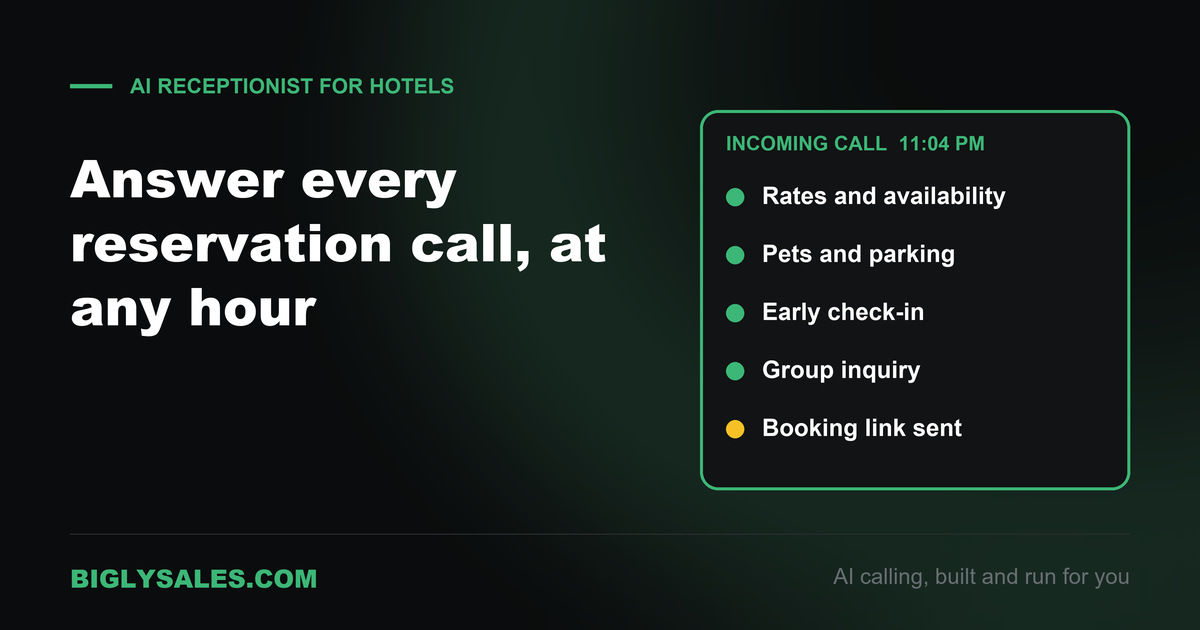


An AI receptionist for hotels answers your reservation line at any hour, so the 11 p.m. caller books with you instead of the next listing.
Rates. Availability. Parking. Pets. Can I check in early.
Guests call with the same questions every day. And they call across every time zone.
This guide covers which hotel and travel calls to hand to AI, how payments stay safe, what stays with your team and what it costs.
With real labor numbers from the BLS and our own pricing.
Key Takeaways
- An AI receptionist answers every call, so late-night and peak-season callers do not hit voicemail.
- Staffing one phone line overnight costs about $6,708 a month in BLS-based hospitality labor.
- Rates, availability, policies and directions are the first calls to automate.
- Group and quote inquiries go to several providers at once, so the first callback usually wins.
- Bigly agents do not collect card numbers on the call. Guests pay through your link or your staff.
- Promotional AI calls need prior express written consent under the TCPA.
Table of contents
- What an AI receptionist for hotels is
- Why reservation calls get missed
- What 24/7 phone coverage costs
- 8 hotel and travel calls to hand to AI
- How payments stay off the call
- Group and quote inquiries are a race
- Vacation rentals, tour operators and travel agencies
- Outbound rules for guest calls
- What the AI needs from you
- What it costs
- Who this is wrong for
- AI receptionist for hotels FAQ
- The bottom line
What an AI receptionist for hotels is
An AI receptionist for hotels is an AI voice agent that answers and places guest calls for a property, using your rates, policies and booking rules.
It answers questions. It captures dates, party size and preferences. It sends your booking link or hands the caller to reservations.
It also calls out. Group inquiry callbacks, booking confirmations and pre-arrival calls.
It is not a phone tree. Nobody presses 2 for reservations. The guest just asks.
And it works the same way for vacation rentals, tour operators and travel agencies. More on those below.
Why reservation calls get missed
Hotels do not miss calls because they do not care. They miss them because the phone rings at the worst time.
- Check-in rush. Three guests at the counter and the phone rings. The guest in front of you wins.
- Late night. Travelers plan after dinner. Your reservations office closed at six.
- Time zones. A guest in London calls your Florida resort at their lunchtime. That is 7 a.m. for you.
- Peak season. Everyone calls the same week. Hold queues grow and callers give up.
Every one of those calls was someone ready to spend money with you.
And booking sites are one tap away. A caller who reaches voicemail rarely leaves a message. They book the next result.
What 24/7 phone coverage costs
Let’s put a number on it.
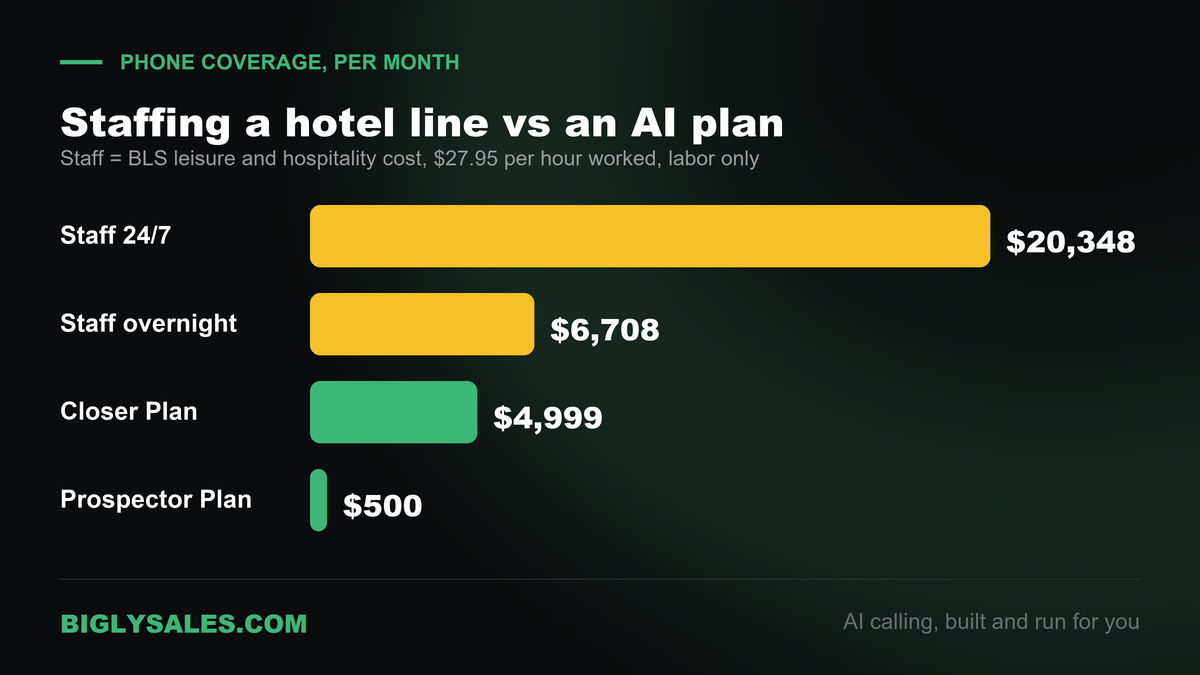
The BLS reports that full-time workers in leisure and hospitality cost employers about $27.95 per hour worked, wages and benefits together, in June 2026.
Staff one phone line overnight, 11 p.m. to 7 a.m. That is 8 hours a night, 240 hours a month. About $6,708.
Staff it around the clock. That is 168 hours a week, or about $20,350 a month. For one line.
And that is labor only. No training, no turnover, no sick days.
Most properties do not pay for that. They send night calls to voicemail, or the night auditor answers between other jobs.
An AI receptionist covers the same hours on a monthly plan. Our guide to after-hours staffing models compares the other options.
One honest note. These are BLS averages for the whole industry, not your payroll. Use your own wage and the hours your line is actually open.
8 hotel and travel calls to hand to AI
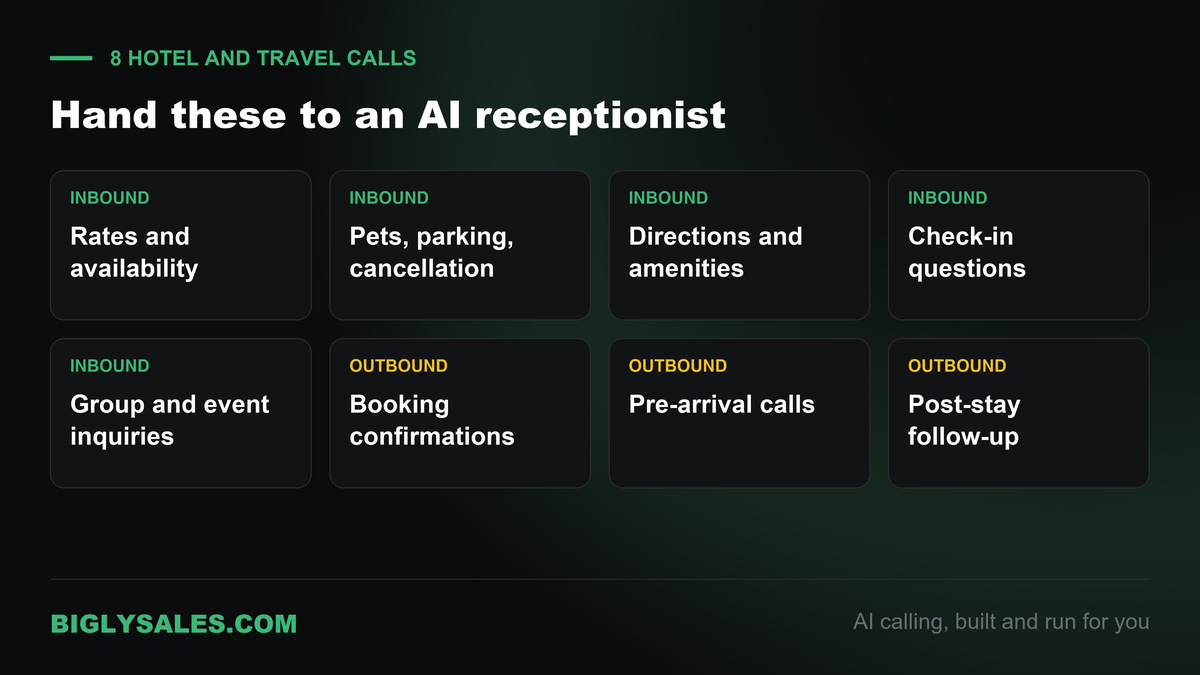
These eight make up most of what a front desk or reservations line handles every day.
| Call | Direction | What the AI needs | Transfer to a person when |
|---|---|---|---|
| Rates and availability | Inbound | Current rates or a booking link | The guest is ready to book by phone |
| Policies, like pets, parking, cancellation | Inbound | Your written policies | The guest wants an exception |
| Directions and amenities | Inbound | Address, hours, amenity list | Rarely |
| Check-in and check-out questions | Inbound | Times and early check-in rules | The guest is already on site with a problem |
| Group, wedding and event inquiries | Inbound and outbound | Group rules and a sales contact | Dates and size are confirmed |
| Booking confirmations | Outbound | Reservation details | The guest wants to change the booking |
| Pre-arrival calls | Outbound | Arrival date and offers | The guest has a special request |
| Post-stay follow-up | Outbound | Stay details and consent | The guest raises a complaint |
Confirmation calls are easy to skip. They are also how you catch a no-show while the room can still be resold.
Free setup session
Hear an AI receptionist answer your line
In 30 minutes we build a working agent with your rates, policies and transfer rules, then call your phone with it. Plans start at $99 a month, and the setup is free.
How payments stay off the call
This is the first question most hotel managers ask. Good.
Bigly agents are set up not to collect full card numbers on the call.
When a guest is ready to pay, the AI does one of two things. It sends your secure booking link. Or it transfers the guest to a staff member.
That keeps card data off recordings and transcripts. Nobody reads a card number out loud to an AI, and nobody writes one on a sticky note at the desk either.
Group and quote inquiries are a race
A wedding planner sends the same inquiry to three hotels. A family sends a trip request to two travel agencies.
Whoever calls back first is having the real conversation. The others are leaving voicemails.
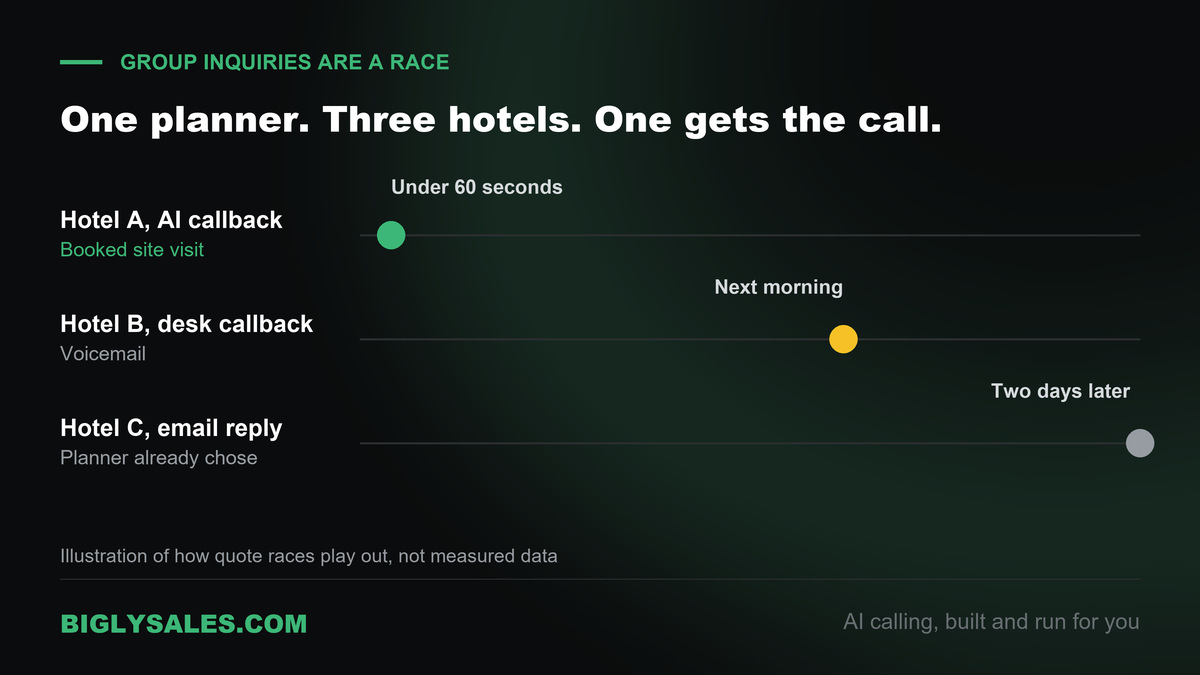
Research in Harvard Business Review found that most companies do not respond to online leads nearly fast enough. Hospitality is no different.
Bigly AI agents call new inquiries back in under 60 seconds, including evenings and weekends. They ask about dates, headcount and budget, then hand the planner to your sales team or book a call.
Vacation rentals, tour operators and travel agencies
The phone day looks a little different for each. The fix is the same.
| Business | Calls that pile up | What the AI does | What stays human |
|---|---|---|---|
| Hotels and resorts | Rates, policies, late-night bookings | Answers 24/7, sends booking link, transfers | Complaints, VIPs, billing |
| Vacation rentals | Check-in codes, owner calls, inquiries | Answers guests across the portfolio | Property damage, refunds |
| Tour operators | Times, meeting points, what to bring | Answers and books the next step | Custom private tours |
| Travel agencies | Quote requests from many sources | Calls back in seconds and qualifies | Trip planning with an advisor |
| Group sales | Wedding and corporate inquiries | Calls back and gathers details | Contracts and pricing |
For booking calls with advisors, see how an AI appointment setter works.
Outbound rules for guest calls
Calls about a guest’s existing booking are service calls. Confirmations and pre-arrival calls fall here.
Promotional calls are different. In February 2024 the FCC ruled that AI generated voices count as artificial voices under the TCPA. So a marketing AI call needs prior express written consent.
Check the Do Not Call registry before promotional campaigns. Call inside legal hours, in the guest’s time zone. Honor stop requests right away.
The FTC Telemarketing Sales Rule covers the basics, and several states require you to disclose the AI on the call.
Bigly checks consent and Do Not Call status before every outbound dial, with compliance controls built in.
What the AI needs from you
- Where rates and availability come from. Current rates or a booking link. The AI should hand off when it cannot see the answer.
- Your policies in writing. Cancellation, pets, parking, early check-in, deposits.
- Transfer rules. Who gets booking-ready guests, group leads and complaints, and at what hours.
- The questions guests ask most. Your desk staff can list them in five minutes.
- Your booking link. So the AI can send it by text when a guest is ready.
Bigly sets this up and connects it to your CRM. Most teams go live within 24 hours once the script and policies are approved.
Expecting heavy volume? See what to look for in an AI receptionist for high call volume.
What it costs
Bigly prices by the minute, and every plan covers inbound and outbound. These are the published plans, checked on our pricing page on November 5, 2026.
| Option | Monthly cost | Included minutes | Fits roughly |
|---|---|---|---|
| Staff one line overnight | About $6,708 | Labor only | One property, nights |
| Staff one line 24/7 | About $20,350 | Labor only | One property, all hours |
| Bigly Scout Plan | $99 | 500 | A small inn testing after-hours calls |
| Bigly Prospector Plan | $500 | 3,000 | One busy property |
| Bigly Hunter Plan | $2,999 | 25,000 | A small group of properties |
| Bigly Closer Plan | $4,999 | 50,000 | A regional group with outbound campaigns |
Annual billing takes 30 percent off every plan. The Rainmaker Plan, at $9,999 a month for 125,000 minutes, covers large groups and agencies.
Who this is wrong for
A small bed and breakfast where the owner answers every call and loves it does not need this.
It is also a poor fit for luxury properties whose whole promise is a personal voice on every call. Use AI only for overflow there, if at all.
And if your rates change by the hour and the AI cannot see them, it will send a lot of booking links. That is fine, but know it going in. Running a phone team for a retail business too? Our guide to AI voice agents for retail covers store lines.
AI receptionist for hotels FAQ
What is an AI receptionist for hotels?
An AI receptionist for hotels is an AI voice agent that answers the property’s phone line in a natural voice. It handles availability, rates, amenities, policies and directions, captures the guest’s dates and details, and transfers booking-ready callers to reservations. It also makes outbound calls, such as booking confirmations and group inquiry callbacks.
Can AI take hotel reservation calls 24/7?
Yes. An AI receptionist answers every call at any hour, including the 11 p.m. caller who would otherwise reach voicemail. It answers questions from the information you provide, captures the guest’s details and either sends your booking link or transfers the caller to staff. Night calls get an answer instead of a message.
Does an AI receptionist take credit card payments?
Bigly agents are set up not to collect full card numbers on the call. Guests are sent your secure booking link or transferred to a staff member to pay. That keeps card data off call recordings and transcripts. If your process needs a card to hold a room, keep that step with your reservations team.
Will an AI receptionist replace the front desk?
No. Your front desk still checks guests in, solves problems in person and handles the calls that need judgment. The AI takes the repeat questions and the calls that come in while staff are busy with guests at the counter. Most properties use it for overflow and nights first, then expand once they trust it.
Which hotel calls should be automated first?
Start with after-hours calls and the questions your desk answers all day. Rates, availability, parking, pets, check-in times and cancellation policy are the usual first set. On the outbound side, group and event inquiry callbacks pay off fastest. Leave complaints, billing disputes and VIP guests with your team.
Can AI help travel agencies and tour operators?
Yes. For travel agencies, the AI calls back every quote request within seconds, asks about dates, budget and party size, and books a call with an advisor. For tour operators, it answers common questions about times, meeting points and what to bring, and books the next step. Advisors spend their time on travelers who are ready to plan.
Are AI calls to guests legal?
Service calls about an existing booking, like confirmations and pre-arrival calls, are treated differently from marketing calls. Promotional AI calls need prior express written consent, because the FCC ruled in February 2024 that AI voices count as artificial voices under the TCPA. Check Do Not Call status too. This is general information, not legal advice.
How much does an AI receptionist for a hotel cost?
Bigly plans start at $99 a month for 500 minutes and go up to $9,999 a month for 125,000 minutes, with 30 percent off on annual billing. Every plan covers inbound and outbound calls. Compare that with about $6,708 a month in BLS-based labor cost to staff one phone line overnight.
How long does setup take?
Most teams go live within 24 hours once the script and policies are approved. Bigly sets up the number, call flows, transfer rules and the connection to your CRM. Properties with several locations or brands take a little longer, so start with one property’s after-hours line and add the rest once it runs well.
The bottom line
Travelers book when they are ready, not when your desk is free. An AI receptionist answers every call at every hour, calls back every group inquiry in under a minute and keeps card numbers off the line.
Your team keeps the guests who need a person. See the full picture on our AI calling for travel and hospitality page.
Start with one line
Cover your reservation line tonight
Pick one property’s after-hours line and we set up the agent, booking link and transfer rules. Most teams go live within 24 hours.