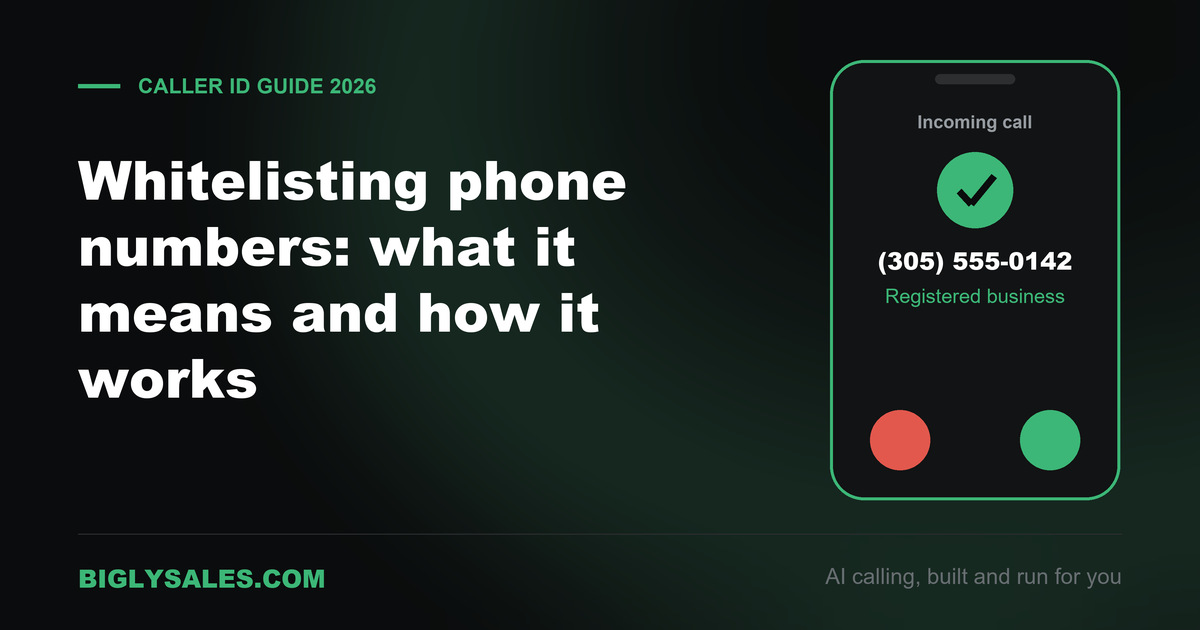


Whitelisting a phone number means registering your business number with the companies that screen calls for the big US carriers, so they know a real business owns it and your calls are less likely to show up as Spam Likely.
It is one of the first questions teams ask when they look at outbound calling, and for good reason. If the number looks like spam, the best script in the world never gets heard.
This guide explains what whitelisting really involves, who decides how your calls are labeled, how to do it yourself for free and what it cannot fix. It is about business numbers that place calls, not the allow list on your own phone.
Key Takeaways
- Whitelisting is not one official list. It is registration plus reputation care.
- Three analytics companies, Hiya, First Orion and TNS, run the Free Caller Registry.
- Registering your numbers there is free and covers all three at once.
- Registration does not guarantee a clean label. How you call still matters most.
- STIR/SHAKEN signing, a clear caller name and monitoring complete the picture.
- Whitelisting never makes a call legal. Consent and Do Not Call rules still apply.
Table of contents
- What whitelisting a phone number means
- Why business numbers need it
- Who decides whether your call looks safe
- The four parts of number whitelisting
- Whitelisting vs STIR/SHAKEN, CNAM and branded caller ID
- How to whitelist your business phone numbers
- What whitelisting cannot do
- How Bigly Sales handles whitelisting
- Whitelisting phone numbers FAQ
- The bottom line
What whitelisting a phone number means
Whitelisting a phone number is the process of registering a business number with call analytics providers and carriers so its calls are treated as coming from a known, verified business.
In practice the word covers a few jobs at once. You register the number to your company, your carrier signs each call so the caller ID can be trusted, and someone watches how the number is labeled and acts when it slips.
The term is informal. No carrier publishes a list called the whitelist, and no single form makes a number safe everywhere. When a vendor says your lines are whitelisted, ask what they actually registered, with whom and how they monitor it.
Business whitelisting vs your phone’s allow list
On a personal phone, whitelisting usually means adding a contact so its calls always ring through call filters. That is a setting the person you call controls. Business whitelisting works on the other side of the call, before the phone ever rings.
Why business numbers need it
The major US mobile carriers screen incoming calls with analytics partners such as Hiya and First Orion. If the screen does not know your number, it has little to go on beyond how the number behaves.
A new number that suddenly places hundreds of short calls looks a lot like a robocaller, even when the calls are wanted. The result can be a Spam Likely or Scam Likely tag on the screen.
Registration gives the screen something to weigh against that pattern. It ties the number to a business with a name, an address and a tax ID. That does not buy a free pass, but it means your calls are judged with context instead of in the dark.
Who decides whether your call looks safe
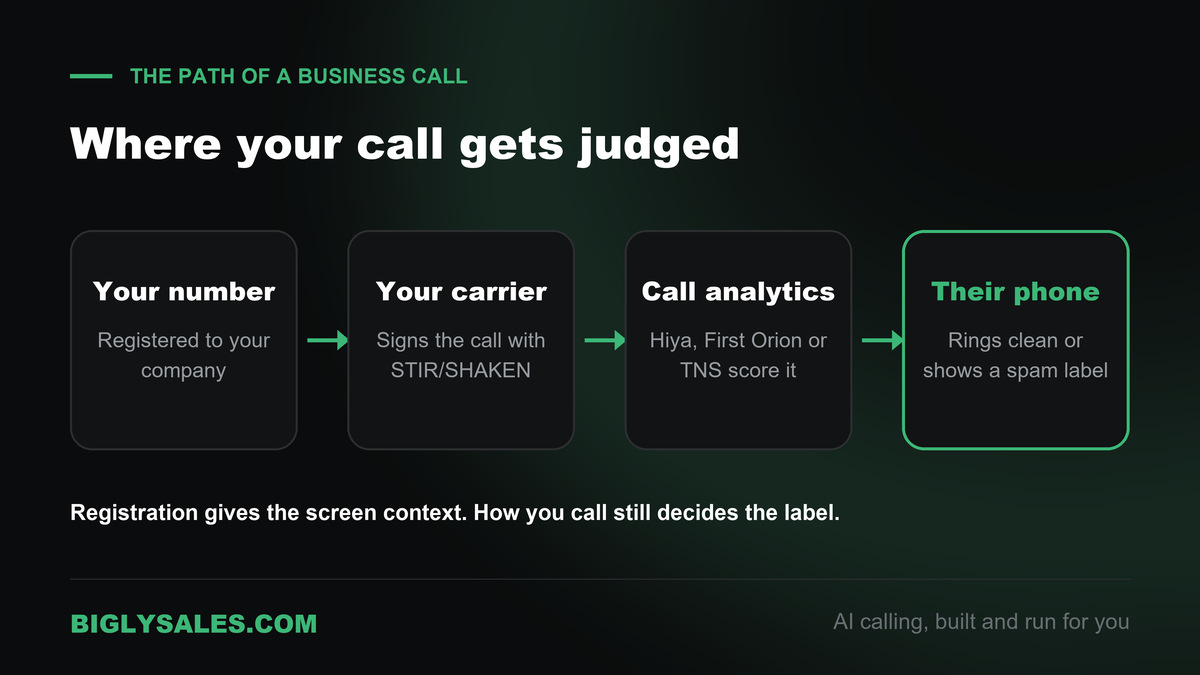
Three call analytics companies sit behind the shared registry that businesses use for outbound numbers.
- Hiya says its spam labeling is used by major mobile networks including AT&T in the US. In September 2025 it made its Caller Reputation report card free for businesses, in cooperation with AT&T.
- First Orion lists in its company history that it partnered with T-Mobile to launch the Scam Likely label.
- TNS is the third provider behind the shared registry.
The three run one shared intake form, the Free Caller Registry, where businesses register outbound numbers at no cost. Each provider then decides on its own how to use the data.
Your carrier adds a second signal. Under the FCC’s STIR/SHAKEN rules, the carrier that places your call signs it with an attestation level that says how sure it is about the caller. The FCC said it expects STIR/SHAKEN to be paired with call analytics, so the signature is one more input next to your call history.
Numbers handled for you
Skip the registration paperwork
Bigly Sales buys, registers and whitelists your numbers under your company before the first call goes out. Most teams are live within 24 hours of a free setup call.
The four parts of number whitelisting
A number counts as whitelisted in any useful sense only when all four of these are in place.
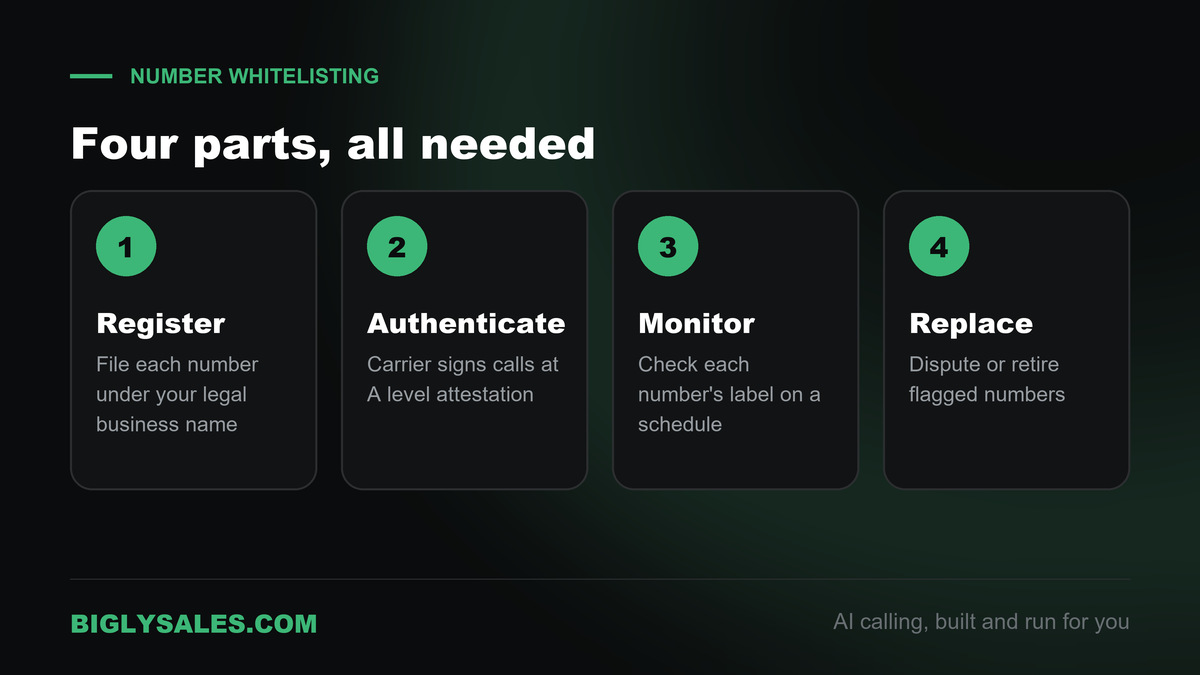
1. Register the number to your business
File each number with the analytics providers under your legal business name, EIN, address and a contact email on your own domain. The Free Caller Registry covers all three providers with one form.
2. Get your calls signed
Your carrier should sign calls from the number at full attestation, the A level, which means it knows you and knows you have the right to use the number. The FCC rule set out three levels, full, partial and gateway. Our STIR/SHAKEN guide explains what each one does to answer rates.
3. Watch the reputation
Check how each number is labeled on a schedule, not only when sales drop. The registry itself says it is not a replacement for reputation monitoring. Hiya’s free report card is one way to see your status on its side.
4. Replace or repair damaged numbers
When a number does get flagged, either dispute the label with the provider or retire the number. Our guide on how to fix Spam Likely on a sales number walks through both paths.
Whitelisting vs STIR/SHAKEN, CNAM and branded caller ID
These four terms get mixed up in sales calls all the time. They do different jobs and stack on top of each other.
| Piece | What it does | Who handles it | Shows your name | Can stop a spam label |
|---|---|---|---|---|
| Whitelisting | Registers your number with the analytics companies and keeps its reputation clean | You or your calling vendor | No | Helps, no guarantee |
| STIR/SHAKEN | Signs each call so the caller ID can be trusted | Your phone carrier | No | Helps, no guarantee |
| CNAM | Stores a caller name of up to 15 characters | Your phone carrier | Sometimes | No |
| Branded caller ID | Sends a verified name, logo and call reason with the call | A branded calling provider | Yes, on supported phones | No |
Branded caller ID is the top layer and needs the others under it. Our branded caller ID guide covers its costs and when it pays off.
How to whitelist your business phone numbers
You can do this yourself for free. It takes paperwork and patience more than money.
- Get your business details in order. Use the exact legal name on your IRS record, your EIN, a physical address and an email on your company domain. Our KYC checklist for outbound calling lists every field.
- Make sure the numbers are in your company’s name. Numbers registered to a vendor while your caller names your business create a mismatch.
- Register every outbound number with the Free Caller Registry before it makes its first call.
- Ask your carrier or calling platform to confirm your calls go out with A level attestation.
- Set a clear CNAM name on each number so landlines and some phones show who is calling.
- Pace the calls. Spread volume across enough numbers so no single line dials far more than a normal business would.
- Check the labels on a schedule and dispute or retire any number that gets flagged.
- Keep the records current. Update your registrations when you add numbers or change your address or name.
A note on local presence numbers
Calling from local area codes only helps when every one of those numbers is registered and kept long term. A large pool of fresh, unregistered local numbers is the pattern spam screens are built to catch. Our local presence dialing guide explains the difference.
What whitelisting cannot do
Whitelisting is worth doing, but it is easy to oversell. Be clear on its limits before you count on it.
- It does not guarantee a clean label. The Free Caller Registry says registration does not guarantee redress.
- It does not show your name. The registry says its data is not used to deliver caller ID names. That is the job of CNAM and branded calling.
- It does not make a call legal. Consent, Do Not Call, calling hours and state rules still apply to every dial.
- It does not fix bad lists. Calling people who never asked to hear from you draws complaints, and complaints drag any number down.
- It does not protect a number forever. Reputation moves with every call, so it needs ongoing checks.
If your team makes a few dozen calls a day from one or two lines, registering those numbers and keeping an eye on them may be all you need. The full routine matters most for teams running real volume across many numbers.
How Bigly Sales handles whitelisting
This is the part prospects ask about most in our demos, so here is how it works on our side.
- We buy and register the numbers. You send us your company details through a short KYC form, and we register your numbers under your company, not ours.
- We whitelist them before the first call. Whitelisting is a set step in setup, so no campaign starts on an unregistered line.
- Calls run on registered lines with monitored reputation and are authenticated under the STIR/SHAKEN framework.
- Local presence comes from owned numbers. We run local presence across 200+ whitelisted lines that are kept and monitored rather than churned.
- Flagged lines come out fast. We monitor numbers continuously and remove any flagged line from the campaign.
Phone numbers are billed at $2 per number, and the whitelisting work is part of setup. See the pricing page for plan details. Bigly Sales is a fully managed service, so if you want to run your own carrier accounts and registrations in house, a developer platform may suit you better.
Whitelisting phone numbers FAQ
What does it mean to whitelist a phone number?
For a business, whitelisting a phone number means registering it with the analytics companies that score calls for the big US carriers, so they know a real, verified business owns it. Your calls are then signed at the carrier and the number is watched for complaints. On a personal phone the word means something else, adding a contact to an allow list so its calls always ring.
Is there an official whitelist for business phone numbers?
No. There is no single government or carrier list that guarantees your calls get through. Whitelisting is an industry term for registering your numbers with the call analytics providers, mainly Hiya, First Orion and TNS, and keeping their reputation clean. Each provider makes its own call on how your traffic is labeled.
How do I whitelist my business phone number?
Start with the Free Caller Registry, a free form run by Hiya, First Orion and TNS that sends one registration to all three. Use your legal business name, EIN, address and a contact on your own domain. Then make sure your carrier signs your calls with STIR/SHAKEN, set a CNAM name and check each number’s reputation over time.
Does whitelisting stop Spam Likely labels?
Not on its own. The Free Caller Registry says plainly that registering numbers does not guarantee redress. Registration tells the analytics companies who you are, but they still score how you call. High volume per number, very short calls and complaints can still earn a label. Whitelisting lowers the risk and gives you a path to dispute a label.
How much does it cost to whitelist a phone number?
The registration itself is free. The Free Caller Registry charges nothing, and Hiya made its Caller Reputation report card free to businesses in September 2025. What costs money is the time to file, check and dispute across many numbers. Bigly Sales does that work during setup and bills phone numbers at $2 per number.
How long does it take to whitelist a number?
There is no published turnaround from the Free Caller Registry or the providers behind it, so plan for days, not minutes. The paperwork goes faster when your legal name, EIN and business email all match. Register new numbers before they make their first call instead of after a problem shows up, so the record is there from day one.
Does whitelisting make my calls legal?
No. Whitelisting is about how your calls are labeled, not whether you are allowed to make them. Consent rules, Do Not Call lists, calling hours and state laws still apply to every call. A registered number that calls people without consent can still draw complaints, lawsuits and fines, and the complaints will hurt its reputation too.
What is the difference between whitelisting and STIR/SHAKEN?
STIR/SHAKEN is a signature your phone carrier adds to each call to confirm the caller ID is real. The FCC required it on IP networks by June 30, 2021. Whitelisting is broader. It covers registering your business with the analytics companies, getting your calls signed, setting your caller name and keeping each number’s reputation clean.
Why do whitelisted numbers still get flagged?
Because the label follows behavior, not paperwork. A registered number that dials too many people too fast, gets hung up on in seconds or draws complaints can still be scored as spam. Numbers bought secondhand may also carry an old history. Spreading volume across enough numbers and replacing damaged ones is part of keeping a line clean.
Whose name should my numbers be registered under?
Your own company’s. The name, EIN and email on the registration should match the business the caller names on the call. Numbers registered to a software vendor while your agent introduces your company create a mismatch that can hurt your reputation and fail branded calling checks. Bigly Sales registers client numbers under the client’s company.
The bottom line
Whitelisting a phone number means registering it to your business with the analytics companies behind the carriers, getting your calls signed and keeping each number’s reputation clean. The registration is free through the Free Caller Registry, but it is a starting point, not a guarantee.
What keeps a number clean over time is how you call with it. Register before the first dial, pace your volume, call people who asked to hear from you and replace numbers that slip.
Talk to our team
Get clean, registered lines from day one
Bigly Sales runs fully managed inbound and outbound AI calling on 200+ whitelisted lines, with compliance controls built in. Bring your questions about numbers to a free 30 minute setup call.