
The Channel Your Competitors Are Not Using
Every eCommerce brand sends the abandoned cart email. Almost none of them picks up the phone. A voice AI agent calls the customer while the intent is still warm, handles the actual objection, and either recovers the order on the call or sends a secure link to finish it. Same for the declined payment, the expiring card on a subscription, and the customer who is overdue for a reorder.
Email is saturated
Your recovery flow competes with every other sender in a promotions tab. A phone call from your brand does not.
Voice handles objections
An email cannot answer “will it arrive before Friday” or “is shipping really that much”. A conversation can, and that is usually the reason the cart was abandoned.
It runs at email scale
Not a call-center project. Every qualifying cart, decline and renewal gets called, at any hour, without adding a single seat.
AI Outbound Calling Campaigns for eCommerce
Each one is triggered by an event in your store or billing system, and each one writes its outcome back.
Abandoned cart recovery
Call the high-value carts your email flow was going to lose. The agent confirms what they were buying, answers the shipping, sizing or delivery-date question that stopped them, and either takes the order forward or texts a checkout link while they are still on the phone.
Failed and declined payments
A decline is not a lost customer, it is an expired card or a bank hold. The agent verifies who it is speaking to, explains that the payment did not go through, and sends a secure link to retry. Recovered revenue you had already earned.
Card updates for subscriptions
Involuntary churn is the quietest leak in a subscription business. Call before the card expires rather than after the renewal fails, and keep the subscriber instead of running a win-back campaign later.
Upsells and cross-sells
Call recent buyers with the accessory, the larger size, the bundle or the annual plan. A conversation converts an upsell that an email would not have earned a click on.
Replenishment and reorder
For consumables, call when they are due to run out, not when a batch email happens to go. Turn one-time buyers into a subscription.
Win-back and lapsed customers
Work the customers who used to order and stopped. Find out why, and make the offer that brings the good ones back.
Delivery, returns and order issues
Proactively call on delayed shipments and failed deliveries, confirm addresses before dispatch, and resolve returns before they become a chargeback or a one-star review.
High-risk order verification
Confirm identity and intent on flagged orders so you can ship more of them with confidence and cancel fewer good ones.
Reviews, referrals and back-in-stock
Ask happy customers for the review at the right moment, and call the waitlist the day a product returns instead of hoping they open the email.
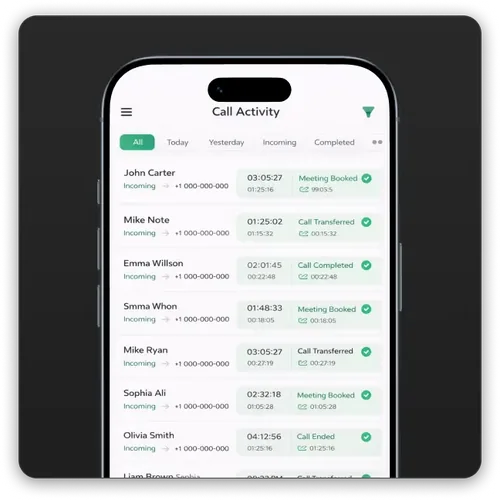
Revenue You Already Earned
Carts that only ever got an email
The customer chose the product and entered the funnel. Then the only follow-up was a message in a promotions tab, competing with every other brand that sent one the same afternoon.
Declines nobody called about
A dunning sequence that runs entirely over email quietly writes off customers whose card simply expired. They were never unwilling to pay.
Subscribers lost to an expiry date
Involuntary churn does not look like churn in your dashboard. It looks like a failed renewal, and then a lapsed customer you spend money reacquiring.
How We Treat Payments And Consent
Calls about money need to be handled carefully. This is how these campaigns are built.
The AI never asks for a card number
No card numbers, CVVs or bank details are spoken to the agent. The customer is authenticated and then sent a secure payment link, or transferred to a human on your side. It keeps sensitive card data out of the call entirely.
Servicing calls and marketing calls are separated
A call about a failed payment on an order the customer placed is a different thing from a promotional upsell, and the consent basis is different. Campaigns are configured accordingly rather than lumped together.
The same guardrails as every other campaign
Consent record, do-not-call scrubbing, calling windows in the customer’s local time zone, AI disclosure and opt-out by meaning. Enforced before the dial. See the TCPA compliance guide.
Voice Recovery vs The Flows You Run Today
What each channel can actually do at the moment a cart is abandoned or a payment fails.
| Core capability | Bigly Sales voice AI | Email and SMS flows |
|---|---|---|
| Handles the actual objection | Yes, in conversation, including shipping cost, delivery date, sizing and fit | No, one-way message with a link |
| Reaches the customer | A live call from your brand | Competes with every other sender in the inbox |
| Recovers expired-card churn | Calls before the renewal fails and drives the update | Relies on the customer opening a dunning email |
| Upsell conversion | A conversation that can read hesitation and respond | Depends on a click |
| Cost to scale | Scales with the campaign, no extra headcount | Cheap to send, and increasingly ignored |
| Data back to your stack | Outcome, transcript, recording and reason-for-abandonment written back | Opens and clicks |
Voice is not a replacement for your email flows. It is the follow-up those flows never had, pointed at the orders worth a phone call.
From Store Event To Recovered Order
We connect to your store and billing events
Cart abandonment, payment failure, upcoming card expiry, delivery exception, order milestone. Whatever your platform emits is what triggers a call.
We set the thresholds with you
Which carts are worth a call, how long to wait, how many attempts, and which customers should never be phoned. Calling every $12 cart is not the goal.
The agent calls and handles the real objection
It knows the products in the cart, the order history and the reason the payment failed, and it answers the question that actually stopped the purchase.
Checkout happens on a secure link or a human
A text or email link to finish payment, or a warm transfer to your team. No card details on the call.
Everything writes back
Recovered revenue, disposition, transcript and the stated reason for abandonment, so your merchandising and shipping decisions get better over time.
AI outbound calling questions answered
Can AI calls really recover abandoned carts?
The mechanism is simple: a customer who filled a cart has already chosen the product, so what remains is an unanswered question or a moment of hesitation. Email cannot answer a question. A short call that addresses the shipping cost, the delivery date or the size, and then sends a checkout link, converts a share of carts that the email flow was going to lose. We set the value threshold with you so the calls only go where the economics work.
Does the AI take payment over the phone?
No. The agent never asks for a card number, CVV or bank details. It verifies who it is speaking to, explains the situation, and sends a secure payment link or transfers to a human. That keeps sensitive card data out of the conversation.
How does it help with failed or declined payments?
Most declines are expired cards, bank holds or a billing address change, not an unwillingness to pay. The agent calls, explains that the charge did not go through, and drives the customer to update the card on a secure link. For subscriptions it can call before the expiry date rather than after the renewal fails.
Will it damage the customer relationship?
It depends entirely on which calls you make. Servicing calls, such as a failed payment or a delayed delivery, are usually welcome. Promotional calls need consent and restraint. We configure frequency caps, quiet hours in the customer’s own time zone and suppression lists, and treat opt-outs as permanent.
Which platforms does it work with?
Campaigns are triggered by events from your store, subscription billing or CRM through an API, so it is not tied to one cart platform. If your system can emit an event or expose an order, it can trigger a call.
Is calling a customer about an abandoned cart TCPA compliant?
It depends on your consent basis and how the call is made, which is exactly what these campaigns are configured around: the consent record, do-not-call scrubbing, permitted calling hours in the customer’s local time zone, AI disclosure and opt-out handling, all enforced before the dial. Our TCPA compliance guide covers the rules in plain English, and it is general information rather than legal advice.
What kind of volume can it handle?
Volume scales with the campaign rather than a fixed daily cap, which matters in eCommerce where cart and decline volume spikes hard around promotions and Q4.
How long until we are live?
About three days for a first live campaign, built against your real cart or decline data rather than a sandbox.
Call The Carts Your Email Flow Is Losing
Book thirty minutes and we will build one recovery agent against your real abandoned-cart or failed-payment data, so you can hear how it handles the objection before you decide anything.


