
standard
+ ChatGPT
answers
to use
What Is MCP?
MCP, the Model Context Protocol, is an open standard that lets AI assistants such as Claude and ChatGPT connect to outside software, data and tools. The official documentation compares it to a USB-C port for AI applications: one standard way to plug an assistant into the systems a business already runs.
An open standard
MCP is not a product. It is a shared set of rules any AI application and any software company can build on, the way USB-C is a shared plug.
A bridge to real data
Without it, an assistant only knows what it was trained on or what you paste in. With it, the assistant can look up live information in the systems you use.
Ask, don’t export
For a business user, MCP means you can ask your assistant a question about your own data and get the answer in the chat, instead of logging in and exporting a report.
The Three Parts Of An MCP Connection
The MCP architecture describes three roles. You ask, the host passes the request through a client, and the server answers from the system it connects to.
Host
The AI application you talk to, such as Claude or ChatGPT. It is the only part you actually see.
Client
A component inside the host that keeps one connection open to one server and passes your requests along.
Server
The program a software company builds to expose its data and actions, such as your calling platform or CRM.
Tools, Resources And Prompts
According to the protocol documentation, a server can expose three kinds of things. Not every server uses all three.
Tools
Actions an assistant can run, such as adding a contact or sending a list into a campaign. Good servers limit tools to what your account allows.
Resources
Data the assistant can read for context, such as call outcomes, summaries and transcripts.
Prompts
Reusable templates that help structure a request, such as a standard daily check on yesterday’s campaigns.
A Short History Of MCP
The problem: isolated assistants
Even strong AI models could not see the data held inside business systems. Every connection had to be custom-built, one assistant and one tool at a time.
November 2024: Anthropic opens the standard
Anthropic introduced the Model Context Protocol as an open standard for connecting AI tools to data sources, with open documentation and reference servers.
2025: the industry adopts it
OpenAI, Google and Microsoft backed MCP, and it quickly became the way AI tools reach real business data instead of guessing.
Today: software companies ship servers
Companies now publish MCP servers so customers can use their product from inside an assistant. Most sales software still has not built one.
How MCP Differs From A Regular Integration
MCP does not replace APIs. Many MCP servers call the company’s API behind the scenes. MCP is the common language that lets assistants use it.
| What matters | MCP | A custom API integration |
|---|---|---|
| Who it is for | AI assistants and the people using them | Developers wiring two systems together |
| How you use it | Ask a question in plain language | Write code against each endpoint |
| Reuse | One server works with every MCP-compatible assistant | Each pairing is built and maintained separately |
| Typical job | Look something up or take a quick action mid-conversation | Move data between systems on a schedule or trigger |
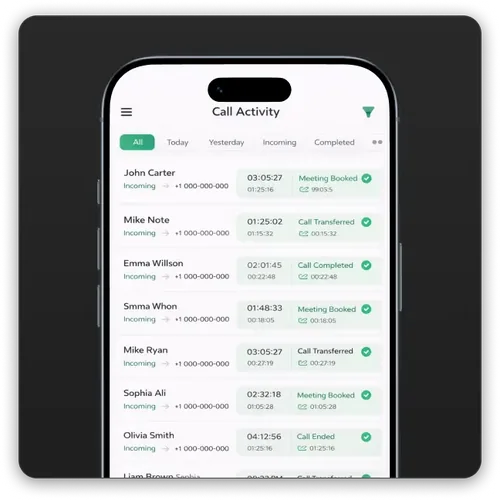
What MCP Means For Your Calling Data
Answers without another login
A sales manager can type “who picked up today and wants a demo?” and get the list without opening a dashboard.
Follow-ups that do not slip
Ask for everyone who requested a callback this week and hand the list to your reps.
Bigly Sales has one
The Bigly Sales MCP server brings call outcomes, transcripts, interested leads and campaign pacing into Claude, ChatGPT and other MCP-compatible assistants.
Five Questions To Ask Any MCP Server
The official MCP documentation includes security best practices worth reading before you connect anything.
Whose permissions does it use?
The safest servers work through your existing account, so the assistant sees only what that account may see.
What can it change?
Know which actions are read-only and which can add, update or launch something.
Who on your team can connect it?
Decide who gets access before anyone links an assistant.
Does it keep your rules in place?
For calling data, consent and do-not-call rules should be enforced by the platform no matter who starts the work.
How will you check the numbers?
Treat an assistant’s answer like a colleague’s: verify any figure you plan to act on against the source.
MCP questions answered
What does MCP stand for?
MCP stands for Model Context Protocol. It is an open standard that lets AI applications such as Claude and ChatGPT connect to outside software, data and tools.
Who created MCP?
Anthropic introduced the Model Context Protocol on November 25, 2024, and released it as an open standard. OpenAI, Google and Microsoft have since added support, which is why it has become the common way AI assistants reach business data. See Anthropic’s announcement.
What is an MCP server?
An MCP server is a program that exposes one system’s data and actions to AI assistants through the Model Context Protocol. A company builds one server and every MCP-compatible assistant can use it.
What is the difference between MCP and an API?
An API is a company’s own interface, and every tool has to be custom-wired to it. MCP is one shared standard that sits on top, so an assistant that speaks MCP can use any MCP server without custom code for each one. Many MCP servers call the company’s API behind the scenes.
Is MCP safe to use with business data?
It can be, if the server and the connection are set up well. Look for a server that works through your own account permissions, decide who on your team may connect an assistant and what it may change, and check any figure you plan to act on.
Do I need to be technical to use MCP?
No. Once a server is connected, you simply ask your assistant questions in plain language. The protocol does its work in the background.
Does Bigly Sales have an MCP server?
Yes. The Bigly Sales MCP server is available to all Bigly Sales customers. It lets Claude, ChatGPT and other MCP-compatible assistants pull call outcomes, transcripts, follow-up lists and campaign pacing from your Bigly account.
Where is the official MCP documentation?
The protocol is documented at modelcontextprotocol.io, including the architecture overview and security best practices.
Put Your Calling Data One Question Away
Bigly Sales runs fully managed AI calling and now connects it to the AI assistant you already use. Book thirty minutes and see it live.


