

A home services cold calling script is a short set of lines your team uses to call homeowners about HVAC, roofing, solar, plumbing and other work on the house.
Most scripts online were written for software reps calling a VP of sales. They tell you to research the prospect on LinkedIn. A homeowner in Tulsa does not have a LinkedIn page about her water heater.
So this guide is built for contractors. You get 24 scripts by trade, a voicemail for each situation, the objection lines homeowners really use and the 2026 rules on who you can call. Every script opens short. That part matters more than anything else on this page.
Key Takeaways
- Open with your name, company and reason in under ten seconds. Long friendly intros sound like a robocall.
- Hand dialed calls to homeowners are legal without consent if the number is not on a do not call list.
- AI and autodialed sales calls need prior express written consent since the FCC’s February 2024 ruling.
- Federal calling hours are 8 a.m. to 9 p.m. Florida, Oklahoma and Maryland stop at 8 p.m. and cap calls at three per day.
- The goal of the first call is a time slot, not a sale.
- Past customers and estimate requests are your easiest legal calls. Cold lists are your hardest.
Table of contents
- What a home services cold calling script is
- Who you can legally call before you dial
- Calling hours and call limits by state
- The shortest legal opener
- Why short intros beat long intros
- How a homeowner call differs from a B2B call
- HVAC cold calling scripts
- Roofing sales scripts
- Solar cold calling scripts
- Scripts for plumbing, windows, bath, pest and lawn
- Follow-up scripts that close the gap
- Voicemail scripts for contractors
- Objection lines homeowners actually use
- How many times to call and when
- Where AI fits and where it does not
- Mistakes that get contractors sued or ignored
- Who these scripts are wrong for
- Home services cold calling FAQ
- The bottom line
What a home services cold calling script is
A home services cold calling script is a written guide for phone calls to homeowners who have not asked you to call today. It covers what to say first, the one question to ask, how to answer pushback and the small next step you want.
It is not a word for word speech. Reps who read sound like they are reading. Homeowners hang up on that.
Think of each script as a skeleton. Learn the order, then say it your way.
If you sell to businesses, our 32 outbound sales call scripts fit better. Agents calling sellers should use the real estate cold calling scripts. This page is only for work on the home.
Who you can legally call before you dial
Get this part right and the scripts below are safe to use. Get it wrong and one campaign can cost more than a year of jobs.
The Telephone Consumer Protection Act lets a homeowner sue for $500 per violating call. A court can triple that to $1,500 when the violation was willful.
Here is the short version for each kind of contact.
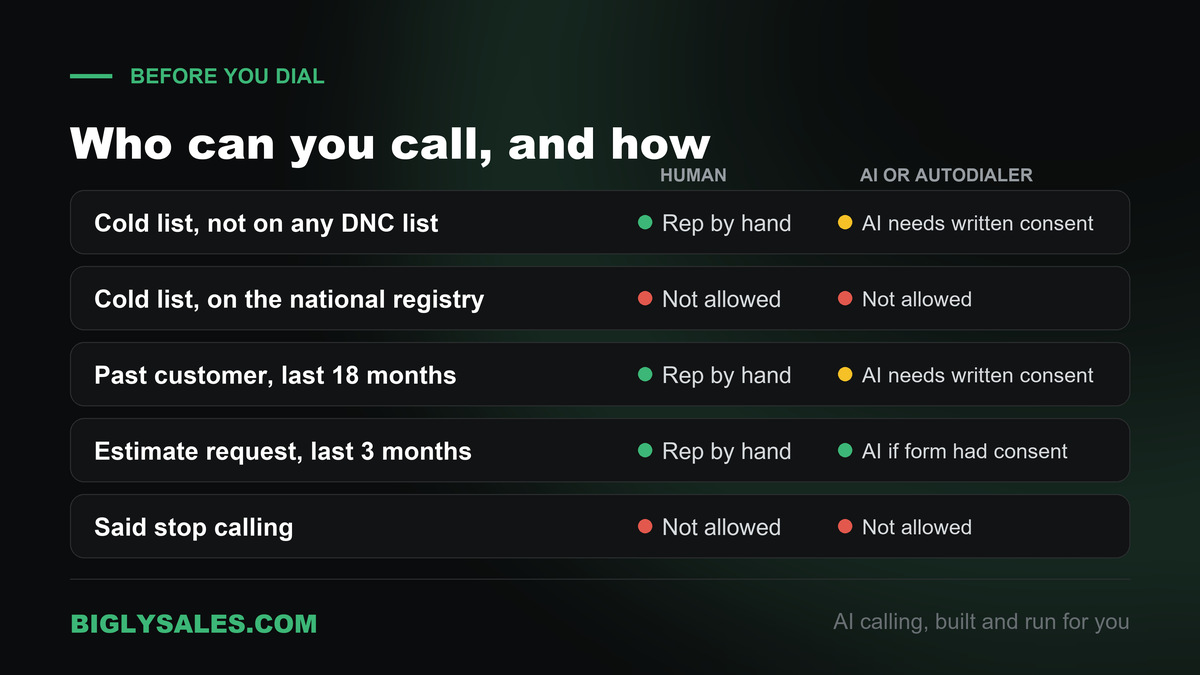
| Who you are calling | A rep dialing by hand | Autodialer or AI voice | What to check |
|---|---|---|---|
| Cold list, not on any do not call list | Allowed | Needs prior express written consent | Scrub against the national registry every 31 days |
| Cold list, on the national registry | Not allowed | Not allowed | No exceptions without consent or a relationship |
| Past customer, bought in the last 18 months | Allowed, even if on the registry | Needs written consent | Established business relationship |
| Asked for an estimate in the last 3 months | Allowed, even if on the registry | Allowed if your form had a written consent line | Keep the form and timestamp |
| Anyone who said stop calling | Not allowed | Not allowed | Internal do not call list, forever |
Three things in that table trip up most contractors.
AI voices count as artificial voices
In February 2024 the FCC ruled that AI generated voices fall under the TCPA’s rules for artificial or prerecorded voices. So an AI agent calling a cold list of cell phones needs the same written consent as a robocall. There is no loophole for a voice that sounds human.
We cover the full consent rules in our guide to TCPA consent for AI voice calls.
Your estimate form is a legal document
The FTC says an inquiry creates an established business relationship for three months. A purchase creates one for 18 months. During those windows a rep can call even if the number is on the national registry. See the FTC’s Telemarketing Sales Rule guide for the exact wording.
If you want AI or a dialer to make those calls, your form needs a clear written consent line. Keep the record of who checked it and when.
Stop means stop, and the rule just changed
The FCC published an updated consent revocation rule on October 26, 2026. It takes effect November 25, 2026. A homeowner who says stop to your marketing calls has ended all of your marketing calls to them. You still have up to ten business days to process it, but your rep should mark it on the call.
Calling hours and call limits by state
The federal window is 8 a.m. to 9 p.m. in the homeowner’s time zone. Their time zone, not yours.
Several states are tighter. These are the ones home services teams hit most often.
| Where | Earliest call | Latest call | Call limit |
|---|---|---|---|
| Federal rule | 8 a.m. | 9 p.m. | None set |
| Florida | 8 a.m. | 8 p.m. | 3 calls per 24 hours on the same subject |
| Oklahoma | 8 a.m. | 8 p.m. | 3 calls per 24 hours on the same subject |
| Maryland | 8 a.m. | 8 p.m. | 3 calls per 24 hours on the same subject |
| Pennsylvania | 9 a.m. | 7 p.m. | No calls on Sundays or legal holidays |
That is not the full list. Our state by state TCPA guide has calling hours for all 50 states and DC.
The shortest legal opener
Federal rules set a floor on how short your opener can be.
The FTC’s rule says a sales caller must promptly give the seller’s name, say the call is a sales call and say what it is about. The FCC’s rule adds the caller’s own name and a phone number or address where the business can be reached. The FTC reads promptly as before any pitch.
So the shortest legal opener has four pieces.
- Your first name.
- Your company.
- Why you are calling this house.
- One easy question.
It sounds like this.
“Hi Dana, this is Mike with Ridgeline Roofing. I’m calling about the hail on Oak Street last week. Do you have thirty seconds?”
That is about six seconds out loud. Give your callback number before you hang up, or when they ask.
If an AI agent makes the call, add one line. “I’m an AI assistant calling for Ridgeline Roofing.” Federal law does not require it yet. Some states do in some cases, and homeowners trust it more. Our AI disclosure laws guide covers the details.
Why short intros beat long intros
Bigly Sales CEO Tom Ryan made this point in a team meeting on November 2, 2026. His example was an opener like “Hi Tom, congratulations on your new business, I hope your week is going great.” He said that is exactly what a robocall sounds like, and people hang up.
A homeowner decides in the first few seconds whether you are a person with a reason or a list with a voice. Warm filler does not buy goodwill. It buys suspicion.
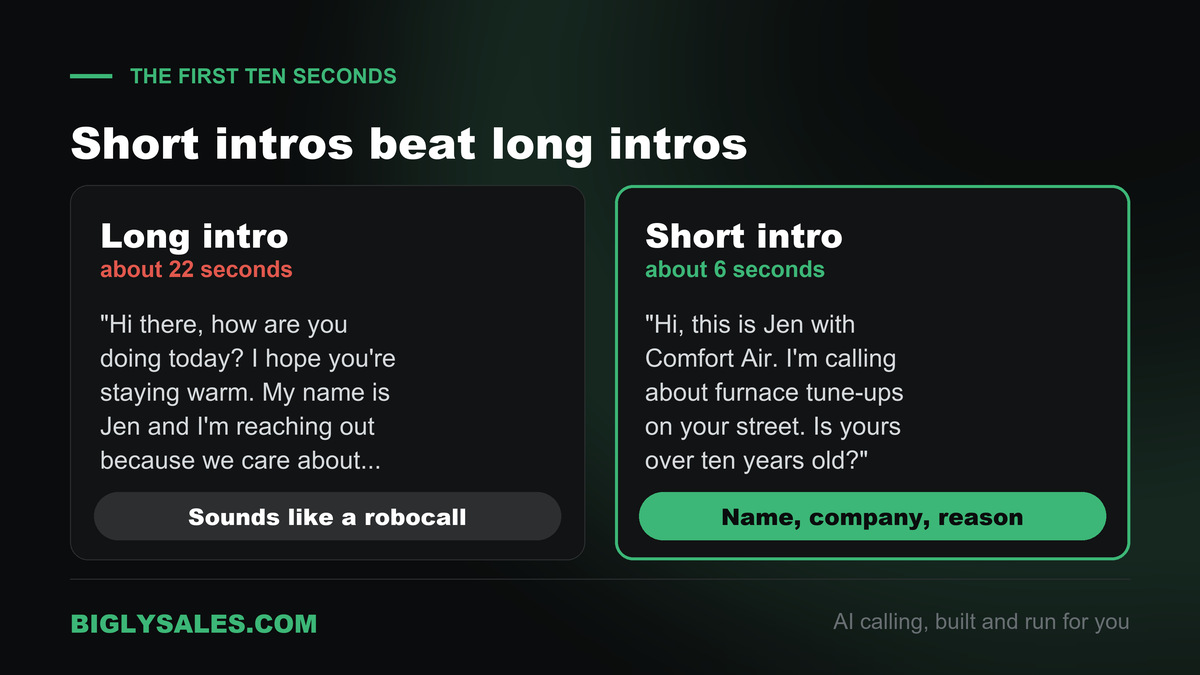
| Call | Long intro that sounds like a robocall | Short intro that earns the next ten seconds |
|---|---|---|
| HVAC tune-up | “Hi there, how are you doing today? I hope you’re staying warm. My name is Jen and I’m reaching out from Comfort Air because we care about families in your area…” | “Hi, this is Jen with Comfort Air. I’m calling about fall furnace tune-ups on your street. Is your system more than ten years old?” |
| Roofing after a storm | “Good afternoon, I’m just calling to check in on you and your family after the big storm we had…” | “Hi, this is Mike with Ridgeline Roofing. We’re inspecting roofs on Oak Street after Tuesday’s hail. Did you see any damage?” |
| Solar follow-up | “Hi, I hope I’m not bothering you, I’m calling because we have some really exciting news about energy savings…” | “Hi Sam, this is Priya with Brightline Solar. You asked for a quote on our site Monday. Is your electric bill over $150 a month?” |
| Plumbing past customer | “Hello, this is a courtesy call from your friends at Pipeworks, we just wanted to take a moment…” | “Hi Luis, this is Ray from Pipeworks. We put in your water heater in 2024. It’s due for a flush. Want me to book it?” |
Notice what the short versions do. They name the company. They give a reason tied to this house. They ask a question the homeowner can answer in one word.
How a homeowner call differs from a B2B call
Four things change when the person on the line owns the house instead of a budget.
The decision is shared
A new roof or HVAC system is usually a couple’s decision. Plan for it. Book the visit when both can be home instead of fighting “I need to ask my wife.”
The next step is a visit, not a meeting
Your close is a two hour window on a specific day. Offer two options. “Thursday morning or Saturday afternoon” beats “when works for you.”
Trust comes from the street, not a title
B2B reps lean on job titles and logos. Homeowners trust a job on their street, a neighbor’s name with permission or your license number.
Timing follows the weather
Furnace calls in October. AC calls in April. Roof calls the week after hail. Gutter calls before leaves fall. The season is your reason for calling.
Free setup call
Call every estimate request in under 60 seconds
Bigly Sales calls your web leads, books the visit and transfers hot calls live to your team, with calling hours and consent checked before every dial. A 30 minute call is all it takes to map it to your trades.
HVAC cold calling scripts
HVAC is the easiest trade to call because every system needs service. Lead with the season and the age of the system.
1. Seasonal tune-up
Use it when the season is about to turn and you have open slots.
“Hi, this is Jen with Comfort Air. I’m calling homeowners on Maple about fall furnace tune-ups. Has yours been checked since last winter?”
If no. “We have openings Tuesday and Thursday this week. It takes about an hour. Which day is easier?”
2. Older system replacement
Use it when you are calling a neighborhood built in the same years, so systems are about the same age.
“Hi, this is Jen with Comfort Air. Most homes on your street were built around 2008, so the original AC units are getting close to the end. Is yours still the original?”
If yes. “We do a free check that tells you how many good years it has left. No pitch if it’s fine. Want me to set that up?”
3. Unsold estimate follow-up
Use it when you quoted a job in the last few weeks and heard nothing back.
“Hi Tom, this is Jen from Comfort Air. Our tech Mark quoted your heat pump on the 3rd. I’m calling to see where you landed. Did anything in the quote raise questions?”
This is the highest return call in HVAC. The homeowner already invited you in.
4. Maintenance plan renewal
Use it when a past customer’s plan is about to lapse.
“Hi Ana, this is Jen with Comfort Air. Your maintenance plan runs out at the end of the month. Want me to renew it and book your spring visit at the same time?”
Roofing sales scripts
Roofing calls live or die on proof that you are local. Name the street, the storm or the job.
5. After a hail or wind storm
Use it when a storm hit an area you serve in the last week or two.
“Hi, this is Mike with Ridgeline Roofing. We’re inspecting roofs on Oak Street after Tuesday’s hail. Have you noticed any leaks or missing shingles?”
If unsure. “Most damage isn’t visible from the ground. Our inspection is free and takes about 30 minutes. Would tomorrow or Friday work?”
Check your city and county rules on storm work, permits and door to door sales before you run a storm campaign. Some states, including Florida, also limit how roofers can talk about insurance claims.
6. Job on their street
Use it when you are working on a neighbor’s roof this week.
“Hi, this is Mike with Ridgeline Roofing. We’re replacing a roof at 412 Oak this week, so our crew is on your street. If you’ve wondered about your roof, we can look while we’re there. Any interest?”
Only name the neighbor’s address if that customer agreed to it.
7. Aging roof
Use it when public records or your own past work show roofs in the area are 15 to 20 years old.
“Hi, this is Mike with Ridgeline Roofing. Homes in Westfield are hitting the 20 year mark, which is about when asphalt roofs start to fail. Do you know how old yours is?”
8. Insurance inspection follow-up
Use it when the homeowner asked about an inspection after filing or thinking about a claim.
“Hi Carla, this is Mike with Ridgeline. You asked us about a roof check for your claim. Has your adjuster been out yet?”
“We can meet the adjuster on site so nothing gets missed. When is the visit scheduled?”
Solar cold calling scripts
Solar gets more complaints than any other home trade, so homeowners are on guard. Be plain. Never say “free panels” or imply a government program.
9. Web quote callback
Use it when someone requested a solar quote online.
“Hi Sam, this is Priya with Brightline Solar. You asked for a quote on our site a few minutes ago. I have two quick questions so the estimate is real. Do you own the home, and is your bill usually over $150 a month?”
Speed matters most here. Our speed to lead guide shows why the first few minutes decide who gets the job.
10. Neighborhood install
Use it when you just finished an install nearby.
“Hi, this is Priya with Brightline Solar. We finished a system on Birch Lane last week and the owners agreed we could mention it. Homes on your street get similar sun. Have you ever looked at what solar would save you?”
11. Rate change reason
Use it when your utility announced a rate increase that is public and verifiable.
“Hi, this is Priya with Brightline Solar. Your utility’s new rates start next month. A lot of homeowners are asking what that does to their bill. Would a five minute look at your numbers help?”
Only cite a rate change you can point to. Made up urgency is the fastest way to a complaint.
12. Stalled quote
Use it when you sent a proposal and the homeowner went quiet.
“Hi Sam, this is Priya from Brightline. I sent your proposal two weeks ago. Most people get stuck on financing or the roof. Which one is it for you?”
Scripts for plumbing, windows, bath, pest and lawn
13. Plumbing, water heater age
Use it when you installed or serviced their water heater years ago.
“Hi Luis, this is Ray from Pipeworks. We installed your water heater in 2017, so it’s getting up there. Want us to check it before it fails on a cold morning?”
Past customers are your easiest plumbing calls. Our guide to AI calling for plumbers covers the missed call side.
14. Windows and doors
Use it when homes in the area still have original windows.
“Hi, this is Kim with ClearView Windows. We’re working on a few homes in Pine Ridge with the original 1990s windows. Do you notice drafts or foggy glass in yours?”
15. Bath remodel callback
Use it when someone downloaded a design guide or asked for pricing.
“Hi Rosa, this is Kim from Fresh Bath. You looked at our walk-in shower pricing yesterday. Is this for you or a parent? That changes what I’d suggest.”
16. Pest control seasonal
Use it when the season for a common pest is starting.
“Hi, this is Dev with Shield Pest. Termite swarm season starts in your area next month. When was your home last inspected?”
17. Lawn and landscaping
Use it when you service other yards nearby.
“Hi, this is Matt with GreenRow Lawn. We mow four yards on Cedar Court, so we’re already there on Tuesdays. Would you like a price to add yours?”
18. Gutters before leaf season
Use it when fall is coming and you clean or guard gutters nearby.
“Hi, this is Matt with GreenRow. We’re cleaning gutters on Cedar Court the week of the 20th. Want me to add yours while the crew is there?”
For more on running these calls at scale, see our guide to AI calling for home improvement companies.
Follow-up scripts that close the gap
Most home services revenue hides in leads you already paid for. These calls are also the safest legally, because the homeowner reached out first.
19. Missed inbound call
Use it when a homeowner called and nobody answered.
“Hi, this is Jen with Comfort Air. You called us about 10 minutes ago and we missed you. I’m sorry about that. What’s going on with the system?”
20. No-show for the estimate
Use it when the homeowner was not home for the appointment.
“Hi Tom, this is Jen from Comfort Air. Mark stopped by at 2 and missed you. No problem at all. Would tomorrow morning or Thursday evening work better?”
21. Aged lead, 60 to 90 days old
Use it when a quote request went cold.
“Hi Dana, this is Mike with Ridgeline. You asked about a roof inspection back in August. Did you get it handled, or is it still on your list?”
Remember the three month rule. An inquiry older than three months no longer lets you call a number on the national registry without other consent.
22. Review and referral ask
Use it when a job finished in the last week.
“Hi Ana, this is Jen with Comfort Air. Mark finished your install Friday. How’s the new system running? If you’re happy, would you mind leaving a quick review? It helps a small company a lot.”
Voicemail scripts for contractors
Keep voicemails under 20 seconds. Say your number twice. Give one reason to call back.
Let the phone ring at least 15 seconds or four rings before you hang up. That is FTC guidance, and it also stops you from looking like a dialer that drops calls.
23. First voicemail
Use it when first attempt, no answer.
“Hi Dana, it’s Mike with Ridgeline Roofing, 555-0142. We’re inspecting roofs on Oak Street after Tuesday’s hail and have two slots left Friday. Call or text me at 555-0142.”
24. Last voicemail
Use it when after four or five tries.
“Hi Dana, Mike from Ridgeline again, 555-0142. I won’t keep calling. If your roof ever needs a look, save my number. Thanks.”
Prerecorded or AI voicemail drops count as artificial voice calls. Use them only with written consent.
Objection lines homeowners actually use
These are the six you will hear most. The first move is always a question, not a rebuttal.
| What they say | What it usually means | What to say back |
|---|---|---|
| “Not interested” | You caught them at a bad time or the reason was weak | “Fair enough. Is it the timing, or is the roof just fine?” |
| “We already have a guy” | They are happy until something breaks | “Good. When did he last check it? We’re glad to give a free second opinion.” |
| “How much does it cost?” | They are interested but scared of a number | “It depends on the house. Our visit is free and the quote is in writing. Thursday or Saturday?” |
| “Send me some information” | A polite way out, or real interest | “Happy to. What would you want to see, price or photos of jobs nearby?” |
| “I need to talk to my spouse” | A shared decision | “Makes sense. Let’s book it for when you’re both home. Evenings or weekends?” |
| “How did you get my number?” | Trust is low | Tell the truth. Then offer to take them off your list right away. |
When someone asks you to stop calling, say “Got it, I’ll take you off our list,” and do it before the next call.
How many times to call and when
The most cited data on call timing comes from a 2007 study by InsideSales.com and MIT. It looked at more than 100,000 call attempts across six companies.
- Calling a lead within 5 minutes made contact about 100 times more likely than calling at 30 minutes.
- 4 to 6 p.m. was the best window to reach people.
- Wednesday and Thursday were the best days.
One caveat. That study used inbound web leads, not cold lists of homeowners. Use it as a starting point and test your own hours.
A cadence that works for most contractors is five or six attempts over about ten days. Mix morning, late afternoon and early evening. Leave one voicemail early and one at the end. In Florida, Oklahoma and Maryland, never go over three calls in 24 hours.
High volume dialing from one number gets it flagged as spam. Our guide to fixing Spam Likely labels explains how to keep your numbers clean.
Where AI fits and where it does not
AI voice agents are good at the calls humans skip. They are not a legal shortcut for cold lists.
| Call type | AI agent | Human rep | Why |
|---|---|---|---|
| Web form callback in under a minute | Strong fit | Often too slow | Speed decides the job and the homeowner gave written consent on the form |
| After hours and weekend calls | Strong fit | Usually not staffed | Leads come in when the office is closed |
| Unsold estimate follow-up | Good fit with consent | Good fit | Repetitive and often skipped by busy reps |
| Cold list, no consent | Not allowed | Allowed if not on a do not call list | AI voices count as artificial voices under the TCPA |
| In-home sales close | Not a fit | Required | Big tickets need a person in the house |
The pattern that works is simple. AI calls fast, qualifies and books. When a homeowner wants to talk now, the call transfers live to your rep.
Mistakes that get contractors sued or ignored
- Buying a list and loading it into an AI dialer. Without written consent every call is a potential $500 claim.
- Calling by your clock instead of theirs. An 8 a.m. call from Chicago lands at 7 a.m. in Denver, which breaks the federal rule.
- Burying your company name. If they have to ask who you are, you are already losing.
- Promising insurance will pay. That is the adjuster’s call, and some states, including Florida, restrict it.
- Ignoring a stop request because “he didn’t mean it.” Treat every stop as real.
- Fake urgency. “This offer ends today” on a roof that isn’t leaking reads as a scam.
Who these scripts are wrong for
If you only get a handful of leads a week and the owner answers every call, you do not need scripts or software. You need to pick up the phone.
Commercial work is different too. Calls to property managers and facilities directors are mostly business to business, and the FTC rule exempts most of them. Use the B2B scripts in our 32 script guide instead.
And if your main source is a purchased cold list of cell phones, AI calling will not fix that. Fix the list first, or build inbound and consent based leads.
Home services cold calling FAQ
Is it legal to cold call homeowners?
Yes, with limits. A person dialing by hand can call a homeowner’s landline or cell phone without prior consent, as long as the number is not on the National Do Not Call Registry or your own do not call list, and you call between 8 a.m. and 9 p.m. their time. Some states set tighter hours and daily limits. Autodialed and AI voice sales calls need prior express written consent.
Can I call homeowners who are on the Do Not Call list?
Only in two cases. You have the person’s signed written agreement to receive your calls, or you have an established business relationship. Under FTC guidance that relationship lasts 18 months after a purchase or service and 3 months after they asked you a question or requested an estimate. Anyone who tells you to stop calling goes on your internal list for good.
Is it legal to use AI to cold call homeowners?
Not on a cold list. In February 2024 the FCC ruled that AI generated voices count as artificial voices under the TCPA. That means AI sales calls to cell phones and home phones need the homeowner’s prior express written consent. AI calling works for people who filled out your form, asked for a quote or agreed in writing to hear from you.
What should I say first on a cold call to a homeowner?
Say your name, your company and why you are calling this home, in one breath. Then ask one easy question. For example, this is Mike with Ridgeline Roofing, I am calling about the hail on Oak Street last week, do you have thirty seconds. That covers the federal disclosure rules and earns the next ten seconds.
What is the best time to call homeowners?
The most cited data comes from a 2007 InsideSales.com and MIT study of web leads. It found 4 to 6 p.m. best for reaching people and Wednesday and Thursday the best days. That study used inbound leads, not cold lists, so test your own hours. Stay inside 8 a.m. to 9 p.m. federally and 8 p.m. in states like Florida, Oklahoma and Maryland.
How long should a home services cold call last?
The opener should take under ten seconds. Most first calls that go well end in two to four minutes with a booked inspection or estimate. Do not try to sell the job on the phone. The goal of a cold call to a homeowner is one small yes, usually a time slot for someone to look at the house.
How many times should I call a homeowner before giving up?
There is no federal number, but Florida, Oklahoma and Maryland cap sales calls at three per 24 hours on the same subject. A practical cadence is five or six attempts over about ten days, mixing times of day, with one voicemail and one text if you have consent to text. Stop at once if they ask you to.
What do I say when a homeowner says they already have a contractor?
Agree with them. Most homeowners who already have a roofer or HVAC company are happy until something goes wrong. Ask one question, such as when they last had the system checked, and offer a second opinion with no cost. If they still say no, thank them and note it. Pushing past a clear no only earns a complaint.
Do I have to say my calls are recorded or that I am using AI?
Recording rules depend on the state. Some states, including California and Florida, require everyone on the call to agree before recording, so a short notice at the start is the safe default. For AI, federal law does not yet require you to say it is AI, but some state laws do in certain cases. Saying it up front protects you and keeps trust.
What happens if a contractor breaks the TCPA?
Homeowners can sue for $500 per violating call, and up to $1,500 per call if a court finds the violation was willful or knowing. Do Not Call suits can start after more than one call in a 12 month period. Class actions add these up across every call in a campaign, which is why one bad list can cost more than a year of jobs.
The bottom line
A good home services cold call is short, local and legal. Say who you are, why you are calling this house and ask one question. Aim for a time slot, not a sale.
The bigger win is usually not colder calls. It is calling every estimate request, missed call and stalled quote fast, with consent and calling hours checked before every dial.
Talk to our team
Stop losing estimate requests to slow callbacks
Bigly Sales plans start at $99 a month for inbound and outbound AI calling, fully managed. Most teams go live within 24 hours of a free setup call.