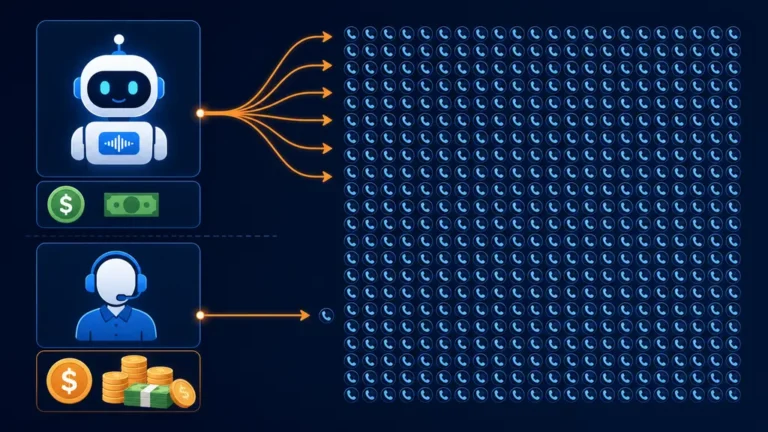


Speed to lead is the elapsed time between a prospect raising their hand and a real human conversation starting. Not an auto-reply email. Not a lead assigned in your CRM. A two-way conversation.
If speed is the gap you need to close, see how AI lead follow up calls every new lead back in under sixty seconds.
In insurance, lending and home improvement, that clock decides who gets the sale, because the same buyer is usually in front of three or four sellers at once. The company that reaches them first is not slightly ahead. It is having a different conversation than everyone who calls later, because it is talking to someone who has not yet formed an opinion.
This post does the arithmetic for those three verticals. It also does something most speed to lead content avoids, which is telling you exactly where the famous multipliers came from and how much weight they can carry.
TL;DR
Calling a new inbound lead in under 60 seconds raises contact rate, and contact rate is the first term in every conversion equation, so a modest gain there compounds through quote rate and close rate. In the insurance model below, moving from a 32 percent contact rate to 47 percent on 1,000 monthly leads produces 13 additional policies bound and cuts cost per acquisition from 643 dollars to 439 dollars.
Those are modeled figures using stated assumptions, not measured results. Be careful with the widely repeated 21x, 100x and 391 percent multipliers, because all of them trace back to vendor-funded research. Speed does not help at all if your leads are low intent or your offer is wrong, and calling faster on a bad list only annoys people faster.
Key takeaways
- Speed to lead means time to a two-way conversation, not time to lead assignment or an auto-reply.
- The 60 second threshold matters because of buyer attention and shared-lead competition, not because of a magic number.
- The famous speed to lead multipliers come from vendor-funded studies and should be treated as directional only.
- You do not need those studies, because the arithmetic works with your own contact rates.
- A 15 point contact-rate gain on 1,000 insurance leads models to 53,040 dollars of additional annual commission.
- Measure the median, not the mean, and count leads you never reached instead of excluding them.
- Speed never overrides consent, calling hours or state telephone solicitation rules.
Table of contents
- What speed to lead is
- Why 60 seconds is the threshold that matters
- Where the famous multipliers came from
- The conversion math that needs no vendor study
- Insurance: the shared lead problem
- Lending and mortgage: the one lender problem
- Home improvement: the estimate window
- The three verticals compared
- Where the minutes actually go
- How to measure speed to lead honestly
- How to get under 60 seconds
- Compliance guardrails on fast calling
- How Bigly Sales fits
- Speed to lead FAQ
- The bottom line
What speed to lead is
Speed to lead is the measured time between a prospect submitting an inquiry and a salesperson or agent starting a live two-way conversation with them. It is a response-time metric, and the definition matters more than most teams realize, because three different clocks get reported under the same name.
The first clock is time to assignment, which is how long until the lead appears in a rep’s queue. The second is time to first dial, which is how long until someone attempts contact. The third is time to first conversation, which is how long until a human actually talks. Only the third one predicts revenue. A team that assigns leads in four seconds and dials them in eleven minutes does not have good speed to lead. It has good routing.
The related term is lead response time, which is often used interchangeably. Our speed to lead overview covers the operational definition in more detail, and the AI outbound calling playbook covers how automated dialing fits into the workflow. This post is about the money.
Why 60 seconds is the threshold that matters
There is nothing physically special about 60 seconds. The threshold matters because of what is true about the buyer inside that window and false outside it.
They are still in the moment
At 30 seconds after submitting a form, the prospect is looking at a confirmation screen, holding the phone they typed their number into, and thinking about the thing they just asked for. A call in that window reads as service. The same call at 20 minutes reads as an interruption from a company they have half forgotten contacting.
They have not shopped further yet
Comparison shopping is sequential. Someone requesting an insurance quote at 9:02 is often on a second comparison site by 9:06 and a third by 9:11. Reaching them at 9:03 means you are the only voice in the conversation. Reaching them at 9:25 means you are the fourth.
Shared leads go out to everyone at once
In insurance and lending especially, a large share of web leads are sold to several buyers simultaneously. Every buyer receives the same record within seconds of each other. In that market, speed to lead is not an optimization. It is the entire competitive position, because the winner is decided in the first few minutes and the other buyers are paying full price for a conversation that already happened.
The person answering is a different person later
Someone who just requested a quote expects a call. Someone who requested a quote yesterday has moved on, does not recognize the number, and screens it. That is the mechanism behind the drop in contact rate, and it is why the biggest gain from speed to lead shows up in the contact-rate term rather than in the close-rate term.
Where the famous multipliers came from
If you have read anything about lead response time you have seen three numbers. Calling within five minutes makes you 21 times more likely to qualify a lead. Contact rates are 100 times higher inside five minutes. Responding in the first minute lifts conversion by 391 percent. Here is where each one actually comes from, because the provenance changes how much you should lean on them.
The 21x and 100x figures
Both come from the Lead Response Management study led by James Oldroyd, first circulated in 2007. The study was funded by InsideSales.com, a company selling lead response software, and the underlying data came from firms that were already customers or partners. The design was not randomized, so the comparison is between companies that happened to respond quickly and companies that happened to respond slowly, which are not otherwise similar organizations. It has not been independently replicated at that magnitude.
The 391 percent figure
This traces to Velocify, another lead response software vendor, in a report on contact strategy. Same structural issue. A vendor measuring an outcome its own product is sold to improve, using data from its own customer base, with no control group.
The most defensible one
The strongest study in this area is “The Short Life of Online Sales Leads,” published in Harvard Business Review in March 2011 by James Oldroyd, Kristina McElheran and David Elkington. It looked at roughly 1.25 million online sales leads and found that firms attempting contact within an hour were nearly seven times as likely to qualify the lead as those that waited an hour longer. That is a much more modest claim than 21x, over a much larger sample, published in a peer-reviewed outlet.
It still comes with caveats. Elkington founded InsideSales.com, so vendor involvement did not disappear. The data is from companies that volunteered it. And it is 2011 data, from before the current mobile and comparison-shopping behavior took hold.
What to do with all of this
Treat every published speed to lead multiplier as directional. Directionally, faster contact produces more contact, and every serious study points the same way. Quantitatively, do not put a vendor’s multiplier in your business case, because you will not hit it and you will have staked your credibility on someone else’s marketing. Use your own numbers instead, which is what the next section does.
The conversion math that needs no vendor study
Conversion from an inbound lead is a chain of rates multiplied together. Speed to lead moves the first term. Because the terms multiply, a change in the first one carries through everything downstream, which is why speed pays out more than its size suggests.
The chain looks like this. Leads received, times contact rate, times qualification or quote rate, times close rate, times revenue per sale. Speed changes contact rate. It does not directly change quote rate or close rate, and any model that claims it does is overreaching.
Everything below is a model. The rates are stated assumptions chosen to be conservative relative to any published multiplier. Replace them with your own numbers from your own CRM and rerun the arithmetic. The point is the structure, not the totals.
Insurance: the shared lead problem
Insurance is the clearest case because the leads are usually shared, the purchase decision is fast, and the product is close to a commodity, so whoever quotes first anchors the comparison.
The model
An agency buys 1,000 auto and home web leads a month at 18 dollars each, for 18,000 dollars of lead spend. Modeled downstream rates are a 40 percent quote rate from every contacted lead, a 22 percent bind rate from every quote, and 340 dollars of first-year commission per policy bound.
At a 32 percent contact rate, which is typical when the median first dial happens around half an hour after the form is submitted, the agency contacts 320 people. That produces 128 quotes and 28 policies bound, for 9,520 dollars of commission. Cost per bound policy is 18,000 divided by 28, or 643 dollars.
At a 47 percent contact rate, a 15 point gain from calling inside 60 seconds, the agency contacts 470 people. That produces 188 quotes and 41 policies bound, for 13,940 dollars. Cost per bound policy falls to 18,000 divided by 41, or 439 dollars.
What that means
Thirteen more policies a month from the same leads, the same agents and the same offer. That is 4,420 dollars of additional monthly commission and 53,040 dollars a year. Cost per acquisition drops 32 percent.
Now run it pessimistically. If the contact-rate gain is only 8 points rather than 15, the agency contacts 400 people, writes 160 quotes and binds 35 policies. That is still 7 more policies a month and 28,560 dollars a year. The conclusion survives a much smaller assumption than any vendor figure. Agencies working this way usually pair it with the coverage on our insurance calling page.
Sixty second callback
Every lead called before it cools
We will connect your lead source and show a live callback firing in under a minute. Twenty five minutes on a call is all it takes.
Lending and mortgage: the one lender problem
Lending has a structural quirk that makes speed to lead worth more than in most categories. Borrowers shop far less than people assume.
In its 2015 report on the National Survey of Mortgage Borrowers, covering consumers who took out a home purchase mortgage in 2013, the Consumer Financial Protection Bureau found that almost half of borrowers seriously considered only a single lender before applying, and about 77 percent applied to only one. You can read the CFPB mortgage shopping research directly. The data is a decade old and behavior has shifted somewhat, but the direction is clear. For a large share of borrowers, the first lender to have a real conversation is the only lender they talk to.
The model
A lender works 600 purchase and refinance inquiries a month. Modeled rates are an 18 percent application rate from every contacted borrower, a 55 percent funding rate from application, and 4,200 dollars of revenue per funded loan.
At a 30 percent contact rate the lender reaches 180 borrowers, takes 32 applications and funds 18 loans, for 75,600 dollars. At a 45 percent contact rate it reaches 270 borrowers, takes 49 applications and funds 27 loans, for 113,400 dollars.
Nine more funded loans a month is 37,800 dollars of additional monthly revenue on the same acquisition spend. Even at a third of that contact-rate gain the arithmetic still clears any reasonable cost of automating the first call. Our mortgage and home lending page covers the workflow specifics.
The honest caveat for lending
Rate-table and aggregator leads in lending are often resold, sometimes several times, and a portion of them are simply bad. Faster calling on a bad list produces faster rejection, not more loans. Speed to lead is a multiplier on lead quality, not a substitute for it. If your contact rate is low because the phone numbers are wrong, calling in 30 seconds changes nothing.
Home improvement: the estimate window
Home improvement works differently again. The buyer is not comparing prices on a screen. They are collecting estimates, and the constraint is calendar slots, not quotes.
A homeowner requesting a roof, window, HVAC or bath estimate typically intends to see two or three contractors. The first contractor to reach them books the first appointment, and the first appointment sets the reference price and the reference standard. Later contractors are responding to that. Being third to call is not being third in line. It is often being excluded, because two appointments already fill the homeowner’s tolerance for having strangers in the house.
The model
A regional contractor receives 400 form fills a month. Modeled rates are a 45 percent appointment-set rate from every contacted homeowner, a 70 percent sit rate, a 30 percent close rate, an average job value of 9,500 dollars and a 35 percent gross margin, giving 3,325 dollars of contribution per job.
At a 35 percent contact rate the contractor reaches 140 homeowners, sets 63 appointments, sits 44 and closes 13 jobs. At a 52 percent contact rate it reaches 208 homeowners, sets 94 appointments, sits 66 and closes 20 jobs.
Seven additional jobs a month at 3,325 dollars of contribution is 23,275 dollars a month. For a contractor, that is usually the difference between a crew being fully booked and a crew having gaps. Details on how this runs are on our home services page.
The three verticals compared
The mechanism is the same across all three. What differs is why the buyer stops being reachable.
| Vertical | Why speed decides it | Modeled contact rate, slow to fast | Extra sales per month | Modeled monthly gain |
|---|---|---|---|---|
| Insurance | Shared leads reach several agencies at once and the first quote anchors the comparison | 32 to 47 percent | 13 policies | 4,420 dollars commission |
| Lending and mortgage | Most borrowers apply with only one lender, so the first real conversation often ends the shopping | 30 to 45 percent | 9 funded loans | 37,800 dollars revenue |
| Home improvement | Homeowners have room for two or three estimates and the first booked appointment sets the reference | 35 to 52 percent | 7 jobs | 23,275 dollars contribution |
Where the minutes actually go
Almost no team intends to call slowly. The delay is assembled out of small, individually reasonable steps.
The handoff chain
A form submits. A webhook fires, sometimes on a queue with a delay. An enrichment or deduplication service runs. A routing rule assigns the lead round robin. The assigned rep is on another call, at lunch, or has 14 other new leads in the queue. Each step is defensible and the total is 22 minutes.
The coverage gaps
Most inbound volume does not respect your staffing chart. Leads arrive at 7:40pm, on Saturday morning, and during the Monday pipeline meeting when every rep is in a room. A team with excellent weekday response times and no evening or weekend coverage still has a poor median across all leads, because the uncovered hours are where a large share of consumer form fills happen.
The measurement gap
Many teams believe their speed to lead is good because their dashboard shows an average of four minutes. That average almost always excludes leads that were never contacted at all, which are precisely the leads that went cold. Removing your worst cases from the average and then reporting the average is how a 22 minute operation reports four minutes.
How to measure speed to lead honestly
Four rules make the number trustworthy.
Report the median, not the mean
Response times are heavily skewed. A handful of instant callbacks pull the mean down while most leads wait far longer. The median tells you what a typical lead experienced.
Measure to conversation, not to dial
Track both time to first dial and time to first two-way conversation, and report the second one as your headline speed to lead metric. The gap between them is your dialing efficiency problem, which is a separate fix from your routing problem.
Count the leads you never reached
Every lead with no conversation should appear in the denominator. If you never reached 40 percent of a month’s leads, your true speed to lead figure has to reflect that rather than quietly dropping those records.
Segment by hour and day of week
An overall median hides the pattern. Break it out by hour of arrival and day of week and the gaps become obvious, usually early morning, after 6pm, and weekends. Those buckets are where the cheapest improvement lives.
How to get under 60 seconds
Getting inside a minute reliably requires removing humans from the trigger, not asking humans to hurry.
- Fire the call directly from the form submission event rather than from a CRM sync that runs on a schedule.
- Attempt contact before enrichment finishes, and enrich in parallel rather than in sequence.
- Give the first call one job, which is to confirm interest and book or transfer, not to sell.
- Warm transfer to a licensed human the moment the prospect qualifies, since in insurance and lending the sale usually needs one.
- Cover every hour the form is live, because a form that accepts leads at 9pm creates a 9pm response obligation.
- Set an escalation path for the calls the automation cannot handle, and review those weekly.
- Keep a second and third attempt on a defined cadence, since first-attempt-only programs give up most of their reachable leads.
Compliance guardrails on fast calling
Speed is never a defense. Every fast-calling program still has to satisfy the same rules a slow one does, and the fast ones draw more attention because they generate more call records.
Under the Telemarketing Sales Rule, telemarketing calls to consumers are restricted to the hours between 8am and 9pm in the called party’s local time, and sellers must scrub against the National Do Not Call Registry unless an exemption applies. The Federal Trade Commission publishes the operative Do Not Call guidance for telemarketers and sellers. Local time is what matters, not your time, which is a common failure in fast automated callbacks that fire the instant a form arrives.
More than fifteen states run their own telephone solicitation statutes with tighter calling windows, stricter consent wording and caps on repeat calls about the same subject. Florida’s Telephone Solicitation Act is the model several other states copied, and it carries a private right of action, so a per-state rule set is not optional for a national program.
One correction worth making
The FCC one-to-one consent rule is still described in a lot of marketing content as binding law. It is not. The Eleventh Circuit vacated it in January 2025 and it never took effect. Prior express written consent under the TCPA remains the operative federal standard. Many teams adopt one-to-one consent internally anyway, because shared and resold leads are where most litigation starts, and that is a sound policy choice rather than a legal requirement. The dated item to plan around is the cross-channel revocation requirement, whose effective date now sits at January 31, 2027. Our page on TCPA compliant AI calling platforms covers how to configure for this.
How Bigly Sales fits
Bigly Sales places the first call from the form submission event, usually within seconds, confirms interest, and warm transfers to your licensed agent or loan officer when the prospect qualifies. Calling windows are enforced in the prospect’s local time, suppression is applied before the dial, and every attempt is logged.
The caveat is the one in the lending section. This improves the contact-rate term. It does not improve lead quality, it does not fix a weak offer, and it will not help a team whose real problem is that nobody follows up after the first conversation. If your contact rate is already above 60 percent and your median response is already under two minutes, the gain here is small and you should spend the money somewhere else.
Speed to lead FAQ
What is a good speed to lead time?
Under 60 seconds to a two-way conversation for consumer web leads in insurance, lending and home improvement. Under five minutes is acceptable in most business-to-business contexts where leads are not shared. The more important test is consistency. A median of 90 seconds across every hour and day beats a median of 30 seconds that only holds between 9am and 5pm on weekdays.
Is the 21x speed to lead statistic real?
It comes from the Lead Response Management study led by James Oldroyd and funded by InsideSales.com, a vendor selling lead response software. The design was observational rather than randomized and it has not been independently replicated at that magnitude. Treat it as directional. The better documented figure is the 2011 Harvard Business Review study, which found firms responding within an hour were nearly seven times as likely to qualify the lead.
Does speed to lead matter for business-to-business sales?
Yes, but less dramatically. Business buyers usually run a longer evaluation and are less likely to be lost to whoever calls first. The gain still exists because contact rate still falls with delay, and a same-hour response signals responsiveness that later becomes a purchase criterion. Five minutes is a reasonable business-to-business target rather than 60 seconds.
Why does contact rate fall so fast after a form fill?
Three reasons stack. The prospect stops expecting a call, so an unknown number gets screened. They contact competitors, so their question gets answered elsewhere. And they physically move on, leaving the desk or putting the phone away. Only the first of those is about attention. The other two are about the window closing, which is why the drop is steep in the first ten minutes and then flattens.
Can automated calling improve speed to lead without annoying prospects?
It depends entirely on the calling window and the intent of the lead. A callback within a minute of someone requesting a quote is expected and generally welcomed. The same call to a month-old list, or at 7am local time, is a complaint. Fast callbacks only work on genuine inbound requests where the prospect asked to be contacted and the consent record supports it.
Should the first call try to close the sale?
No. In insurance, lending and home improvement the first call should confirm the prospect still wants what they asked for, capture the two or three facts needed to quote, and either transfer to a licensed person immediately or book a specific time. Trying to close on the first contact lowers both contact quality and downstream conversion.
How many follow-up attempts should we make?
Enough that first-attempt failures are not permanent losses. Most reachable leads that are missed on attempt one are reachable on attempts two through five, spread across different hours and days. Set the cadence in advance, cap it in line with state rules on repeat calls about the same subject, and stop immediately on any opt-out.
How do we measure speed to lead if leads arrive after hours?
Report two numbers. The first is the raw median across all leads, including overnight arrivals, which reflects what buyers experienced. The second is the median measured from the start of the next legal calling window for leads that arrived outside it. The gap between the two tells you exactly what after-hours coverage is worth before you pay for it.
Does faster calling create compliance risk?
It creates volume, which creates exposure if anything is misconfigured. The specific risks are calling outside 8am to 9pm in the prospect’s local time, dialing a number on your internal suppression list before the suppression syncs, and ignoring stricter state rules. All three are configuration problems rather than reasons to slow down.
What if our contact rate does not improve?
Then the constraint is lead quality or phone data accuracy, not speed. Check the share of leads with invalid or disconnected numbers, the share of records that are resold, and how many of your leads came from incentivized sources. Speed to lead multiplies whatever quality you already have, and multiplying a bad number does not help.
The bottom line
Speed to lead pays because contact rate is the first term in a chain of multiplied rates, so a moderate gain there flows through everything downstream. In the three models above, contact-rate gains of 15 to 17 points produce 13 more policies, 9 more funded loans and 7 more jobs a month from unchanged lead spend.
Do not build the business case on someone else’s multiplier. Pull your own contact rate, your own quote and close rates and your own revenue per sale, put them in the same chain, and see what a realistic gain is worth. If the answer is small, your constraint is somewhere else and this is not the project to fund.
Run your numbers
Find out what your slow leads cost
Bring your contact rate and lead volume and we will work the arithmetic with you on the call. No commitment and no build required.