

AI outbound calling is software that places the first call to a new lead automatically, holds a real qualifying conversation, and hands the warm prospects to your reps with context attached. Applied to speed to lead, it removes the single biggest variable in lead response, which is whether a human happened to be free.
Speed to lead is the gap between a prospect raising their hand and your team making first meaningful contact. Almost every sales team measures it. Very few teams control it, because controlling it means being available at 11pm on a Saturday and during the 20 minutes when all five reps are already on calls.
That is an architecture problem rather than an effort problem, and it is the reason the same benchmark keeps showing up in research year after year.
TL;DR
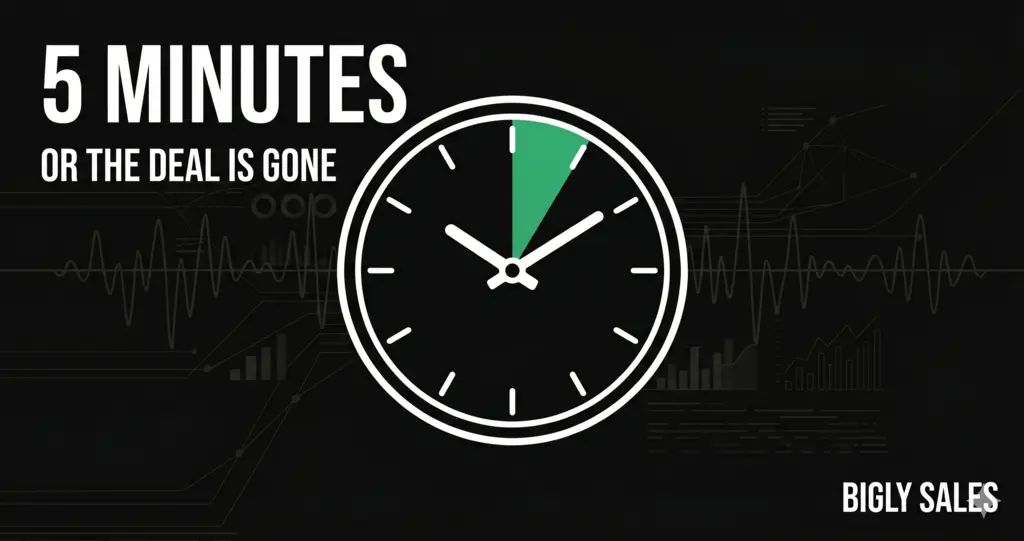
Lead intent decays in minutes. Widely cited lead response research puts the drop-off at five minutes, after which a lead is roughly 21 times less likely to qualify than one contacted immediately, and the average business takes more than a day to respond at all.
AI outbound calling closes that gap structurally rather than through discipline. It contacts every new lead within seconds of the record being created, at any hour and at any volume, runs a qualifying conversation, and routes the warm ones to a human. Around 40 percent of high-intent inquiries arrive on evenings and weekends, which is when no human team is working.
Speed without controls is a liability. If your consent records are weak or your lead source is reselling the same form, dialing faster only produces complaints sooner. Fix the inputs before you buy speed.
Key takeaways
- Speed to lead is the elapsed time between a prospect’s inquiry and your first meaningful contact, not your first automated email.
- Response inside the first minute converts at multiples of response after five, and the advantage compounds when a lead is shared with competitors.
- Human teams cannot hold a sub-minute response standard, because leads arrive unpredictably and reps work fixed hours with finite queues.
- Around 40 percent of high-intent inquiries land outside business hours, which is a structural gap rather than a scheduling one.
- AI outbound calling scales with lead volume instead of headcount, contacting 50 simultaneous leads as easily as one.
- Every fast-response program still needs consent verification, suppression logic, calling windows, and call records.
- Faster response on a bad list produces complaints, not pipeline. Lead source quality gates the whole strategy.
Table of contents
- What speed to lead is
- The lead response problem nobody has fixed
- What the response-time data actually shows
- Why human teams cannot close the gap
- How AI outbound calling closes the gap
- Which industries lose the most from slow response
- The real cost of slow lead response
- Compliance rules for fast AI outbound campaigns
- How to build a speed to lead workflow
- How Bigly Sales fits
- Speed to lead FAQ
- The bottom line
What speed to lead is
Speed to lead is the time between a prospect submitting an inquiry and your team making the first meaningful contact, measured to the conversation rather than to the auto-reply. A confirmation email is not contact. A voicemail is not contact. The clock stops when a human or an AI agent is actually talking to the prospect.
A lead is not a record in your CRM. It is a moment of intent. Someone filled out a form, requested a quote, asked for a demo, compared pricing, submitted a refinance request, asked about solar, or looked for insurance. In that moment they are active, considering the problem, comparing options, and often still on the page where they submitted.
Speed to lead measures whether you reach them while that state is still live. Once it passes, the conversation changes completely. The prospect may have spoken with a competitor, forgotten the form, gone back to work, started driving, or simply stopped caring. This is why the metric is not vanity. It moves contact rate, qualification rate, booking rate, show rate, and everything downstream of them. Our speed to lead overview covers how the managed version of this works in practice.
The lead response problem nobody has fixed
Benchmark studies of inbound response times keep landing in the same place. The average business takes more than a day to respond to a new inbound lead, and one study of 1,000 companies found that roughly two thirds never responded at all.
Consider what that means concretely. A homeowner in Florida submits a solar quote request at 7pm on a Tuesday. She submitted the same form to three other providers. Two of them will not call until the next business morning. One may never call. If you reach her inside five minutes, you are not slightly ahead. You are the only company she has spoken to.
This is not a discipline problem. Sales development reps spend a minority of their working day on actual selling, with the rest going to CRM updates, internal meetings, admin, and research. Even a motivated, well-managed rep cannot answer every new lead within 60 seconds while already on a call, in a meeting, or logged off for the night.
In 2026 there is a new layer on top. Handset-level call screening now intercepts calls from unknown numbers before they ring on many devices. That raises the value of reaching a prospect while they still remember submitting the form, because recognition is the thing that gets a call picked up. The window for meaningful first contact is measured in minutes.
What the response-time data actually shows
The research is unusually consistent for a sales topic.
Leads contacted inside the first minute convert at several times the rate of leads contacted a few minutes later. MIT-affiliated research on lead response found that contacting a lead at five minutes makes them roughly 21 times more likely to qualify than contacting the same lead at 30 minutes. Harvard Business Review’s audit of response times found that responding within an hour made a company far more likely to qualify a lead than waiting a day.
| Response window | Prospect state | Competitive position | Realistic owner |
|---|---|---|---|
| Under 1 minute | Still on the page, phone in hand, context fresh | Almost certainly first to contact | AI outbound only |
| 1 to 5 minutes | Engaged, expects a call | Usually first, sometimes second | AI outbound, or a rep who happens to be free |
| 5 to 30 minutes | Attention moving elsewhere | A competitor has likely called | A well-staffed team on a quiet day |
| 30 minutes to 4 hours | Recall fading, screening unknown numbers | Recovering ground someone else took | Typical human queue |
| Next business day | Often does not remember the form | Cold outreach with a warm label | Anything that arrived after hours |
The competitive shopping reality sharpens all of it. In insurance, mortgage, solar, home services, and most high-volume consumer verticals, one submitted inquiry reaches several providers at once. The first company to hold a real conversation anchors the relationship, and everyone after that is arguing against an incumbent.
Then there is the timing distribution. Around 40 percent of high-intent inquiries arrive during evenings and weekends according to 2026 benchmark research, and in several home service verticals a similar share of jobs get booked after hours. Nearly half of your pipeline arrives when nobody on your team is working.
Why human teams cannot close the gap
This is not a criticism of sales teams. It is a description of how human capacity works.
A rep handling 60 to 80 calls a day is already at the practical limit for one person. They cannot simultaneously watch for new leads, work an existing queue, update records after each call, and answer every new form submission within 60 seconds.
Multi-lead moments compound it. When 20 leads arrive during a morning campaign and five reps are available, each rep takes four. The queue ahead of the fourth lead structurally delays its response, and no scheduling change removes that. You can add reps, but reps add fixed cost and still do not guarantee speed on the fifth and sixth lead in a given hour.
Nights, weekends, and holidays remove the capacity entirely. A mortgage lead submitted at 11pm Saturday sits until Monday morning in most operations, by which point the borrower has spoken to at least one lender.
How AI outbound calling closes the gap
AI outbound calling does not improve speed to lead incrementally. It removes the structural cause of slow response, which is the dependency on someone being available.
The moment a lead enters the pipeline, whether from a web form, an aggregator, a campaign, or an inbound call, the system dials. Not when a rep finishes their current call. Not after the CRM syncs. Within seconds of the record being created.
That is parallel capacity, and it scales with lead volume rather than headcount. When 50 leads arrive in a peak hour, all 50 get contacted. When 200 arrive overnight, every one has been called before your reps log in. When a prospect submits a form on Sunday evening, the qualifying conversation has already happened, the CRM is already updated, and the highest-intent records are already at the top of Monday’s queue.
The conversation is the part that matters. This is not a notification or a voicemail drop. The AI confirms interest, gathers what your reps need, handles the first objection, and transfers the qualified prospects with full context attached.
One Bigly enterprise client, a high-volume lending operation, re-engaged thousands of leads their human team had never reached. The AI contacted every lead the same day it entered the pipeline, at any hour and regardless of volume, and the human team closed deals out of the resulting conversations inside the same week.
Response time audit
Find out what your real speed to lead is
We will measure your current time to first conversation by lead source and hour of day. The review takes about 20 minutes and you keep the numbers.
Which industries lose the most from slow response
The industries most exposed to slow lead response are those where buyer intent is urgent, competition is high, and a single inquiry reaches several providers at once. Speed matters everywhere. It decides outcomes in the verticals below. The full list of what we support sits on our industries page.
Insurance
Insurance leads are among the most competitive because consumers routinely compare several agents or carriers at the same time. One form can reach four agencies. The first to make contact frames the conversation, understands the need, and books the agent call. Slow response turns a paid lead into someone else’s sale. AI outbound calling helps by contacting eligible leads quickly, confirming the inquiry, collecting coverage context, and routing to a licensed agent.
Mortgage
Mortgage leads are time sensitive because borrowers compare lenders, rates, and pre-approval options inside a narrow window. If your loan officer responds hours later, the borrower may already be in process elsewhere. AI outbound calling collects preliminary borrower context and books loan officer appointments faster. The AI should not quote personalized rates, approve borrowers, or give lending advice. It handles intake and routing.
Solar
Solar leads are competitive because several providers commonly contact a homeowner after one online inquiry. A high utility bill, an incentive deadline, or a recent ad creates motivation that fades quickly. AI outbound calling confirms interest, qualifies property fit, and books consultations while the homeowner still remembers the inquiry.
Home services
Home service leads are often urgent, which ties fast response directly to booked jobs. A homeowner with a leak, a dead HVAC system, a pest issue, or an electrical fault calls several companies. The one that answers or calls back first usually gets the appointment. AI outbound calling supports quote follow-up, missed-call recovery, job intake, booking, and dispatcher routing.
Debt relief and financial services
These leads carry high emotional urgency that fades if the response is delayed. A consumer who asks for help feels motivated in that moment. If follow-up is slow, they hesitate, avoid the call, or choose another provider. AI outbound calling identifies interest, collects basic context, and books a conversation with the right specialist.
Staffing and recruiting
Candidate inquiries go cold quickly because strong candidates apply to several roles at once. If a recruiter waits, another agency schedules them first. AI outbound calling screens basic fit, confirms availability, and books recruiter conversations.
The real cost of slow lead response
Slow response is a cost problem before it is a conversion problem.
Every lead you fail to reach in the first few minutes represents money already spent. Whether the lead came from paid search, an aggregator, direct mail, or a referral program, the acquisition cost is fixed whether or not you convert. A lead that goes cold because nobody called is a full acquisition cost with zero return, and at thousands of leads a month that compounding is significant.
The arithmetic runs the other way once the gap closes. A lending operation running 45,000 answered calls per day through AI outbound infrastructure generates qualified conversations at a cost per conversation that a human-only operation cannot approach. The AI does not replace the closing capability. It ensures the closers spend their hours on people who are already qualified, already interested, and already expecting the call.
Compliance rules for fast AI outbound campaigns
Fast response does not override compliance, and this is the section most speed-to-lead content skips.
In February 2024 the FCC confirmed that AI-generated voices fall under the TCPA rules for artificial or prerecorded voice. For covered consumer telemarketing using AI-generated, artificial, or prerecorded voice, prior express written consent is generally required before dialing. Note that the separate FCC one-to-one consent rule was vacated by the Eleventh Circuit in January 2025 and never took effect, so prior express written consent remains the operative standard. One-to-one consent is still worth adopting as internal policy, because it is the strongest record to hold in litigation.
The Federal Trade Commission’s guidance on complying with the Telemarketing Sales Rule requires covered sellers and telemarketers to synchronize their calling lists with the National Do Not Call Registry at least every 31 days. Internal suppression sits on top of that. If a person has asked not to be called, the system stops calling them, across every channel and not only the one where they asked.
Calling windows apply to AI the same way they apply to humans. Configure outreach against the recipient’s local time and the applicable state rules rather than your own time zone. Our TCPA compliance overview goes through the framework in detail.
How to build a speed to lead workflow
A workflow that is fast and defensible includes all of the following. Missing any one of them turns a speed advantage into a liability.
- Lead source review. Know where each record came from and how many other buyers received it.
- Consent documentation. Hold the artifact, not a claim that consent exists somewhere upstream.
- Registry and internal suppression. Both, checked before the dial rather than reconciled after it.
- Calling window controls. Enforced against the recipient’s local time and state rules.
- Clear caller identity. Including AI disclosure at the top of the call.
- Approved opening language. Reviewed once, then used consistently.
- Opt-out detection. Language aware, not keyword matching, with immediate cross-channel propagation.
- CRM writeback and call records. Transcript, disposition, and recording stored together.
- Complaint response process. A named owner and a defined turnaround.
The goal is not rapid calling. The goal is a fast, controlled, well-documented first response.
How Bigly Sales fits
Bigly Sales improves speed to lead with managed AI voice agents that contact eligible leads quickly, qualify interest, book appointments, transfer warm prospects, and update your systems. It is built for teams that need more qualified conversations without asking reps to chase every record by hand.
Bigly supports fast follow-up on eligible inbound leads, missed-call recovery, quote request follow-up, appointment setting, live transfer workflows, lead qualification, CRM-ready summaries, transcripts and recordings where permitted, disposition tracking, opt-out capture, suppression workflow support, lead source reporting, and continuous campaign optimization.
To see this playbook applied to every new lead, read about AI lead follow up that works a compliant voice and SMS cadence.
The value is not raw call speed. It is a controlled response workflow. Bigly helps you define who can be called, what the AI asks, when a prospect gets booked, when a human takes over, what gets logged, and how the workflow improves over time.
A pilot proves this before any long-term commitment. Your AI infrastructure is configured, your numbers are registered and whitelisted with the carrier analytics providers, your consent and suppression rules are verified, and your calls run. You see answer rate, qualification rate, and conversion data before deciding anything else.
The honest caveat is the same one that applies to every managed platform. This is built for teams with real lead volume and documented consent. If you receive 40 leads a month, a disciplined manual callback rule will serve you better and cost you less.
Speed to lead FAQ
What is speed to lead and why does it matter in 2026?
Speed to lead is the time between a prospect’s inquiry and your team’s first meaningful contact. It matters because intent peaks in the moments right after submission. Research associated with MIT found that contacting a lead at five minutes makes them roughly 21 times more likely to qualify than contacting them at 30 minutes. In 2026 the window has narrowed further, because handset call screening filters unknown numbers and prospects routinely submit to several competitors at once.
Can AI outbound calling really contact leads within seconds?
Yes, when the AI outbound system is wired directly into the lead pipeline through CRM webhooks, form integrations, or an API. A new record triggers the call with no human in the loop. The practical limit is usually your lead source rather than the technology, since aggregators that batch deliveries every 15 minutes cap your response time regardless of what dials the number. Ask any vendor how they receive the lead event before you ask how fast they dial.
How does AI stay compliant when calling this quickly?
Consent is verified before the dial rather than reconciled afterward. The FCC’s February 2024 ruling requires prior express written consent for AI-voiced marketing calls to consumers, so the pre-call check has to pass before the system will place the call. State calling windows, Do Not Call suppression, and internal suppression run as automated components rather than manual checklists. Speed and compliance only conflict when the compliance layer is a person rather than a system.
What happens to leads that arrive overnight or on a weekend?
This is where the advantage is clearest. Around 40 percent of high-intent inquiries arrive on evenings and weekends. For a human team those records sit until the next business morning. For an AI outbound operation they receive a qualifying conversation within seconds, at whatever hour they arrive. Monday morning then starts with a prioritized queue of already-qualified prospects rather than a backlog of cold records nobody has touched.
Does responding faster mean rushed or lower-quality conversations?
Speed describes when first contact happens, not how the conversation is run. The AI conducts the same structured qualifying conversation at 11pm Saturday as at 10am Tuesday. Quality stays consistent because the system does not have bad days, does not rush when the queue is long, and does not skip steps when it is tired. Faster contact usually produces a better conversation, because the prospect still remembers why they submitted the form.
What is a good speed to lead benchmark?
Under five minutes is the widely accepted threshold, and under one minute is the standard worth building toward in competitive shared-lead verticals. Measure to the first real conversation rather than to an automated email, and measure by lead source and by hour of day rather than as a single average. A blended average of 12 minutes usually hides a business-hours figure of two minutes and an overnight figure of 14 hours.
Should AI call every lead, or only some of them?
Only leads with valid, documented consent that are not on a suppression list, and only inside permitted calling windows for the recipient’s state. Beyond the legal filter, most teams route by source quality and intent signal. High-intent form fills get an immediate call. Low-intent content downloads usually do not warrant one, and calling them tends to generate complaints that damage the number reputation you need for the leads that matter.
Does AI outbound calling replace SDRs?
No, it changes what they spend time on. The AI handles first contact, qualification, and the after-hours coverage no human team provides, then transfers the engaged prospects. SDRs and closers work the conversations that are already live. Teams that deploy this expecting to cut headcount usually find the model disappointing. Teams that deploy it to raise conversations per rep usually do not.
What ruins a fast-response program?
Three things, in order. Weak consent records, which turn volume into legal exposure. Unregistered phone numbers, which get labeled by carrier analytics engines so your fast calls never ring. And a lead source reselling the same form to six buyers, which means your speed advantage is competing against five other companies doing exactly the same thing. Fix all three before optimizing seconds.
The bottom line
If your operation responds to leads in hours rather than seconds, the leads lost to that delay are the most addressable revenue you have. The fix is not motivating people to move faster. It is changing the architecture so response does not depend on human availability at all.
AI outbound calling, deployed with real consent controls and managed number health, gives every eligible lead a qualifying conversation within seconds of submission, at any hour and at any volume. Get the consent artifacts and the number infrastructure right first, then measure your speed to lead by source and by hour rather than as one comfortable average.
Pilot program
Every lead called in seconds, around the clock
Registered numbers, verified consent, and qualifying conversations on every eligible lead. You see answer and qualification rates before committing to anything.