

An after-hours call center is the staffed or automated operation that handles your inbound calls once the day shift goes home. It is a capacity decision before it is a technology decision. The question is not whether the phone should be answered at 9 PM. It is who answers it, at what cost per handled call, and whether the answer is worth the payroll.
Running a call center is a numbers job. You track dials, connect rates, talk time, conversions, and cost per lead. Managers review performance every morning and agents know exactly where they stand. Almost nobody tracks the calls that arrived after hours and went nowhere, because those calls never reach a report.
This is the operator’s view of an after-hours call center. What the night shift actually costs when you staff it, what it costs when you outsource it, what it costs when you automate it, and how to decide which of the three fits the volume you have.
For a wider look at how usage based, managed and enterprise models compare, see AI pricing for contact centers.
Key takeaways
- Judge an after-hours call center on cost per handled call, never on hourly wage or per-minute rate.
- Fully loaded agent cost runs roughly $28 to $45 an hour once benefits, differential, and supervision are counted.
- Overnight occupancy below 20 percent means you are paying mostly for availability, not for work.
- About 30 percent of inbound volume in sales operations lands outside business hours.
- Blended coverage, with automation on volume and one on-call human on escalation, beats either extreme.
- Measure missed call rate, abandon rate, cost per handled call, and cost per qualified lead before you change anything.
- Do not automate calls that require licensed advice, complaint handling, or genuine crisis response.
Table of contents
- What an after-hours call center is
- The revenue sitting in your voicemail box
- What the night shift really costs to staff
- Three ways to run after-hours coverage
- Why the blended model usually wins
- The six numbers to run this on
- Designing the overnight workflow
- Quality control when no supervisor is on the floor
- How after-hours answering service pricing works
- Seven rules before you sign
- What two million calls showed us
- When not to automate the night shift
- After-hours call center FAQ
- The bottom line
What an after-hours call center is
An after-hours call center is any staffed or automated operation that answers your inbound queue during evenings, overnights, weekends, and holidays. It can be your own agents on a night rotation, an outsourced provider running the queue for you, an AI voice agent handling the conversation, or some combination of the three.
The distinction that matters operationally is between coverage and capture. Coverage means the phone gets answered. Capture means the caller is qualified, the outcome is recorded, and the next step is booked. Voicemail is neither. A pooled operator taking a name and a number is coverage without capture.
If you are shopping for a vendor rather than sizing your own operation, the buying criteria are different, and the sections on pricing models and rules before you sign cover that in detail. This post is about the economics of running the shift.
The revenue sitting in your voicemail box
Take your weekly inbound lead volume and assume roughly 30 percent of those calls arrive outside business hours. For a call center handling 200 leads a week, that is about 60 conversations a week that went to voicemail or to a service that took a name and called it a night.
Now apply your close rate. If you close 15 percent of inbound leads, and after-hours leads convert at even half that because of the cold next-day callback, you are losing 4 or 5 deals every week. In insurance, where an average policy runs around $1,200 a year, that is $5,000 to $6,000 in weekly revenue disappearing. In mortgage, solar, or debt relief, where deal values are higher, the number grows quickly.
None of it appears in a report. There is no flag and no alert. The leads never entered the pipeline, so nothing marks them as lost.
Every one of those leads also carries an acquisition cost you already paid. Paid search, lead aggregators, direct mail, and referral fees are spent whether or not you convert. A lead that goes cold after hours is a full acquisition cost with zero return. At scale that is a quiet and substantial drain.
What the night shift really costs to staff
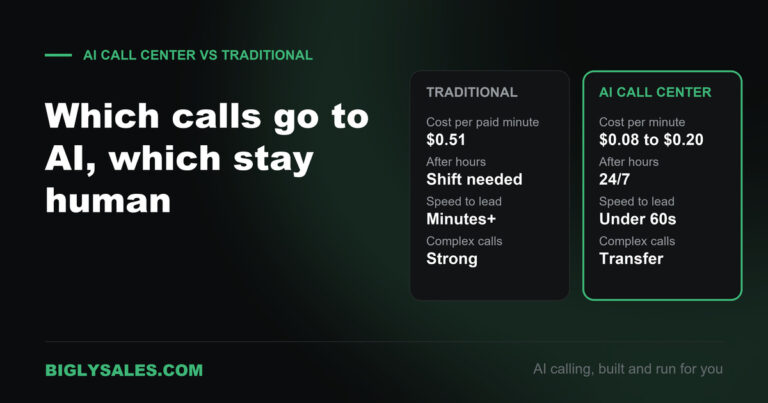
Costing an in-house after-hours call center starts with the fully loaded hourly cost of an agent rather than the wage. In the United States, a $20 an hour agent typically costs $28 to $45 an hour once you add payroll taxes, benefits, paid time off, recruiting, training, workstation and software licensing, and a share of supervision. Night and weekend shift differentials of 10 to 15 percent sit on top of that.
Then apply occupancy. Occupancy is the share of paid time an agent spends actually handling contacts. Daytime queues in a busy center often run 70 to 85 percent. Overnight queues rarely clear 20 percent, because arrival rates are low and unpredictable but you still need somebody present for the whole window.
That combination produces the number operators find uncomfortable. One agent covering an eight-hour night at $35 loaded costs $280. If that agent handles 12 calls across the shift, your cost per handled call is more than $23 before you count supervision or the manager who has to build the rota.
The coverage floor problem
You cannot staff a fraction of a person. Even a queue that averages one call an hour needs someone available for the whole window, and it needs a second person for breaks, sickness, and the night the volume triples. That coverage floor is why in-house night shifts almost never scale down gracefully.
Turnover is the multiplier
Night and weekend seats churn faster than day seats. Every replacement costs recruiting time, a training class, and several weeks of below-average performance. Build turnover into the model rather than treating it as an unpleasant surprise, because on a small night team a single departure can wipe out a quarter of your coverage.
Three ways to run after-hours coverage
| Model | Cost basis | Behavior at 4x volume | Qualification depth | Best fit |
|---|---|---|---|---|
| In-house night shift | $28 to $45 loaded per agent hour plus differential | Queue backs up, abandon rate climbs | Full, same as your day team | Complex or licensed conversations, steady volume |
| Outsourced answering or BPO | $1.00 to $2.50 per minute, or per seat on a dedicated contract | Hold times rise, quality varies by who is on shift | Script-limited, usually name and reason | Message taking and simple triage |
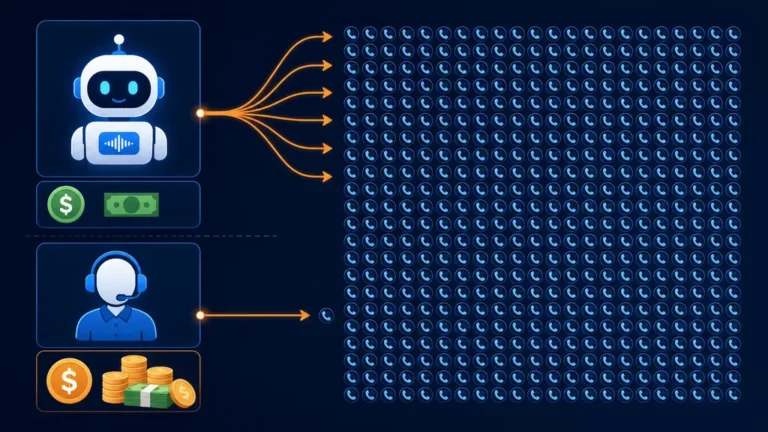
| AI voice agents | Per call or per minute, no headcount step-ups | Handles the spike at the same speed and cost per call | Full scripted qualification with CRM logging | Spiky sales volume with repeatable qualification |
| Blended | Automation on volume plus one on-call human | Automation absorbs the spike, human takes escalations | Full, with human judgment on exceptions | Most sales operations above 20 after-hours calls a week |
Read the table by column rather than by row when you size an after-hours call center. The cost basis column decides your budget. The behavior at 4x column decides whether a marketing push or a storm turns into revenue or into abandoned calls. The qualification column decides what your team walks into in the morning.
One honest caveat about the outsourced row. A live operator service is better than voicemail, but not by as much as the price difference implies. The operator takes a name and a number, so your agent still calls back cold twelve or more hours later, which in a competitive market is often long enough for the decision to have been made.
Night shift math
Get your real cost per handled call
We will model your after-hours volume against staffed, outsourced, and automated coverage. The working session takes about 30 minutes.
Why the blended model usually wins
Most operations do not have to choose between people and automation in their after-hours call center. They have to choose where the line sits.
Put automation on the front of the queue. Every after-hours call gets answered on the first or second ring, greeted in your business name, and taken through your qualification set. The AI decides whether this is a ready buyer, a general question, an existing customer, or noise.
Put one human on call behind it. When the AI flags a high-value or urgent caller, it warm transfers to whoever is on rotation with the context already gathered. That person is not sitting in a queue for eight hours. They are on standby, paid a modest on-call stipend, and pulled in a handful of times a night.
The economics of that split are straightforward. You pay per conversation for the volume and you pay for availability only on the exceptions. The qualification depth stays high because the AI runs your full script rather than a shortened operator card, and the human judgment stays available for the calls that actually need it.
The six numbers to run this on
After-hours missed call rate
The share of calls arriving outside business hours that reached nobody. Most centers have never pulled it. Get it from your carrier or phone system before you price a single vendor, because it sets the size of the problem.
Abandon rate on the night queue
Callers who hang up before anyone answers. On a thin night rota this is the first metric to degrade when volume spikes, and it is the one your caller remembers.
Cost per handled call
Total after-hours cost divided by calls actually handled. This is the only number that compares a staffed shift, a per-minute contract, and a per-call platform on the same basis.
Cost per qualified lead
The same division, but against calls that produced a qualified opportunity. A cheap model that qualifies nothing will look good on the previous metric and terrible on this one.
Time to first human contact
Measured from the moment the caller reached you to the moment a person spoke with them. For a booked callback, that is the gap the appointment creates. This is where an after-hours call center either preserves urgency or loses it.
Morning queue clearance
How long it takes the day team to work through the overnight backlog. If the first two hours of every day go to cleanup, your night coverage is producing work rather than pipeline.
Designing the overnight workflow
Design an after-hours call center backward from the escalation tier. Define that tier first. Write down exactly which callers justify pulling someone off standby, and be strict about it. Most centers find the honest list is short. High-value inbound in a competitive vertical, existing customers with a service failure, and anything with a stated deadline.
Set a fallback for every escalation. If the on-call agent does not answer within two rings, the caller should be offered a booked slot rather than dropped back into the queue. A transfer that rings out is worse than never offering one, because the caller now knows somebody could have picked up.
Decide what gets resolved without a human at all. Hours, location, payment status, appointment confirmations, and document requests do not need a person. Every one of those handled overnight is a call your day team never has to take. Hotels are a clear example, see our guide to an AI receptionist for hotels.
Write everything to the CRM before the morning. The transcript, the summary, the qualification answers, the urgency flag, and the booked next step should be on the contact record when the day shift logs in. Agents picking up an after-hours call should be continuing a conversation, not starting one.
Quality control when no supervisor is on the floor
The hardest part of running an after-hours call center is that nobody is watching. Day-shift quality assurance depends on floor presence, side-by-side coaching, and a supervisor who notices a bad call in progress. None of that exists at 2 AM.
Automation changes the shape of that problem rather than removing it. An AI voice agent asks the same questions in the same order on every call, so script adherence stops being a coaching issue. What you monitor instead is containment, escalation accuracy, and the rate at which the AI hands off calls it should have handled or keeps calls it should have escalated.
Sample the transcripts weekly. Pull every escalated call and a random sample of contained ones. The pattern you are looking for is not tone. It is whether the qualification outcome matched what the day team found when they followed up.
Compliance also needs a rule that does not depend on somebody remembering. Recording consent, do-not-call suppression, and the 8 AM to 9 PM local calling window set out in the Federal Trade Commission’s Telemarketing Sales Rule guidance should be enforced by the platform rather than by a tired agent. The underlying consent standard sits in the Telephone Consumer Protection Act at 47 U.S.C. 227, and it applies to every outbound callback your after-hours call center makes. Our TCPA compliance guide for managed AI calling covers how those controls are configured.
How after-hours answering service pricing works
There are three pricing models in this market and each one rewards a different behavior.
Per minute with a bundle
The standard live model. You buy a block of minutes each month at $1.00 to $2.50 per minute and pay a higher rate for anything above it. The trap is that your most valuable calls are your longest calls, so the plan charges you most for exactly the outcomes you wanted. Ask how minutes are rounded, because per-call rounding up to the next minute on a high volume of short calls quietly inflates a bill.
Per call
A flat charge per answered call regardless of length. Easier to forecast and friendlier to long qualification conversations. Confirm what counts as a billable call, especially hang-ups, wrong numbers, and repeat callers within the same evening.
Per seat or flat monthly
Common with dedicated receptionists and with managed AI deployments. Predictable, and usually the cheapest per conversation once volume is real, but it requires you to have enough volume to justify the floor.
Whichever model you choose, get the setup fee, the minimum term, the overage rate, and the cancellation notice period in writing before you compare quotes. Two services quoted at the same headline rate can differ by half again on the invoice.
Seven rules before you sign
1. Ask what happens after the greeting
Make the vendor walk you through a full call from ring to CRM record. If the answer stops at “we take a message and email it to you,” you are buying message taking. Price it accordingly.
2. Get the pricing model in writing
Setup fee, included minutes or calls, overage rate, rounding rule, minimum term, and notice period. Ask for a sample invoice from a customer with roughly your volume.
3. Check the handoff into your CRM
A summary that arrives as an email is a summary your team has to retype. Ask which CRMs are supported natively, what fields get written, and whether the transcript is attached to the contact record.
4. Test the escalation path
Decide in advance which callers justify waking someone up. Then confirm how the service recognizes them, who it calls, and what it does when that person does not answer. A service with no fallback rule will simply drop your best lead into the morning queue.
5. Confirm recording, consent, and retention
Ask whether calls are recorded, how consent is captured in two-party consent states, how long recordings are kept, and how you get them back if a complaint is filed. This is a five-minute question that saves a very expensive week.
6. Ask about volume spikes
Describe your worst night. A television spot, a storm, a competitor outage, a lead vendor dumping a batch at 9 PM. Ask what happens to hold times at four times normal volume and whether the price changes.
7. Run a trial on live traffic
Two weeks on real after-hours calls tells you more than any reference call. Measure answered calls, calls qualified, calls escalated, and how many of the resulting appointments actually held. Then compare that to the invoice.
What two million calls showed us
We ran an analysis across two million calls for one of our clients. Every conversation was reviewed for what happened, what questions came up, what objections appeared, and what led to a conversion. One of the clearest patterns was that leads who got a real response quickly, including after-hours responses handled by AI, converted at a materially higher rate than leads who waited until the next day.
That is not a pattern you find by listening to calls one at a time. Nobody works through two million recordings by hand. The data has to be aggregated before the effect becomes visible, and once it is, the staffing argument tends to settle itself. Our post on speed to lead and response time covers the wider research behind it.
Three things come up repeatedly when we ask operators what surprised them after moving to an automated after-hours call center. After-hours volume was larger than they had assumed. The quality of those leads was higher than they had assumed. And the change in the morning routine was immediate, because agents started the day on prioritized follow-ups with context attached instead of a pile of incomplete messages.
When not to automate the night shift
Automation is the wrong answer for some after-hours call center queues, and pretending otherwise is how deployments fail.
Do not automate conversations that require licensed advice. If the answer to a caller’s question would constitute a recommendation that a licensed professional has to make, route it to a person or book it for one.
Do not automate complaint handling or anything with a safety dimension. A caller who is angry, distressed, or in an emergency needs a human, and the reputational cost of getting that wrong is far larger than the payroll you saved.
Do not automate a queue with fewer than about 20 after-hours calls a week. Below that, the configuration effort and the platform floor cost more than the leads you recover. Fix your callback discipline first.
And be clear about what this category is not. Bigly Sales does not sell dialers, telephony, or CRM software. We run the conversation layer and connect it to the systems you already have, which is a different approach from buying a dialer and staffing it.
After-hours call center FAQ
What is an after-hours call center?
It is the staffed or automated operation that handles inbound calls to your business outside normal working hours, covering evenings, overnights, weekends, and holidays. It can be your own agents on a night rota, an outsourced provider, an AI voice agent, or a blend. The meaningful difference between options is not who answers but whether the caller gets qualified and the outcome gets recorded.
How much does after-hours call center coverage cost?
Staffing it in house costs roughly $28 to $45 per agent hour fully loaded in the United States, plus a 10 to 15 percent night differential. Outsourced live operator services generally run $1.00 to $2.50 per minute. AI voice agents price per call or per minute and do not step up with headcount. Compare all three on cost per handled call, because hourly and per-minute rates are not comparable on their own.
Is it cheaper to outsource or automate the night shift?
Automation is usually cheaper per handled call once volume is spiky or above about 20 calls a week, mainly because you stop paying for idle availability. Outsourcing wins when volume is very low and you only need a human voice and a message. In-house staffing wins when the conversation is complex, licensed, or high touch enough that a script cannot carry it.
What is a realistic overnight occupancy rate?
Most overnight queues run under 20 percent occupancy, meaning agents spend less than a fifth of paid time handling contacts. That is not a management failure. Arrival rates at night are low and irregular, so you are paying for availability rather than for work. Recognizing that is what makes cost per handled call the right yardstick instead of hourly rate.
How many calls actually arrive after hours?
In sales-driven operations it is commonly around 30 percent of inbound volume, though it varies widely by vertical and by how much of your demand comes from consumers rather than businesses. Pull the real number from your phone system or carrier before making any decision. Consumer-facing verticals such as insurance, solar, real estate, and home services usually sit at the higher end.
Can AI handle a sudden spike in after-hours call volume?
Yes, and this is the clearest operational advantage over a staffed or outsourced shift. An AI voice agent handles 10 calls and 1,000 calls the same way, with no queueing, no advance scheduling, and no change in cost per call. A staffed rota cannot flex on the night itself, which is exactly when a marketing push or a weather event drives volume.
What should the day team see when they arrive?
A prioritized queue rather than a voicemail list. Every after-hours call should carry a transcript, a short summary, the qualification answers, an urgency flag, and a booked next step, all written to the CRM before the shift starts. Measure how long the day team takes to clear that queue. If cleanup eats the first two hours, your night coverage is creating work.
How do you run quality assurance overnight with no supervisor?
Shift the focus from tone to outcomes. Sample transcripts weekly, review every escalated call plus a random set of contained ones, and check whether the qualification result matched what the day team found on follow-up. With automation, script adherence is a configuration question rather than a coaching one, so your monitoring effort goes to escalation accuracy instead.
Do we still need people on call at night?
In most sales operations, yes, but far fewer than a staffed shift requires. One person on standby with a modest on-call stipend, pulled in only for flagged escalations, gives you human judgment where it matters without paying for eight hours of idle time. Always define a fallback so an unanswered escalation converts into a booked callback.
How long does it take to stand up after-hours coverage?
A voicemail change takes minutes and an outsourced message-taking contract can be live within days. A qualifying deployment takes longer because the call flow, qualification rules, CRM field mapping, and escalation paths all have to be built. Budget a few business days for setup and a further two weeks of tuning against live traffic before judging the numbers.
Is an AI answering service better than a live operator?
For qualification and handoff, generally yes. A pooled operator works from a short script and passes on a name and a number. An AI voice agent asks your full qualification set, captures what the caller needs, logs the transcript to your CRM, and flags urgency. For a caller in genuine distress who needs judgment and empathy, a trained human is still the better answer, which is why escalation rules matter.
Can the service transfer calls to my team at night?
Yes, if you set up an on-call rotation and define which callers qualify for a transfer. Good practice is to reserve live transfer for a narrow, clearly defined set of high-value or urgent callers and to book scheduled callbacks for everyone else. Always specify a fallback so a transfer that goes unanswered turns into a booked time rather than a dropped call.
Which industries get the most out of after-hours coverage?
Insurance, mortgage, solar, debt relief, real estate, home services, and staffing. The common pattern is that the same lead reaches several providers at once, the buying decision often happens in the evening, and the first real conversation carries most of the advantage. Deal values in those verticals are also high enough that a handful of saved conversations covers the cost of coverage.
Will callers know they are talking to an AI?
Many will not from voice quality alone, which is exactly why disclosure matters. Say plainly at the start of the call that the caller is speaking with an automated assistant and make it easy to reach a person. Disclosure costs you very little in practice, and it removes the single most damaging outcome in this category, which is a customer who feels misled after the fact.
The bottom line
An after-hours call center is a capacity problem wearing a technology costume. Once you price it properly, per handled call rather than per hour or per minute, the choice between staffing, outsourcing, and automating usually becomes obvious for your particular volume.
Pull your after-hours missed call rate first. Model the three options against it. Then pick the blend that keeps your cost per qualified lead down without putting an automated system in front of a conversation that needs a person. If your volume is thin, the honest answer is to do nothing yet and fix your callback discipline instead.
Pilot the night
Run one month of automated night coverage
Cover your evenings and weekends with AI agents and one on-call rep, then compare cost per qualified lead against your current rota. Setup takes days.