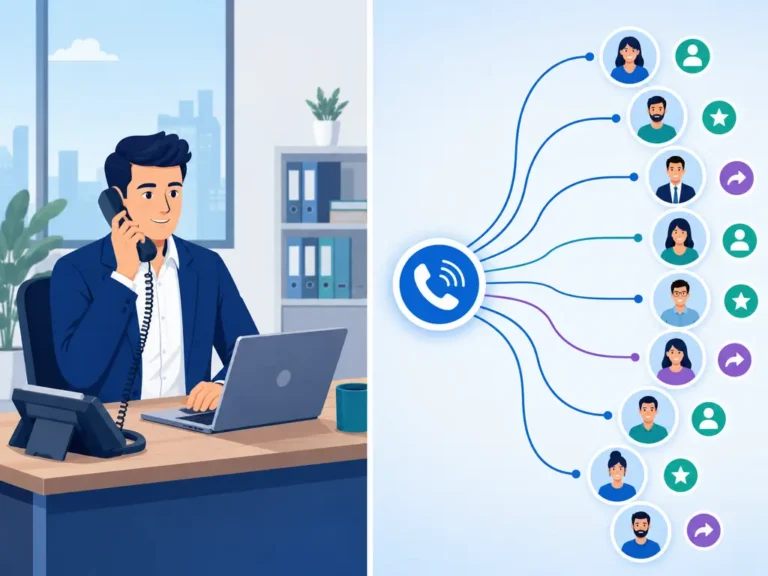
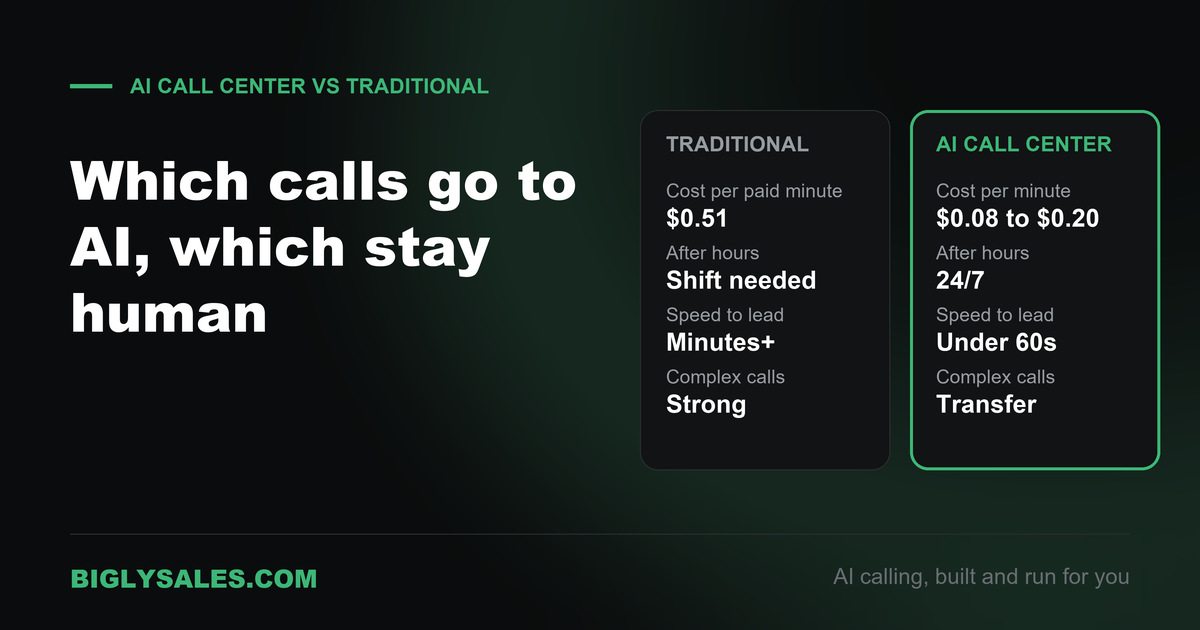


An AI call center uses AI voice agents to answer and make calls. A traditional call center uses people for every call.
That sounds like a simple choice. It is not.
Most floors that try AI do not pick one side. They split the work. The question is which calls go where, and what each one really costs.
This guide compares both models on cost per minute, coverage, compliance and quality. With real numbers from the BLS and our own pricing.
And it covers the calls where humans still win.
Key Takeaways
- A US customer service rep costs about $0.51 per paid minute in wages and benefits, before seats and idle time.
- AI voice minutes on Bigly plans run from $0.08 to $0.20 per included minute.
- One 24/7 seat needs about 4.2 full time agents. An AI agent covers it alone.
- AI wins on volume, speed to lead and after-hours. Humans win on escalations and negotiated sales.
- AI voice calls fall under the TCPA, so consent and disclosure still apply.
- Most BPOs end up with a hybrid floor that warm-transfers complex calls to people.
Table of contents
- What an AI call center vs a traditional call center is
- AI vs traditional call center, side by side
- What each model costs per minute
- Coverage, queues and speed to lead
- Where human agents still win
- Compliance works differently
- The hybrid floor most BPOs end up with
- How to choose for your floor
- Who AI calling is wrong for
- AI call center vs traditional call center FAQ
- The bottom line
What an AI call center vs a traditional call center is
An AI call center is a phone operation where AI voice agents answer inbound calls and place outbound calls in real time, then hand calls to people when needed.
A traditional call center is a phone operation where human agents handle every call, usually on a shared floor with a dialer, a queue and shift schedules.
The real difference is what limits your capacity.
On a traditional floor, it is headcount. Calls wait when everyone is busy. Lines go quiet when the shift ends.
On an AI floor, it is the system. It answers on the first ring at any volume, at any hour.
If you want the different kinds of AI tools a call center can buy, see our breakdown of the six types of AI call center solutions. This post is the head to head.
AI vs traditional call center, side by side
Here is the short version. Three models, eight things that matter to an operations lead.
| Factor | Traditional (human only) | AI only | Hybrid (AI plus humans) |
|---|---|---|---|
| Capacity | Limited by agents on shift | Scales with the campaign | AI absorbs peaks, agents take transfers |
| After-hours coverage | Needs night and weekend shifts | 24/7 by default | 24/7, humans on business hours |
| Speed to lead | Minutes to hours, depends on the queue | Seconds | Seconds, then a live transfer |
| Cost driver | Wages, benefits, seats, turnover | Minutes used | Minutes plus a smaller agent team |
| Complex or emotional calls | Strong | Weak | Routed to people |
| Consistency | Varies by agent and shift | Same script every call | Same opening, human judgment later |
| Quality review | Sampled calls reviewed by hand | Every call recorded and transcribed | Every call recorded and transcribed |
| Script change | Retrain the team | Live on every call at once | Live at once for the AI part |
Notice the last column. That is where most floors land. More on that below.
What each model costs per minute
Let’s do the math with public numbers.
The BLS puts the median wage for customer service representatives at $21.53 an hour in May 2025.
Wages are only part of the cost. In private industry, benefits make up 30 percent of total employer compensation, per the BLS June 2026 release.
So the loaded cost is about $30.76 an hour. That is $0.51 for every paid minute.
And that is the floor. It leaves out the seat, the dialer, the supervisor, training and turnover.
It also assumes the agent talks for all 60 minutes. Nobody does. Every minute spent waiting, wrapping up or on a break pushes the real cost per talk minute higher.
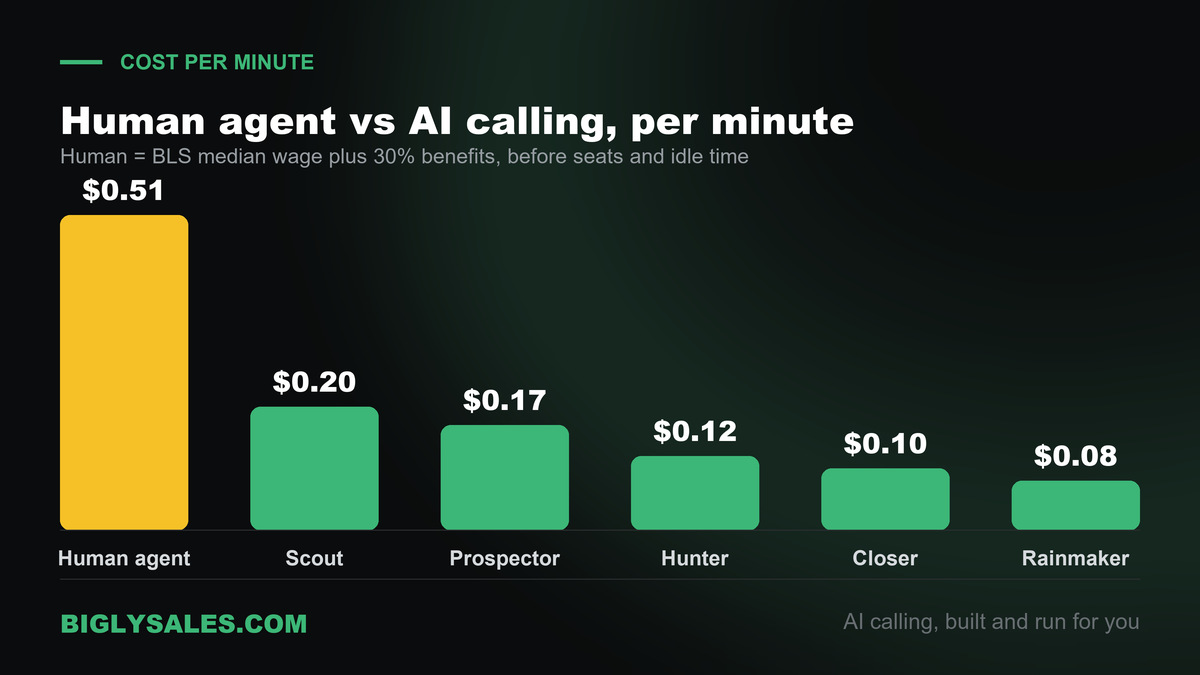
Now the AI side. These are the published Bigly plan prices, checked on our pricing page on November 5, 2026.
| Option | Monthly price | Included minutes | Cost per included minute |
|---|---|---|---|
| Human agent, median US wage plus benefits | About $5,330 at 173 paid hours | 10,400 paid minutes | $0.51, before seats and idle time |
| Bigly Scout Plan | $99 | 500 | $0.20 |
| Bigly Prospector Plan | $500 | 3,000 | $0.17 |
| Bigly Hunter Plan | $2,999 | 25,000 | $0.12 |
| Bigly Closer Plan | $4,999 | 50,000 | $0.10 |
| Bigly Rainmaker Plan | $9,999 | 125,000 | $0.08 |
One honest caveat. A minute of AI is not the same as a minute of a skilled agent.
The AI is cheaper on structured calls. It is not cheaper on a call it cannot finish. A failed call that ends in a frustrated transfer costs you both.
So compare by call type. For the full pricing models vendors use, see AI pricing for contact centers.
Coverage, queues and speed to lead
This is where the gap is widest.
A week has 168 hours. A full time agent works about 40 of them.
So keeping one phone seat open around the clock takes about 4.2 people. That is before breaks, sick days and holidays.
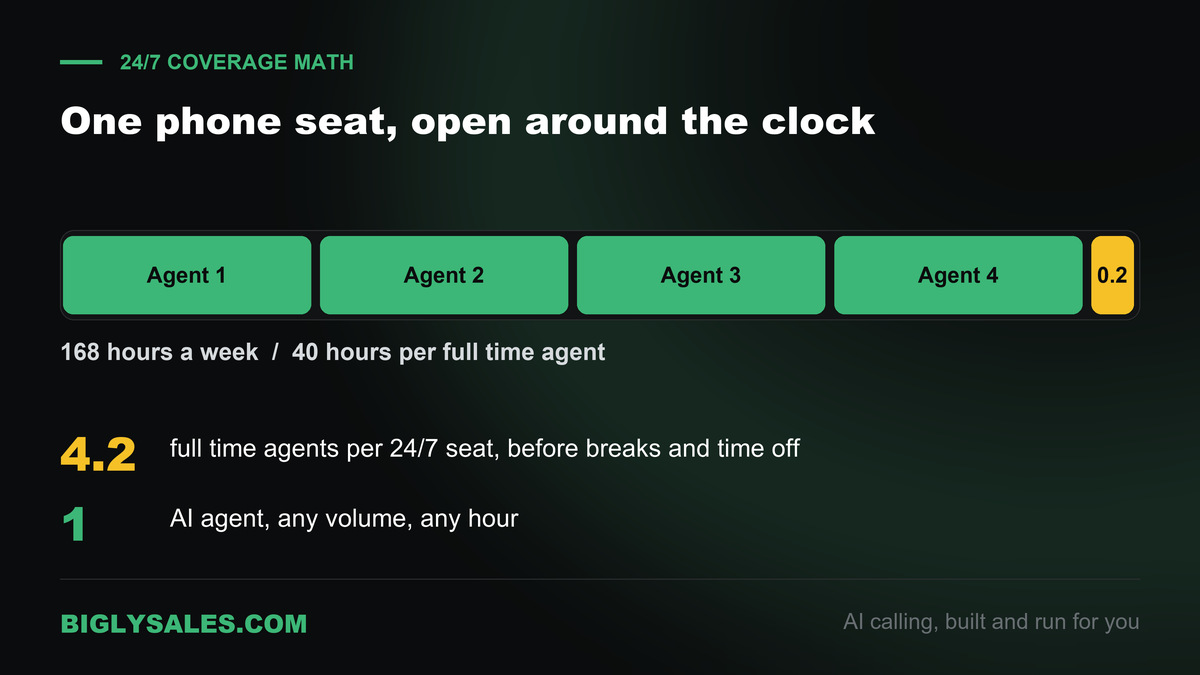
Most floors do not pay for that. They let calls go to voicemail after hours, or they pay a premium for a night shift. Our guide to after-hours call center staffing models walks through the options.
Queues are the daytime version of the same problem.
When ten calls land at once and six agents are free, four people wait. Some hang up. Those are abandoned calls, and every one is a lost lead or a missed SLA.
Outbound has its own clock. A web lead goes cold fast.
Bigly AI agents call new leads back in under 60 seconds. A human floor gets to them when someone is free. Sometimes that is the next morning.
Free setup session
Hear an AI agent work your call floor
In 30 minutes we build a working inbound and outbound agent for one of your programs and call your phone with it. Plans start at $99 a month, and the setup is free.
Where human agents still win
AI is not good at everything. Pretending it is would cost you clients.
Even the BLS says it. Automation is taking over simple tasks, but companies keep in-house teams for complex inquiries such as refunding accounts or confirming insurance coverage. It still projects about 289,500 customer service openings a year through 2035.
Here is where people beat AI today.
- Escalations. An angry customer wants a person with authority, not a script.
- Emotional calls. A bereavement, a billing mistake that hurt someone, a medical scare.
- Negotiated sales. Pricing pushback, bundles and anything that needs a judgment call.
- Messy troubleshooting. Problems with no clear script and five possible causes.
- Contract carve-outs. Calls a BPO client has reserved for a human, in writing.
The fix is not to keep AI away from these calls. It is to make sure the AI hands them off fast, with context. We cover how to split the work in human and AI collaboration in call centers.
Compliance works differently
Both models have rules. The risks sit in different places.
Traditional outbound floors worry about dialers. Under the FTC Telemarketing Sales Rule, a predictive dialer can abandon no more than 3 percent of answered calls per campaign over 30 days. And a live rep has to come on the line within 2 seconds of the person’s greeting.
When the floor is short-staffed, that 3 percent cap is the first thing at risk.
AI floors worry about the voice itself. In February 2024 the FCC ruled that AI generated voices count as artificial voices under the TCPA.
That means AI marketing calls need prior express written consent. Several states also require you to disclose the AI on the call.
The upside of AI is enforcement. A system does not forget the calling window in Texas or skip the opt-out on a busy day.
Bigly applies calling windows, Do Not Call checks and stop requests on every dial, with compliance controls built in. Your consent records still have to be right. No platform fixes a bad list.
The hybrid floor most BPOs end up with
Here is how it works on a real floor.
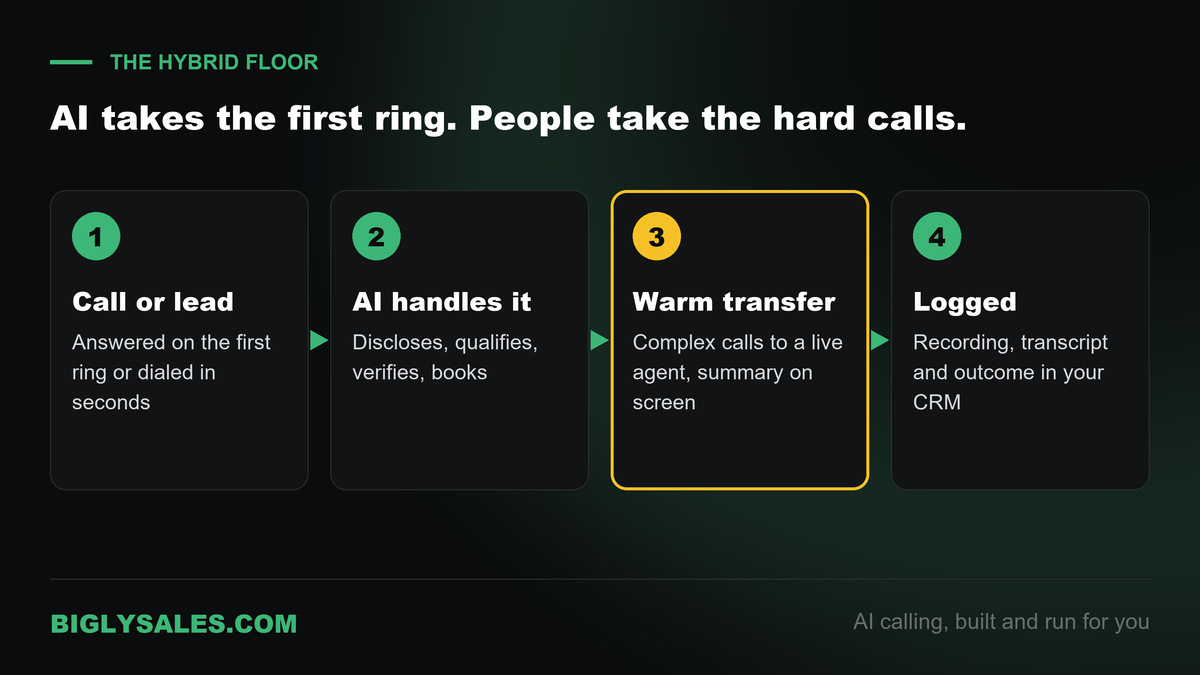
- A call comes in or a lead lands. The AI answers on the first ring, or dials the new lead within seconds.
- The AI handles the structured part. It discloses, greets, qualifies, verifies or books, using the script you approved.
- Agents get the calls that need them. Qualified or complex calls go to the next free agent through a warm transfer, with a summary on screen.
- Everything is logged. Recording, transcript and outcome land in your CRM for QA and client reporting.
Your agents keep the calls that earn their wage. The AI takes the first ring, the fifth follow-up and the 2 a.m. call nobody was scheduled to answer.
That is the model behind our AI calling for BPOs and call centers. Bigly runs over 500,000 AI calls a month this way.
How to choose for your floor
Do not start with the vendor. Start with your call reasons.
Pull one week of calls and sort them by type. Then use this table.
| Call type | Volume | Follows a script | Where it fits |
|---|---|---|---|
| After-hours and overflow | High | Yes | AI |
| New lead callback | High | Yes | AI, then transfer to a closer |
| Appointment set or confirm | High | Yes | AI |
| Order or status question | High | Mostly | AI |
| Aged list reactivation | High | Yes | AI |
| Billing dispute | Medium | No | Human |
| Escalation or complaint | Low | No | Human |
| Negotiated or high value sale | Low | Partly | Hybrid, AI qualifies, human closes |
Then ask four questions.
How does the hand-off work? Who owns the numbers and carrier registration? How is consent enforced on every dial? What does QA get from each call?
If a vendor cannot answer all four in plain English, keep looking.
Who AI calling is wrong for
AI calling is the wrong fit if most of your calls are complex, emotional or negotiated. You will transfer almost everything and pay for both.
It is also wrong if you cannot prove consent for your outbound list. The AI will dial faster, which means a bad list gets you in trouble faster.
And if your volume is tiny, a few dozen calls a week, one good person may be all you need. Worried about your team’s jobs? Our take on whether AI will replace call center agents is worth a read.
AI call center vs traditional call center FAQ
What is the difference between an AI call center and a traditional call center?
A traditional call center uses human agents for every call, so capacity depends on how many people are on shift. An AI call center uses AI voice agents to answer and place calls, so capacity depends on the system, not headcount. Most real operations mix the two. The AI takes the repeatable calls and hands the complex ones to people.
Is an AI call center cheaper than a traditional call center?
Per minute, usually yes. A US customer service rep costs about $0.51 per paid minute in wages and benefits, based on BLS data, before seats, software and idle time. Bigly plans work out to $0.08 to $0.20 per included minute. But an AI minute does not do the same work as a skilled agent minute, so compare by call type, not by total.
Can AI replace human agents in a call center?
Not wholesale. AI handles structured calls well. Qualification, scheduling, confirmations, order status and after-hours answering. It is weak on escalations, emotional calls and negotiated sales. The BLS still expects about 289,500 customer service openings a year through 2035, even as the job shrinks. Treat AI as a layer on the floor, not a replacement for it.
What is a hybrid call center?
A hybrid call center splits the work between AI voice agents and human agents. The AI answers first, handles the scripted part and qualifies the caller. When a call needs judgment, it warm-transfers to a live agent and passes a summary, so the caller never repeats themselves. Most BPOs that add AI end up running this model.
Which calls should a call center automate first?
Start with calls that are high in volume and follow a script. After-hours overflow, appointment confirmations, lead callbacks, order status and list reactivation are the usual first picks. Leave complaints, cancellations and anything a client contract reserves for a person with your human agents. Pull a week of call reasons before you decide.
Do AI call centers work 24/7?
Yes. An AI voice agent can answer at 2 a.m. on a Sunday with the same script it uses at noon. Covering one phone seat around the clock with people takes 168 hours a week, or about 4.2 full time agents before breaks and time off. That staffing math is why after-hours lines are usually the first thing teams hand to AI.
Are AI calls legal under the TCPA?
They can be. In February 2024 the FCC ruled that AI generated voices count as artificial voices under the TCPA. That means AI marketing calls need prior express written consent, a clear way to opt out and calls inside legal hours. Disclosure rules also apply in several states. This is general information, not legal advice.
Do customers know they are talking to AI?
They should. Good practice, and the law in a growing number of states, is to disclose the AI at the start of the call. Bigly agents say they are AI on every call. In our experience, disclosure does not end most calls. A slow, robotic or confused agent does. Pacing and the hand-off to a human matter more than the label.
How long does it take to launch an AI call center?
On Bigly, most teams go live within 24 hours once the script is approved. Bigly sets up the numbers, carrier registration, script and call flows for you. Bigger programs with CRM integration, multiple campaigns and custom transfer rules take longer, so plan a short pilot on one call type before you move a whole queue.
The bottom line
A traditional call center buys capacity in people. An AI call center buys it in minutes. At $0.51 a paid minute for a median US agent versus $0.08 to $0.20 for AI, the structured calls belong to the AI.
The complex ones still belong to your strongest agents. Build the hand-off between them well and you get both. Faster answers on every call, and agents who spend their day on the calls that need them.
Try it on one program
Put AI on your overflow line this week
Pick one call type, like after-hours or lead callbacks, and we set up the agent, numbers and warm transfer to your team. Most teams go live within 24 hours.