

Average handle time is the most reported and most misused metric in contact centers. It is easy to calculate, easy to benchmark against a competitor who measures it differently, and easy to improve in ways that quietly cost you customers.
This guide covers the actual formula, the parts teams forget to include, why chasing a lower number backfires, and what genuinely reduces handle time without pushing the work somewhere you are not measuring.
TL;DR
Average handle time is talk time plus hold time plus after-call work, divided by the number of contacts handled, and all three components belong in the figure. Leaving out after call work is the most common way the number gets flattered, and it makes your number incomparable with anyone else’s, including your own, from last quarter. There is no universal good figure, because a password reset and an insurance claim should not take the same time, so segment by contact reason and watch your own trend. Do not set it as an agent target, though, because it moves work into callbacks and thinner notes rather than removing it.
Key takeaways
- Handle time is talk plus hold plus after-call work, divided by calls handled.
- Omitting after call work is the most common way the number gets flattered.
- Segment by contact reason. A single site-wide average mostly reports your contact mix.
- Used as a target, it displaces work into callbacks, transfers, and thinner notes.
- Remove steps before and after the conversation rather than shortening the conversation.
- Good deflection raises handle time. Judge it on cost per resolved contact instead.
Table of contents
- What average handle time measures
- The formula and a worked example
- What counts as a good number
- Why targeting it backfires
- What actually reduces it
- What changes when AI takes the first call
- Average handle time FAQ
- The bottom line
What average handle time measures
Average handle time, usually shortened to AHT, is the average total time an agent spends dealing with one contact from beginning to end.
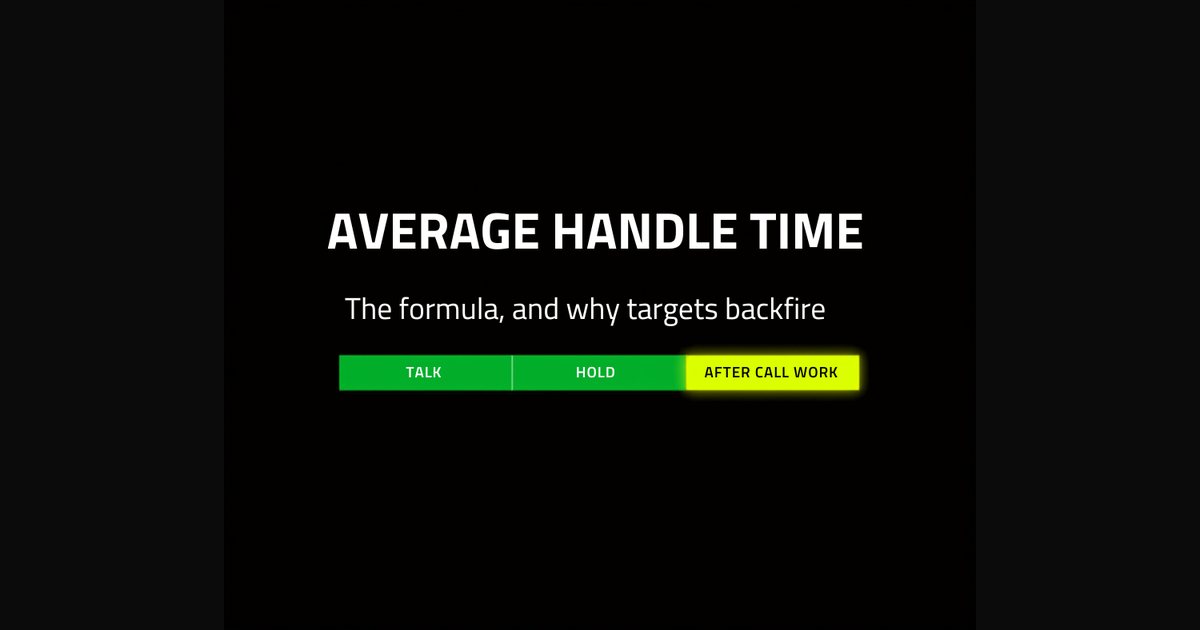
The important word is total. It is not how long the agent was talking. It covers three things.
Talk time is the conversation itself.
Hold time is every second the customer waited while the agent looked something up, consulted a colleague, or waited for a system to load.
After-call work is what happens once the customer has gone. Writing the note, updating the record, raising a ticket, and sending the follow-up email.
Leave out any of the three, and the number stops being comparable to anyone else’s, including your own from last quarter.
The formula and a worked example
The calculation is simple. Add total talk time, total hold time, and total after-call work, then divide by the number of calls handled.
Take a small team over one day. Total talk time of 40 hours, hold time of 6 hours, and after-call work of 9 hours, across 600 calls handled.
That is 55 hours across 600 calls, which comes to 5.5 minutes per call.
Two details change the answer more than people expect. Count calls handled, not calls offered, because abandoned calls consumed no agent time and including them flatters the figure. And decide once whether transfers count as one contact or two, then never change it, because switching quietly rewrites your history.
| Component | What it covers | Commonly excluded | Effect of leaving it out |
|---|---|---|---|
| Talk time | The conversation itself | No | None, everyone counts this |
| Hold time | Every second the customer waited while the agent looked something up | Sometimes | Hides slow systems, which is usually the real cost |
| After call work | Notes, record updates, tickets, follow-up emails | Very often | Understates real agent cost and flatters the number |
| Contacts handled | The denominator, handled rather than offered | Misused | Counting offered calls flatters the average further |
What counts as a good number
There is no useful universal benchmark, and any article giving you one figure across all industries is not being straight with you.
A password reset and an insurance claim are both calls. Expecting them to take the same time is not a target, it is a category error. Handle time varies with the complexity of the request, how many systems the agent has to touch, whether they need approval from anyone, and how much of the customer’s history is available on screen.
The comparison that actually helps is against yourself. Segment by contact reason, then watch the trend inside each segment. A rising figure for one contact type is a real signal. A single average across everything mostly tells you what your contact mix looked like this month.
Two questions are worth more than any benchmark. Is handle time rising for a specific reason, and is it rising because conversations got harder or because a system got slower?
Why targeting it backfires
This is the part that matters most, and it is where most handle time programs go wrong.
If you tell agents to reduce handle time, they will. The question is how.
Work moves rather than disappearing. An agent under time pressure ends the call before the issue is fully resolved, and the customer calls back tomorrow. Handle time fell, contact volume rose, and total cost went up. If callbacks are counted in a different report, this looks like a win.
After-call work gets skipped. Notes get thinner, records get less accurate, and the next agent has to ask the customer to explain everything again. That cost is real, and it lands outside the metric.
Hold becomes transfer. Rather than waiting on a system, the agent passes the customer along. Their handle time improves, and the customer’s total time gets worse.
The pattern is consistent. Handle time is a diagnostic, and it stops being informative the moment it becomes a target. Pair it with first contact resolution and a satisfaction measure, or you cannot tell an improvement from a displacement.
What actually reduces it
Real reductions come from removing steps, not from shortening conversations.
Cut the systems count. Agents toggling between several windows to answer one question is usually the largest hidden cost. Consolidating what they need onto one screen removes hold time without touching the conversation.
Arrive with context. If the agent already knows who is calling and why, the first minute of every call disappears. That minute across thousands of calls dwarfs anything you gain from coaching people to talk faster.
Automate the after-call work. Notes, dispositions, and CRM updates written automatically remove the tail of every contact. This is the cleanest win available because nothing about the customer experience changes.
If you want to convert handle time into money rather than minutes, published wage data for customer service representatives gives you a defensible hourly figure to multiply against. Seconds per contact is abstract. Dollars per contact gets a budget approved.
Deflect the deterministic contacts. Order status and opening hours do not need a person. Removing them raises your average, because what remains is genuinely complex, and that is the correct outcome rather than a problem.
That last point catches teams out. Successful deflection makes handle time go up. If you are also targeting a lower number, you have set two goals that fight each other.
Remove steps, not seconds
Let the agent arrive with the context
Most of the first minute of every call is the agent working out who is calling and why. We will show you an AI agent gathering that before a person joins, on a 30-minute screen share, using your own contact reasons.
30 minutes · screen shared · no obligation
What changes when AI takes the first call
Worth being direct that Bigly Sales sells AI voice agents, so treat this as the argument for a different measurement approach rather than a neutral survey.
When an AI agent answers first, handle time stops describing what you thought it described.
The simple contacts get resolved without an agent, so they leave the denominator. The calls that reach a human are the harder ones, and their handle time is longer by definition. A team that automates well will watch its AHT rise while its cost per resolved contact falls. Read the first number alone and you will conclude things got worse.
The metric worth watching in that setup is cost per resolved contact, split by whether a human was involved. Handle time still matters for the human calls, and it is a better number there because the agent starts with the context the AI already gathered rather than with an empty screen. That mechanic is described in AI inbound calling for leads and support.
One honest caveat. This only holds if the handoff is good. If the AI passes a caller over without the context it collected, you have added a step and made handling time worse. We cover that boundary in AI agents and the human handoff.
For the rest of the metrics that sit alongside handle time, the AI calling glossary defines each one and says what it is actually good for.
Average handle time FAQ
What is average handle time?
Average handle time is the average total time an agent spends on one contact, including the conversation, any time the customer is on hold, and the after-call work needed to finish the record. It is usually shortened to AHT.
How do you calculate average handle time?
Add total talk time, total hold time, and total after-call work for a period, then divide by the number of contacts handled in that period. Use contacts handled rather than contacts offered, because abandoned calls used no agent time.
Does average handle time include after-call work?
Yes, and leaving it out is the most common error. After call work is real agent time that cannot be spent on another customer, so excluding it produces a number that looks better than reality and cannot be compared with anyone else’s.
What is a good average handle time?
There is no single good figure, because it depends entirely on the complexity of the contact. A password reset and an insurance claim should not take the same time. The useful comparison is your own trend within each contact reason, not an industry number.
Why is our average handle time increasing?
Common causes are a slower or newly added system, a shift in contact mix toward harder problems, new agents still learning, or successful automation of the simple contacts. That last one is a good sign, not a problem, so check the mix before treating a rise as a failure.
Should we set an average handle time target for agents?
Generally no. Targeting it directly tends to move work rather than remove it into callbacks, transfers, and thinner notes. Use it as a diagnostic and pair it with first contact resolution and a satisfaction measure so you can tell improvement from displacement.
What is the difference between average handle time and talk time?
Talk time is only the conversation. Handle time adds hold time and after-call work, so it reflects the full cost of the contact to the agent rather than just the part the customer experiences. Talk time alone will always understate it, which is why teams comparing the two figures reach different conclusions about the same operation.
How does AI change average handle time?
It usually raises it, and that is expected. AI resolves the simple contacts without an agent, so the calls reaching a human are the harder ones. Cost per resolved contact is the better measure in that setup, split by whether a person was involved.
What reduces average handle time without hurting service?
Reducing the number of systems an agent has to touch, giving them caller context before the conversation starts, and automating notes and CRM updates. All three remove steps rather than pressuring anyone to talk faster, so nothing about the customer experience gets worse. Coaching people to be quicker does the opposite.
Handle time targets also sit inside a compliance envelope. The FTC Telemarketing Sales Rule caps abandoned calls at three percent measured over 30 days per campaign and requires a live representative within two seconds of the greeting, so any push to shorten handle time has to respect those limits before it respects the dashboard.
The bottom line
Measure handle time properly, including after-call work, segmented by contact reason. Watch the trend rather than comparing yourself to a benchmark built on somebody else’s contact mix.
Then treat it as a diagnostic rather than a goal. The moment it becomes a target, agents will hit it in ways that cost more elsewhere, and your reporting will not show you where the cost went.
If you want the simple contacts handled before a person picks up and your agents start each call with the context already gathered, book a free setup session and we will walk through it on your own call mix.
Cost per resolved contact
Find out which calls need no agent
We will go through your contact reasons and identify the repetitive ones that can be resolved without a person. You get the list whether or not you buy anything.