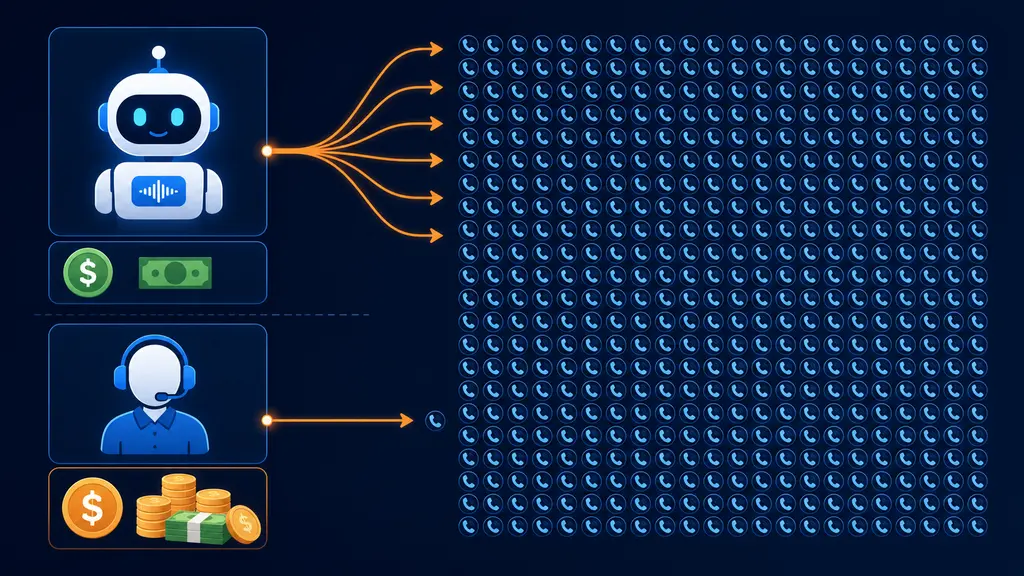


An AI cold calling bot is an autonomous voice agent that places outbound calls, speaks with prospects in natural language, qualifies them against your criteria, and routes the interested ones to human closers. It is not a prerecorded robocall and it is not a dialer that helps a rep work a list faster. It conducts the first conversation itself.
That distinction changes how you buy it, how you staff around it, and how you keep the campaign lawful. Sales teams have always been able to buy better lists, hire more sales development reps, and add dialers. The same operational problems survive all of it. Reps burn hours on numbers that never answer. Good leads sit overnight. Qualification standards drift from rep to rep. CRM notes get skipped.
This guide covers what the technology actually does, where it earns its keep, where a human still wins, what United States telemarketing law requires in 2026, and how to evaluate a vendor before you sign anything.
TL;DR
An AI cold calling bot places outbound calls and runs the first qualification conversation without a human on the line, then hands warm prospects to closers. It works in high-volume, repeatable, top-of-funnel motions such as lead qualification, appointment setting, and aged lead reactivation.
Federal telemarketing law treats an AI-generated voice the same as an artificial or prerecorded voice, so covered consumer telemarketing calls generally need prior express written consent before the bot dials. The Federal Trade Commission requires sellers and telemarketers to scrub against the National Do Not Call Registry at least every 31 days, and calls before 8 a.m. or after 9 p.m. in the recipient’s local time are off limits without consent.
Do not buy one if your deals need deep discovery from the first minute, if your buyers expect a senior human immediately, or if you cannot document where your leads came from and what they agreed to.
Key takeaways
- An AI cold calling bot conducts the conversation. A power dialer only speeds up a human rep.
- The strongest use cases are qualification, appointment setting, aged lead reactivation, and missed-call follow-up.
- Humans still win on negotiation, complex objections, multi-stakeholder deals, and high-value decisions.
- An AI-generated voice does not escape consent rules. Prior express written consent is the operative federal standard for covered consumer telemarketing.
- The FCC one-to-one consent rule was vacated in January 2025 and never took effect, but seller-specific consent is still the safer internal policy.
- Scrub against the National Do Not Call Registry at least every 31 days and suppress opt-outs immediately rather than waiting out the 10-business-day ceiling.
- AI magnifies your process. A messy process gets scaled, not fixed.
Table of contents
- What the term means
- How the technology works
- How it compares with dialers
- Why sales teams use them
- Where they perform best
- Where humans still beat the bot
- The AI first, human second model
- Is it legal in 2026
- What happened to one-to-one consent
- Compliance controls the workflow needs
- Why McLaughlin v. McKesson changed the risk picture
- How to evaluate a vendor in seven steps
- When it makes sense and when it does not
- How Bigly Sales approaches AI cold calling
- Frequently asked questions
- The bottom line
What an AI cold calling bot is
An AI cold calling bot is an autonomous voice agent that places outbound calls, holds a natural-language conversation with the person who answers, captures structured answers to qualification questions, and routes the right conversations to a human sales team. The word bot is misleading for anyone who still pictures a recorded message playing into a phone. Those older systems could not hear the person on the other end.
A modern system listens, converts speech to text, interprets intent, chooses a response, and speaks back through a generated voice. When it is configured well, it can run a structured sales conversation end to end without a rep on the line.
What it is not is a sales strategy. It removes waste from the front of the pipeline. It does not decide who to sell to, what to say, or what a qualified lead looks like. You supply all of that.
How an AI cold calling bot works
The system combines outbound telephony, speech recognition, language processing, text-to-speech, CRM integration, and campaign workflow rules into a single call flow. A typical stack has seven layers.
- Contact list and campaign data, including consent records
- Telephony and calling infrastructure, including caller ID and number health
- Speech recognition
- Language model and conversation logic
- Text-to-speech voice response
- CRM update and disposition logic
- Compliance controls and an audit trail
The important word is structured. The bot works when your team gives it a clear goal, explicit qualification criteria, approved scripts, compliant lead data, routing rules, and a defined handoff. Drop it into an undefined sales motion and it will produce undefined results at volume.
In practice, the questions look ordinary. Are you still interested in learning more. What state are you located in. Are you the decision-maker. When are you looking to get started. Would you like me to schedule a call with a specialist. Is this still the best number to reach you. Repeatable questions at scale is exactly the work this technology is good at.
AI cold calling bot compared with dialers
Teams use power dialer, predictive dialer, AI dialer, and AI cold calling bot interchangeably. They are four different products with four different risk profiles. Dialers are a category Bigly Sales does not sell, so treat the comparison below as a map of the market rather than a pitch.
| Tool | Who dials | Who talks | Best use case |
|---|---|---|---|
| Power dialer | Software | Human rep | Helping reps move through lists faster |
| Predictive dialer | Software | Human rep | Raising agent talk time in larger call centers |
| AI-assisted dialer | Software with AI support | Human rep | Notes, prompts, summaries, and next-best actions |
| AI cold calling bot | AI system | AI voice agent | Automating first-touch qualification and routing |
The compliance picture shifts at the bottom row. Once the AI generates the voice and conducts the call instead of assisting a human, the campaign falls under the artificial or prerecorded voice rules described later in this guide. If you are shopping the wider category, our roundup of the best AI cold calling software compares specific vendors by operating model.
Why sales teams use AI cold calling bots
Sales leaders reach for AI cold calling bots for five reasons, and none of them is novelty.
The first is speed to lead. Every minute between a form submission and a first call reduces the chance of reaching that person while intent is live. AI can call within minutes, including evenings and weekends where the campaign is lawfully configured to do so.
The second is consistency. One rep asks every question. Another skips half the script. One marks a lead qualified too early, another disqualifies someone who should have moved forward. The bot applies the same criteria on every call, which also makes your funnel data comparable.
The third is aged leads. Most CRMs hold thousands of contacts that were never reached or asked to be called back later. Human reps reasonably prefer to spend their best hours elsewhere. AI makes reactivation economically sensible.
The fourth is the administrative drag on selling time. Salesforce State of Sales research has repeatedly found that reps spend a majority of their week on non-selling work such as admin, CRM updates, internal coordination, and call prep.
The fifth is closer focus. A closer should not spend the day asking whether someone is the decision-maker. The point is not more calls. It is more valuable human hours.
Where AI cold calling bots perform best
These bots perform best in structured, high-volume workflows where the goal is qualification, appointment setting, reactivation, or routing to the right person.
Lead qualification is the strongest case. The bot calls new leads, confirms interest, asks predefined questions, collects missing details, and decides whether the lead reaches a closer. In mortgage, insurance, solar, debt relief, and home services, that first conversation follows a repeatable shape. The business needs to know who the prospect is, what they need, whether they qualify, how soon they want help, and whether they will talk to a specialist.
Appointment setting is close behind. The bot confirms interest, offers times, books the slot, and writes the outcome to the CRM or calendar.
Aged lead reactivation, missed-call follow-up, form-fill follow-up, renewal reminders, quote follow-ups, and campaign re-engagement all fit the same pattern. The common thread is a narrow goal and a defined next step. Ask the bot to run a complex negotiation from start to finish and it will underperform a mediocre human.
Where humans still beat the bot
Humans still win when the conversation needs trust, nuance, negotiation, empathy, or judgment. That covers more of the funnel than vendors like to admit.
A human closer is better when the prospect raises complex objections, when several stakeholders are involved, when legal or financial concerns surface, when there is emotional hesitation, or when the purchase is large enough that the buyer wants to size up the person selling it. Enterprise buyers, founders, and high-value consumers often want a peer on the call, not a script.
Humans are also better at reading a shift in tone. They slow down, change direction, tell a relevant story, and make a judgment call that no qualification tree anticipated.
So the framing of AI against humans is the wrong one. The right framing is AI before humans.
The AI first, human second model
The strongest outbound teams split the work into two layers rather than choosing a side.
The AI layer covers calling leads, confirming interest, asking qualification questions, capturing structured answers, detecting opt-outs, booking appointments, routing qualified prospects, and updating the CRM.
The human layer covers discovery, trust-building, complex objection handling, negotiation, proposal discussion, closing, and retention.
That division protects the scarcest resource you have, which is closer time. Instead of asking closers to call every lead, you use the bot to surface the leads worth their attention. A human-only team is bounded by working hours, energy, call reluctance, and follow-up discipline. A hybrid team keeps the pipeline moving continuously and passes people the conversations that deserve people.
See it live
Hear an AI agent qualify your leads
We will walk your list, your criteria, and your handoff rules on one call. Twenty minutes, no build required.
Is an AI cold calling bot legal in 2026
An AI cold calling bot can be run lawfully in 2026, but covered consumer telemarketing campaigns that use an AI-generated voice must satisfy the same consent, do-not-call, opt-out, calling-window, and state telemarketing rules as any other artificial or prerecorded voice campaign.
In February 2024 the FCC confirmed that AI-generated voices fall within the Telephone Consumer Protection Act restrictions on artificial or prerecorded voice calls. You cannot escape those obligations by pointing out that the voice was synthesized rather than recorded. The underlying statute is 47 U.S.C. 227.
For covered consumer telemarketing calls, prior express written consent is generally required before dialing with an artificial or prerecorded voice. The exact analysis turns on call purpose, recipient type, number type, the consent record, any applicable exemption, and state law on top of the federal floor.
The operational rule is short. Do not treat AI voice as a shortcut around consent. If the bot is calling consumer numbers for sales or marketing, the campaign needs legal review before launch, not after the first demand letter. For a deeper walkthrough of vendor-side controls, see our guide to TCPA compliant AI calling platforms.
What happened to one-to-one consent
The FCC one-to-one consent rule was vacated by the Eleventh Circuit in January 2025 and never took effect. It is not law, it was never law, and any vendor or article telling you it became binding in 2025 or 2026 is wrong.
The rule would have required separate consent for each individual seller and limited outreach to subjects logically and topically related to the original interaction. The Eleventh Circuit struck it down before the compliance date arrived, so the standard that governs your campaigns today is the one that governed them before, which is prior express written consent under the TCPA.
That is a correction, not a relaxation. Seller-specific consent remains worth adopting as internal policy because it is far easier to defend. If your consent record clearly shows that this person agreed to receive this type of call from this company, your litigation exposure drops regardless of what the FCC has or has not codified.
Lead buyers should be strictest of all. A lead aggregator form may not give your company the consent you assume it does. Before pointing AI voice at purchased leads, verify the consent language, timestamp, source, named seller, phone number, and authorized contact method.
The rule that genuinely did take effect is different. Under the FCC revocation-of-consent requirements, the cross-channel provision takes effect on January 31, 2027, meaning a consumer who revokes consent through one channel has revoked it for that caller across channels and subject matter. That is the 2026 date that belongs in your compliance calendar.
Compliance controls the workflow needs
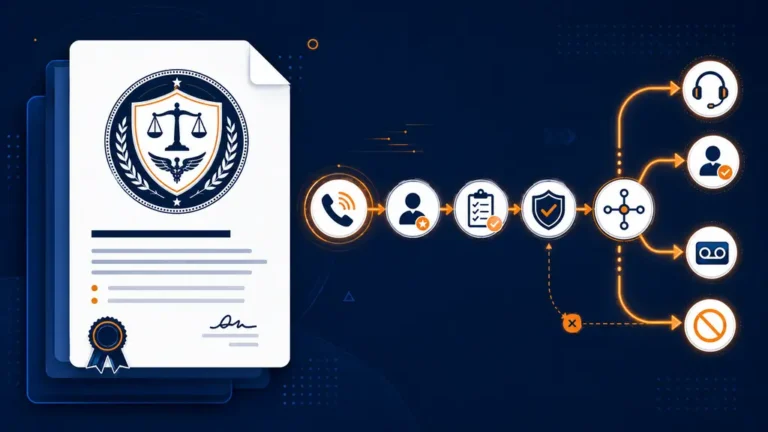
A defensible AI cold calling workflow is built on controls, not assumptions. Six of them are non-negotiable.
Consent verification comes first. Before the bot dials, the record should show who consented, when, what number they gave, what language they saw, which seller was named, and what contact method was authorized.
Do-not-call and internal suppression come second. The FTC Telemarketing Sales Rule requires sellers and telemarketers to scrub calling lists against the National Do Not Call Registry at least every 31 days. For high-volume AI campaigns, 31 days is a legal floor and a poor operating target. Check suppression closer to the moment of dialing. The FTC publishes its own compliance guidance for the Telemarketing Sales Rule.
Calling windows come third. Federal TSR guidance treats calls before 8 a.m. or after 9 p.m. local time at the called person’s location as a violation absent prior consent to be called outside that window. Several states are stricter, and the bot needs to know which rule applies to which area code and address.
Opt-out detection comes fourth. Consumers may revoke consent by any reasonable means, and callers must honor do-not-call and revocation requests within a reasonable time not exceeding 10 business days. For an automated system dialing thousands of numbers, immediate suppression is the only sane standard. The bot should recognize stop calling me, take me off your list, do not contact me again, remove my number, and their obvious variants.
Logging comes fifth. Every request should be timestamped, suppressed, and pushed to the connected CRM or suppression database.
Audit trails come sixth. Transcripts, recordings where permitted, dispositions, and script versions should be retrievable months later without a support ticket.
Why McLaughlin v. McKesson changed the risk picture
The Supreme Court decision in McLaughlin Chiropractic Associates, Inc. v. McKesson Corp., decided in June 2025, held that federal district courts are not bound by FCC interpretations of the TCPA under the Hobbs Act in private litigation.
The practical takeaway for anyone running an automated outbound campaign is that favorable FCC guidance no longer functions as a shield. Courts may read the statute independently, and outcomes can differ by jurisdiction on similar facts.
That raises the value of conservative campaign design and documentation. Consent records, suppression records, approved scripts, call logs, and opt-out logs are what you will actually be judged on.
How to evaluate a vendor in seven steps
Before deploying one, work through these seven checks in order. Skipping the first one is the most common and most expensive mistake.
1. Audit the list before the software
Where did the leads come from, what did the prospects consent to, can that consent be documented, does it cover the call you want to place, do state restrictions apply, and which numbers are already suppressed.
2. Listen to production calls, not demos
Demo calls are rehearsed. Ask for recordings of real campaigns and pay attention to interruptions, objections, confusion, background noise, and off-script questions.
3. Test latency and turn-taking
Long pauses and clipped interruptions cost you connects. The conversation should feel unremarkable, which is a higher bar than it sounds.
4. Ask who owns each compliance control
Consent review, internal suppression, do-not-call logic, calling windows, opt-out detection, outcome logging, transcripts, recordings, and CRM sync all have an owner. Get it in writing before launch.
5. Confirm the CRM integration
The bot should push structured outcomes into the system your team already lives in. Another disconnected dashboard is a net loss.
6. Test the human handoff
When a prospect is interested, the transfer or booking must carry context. A closer picking up a cold transfer with no notes will not thank you.
7. Review the reporting
Track answer rates, qualification rates, appointment rates, transfer rates, opt-out rates, call duration, objection patterns, lead source performance, and close rates after handoff. If a vendor cannot show you opt-out rate by campaign, that is a signal.
When it makes sense and when it does not
An AI cold calling bot makes sense when your outbound motion has high volume, clear qualification criteria, documented consent, and a defined next step. It fits when you receive more leads than your team can call quickly, when reps lose hours to low-intent prospects, when you need after-hours coverage, when aged leads sit untouched, when qualification is repetitive, and when you want cleaner CRM data.
It is a poor fit when every deal needs deep discovery from the first minute, when the sale is emotionally sensitive, when buyers expect a senior human advisor immediately, when consent records are thin or missing, or when nobody on your team has written down what qualified means.
That last one matters most. AI magnifies your process. A clear process scales. A messy one scales into a mess with a phone bill attached. If terminology is slowing the internal debate down, our AI calling glossary defines the terms consistently.
How Bigly Sales approaches AI cold calling
Bigly Sales runs managed AI outbound calling for teams that want the workflow operated rather than assembled. Our agents call leads, qualify prospects, book appointments, route warm conversations, capture structured answers, and push outcomes back into the CRM.
The managed part is the point. Consent-oriented checks, suppression logic, calling-window controls, opt-out handling, call records, transcripts, recordings where permitted, CRM updates, and campaign reporting are configured and monitored as part of the service rather than left as homework.
An honest caveat belongs here. No vendor, including us, can remove your compliance risk. Legality still depends on your lead sources, your consent quality, your campaign purpose, your script, and your states. What a managed platform changes is how much of that depends on manual execution by a busy team.
AI cold calling bot FAQ
What is an AI cold calling bot?
An AI cold calling bot is an autonomous voice agent that places outbound calls and speaks with prospects in natural language. It asks qualification questions, captures the answers, books appointments, routes interested prospects to human closers, and updates the CRM after the call. Unlike a robocall, it hears and responds to the person on the other end rather than playing a fixed message.
Is AI cold calling legal in the United States?
It can be, provided the campaign follows the applicable TCPA, FCC, FTC, do-not-call, consent, opt-out, calling-window, state telemarketing, and recordkeeping requirements. Covered consumer telemarketing calls using an AI-generated, artificial, or prerecorded voice generally require prior express written consent before dialing. The technology is not the legal question. The consent record and the call purpose are.
How is an AI cold calling bot different from a power dialer?
A power dialer speeds up a human rep by dialing numbers automatically, but the rep still holds every conversation. An AI cold calling bot conducts the first conversation itself. It listens, responds, qualifies, dispositions, and routes the lead without a human speaking during the initial call. The compliance treatment differs too, because a generated voice falls under artificial voice rules.
Did the FCC one-to-one consent rule ever take effect?
No. The Eleventh Circuit vacated it in January 2025 before the compliance date, so it never became binding. Prior express written consent under the TCPA remains the operative federal standard. Seller-specific consent is still worth adopting as internal policy because a clear, single-seller consent record is much easier to defend in litigation than a broad partner-list disclosure.
How often do I have to scrub against the Do Not Call Registry?
The FTC Telemarketing Sales Rule requires sellers and telemarketers to update their calling lists against the National Do Not Call Registry at least every 31 days. That is a floor rather than a target. For automated campaigns dialing at volume, most operators check internal suppression and registry status much closer to the moment of dialing to reduce the window in which a stale list can cause a violation.
What hours can an AI voice agent legally call?
Federal TSR guidance prohibits telemarketing calls before 8 a.m. or after 9 p.m. in the called person’s local time without prior consent to be called outside that window. Several states impose narrower windows and additional restrictions. The system should resolve local time from the recipient’s location rather than the area code alone, since numbers travel with people.
When should a human take over from the bot?
As soon as the prospect is qualified, interested, complex, emotionally invested, or high value. AI is strongest at reaching people and applying consistent criteria. Humans are strongest at persuasion, negotiation, and judgment. The handoff should carry the full call context so the closer opens with what the prospect already said rather than starting over.
What compliance controls should an AI cold calling bot have?
Consent review before dialing, do-not-call and internal suppression, calling-window enforcement by local time, opt-out detection with immediate suppression, approved script versioning, call records and transcripts, CRM updates, and a retrievable audit trail. If a vendor cannot demonstrate each of these on a live account rather than a slide, treat that as a material gap.
How much of the sales process can it actually handle?
The first touch and the qualification layer, reliably. Booking, routing, and CRM capture, reliably. Anything requiring negotiation, pricing strategy, multi-stakeholder coordination, or trust-building, unreliably. Teams that try to push it further usually see connect rates hold and conversion rates fall, which is a harder problem to diagnose than an outright failure.
Does this technology replace sales development reps?
It replaces the repetitive portion of the role rather than the role. Teams that adopt it well tend to keep their sales development reps and move them onto higher-value work such as account research, personalized outreach, and handling the conversations the bot escalates. Teams that cut headcount first and configure the bot second usually end up with worse pipeline than they started with.
The bottom line
An AI cold calling bot is not a shortcut to easy sales. It is a way to turn high-volume outbound work into a controlled, consistent, measurable process. The bot handles speed, coverage, qualification, follow-up, and data capture. Humans handle trust, persuasion, negotiation, and closing.
It will not fix a bad list, rescue a weak offer, or excuse a thin consent record. What it will do, for teams that understand the division of labor and have their compliance house in order, is give closers better conversations and give managers a clearer record of what happened on every call.
Start with your list
Find out what your aged leads are worth
Send us a sample campaign and we will map the qualification flow and the compliance controls it needs. No build, no commitment.