

Testing an AI voice agent means calling it on purpose, the way real people will, before it calls anyone on your list. A good test finds the script that sounds fine in a demo and fails on a busy Tuesday, the opt-out that does not stick and the transfer that rings out.
This guide gives you a plain checklist you can run without engineering help. It has twelve call tests with pass and fail signs, a set of test callers to play, the compliance checks to finish first and a small live pilot to run before you scale. It is written for the sales or operations manager who owns the phone process. For the bigger question of where AI fits next to people, read our guide to AI sales agents vs human SDRs.
Speed is the reason testing matters. Most teams go live within 24 hours of setup, so a bad script reaches real leads fast if nobody checks it. Our guide to choosing an AI voice agent platform covers the buying side.
TL;DR
Testing an AI voice agent means running twelve call tests, finishing the compliance checks and then starting a small live pilot before you scale. The twelve tests cover the opening line, qualifying questions, interruptions, off-script questions, angry callers, opt-outs, the are-you-a-robot question, silence, voicemail, live transfer, records and calling windows.
Any compliance failure blocks launch, because a call without valid consent can cost $500 or more. Write your pass and stop thresholds before the pilot starts.
A vendor demo is not a test, and a team that will not listen to calls should not launch at all.
Key Takeaways
- A vendor demo runs under ideal conditions and proves very little about your calls.
- Run twelve call tests, one per risk, and repeat the failures after every script change.
- Play test callers who interrupt, stay silent, get angry and ask for a person.
- Treat any consent, opt-out, calling window or disclosure failure as a launch blocker.
- Test the live transfer both when a rep answers and when nobody does.
- Run a small live pilot with a human control group and set thresholds in advance.
- Keep listening to calls after launch, since scripts drift as leads change.
Table of contents
- What testing an AI voice agent means
- Why a vendor demo is not a test
- The three stages of testing
- The 12 call tests
- Test callers to play and what to say
- Compliance checks before the first real call
- How to run a small live pilot
- How to score the results
- How testing works with Bigly Sales
- Who should not skip a step
- AI voice agent testing FAQ
- The bottom line
What testing an AI voice agent means
Testing an AI voice agent means checking how it behaves on real calls before it reaches your leads. That covers four things, the script and facts it uses, how it handles a live conversation, whether it follows calling rules and what happens after the call ends.
An AI voice agent, also called an AI SDR, is software that places or answers phone calls, runs a qualifying conversation and hands a live prospect to a person. The AI calling glossary defines the terms vendors use loosely. Because the agent talks for your company, a mistake is public. A wrong price, a skipped disclosure or a call to someone who said stop is yours to own.
Why a vendor demo is not a test
A demo is recorded or rehearsed under ideal conditions. The caller speaks clearly, answers in order and never interrupts. Real leads do none of that. They are driving, distracted, suspicious or annoyed.
Ask instead for a live call on your own script, with your own objections, from a phone you control. If a vendor will not let you do that, treat it as a warning.
The three stages of testing
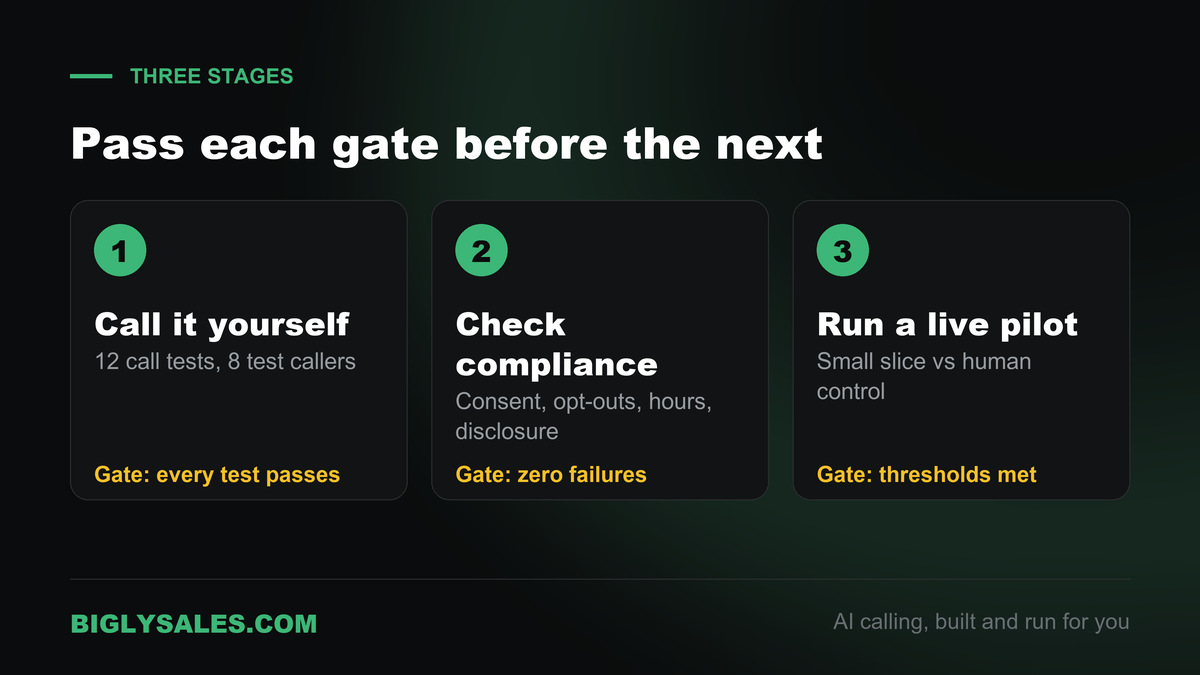
Work in three stages and move on only when the stage before it passes.
| Stage | What you do | Who is involved | Gate to move on |
|---|---|---|---|
| 1. Call it yourself | Run the twelve call tests and play the test callers | You and two or three colleagues | Every test passes or has a fix scheduled |
| 2. Check compliance and data | Verify consent, opt-outs, calling windows, disclosure and records | You and whoever owns compliance | Zero compliance failures |
| 3. Run a small live pilot | Call a slice of the real list and compare with a human control group | Sales lead, transfer reps, account manager | Results meet thresholds you set in advance |
The 12 call tests
Run each test at least once, write down what the agent said and mark it pass or fail. Repeat any failure after the script is changed.
| Test | What you do | Pass looks like | Fail looks like |
|---|---|---|---|
| 1. Opening line | Answer the call and listen | Names the company, says why it is calling and that it is an AI | Skips who is calling or hides that it is an AI |
| 2. Qualifying questions | Answer every question normally | Asks each criterion once and records each answer | Skips a question or asks the same one twice |
| 3. Interruptions | Talk over the agent mid-sentence | Stops, listens and picks up without repeating | Keeps talking or restarts from the top |
| 4. Off-script question | Ask something the script does not cover | Answers from approved facts or offers a person | Invents a price, term or promise |
| 5. Angry or confused caller | Sound irritated or lost | Stays calm and offers a person or ends politely | Argues, loops or apologizes repeatedly |
| 6. Opt-out | Say take me off your list | Confirms, ends the call and suppresses the number | Keeps pitching or the number is called again |
| 7. Are you a robot | Ask directly | Answers honestly and continues if you agree | Dodges or claims to be human |
| 8. Silence and noise | Stay silent, then add background noise | Re-prompts once or twice, then ends cleanly | Loops, talks over noise or hangs on the line |
| 9. Voicemail | Let the call go to voicemail | Follows the rule you chose, hang up or a compliant message | Leaves a long or non-compliant message |
| 10. Live transfer | Qualify as a ready buyer, then try it with nobody answering | Rep’s phone rings with context and caller is not re-asked | Transfer drops, loses data or leaves the caller stranded |
| 11. Records | Check the transcript, outcome and CRM fields | Everything lands on the right lead | Missing fields, wrong lead or no transcript |
| 12. Calling window and Do Not Call | Test a number in another time zone and a number you listed as Do Not Call | Neither is dialed | Either number rings |
Three of these carry legal weight. Test 6 ties to opt-out rules, which our guide to the TCPA revocation of consent covers. Test 7 ties to the state and federal rules in our guide to AI call disclosure laws. Test 9 ties to the rules in our guide to AI voicemail.
Free setup
Test it on your own script first
Book a free 30-minute setup call. Bigly Sales builds the agent on your script, and most teams go live within 24 hours, so bring this checklist to the call.
Test callers to play and what to say
Tests are more useful when you play a real person. Use these callers and write down what the agent did. Have a colleague play some of them so you are not the only voice it hears.
| Caller | What to say | What to check |
|---|---|---|
| The friendly buyer | Answer every question and ask about next steps | Qualification is complete and the transfer works |
| The busy caller | I only have a minute, what is this about | Gets to the point in one sentence and offers a callback |
| The skeptic | Who gave you my number | Answers honestly and offers to remove the number |
| The wrong person | You have the wrong number | Apologizes, ends the call and marks the number |
| The decision maker’s assistant | She is in a meeting, call back | Handles a callback request without pitching the assistant |
| The angry caller | Stop calling me, I am on the list | Ends the call, confirms the opt-out and does not argue |
| The price shopper | Just tell me the price | Gives only approved pricing or transfers to a person |
| The talker | Talk over the agent and change topics | Recovers and returns to the goal without repeating itself |
Compliance checks before the first real call
Compliance failures are the ones that cost real money, so finish these before any live call. This section is general information and not legal advice.
- Consent. Confirm the consent record behind every number you will upload. Telemarketing calls with an artificial voice need prior express written consent that meets 47 CFR 64.1200(f)(9). Our guide to TCPA consent for AI voice calls covers how to collect and store it.
- Calling hours. Telemarketing calls are limited to 8 a.m. to 9 p.m. in the recipient’s local time under 47 CFR 64.1200(c)(1). Test a lead in another time zone.
- Do Not Call. Numbers on the national registry cannot be called for telemarketing without an exception, under 47 CFR 64.1200(c)(2). Test a number you have listed.
- Disclosure. The FCC ruled in February 2024 that an AI voice is an artificial voice under the TCPA. Make the agent say it is an AI by default.
- Opt-outs across systems. If your calling platform, CRM and text provider each keep their own list, a stop request in one will not reach the others.
The official text of 47 CFR 64.1200 is on govinfo.gov. Under 47 USC 227(b)(3), a person can recover actual losses or $500 for each violation, whichever is greater, and a court may raise the award to as much as three times that for willful or knowing violations. One hundred calls without valid consent carry $50,000 in exposure at $500 each. Bigly Sales builds compliance controls into the platform, but the platform cannot make an unlawful list lawful.
How to run a small live pilot
Call tests use people who know the script. A pilot uses strangers. Run one before you scale.
- Choose a slice. Pick a segment of the real list that is large enough to compare and small enough that a mistake is cheap.
- Keep a control group. Give a similar slice to your human team, with the same lead source, hours and definition of qualified.
- Set thresholds first. Decide in advance the cost per booked appointment you will accept, the highest opt-out and complaint rate you will tolerate and the lowest transfer answer rate.
- Listen every day. Review a sample of calls each day, including the ones that ended early.
- Know your stop rule. Pause the campaign if a compliance failure appears or a threshold is crossed.
Our guide to AI sales agents vs human SDRs lists the metrics to compare, including cost per booked appointment, transfer to close rate and minutes per booked appointment.
How to score the results
Mark each of the twelve tests pass or fail and keep the list. Fix the script for every failure and rerun that test. Do not average the results, because one compliance failure matters more than eleven passes.
- Block launch for any failure on tests 1, 6, 7, 9 or 12, or any consent problem found in the compliance checks.
- Fix before scaling any failure on tests 4, 10 or 11, since wrong facts and broken transfers waste real leads.
- Tune during the pilot any failure on tests 2, 3, 5 or 8, which affect quality more than risk.
After launch, keep listening. Scripts drift as lead sources, offers and seasons change, so repeat the call tests whenever you change the script or the list.
How testing works with Bigly Sales
Bigly Sales is a fully managed AI calling service for inbound and outbound calls, with live transfer to your reps. Your account manager builds the agent on your script, and most teams go live within 24 hours. Plans and minutes are on the pricing page. Use this checklist on your setup call, ask to hear the agent on your own script before real leads and plan to change the script after the first calls.
Every minute on a plan costs the same whether it books an appointment or not, so a weak script is a cost problem as well as a quality problem. Testing is how you find it cheaply.
Who should not skip a step
Nobody should skip the compliance checks. The rest of the plan scales with risk, so you can shorten it for a small, low-stakes list but not remove it. Three situations call for the full plan.
- A list you bought or inherited. You cannot show consent for it yet, so fix the data first.
- A regulated offer. Insurance, lending, healthcare and debt services carry more rules and more risk.
- A team with nobody to take transfers. The agent will find leads you cannot use.
AI voice agents are also the wrong tool if you make very few calls or every call needs a person’s judgment. In that case a testing plan will not rescue the idea.
AI voice agent testing FAQ
What does it mean to test an AI voice agent?
Testing an AI voice agent means calling it on purpose, the way real people will, before it calls anyone on your list. You check the script, how it handles interruptions and odd questions, opt-outs, transfers and records. Then you run a small live pilot against a control group before you scale.
How many test calls should I make before launch?
Make at least one call for each of the twelve tests in this guide, then repeat the failed ones after every script change. A vendor demo does not count. After the call tests pass, run a small live pilot, because real leads behave differently from staff who know the script.
What should I say on a test call?
Play real callers. Be friendly and answer normally, then be busy, skeptical, confused and angry. Ask something off script, talk over the agent, stay silent and say stop calling me. Use the persona table in this guide, and write down exactly what the agent did each time.
How do I test that the agent stops when someone says stop calling me?
Say it on a test call in plain words, such as take me off your list. The agent should confirm and end the call. Then check that your own number lands on the suppression list and that no later call reaches it. Make sure the stop applies across every system and channel you use.
Should an AI voice agent say it is an AI?
Yes, treat disclosure as the default. The FCC ruled in February 2024 that an AI voice is an artificial voice under the TCPA, and several states require automated callers to disclose that they are not human. Test two cases, the opening line and a direct question such as are you a robot.
How do I test a live transfer?
Qualify yourself as a ready buyer and watch what happens on the rep side. The rep’s phone should ring quickly, the qualification should arrive with the call and you should not be asked the same questions again. Then test the failure case by letting nobody answer, and see what the agent tells the caller.
What should happen when an AI voice agent reaches voicemail?
It should follow a rule you chose in advance, either hang up or leave a compliant message. A voicemail left by an AI is a call under the TCPA, so the same consent rules apply. Let a test call go to voicemail and check the result against your rule.
How big should a pilot list be?
Large enough to produce enough calls to compare, and small enough that a mistake is cheap. A slice of the list, such as a tenth, is a common starting point. Keep a similar slice with your human team as a control group, and set your pass and stop thresholds before the pilot starts.
What failures should stop a launch?
Any compliance failure stops it. That includes calling a number without consent, ignoring an opt-out, dialing outside the 8 a.m. to 9 p.m. window or hiding that the caller is an AI. Wrong facts about price or terms and transfers that drop without a person also stop it until fixed.
How long does testing take?
We suggest an afternoon for the twelve call tests and one to two weeks for a small live pilot. Most teams go live within 24 hours of setup, according to the Bigly Sales pricing page, so the test plan is what keeps speed from becoming risk. Do not skip the pilot to save days.
The bottom line
An AI voice agent is only as good as the calls you check before launch. Run the twelve call tests, finish the compliance checks and start with a small pilot against a human control group.
Treat any consent, opt-out, calling window or disclosure failure as a blocker, and keep listening after you scale. Testing takes days and a bad launch takes months to repair.
Ready when you are
Launch with a plan, not a hope
See plans and pricing for Bigly Sales, then bring your script and this checklist. Setup starts with a free 30-minute call, and most teams go live within 24 hours.