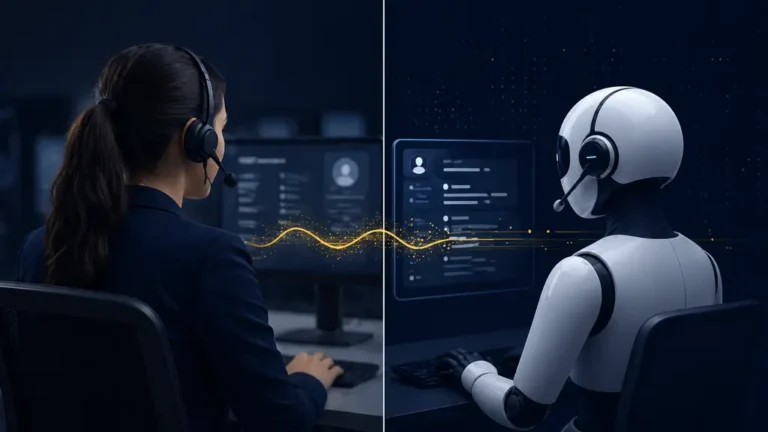


AI disclosure laws for phone calls are the rules that decide whether a business has to tell a person that an automated voice, and not a human being, is on the line. There is no single federal rule that says “you must announce you are an AI” today, but a mix of federal telemarketing rules and a growing set of state laws already gets you most of the way there.
This guide to AI disclosure laws for phone calls covers what the law requires right now, what is only proposed, and what we recommend you say on the first sentence of every AI call. It is general information and not legal advice, and it was checked in October 2026.
TL;DR
No final federal rule yet requires an AI voice agent to say it is an AI, but the FCC has proposed one and already treats AI voices as artificial voices under the TCPA, which requires consent and caller identification. Maine requires a clear notice when a reasonable consumer could think they are talking to a human, and its law covers voice. Utah requires disclosure when a consumer clearly asks. Telling people at the start of the call is the safest default and costs you a few seconds. This is general information, so confirm your state and call type with counsel before you dial.
Key Takeaways
- The FCC ruled in February 2024 that AI-generated voices count as artificial voices under the TCPA.
- A federal rule that would require saying “AI-generated call” is still only proposed.
- Maine already requires a clear and conspicuous notice when a consumer could be misled into thinking they are talking to a human.
- Utah requires you to disclose generative AI when a consumer clearly and unambiguously asks.
- Callers must identify the business and the purpose of a sales call before the pitch, with or without AI.
- Say it is an AI in your first sentence and never deny it when asked.
Table of contents
- What AI disclosure laws are
- What federal AI disclosure laws require today
- State AI disclosure laws that reach voice calls
- AI disclosure laws compared
- Why we recommend disclosing despite unsettled AI disclosure laws
- What a good disclosure sounds like
- Mistakes that create legal risk under AI disclosure laws
- AI disclosure laws FAQ
- The bottom line
What AI disclosure laws are
An AI call disclosure law requires the business behind a call to tell the person being called that an automated system is speaking, usually at the start of the call or when the person asks. The goal is simple. Nobody should be misled into thinking they are talking to a human being when they are not.
The AI disclosure laws that apply to calls come from three places. The first is the federal Telephone Consumer Protection Act and the FTC’s Telemarketing Sales Rule. The second is state law. The third is a pending FCC rulemaking. None of the three is complete on its own, so you need to look at all of them together.
What federal AI disclosure laws require today
The FCC treats AI voices as artificial voices
In February 2024 the FCC issued a declaratory ruling that voices generated with artificial intelligence are “artificial” voices under the TCPA. That means every consent rule that applies to a prerecorded or artificial voice call now applies to an AI voice agent. For a marketing call to a cell phone, that means prior express written consent. Our guide to TCPA consent for AI voice calls walks through the twelve rules in detail.
The rule on artificial voices also requires the call to state the identity of the business responsible for the call at the start. The official text of 47 CFR 64.1200 is available from govinfo.gov.
Caller identification and the FTC telemarketing rule
The FTC’s Telemarketing Sales Rule applies to a sales call no matter who or what is speaking. The caller has to tell the person promptly, and before any sales pitch, who the seller is, that the purpose of the call is to sell something, and what is being sold. The FTC explains this in its plain-language guide to the Telemarketing Sales Rule.
Notice what is missing. Neither rule says the words “I am an AI.” They require honesty about who is calling and why. They do not yet require honesty about what is calling.
The FCC proposal that would require saying it is AI
In August 2024 the FCC proposed a rule that would define an “AI-generated call” and add two disclosures. The first would happen when a caller collects consent, telling the person they may receive AI-generated calls. The second would happen at the start of each AI-generated call. The proposal was published in the Federal Register, and comments closed in October 2024.
As of this writing we could not find a final rule. Treat it as a proposal, and expect the final version to look a lot like what is described above.
State AI disclosure laws that reach voice calls
State law is where the explicit AI disclosure laws are showing up first. Three examples matter most for outbound calling.
Maine
Maine’s chatbot law defines an AI chatbot as software that simulates human conversation through textual or aural communications. Aural means spoken, so a voice agent is covered. A business may not use one in trade or commerce in a way that could mislead a reasonable consumer into believing they are talking to a human, unless the consumer is told clearly and conspicuously that they are not. A violation counts as a violation of the Maine Unfair Trade Practices Act.
Utah
Utah’s Artificial Intelligence Policy Act, as amended in 2025, requires a business to disclose that a consumer is interacting with generative AI when the consumer makes a clear and unambiguous request. A narrower set of higher-stakes interactions, such as regulated professions, faces a stricter duty to disclose up front. Read the current version of the statute before you rely on this summary, because Utah has amended it more than once.
California
California changed its automated calling rules in 2024 through AB 2905, effective January 1, 2025. When an automatic dialing system plays a prerecorded message, a live natural voice must come first, state the nature of the call and the business details, ask whether the person agrees to hear the recording, and say if the message uses an artificial voice generated or significantly altered with AI. The law is written around prerecorded messages, so a fully conversational agent may fall outside its exact wording.
Compliant by design
See how an AI call opens the right way
Book a short demo and we will walk through how an outbound AI call opens, identifies itself and handles opt-outs. It costs nothing and there is no obligation.
AI disclosure laws compared
| Rule | Covers | What it requires | Status |
|---|---|---|---|
| FCC ruling, February 2024 | All AI voice calls under the TCPA | Treats AI voices as artificial voices, so consent rules apply | In force |
| 47 CFR 64.1200 | Artificial or prerecorded voice calls | Identify the business responsible for the call at the start | In force |
| FTC Telemarketing Sales Rule | Telemarketing calls | Seller, sales purpose and what is sold, before the pitch | In force |
| FCC AI-generated call proposal | Calls and texts using AI voice | Disclose at consent and at the start of each call | Proposed |
| Maine | Chatbots in trade, text and voice | Clear notice if a consumer could think it is a human | In force |
| Utah | Generative AI with consumers | Disclose when clearly asked, up front in higher-stakes uses | In force |
| California AB 2905 | Prerecorded automated calls | Natural voice first, consent to the recording, artificial voice noted | In force |
Why we recommend disclosing despite unsettled AI disclosure laws
Our advice is to tell people it is an AI on every call. Unclear rules are not a reason to wait, and we do not think you should risk it.
There are three practical reasons. First, the direction of travel is obvious. The FCC proposal, Maine and Utah all point toward saying it up front, and a call script is easier to change before a rule lands than after. Second, you call people in many states at once, and the strictest state sets your floor. Third, a person who finds out mid-call that they were fooled hangs up and may report you. A person who knew from the first sentence and stayed on the line has told you they are interested.
Disclosure does not need to hurt your results. The calls that matter, with people who want what you sell, survive an honest opening. If your campaign only works when people think they are talking to a human, you have a different problem. Our post on TCPA compliance for AI outbound calling covers how a compliant campaign is built from the start.
What a good disclosure sounds like
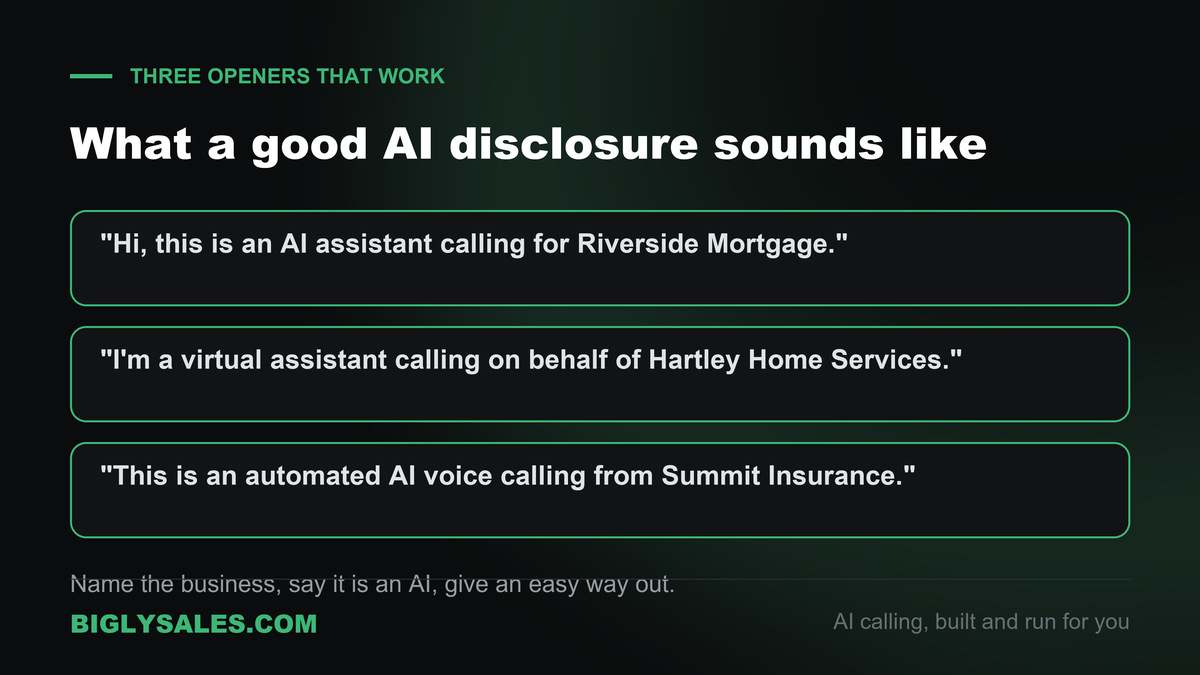
A good disclosure is short and plain, and it comes before anything else. It names the business, says it is an AI, and gives the person an easy way out. Here are three openings that do that.
- “Hi, this is an AI assistant calling for Riverside Mortgage. Do you have a minute to talk about your recent loan inquiry?”
- “Hello, I’m a virtual assistant calling on behalf of Hartley Home Services. I can help schedule your estimate, or I can take you off our list if you prefer.”
- “This is an automated AI voice calling from Summit Insurance about the quote you requested. You can say stop at any time.”
If the person asks, “Are you a real person?” or “Is this a robot?” the answer is yes, it is an AI. Follow it with an offer to continue or to connect them with a human. Utah’s law makes this explicit, and Maine’s covers it by its terms. It is also the right answer in every state.
Mistakes that create legal risk under AI disclosure laws
- Giving the agent a human name and backstory. A name is fine. Pretending to have a lunch break or a family is not.
- Denying it when asked. This is the single fastest way to turn a compliance gap into a deception claim.
- Burying the disclosure. Saying it in the last sentence of a long opener does not count as saying it first.
- Treating disclosure as a substitute for consent. Telling someone the call is AI does not give you permission to make it. Read our list of TCPA compliance mistakes before you launch.
- Checking only your own state. The law that applies is usually the one where the person you called lives.
- Ignoring recording laws. Call recording consent is a separate set of state rules from AI disclosure, and some states need everyone’s agreement.
The honest caveat is that this area is moving fast. A rule that applies this month may change next quarter, and a few of these laws have already been amended once. Check the current text, and talk to a lawyer who handles telemarketing before you launch in a new state.
AI disclosure laws FAQ
Do you have to tell people they are talking to an AI?
There is no final federal rule that says so, but you often have to anyway. The FCC treats AI voices as artificial voices under the TCPA, Maine requires a clear notice when a consumer could think they are talking to a human, and Utah requires disclosure when asked. The safest practice is to say it in the first sentence of every call.
Is it legal for an AI to call me without saying it is an AI?
It depends on the state and the type of call. A sales call must still identify the seller and the purpose before the pitch, and an AI voice needs consent like any artificial voice. In states like Maine, staying silent about it can be an unfair trade practice. Where no state rule applies, an undisclosed AI is still a bad idea.
What does the FCC say about AI voice calls?
The FCC ruled in February 2024 that AI-generated voices are artificial voices under the TCPA, so consent rules apply. In August 2024 it proposed adding an AI-generated call definition and disclosure at consent and at the start of each call. As of October 2026 we could not find a final version of that proposal.
Does Maine’s law cover phone calls?
Yes. Maine defines an AI chatbot as software that simulates human conversation through textual or aural communications, and aural means spoken. A business using a voice agent in trade or commerce must clearly and conspicuously tell the consumer it is not a human if the consumer could otherwise be misled. A violation falls under the state Unfair Trade Practices Act.
What do I do if someone asks whether they are talking to a robot?
Tell the truth right away. Say it is an AI assistant, then offer to continue, to schedule a callback, or to connect them with a person. Utah’s law requires disclosure on a clear and unambiguous request, and a denial can turn an ordinary call into a deception complaint in any state.
Does telling people it is an AI hurt response rates?
Some people hang up, and that is a good filter, because those people were not going to buy. Callers who stay on the line after an honest opening are better qualified and less likely to complain. Test your opening line with real numbers instead of guessing, and keep the disclosure in every version you test.
Do the same rules apply to AI text messages?
Maine’s law covers textual communications as well as voice, and the FCC proposal also covers AI-generated texts. Text messages carry their own consent and registration rules on top of that. Our guide to 10DLC registration covers the registration side for business texting.
Is AI disclosure the same as call recording consent?
No. They are separate legal questions. Disclosure is about telling the person who or what is speaking. Recording consent is about whether you are allowed to record the call at all, and some states require every party to agree. You may need to handle both at the start of the same call.
The bottom line
The AI disclosure laws are still catching up with the technology, but the direction is clear. Federal telemarketing rules already require consent and identification, Maine and Utah already require honesty about automation, and the FCC has put a national disclosure rule on the table.
Say it is an AI in your first sentence, answer honestly when asked, and get consent before you dial. That approach keeps you safe today and in front of the rules that are coming.
Start with a clean script
Launch AI calls with compliance built in
Tell us your industry and the states you call, and we will walk through how your opening, consent and opt-outs should work. There is no obligation.