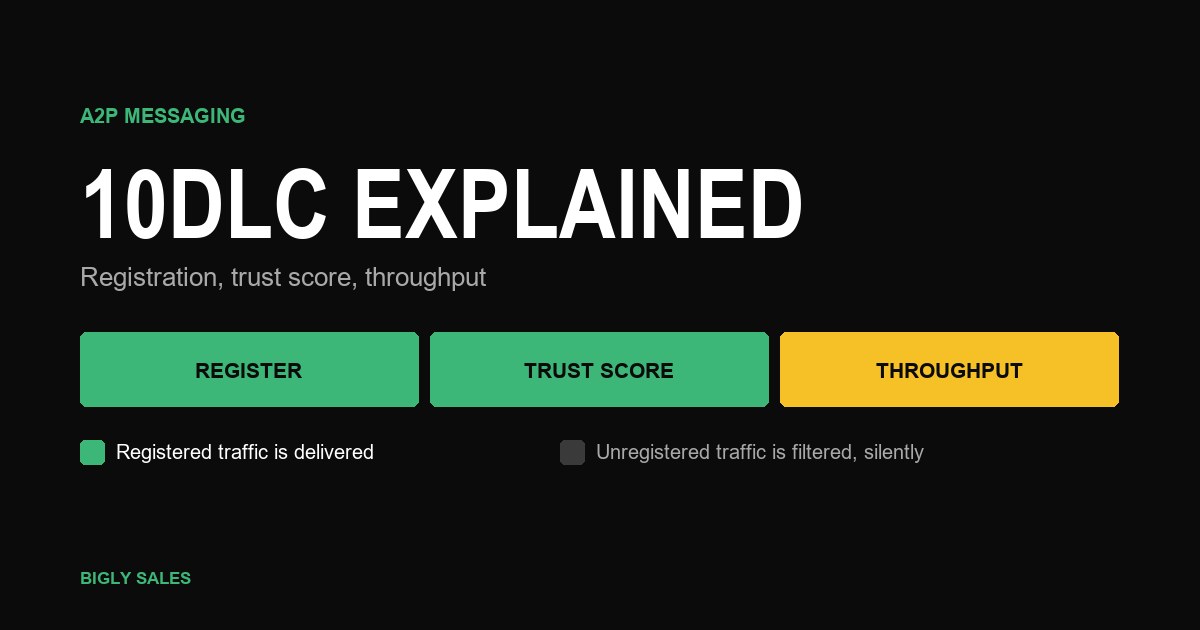


If your business texts customers from a normal ten-digit US phone number, you have to register that traffic with the carriers first. That registration process is 10DLC, and skipping it is why so many companies find their messages quietly disappearing.
The frustrating part is that nothing tells you. There is no bounce, no error, and no warning. Your platform reports the message as sent, the carrier filters it, and the customer never sees it. Teams often run for weeks before noticing that their reply rate collapsed.
This guide covers what 10DLC actually is, how brand and campaign registration differ, why your throughput is lower than you expected, and what gets applications rejected.
TL;DR
10DLC is the carrier-approved route for sending automated text messages from an ordinary ten-digit US business number, and it requires registering both your brand and each individual use case before you send. Unregistered traffic is filtered rather than rejected, so your platform reports every message as sent while the customer receives nothing. Your assigned trust score, not your platform, decides how many message segments you may send per minute, which is why two fully registered businesses can have completely unique real capacity. Registration is a carrier requirement, though, not a consent framework, so permission rules still apply on top of it.
Key Takeaways
- 10DLC is registration for automated texting from a standard ten-digit US number.
- Brand registration identifies the business, campaign registration covers each use case, and you need both.
- Trust score sets your throughput, so approval alone does not guarantee the capacity you assumed.
- Unregistered traffic is filtered silently, so nothing alerts you that messages are not arriving.
- Most rejections come from thin opt-in evidence rather than from the message text.
- Registration is a carrier requirement, not a consent framework. Permission rules still apply on top.
- 10DLC is the carrier-approved route for application to a person texting from a standard ten-digit US number.
Table of contents
- What 10DLC means
- Why registration exists
- How registration actually works
- Trust score and throughput
- 10DLC against toll-free and short codes
- What gets campaigns rejected
- Where this touches your calling operation
- 10DLC FAQ
- The bottom line
What 10DLC means
10DLC stands for ten-digit-long code. A long code is an ordinary phone number, the kind a person would dial, as opposed to a five- or six-digit short code.
A2P means application to person, which is any message sent by software rather than typed by a human on a handset. Your appointment reminders, delivery updates, two-factor codes, and marketing blasts are all A2P.
Put together, 10DLC is the sanctioned way to send A2P messages from a normal business number in the United States. It exists because businesses were sending automated traffic from long codes that were only ever designed for person-to-person texting, and carriers had no way to tell legitimate senders from spammers.
Why registration exists
Before registration, carriers filtered A2P traffic on long codes by guessing. Volume spikes, repeated content, and unfamiliar numbers all looked like spam, so plenty of legitimate business messaging got blocked while actual spam got through.
Registration replaces guessing with identity. You tell the carriers who you are, what you intend to send, and how you collected permission. In exchange, you get predictable delivery and a known throughput allowance.
The trade is real. You give up anonymity and some setup time. You get messages that actually arrive. For anyone whose business depends on a customer receiving a text, that is not a close call.
How registration actually works
Two stages, and people routinely confuse them.
Stage one: Brand registration
You register the business itself. Legal entity name, tax ID, address, website, and contact details. This step identifies who is behind the traffic, and it is done only once.
Accuracy matters more than speed here. The details are checked against third-party records, and a legal name that does not exactly match your tax ID is the most common reason a brand fails vetting. Use the name on the tax paperwork, not the trading name on your website.
Stage two: Campaign registration
Then you register each use case separately. Appointment reminders are one campaign. Marketing promotions are another. Two-factor codes are another.
For each you describe the use case, provide sample messages, and explain exactly how subscribers opt in. That last part is where most applications fail, and it is covered below.
Optional vetting
You can pay for enhanced vetting, which usually raises your trust score and therefore your throughput. Whether it is worth it depends entirely on volume. A business sending a few hundred reminders a day will not notice. One sending tens of thousands will.
Trust score and throughput
The trust score is the part that surprises people after approval.
Registration does not give everyone the same sending capacity. Each brand gets a trust score based on the vetting outcome and the business profile, and that score maps to how many message segments per minute you may send and how many you may send per day to each carrier.
So two companies using the same messaging platform, both fully registered, can have very different real-world capacity. If your reminders go out slower than expected, the platform is usually not the constraint. The trust score is.
Two practical consequences. Check your assigned throughput before designing anything time-sensitive, because a same-minute reminder for a thousand appointments needs capacity you may not have. And remember a long message counts as multiple segments, so throughput in segments per minute is not the same as messages per minute.
10DLC against toll-free and short codes
Three routes exist for business messaging in the US, and they suit different situations.
10DLC uses a normal local number, costs the least, and supports both calls and texts on the same number. Throughput is the lowest of the three. It suits most businesses, particularly where the local number matters to how customers see you.
Toll-free messaging runs on an 800-style number and needs its verification rather than 10DLC registration. Throughput is generally higher, and approval is often faster. It suits national brands where a local presence is irrelevant.
Short codes are the five- or six-digit numbers. They have the highest throughput and best deliverability, but they are considerably more expensive and take weeks to provision. They suit very high-volume programs where a delayed message is a real business problem.
If you are choosing today, start with 10DLC unless you know your volume exceeds what it allows.
| Route | Number shown | Registration needed | Relative throughput | Best for |
|---|---|---|---|---|
| 10DLC | Your local ten-digit number | Brand plus each campaign | Lowest | Most businesses, especially where a local number matters to customers |
| Toll-free | An 800-style number | Toll-free verification instead | Higher | National brands where a local presence is irrelevant |
| Short code | A five- or six-digit code | Full provisioning process | Highest | Very high-volume programs where a delayed message is a business problem |
What gets campaigns rejected
Rejections cluster into a handful of causes, and almost all of them are avoidable.
Weak opt-in evidence. This is the big one. Saying customers agreed is not enough. You need to show where they agreed, what wording they saw, and that the consent covered the messages you now want to send. A screenshot of the actual form beats any description of it.
Mismatched details. A legal name that does not match the tax ID, or a website that does not mention messaging at all.
Sample messages that do not match the use case. If you register appointment reminders, your samples cannot contain promotional language. Carriers read them.
Missing opt-out language. Recipients need a clear way to stop, and it needs to appear in your samples.
Restricted content. Certain categories face additional scrutiny or outright prohibition. Check before building a program around one.
The industry standards these reviews follow are published in the CTIA Messaging Principles and Best Practices, which is worth reading once before you apply.
Before you register
Get the consent evidence right first
Most campaign rejections come down to thin opt-in documentation rather than the message text. We will walk through how consent is captured and logged on a live call or on a 30-minute screen share so the evidence exists before a reviewer asks for it.
30 minutes · screen shared · no obligation
Where this touches your calling operation
Most teams treat texting and calling as separate problems with separate vendors. The carriers do not.
The same number that places your calls often sends your texts, and its reputation is shared. Aggressive dialing that gets a number labeled as spam can affect how that number’s messages are treated, and heavy unregistered texting can affect how its calls are received. We cover the calling half of this in number health when outbound calls get flagged as spam and in how STIR SHAKEN affects your answer rates.
Consent is the other shared piece. The permission rules that govern automated calls also govern marketing texts, and 10DLC registration is not a substitute for them. The FTC guidance on complying with the Telemarketing Sales Rule sets out the disclosure and record-keeping duties that sit underneath both channels. Registration tells carriers who you are. It does not establish that you were allowed to contact someone. That is covered in our guide to TCPA compliance for AI outbound calling.
Deliverability vocabulary gets dense quickly, and the AI calling glossary defines the messaging and number reputation terms in plain language.
10DLC FAQ
What is 10DLC?
10DLC stands for ten digit long code, and it is the carrier approved route for sending application to person text messages from an ordinary US business phone number. Before you send anything you register two separate things, your brand and each individual use case, and the carriers assign a trust score that caps how fast you may send.
What is the difference between 10DLC and A2P 10DLC?
They are used interchangeably in practice. A2P means application to person, so A2P 10DLC is the precise term for automated messages sent from a ten-digit-long code. When a vendor says 10DLC, they almost always mean A2P 10DLC, because person-to-person texting from a handset needs no registration at all.
Is 10DLC registration mandatory?
For sending automated messages from a ten-digit US number, effectively yes. Major carriers filter or block unregistered A2P traffic. It is a carrier requirement rather than a law, but the practical outcome of ignoring it is that your messages do not arrive.
What happens if I do not register?
Your messages get filtered rather than rejected, which is what makes it dangerous. Your platform reports them as sent, and no error comes back, so the failure only shows up later as a mysterious drop in replies, bookings, or conversions. Teams routinely run for weeks before anyone connects the two.
How long does 10DLC registration take?
Brand registration is often quick, sometimes within a day. Campaign approval varies with the use case and how clear your opt-in evidence is and can take from a couple of days to a couple of weeks. Vague opt-in documentation is the usual cause of delay.
What is a 10DLC trust score?
It is a rating assigned to your registered brand based on vetting and business profile, and it determines your message throughput and daily limits per carrier. A higher score means you can send faster, which is why two fully registered businesses can have very different capacity.
Why are my messages slow to send after registration?
Almost always throughput rather than the platform. Your trust score caps how many message segments you may send per minute to each carrier. Long messages count as multiple segments, so a campaign consumes capacity faster than the message count suggests. Check your assigned throughput before designing anything time sensitive.
Should I use 10DLC, a toll-free number, or a short code?
10DLC for most businesses, especially where a local number matters. Toll-free when you want higher throughput without a short code cost, and a local number is irrelevant. Short codes are only for very high-volume programs that can justify the expense and the provisioning time.
Does 10DLC registration make my texting compliant?
No. Registration tells carriers who you are and what you intend to send. It does not establish that a recipient gave you permission to message them. Consent, opt-out handling, and record-keeping are separate obligations that still apply in full.
The bottom line
10DLC is unglamorous plumbing, and it is the difference between messages that arrive and messages that vanish without telling you.
Register the brand carefully with details that match your tax records, register each use case separately, and put real effort into the opt-in evidence because that is what reviewers actually scrutinize. Then check your assigned throughput before you design anything time sensitive.
If you are running calls and texts against the same customer list, treat number reputation and consent as one problem rather than two. Book a free setup session if you want to see how that works when both run on one platform.
One record per contact
See calls and texts on one platform
When the same number places your calls and sends your texts, its reputation is shared and so is the consent record. Book a walkthrough and we will show you both running against your own list.