

Teams searching for Five9 alternatives are usually not unhappy with the software. They are unhappy with what it costs to keep every seat licensed, or with how long it takes to change anything, or with the fact that they bought a platform to route calls and now want something that resolves them.
Those are three different problems with three different answers, which is why most comparison lists are useless. Swapping one contact center platform for another fixes the price for a while and changes nothing else.
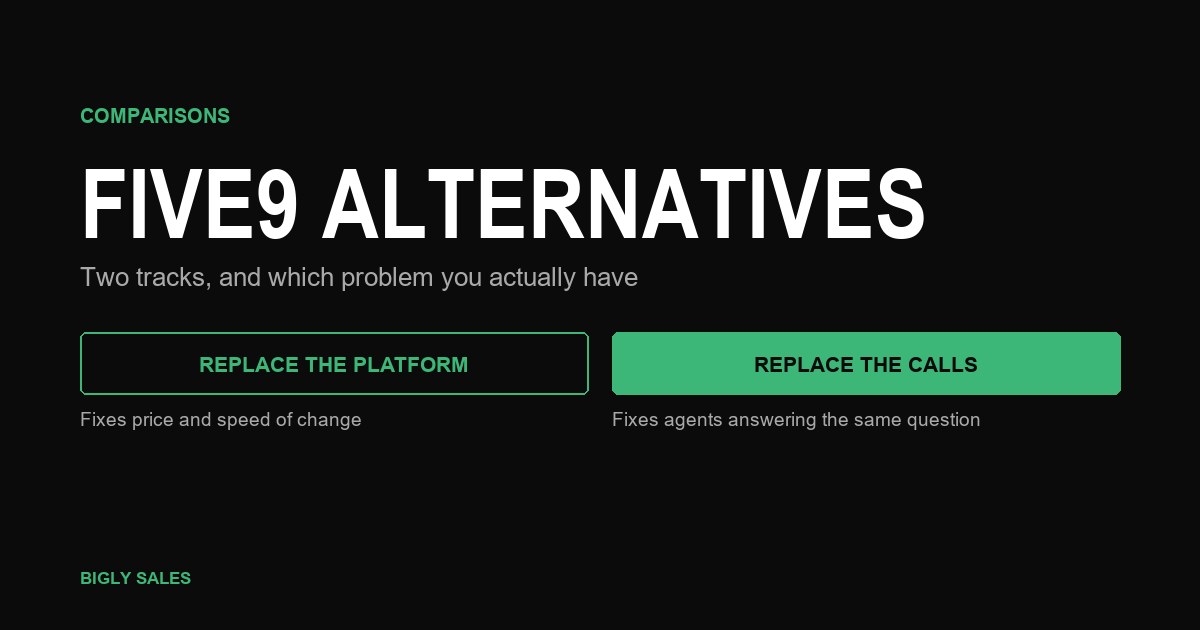
This guide covers the real options across two tracks, because replacing your contact center platform and replacing what you actually use it for are not the same project.
A note on who wrote this. Bigly Sales publishes this, and Bigly appears in it. We sell AI voice agents, not a contact center platform, so we are honest below about the large parts of Five9 we do not replace. Judge the reasoning and decide for yourself.
A note on pricing. Every platform in the first track is sold by quote, not from a public price list. Anyone quoting you a firm per seat figure for these in an article is guessing. We describe how each one charges instead, which is the part that actually determines your bill.
TL;DR
Five9 is a full cloud contact center, so replacing it properly means moving routing, reporting, workforce management and agent tooling at the same time. Most teams shopping for an alternative only heavily use a slice of it, and replacing that slice costs far less than replacing the platform. All five enterprise alternatives covered here are sold by quote and priced per licensed agent, so compare the charging model rather than any headline rate you are shown. If your real problem is that repetitive calls reach agents at all, a platform swap will not fix it.
Key Takeaways
- Decide whether your problem is price, speed of change, or the fact that calls get routed rather than resolved.
- A platform swap fixes the first two. Only automation fixes the third.
- Genesys, Talkdesk, NICE CXone, 8×8 and Amazon Connect are the genuine like for like options.
- All of them are quote based, so compare charging models rather than headline rates.
- Most teams use a slice of Five9, and replacing that slice beats replacing the platform.
- Check number portability, data export and your notice period before you shortlist anyone.
- Five9 is a full cloud contact center, so a true replacement means moving routing, reporting, workforce management and agent tooling all at once.
Table of contents
- What Five9 is and what replacing it involves
- Why teams look for an alternative
- The two tracks
- Track 1: platforms that replace Five9
- Track 2: replacing what you actually use it for
- How these platforms actually charge
- How to choose
- Migration checklist
- Five9 alternatives FAQ
- The bottom line
What Five9 is and what replacing it involves
Five9 is a cloud contact center platform, meaning it handles inbound and outbound routing, agent desktops, dialing, recording, reporting and workforce management as one licensed system rather than as separate tools. That scope is the reason replacing it is harder than replacing a phone system. A dialer swap touches one workflow, while a platform swap touches routing rules, integrations, historical reporting, quality scoring and every agent screen at the same time.
It also explains why so many alternatives look cheaper than they are. A product that replaces the dialing half of Five9 is not competing with your whole bill, so comparing its price against your platform invoice tells you very little.
Why teams look for an alternative
Most searches for Five9 alternatives start with a renewal quote rather than a product complaint.
Three reasons come up repeatedly, and they point in different directions.
The bill scales with seats, not with value. Contact center platforms charge per licensed agent. Add ten people for a busy quarter and the cost stays until someone remembers to remove the licenses. Teams whose call volume grew faster than their resolution rate feel this hardest, because they are paying more to handle the same problems.
Changes take too long. Adjusting a routing flow or adding a queue often means a ticket, a professional services conversation, or an internal specialist who is booked for three weeks. Marketing wants to test a campaign this week and the platform operates on a quarterly rhythm.
It routes rather than resolves. This is the one that a platform swap will not fix. If most of your volume is the same handful of repetitive questions, the problem is not which platform delivers them to an agent. It is that a person is answering them at all.
Work out which of the three you actually have before you shortlist anything, because only the first two are solved by a different platform.
The two tracks
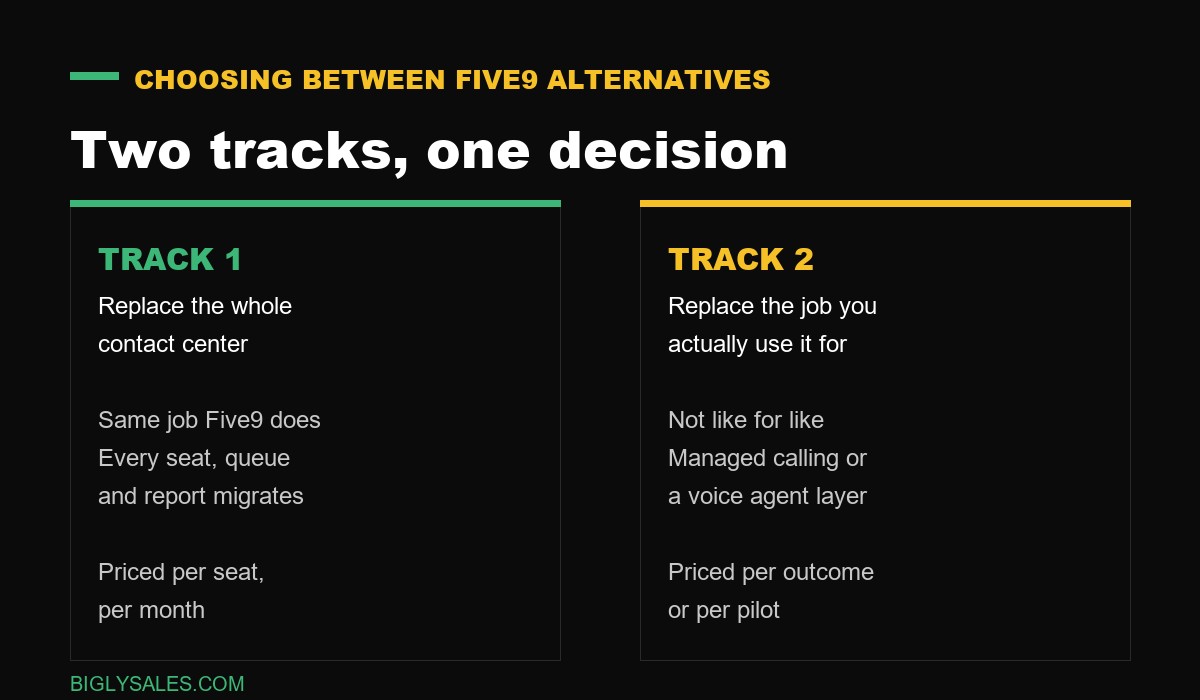
Five9 alternatives split into two tracks, and picking the wrong track is the most expensive mistake in this whole evaluation.
Five9 does a lot. Inbound routing, outbound dialing, IVR, recording, quality management, workforce scheduling, reporting, and the agent desktop that ties them together.
Almost nobody uses all of it heavily. Most teams lean on two or three parts and tolerate the rest.
That gives you two honest options. Replace the whole platform with another whole platform, which is track one. Or keep the platform and replace the specific job you are frustrated with, which is track two and is usually the cheaper, faster answer.
Track 1: platforms that replace Five9
These Five9 alternatives aim to do the same job Five9 does, as a full contact center platform. If you need every seat, queue and report to survive the move, your shortlist of Five9 alternatives lives here.
These are genuine like for like replacements. All are enterprise sold, all take months rather than weeks, and all charge per seat.
1. Genesys Cloud
The most feature complete option and the most complex. If your requirements list is long and includes things no other vendor supports, this is usually where you end up. The trade is that breadth brings configuration burden, so budget for someone whose job is running it.
2. Talkdesk
Positions around industry specific packaging rather than raw breadth, so a lot of the vertical configuration arrives pre built. Teams generally find it faster to get live than Genesys.
3. NICE CXone
Strongest reputation in workforce management and quality, which matters enormously if your operation is large enough that forecasting and scheduling are their own discipline. If you moved off Five9 and your scheduling got worse, this is the direction to look.
4. 8×8
Combines business phone and contact center in one contract, which is attractive when you are currently paying two vendors for a phone system and a contact center. Consolidation is the pitch rather than depth in either half.
5. Amazon Connect
Pay for what you use rather than per seat, which changes the economics completely for spiky volume. The catch is that it is closer to a toolkit than a product, so you are budgeting engineering time rather than licenses.
| Platform | Charging model | Setup effort | Strongest at | Best for |
|---|---|---|---|---|
| Genesys Cloud | Per licensed seat | Highest | Breadth of capability | Large operations with in house platform expertise |
| Talkdesk | Per licensed seat | Medium | Industry specific packaging | Mid market and up wanting less assembly |
| NICE CXone | Per licensed seat | High | Workforce management and quality | Operations where scheduling is its own cost center |
| 8×8 | Per licensed seat | Medium | Phone system plus contact center in one contract | Teams paying two vendors today |
| Amazon Connect | Per usage | Engineering, not configuration | Spiky volume economics | Teams with developers who prefer to build |
Track 2: replacing what you actually use it for
The second group are not really Five9 alternatives in a like for like sense, and that is the point.
This track is worth taking seriously if your honest answer to what do you use Five9 for is one or two things.
6. Bigly Sales
We are an AI voice agent platform, not a contact center platform. The agent answers or places the call itself, holds a real conversation, qualifies against your criteria, books the appointment, and brings a person in only when there is a reason to. Inbound and outbound run on one system with one record per lead. Compliance checks run before the call rather than in an audit afterwards, which matters if you operate in insurance, lending, legal or healthcare.
Where Bigly is the wrong choice. If you need workforce scheduling, quality management scorecards, or an omnichannel agent desktop that handles email and chat alongside voice, we do not replace those and you should stay on a contact center platform. If your volume is a handful of calls a day, our plans start above what that justifies. And if your calls are genuinely complex from the first sentence, an AI agent taking the first touch adds a step rather than removing one.
Where it does fit, the change is not a cheaper seat. It is fewer seats needed for the same volume, which is a different kind of saving. You can see the detail in every Bigly Sales feature.
7. Dedicated AI voice platforms
Several vendors sell AI voice agents as developer infrastructure rather than as a managed service, including Retell, Vapi and Bland. You get more control and lower per minute cost, and you take on building the agent, the compliance layer and the number management yourself. Best fit for teams with engineers who want to own the stack. We compare these directly in Bigly versus Retell and Bigly versus Vapi.
8. Standalone dialers
If outbound is the only part of Five9 you use heavily, a dedicated dialer is far cheaper than a contact center license. Understand which pacing model you are buying before you sign, because the type determines your compliance exposure. Our guides to the predictive dialer and the power dialer cover that choice.
9. Human answering services
Worth naming because it is sometimes the right answer. Low call volume, high complexity, and no appetite for managing software at all points here rather than at any platform. The cost per contact is high and it stops being viable as volume grows.
10. Doing nothing yet
Also a legitimate option, and the one nobody lists. If your contract has eighteen months left and your real problem is that nobody has redesigned the routing flow since 2023, a migration is an expensive way to avoid a configuration project.
Before you shortlist
Find out which calls need no platform
We will go through your contact reasons and show which of them an AI agent resolves without a licensed seat. Thirty minutes, your own call mix, and you keep the breakdown either way.
30 minutes · screen shared · no obligation
How these platforms actually charge
Pricing is where Five9 alternatives separate from each other far more than feature lists suggest. Two Five9 alternatives with near identical features can differ by a factor of three once you model your real call mix.
Compare the model rather than a rate, because the model is what surprises you.
Per licensed seat is the norm for Five9 and every track one alternative. You pay for the license whether the agent took one call or two hundred. Costs grow with headcount, and they do not shrink until somebody actively removes licenses.
Per concurrent agent is offered by some vendors and suits shift based operations, because two people sharing one shift can share one license.
Per usage is the Amazon Connect model, and it inverts the risk. Quiet months genuinely cost less and busy months genuinely cost more, which is better for spiky volume and worse for budgeting.
Per minute or per call is how AI voice platforms including ours charge. The reason it matters is not that the rate is lower. It is that the cost tracks conversations rather than headcount, so handling more volume does not automatically mean hiring.
Three questions get you further than any comparison table. What happens to the bill when volume doubles but headcount does not. What is the minimum commitment and the term. And what is the exit cost, including getting your recordings and transcripts out.
How to choose
Choosing among Five9 alternatives comes down to one honest question about what you actually run today. Answer it first and most Five9 alternatives eliminate themselves before you sit through a single demo.
- You need everything Five9 does and want fewer gaps, look at Genesys Cloud and accept the configuration overhead.
- You want the same category with less assembly, look at Talkdesk.
- Your scheduling and quality processes are the expensive part, look at NICE CXone.
- You are paying separately for a phone system and a contact center, look at 8×8.
- Your volume is spiky and you have engineers, look at Amazon Connect.
- Most of your volume is repetitive questions, look at AI voice agents rather than another platform.
- Only outbound matters to you, buy a dialer and stop paying for a contact center.
- Your real problem is an unmaintained routing flow, fix that before you shortlist anyone.
Migration checklist
Whichever of the Five9 alternatives you pick, work these steps in order and the cutover stays boring. Re-verify your consent records and calling windows against the FTC Telemarketing Sales Rule before the first campaign runs on the new stack, because the obligation follows you across platforms. Teams that skip a step here are the ones who end up evaluating Five9 alternatives again a year later.
- Confirm number portability in writing before anything else, including any numbers your platform provisioned rather than you. Federal number portability rules give you the right to take your numbers with you, but both carriers still have to schedule and confirm the port.
- Export your recordings and transcripts while you still have access. Retention obligations do not pause because you switched vendor.
- Document the routing you actually use rather than what the diagram says. Most flows have branches nobody has touched in years.
- Run both in parallel on a slice of volume. Any vendor unwilling to support that is telling you something.
- Check your notice period today. Auto renewal clauses have quietly decided plenty of these projects.
- Re-verify compliance on the new stack. Consent records, quiet hours and suppression lists do not migrate themselves, and our guide to TCPA compliance covers what has to survive the move.
If you are comparing platforms, the AI calling glossary defines the routing, workforce and dialing terms vendors use differently from each other.
Five9 alternatives FAQ
What is the best Five9 alternative?
It depends which problem you are solving. Genesys Cloud is the most complete like for like replacement, Talkdesk is faster to get live, NICE CXone is strongest on workforce management, and Amazon Connect changes the economics if your volume is spiky. If your issue is that repetitive calls reach agents at all, an AI voice agent is a better answer than any of them.
Is there a cheaper alternative to Five9?
Usually yes, but the saving comes from buying less rather than from a lower rate. Replacing a full contact center license with a dialer, or with an AI voice platform priced per minute, costs less than swapping one per seat platform for another.
Can I replace Five9 with an AI voice agent?
Only partly, and it is worth being clear about that. An AI voice agent replaces the conversations, not the workforce management, quality scorecards or omnichannel agent desktop. Teams that use Five9 mainly for inbound and outbound calling often can. Teams that rely on scheduling and quality tooling cannot.
How long does it take to migrate off Five9?
Moving to another contact center platform is typically a multi month project once number porting, routing rebuilds, integrations and agent training are counted. Replacing a single function, such as outbound calling, is far shorter because the rest of the stack stays put.
What does Five9 cost?
It is quote based and priced per licensed agent, with the total depending on tier, contract length and which add ons you take. Any article giving you one firm number is guessing. The useful question is what happens to the bill when call volume doubles but headcount does not.
Will I lose my phone numbers if I switch?
Usually not, but get portability confirmed in writing before you commit, and check specifically for numbers the platform provisioned on your behalf rather than ones you brought with you. Those are the ones that cause problems late in a migration, when the timeline is already fixed and the leverage has gone.
Does Amazon Connect really work out cheaper?
For spiky volume, often. It charges for usage rather than seats, so quiet periods genuinely cost less. The offset is engineering time, because it behaves more like a toolkit than a finished product, so compare total cost including the people who will build and maintain it.
Should we consolidate our phone system and contact center?
It saves contract overhead and is worth looking at if the same staff handle internal and customer calls. If your contact center is a distinct operation with its own scheduling and quality needs, a combined product usually means accepting a weaker contact center half.
What should we do first before shortlisting alternatives?
Write down what you genuinely use, contact reason by contact reason, and how much of your volume each accounts for. Most teams discover that a small number of repetitive reasons make up most of the load, which changes the shortlist entirely.
The bottom line
The best of the Five9 alternatives depends entirely on which track you are on. Judge Five9 alternatives against the work you actually do, not against a feature grid.
If Five9 is too expensive or too slow to change, Genesys, Talkdesk, NICE CXone, 8×8 and Amazon Connect are the honest like for like options, and you should compare how they charge rather than what they list.
If the real frustration is that your agents spend their day on the same few questions, no contact center platform fixes that, because they all assume a person takes the call. That is the case where an AI voice agent is worth looking at, and where we would put ourselves forward.
Want to know which of your contact reasons could be handled without an agent? Book a demo and we will go through your own call mix rather than a generic pitch.
Not a seat license
Priced by conversation, not headcount
Handling more volume should not mean hiring or licensing more people. Book a walkthrough and we will run your list through an agent so you can compare the cost against your current per seat bill.