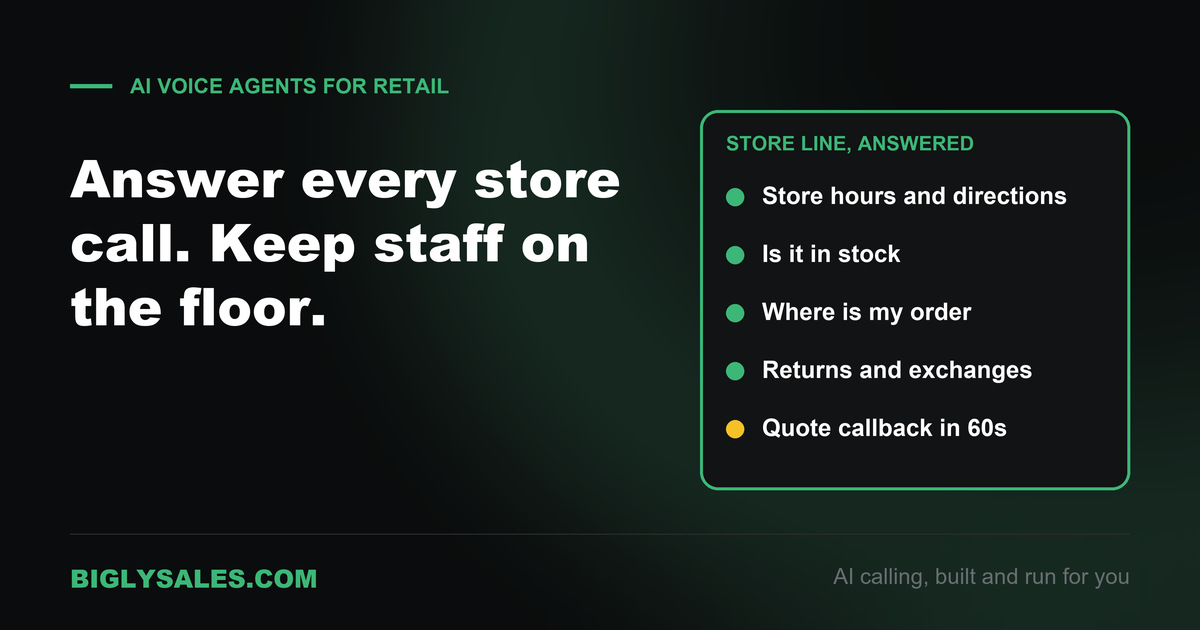


AI voice agents for retail answer the store phone so your staff do not have to stop selling to pick it up.
Hours. Directions. Is it in stock. Where is my order. Can I return this.
Those calls never stop. And they always seem to land when the floor is busiest.
This guide shows which store calls to hand to AI first, what stays with your team and what it costs.
With real numbers from the BLS and our own pricing.
Key Takeaways
- An AI voice agent answers every store line at once, so calls stop ringing out during rushes.
- Forty three minute calls a day is two hours of staff time off the sales floor.
- Hours, stock, order status, returns and bookings are the first calls to automate.
- Quote and special-order follow-up is the outbound call that pays off fastest.
- Promotional AI calls need prior express written consent under the TCPA.
- Complaints, refund exceptions and big-ticket buyers should still reach a person.
Table of contents
- What an AI voice agent for retail is
- Why the store phone still matters
- What the store phone really costs you
- 8 store calls to hand to AI first
- What should stay with your staff
- What the AI needs from you
- Outbound rules for retailers
- Store calls vs e-commerce calls
- What AI calling costs for a store or a chain
- Who this is wrong for
- AI voice agents for retail FAQ
- The bottom line
What an AI voice agent for retail is
An AI voice agent for retail is software that answers and places phone calls for a store or chain in a natural voice, using your hours, policies and order data.
It answers the questions shoppers call about. It books visits and fittings. It calls back quote requests while the buyer is still interested.
And when a call needs a person, it hands the caller to the right store or team, live.
It is not a phone menu. Nobody presses 3 for returns. The caller just asks, and the agent answers.
If you sell online too, the calls look different. We cover those in our guide to AI for e-commerce. This post is about the store phone.
Why the store phone still matters
Online shopping keeps growing. The store phone still rings.
The BLS says it plainly. Many consumers are still expected to visit physical stores, so retail salespeople will still be needed to help customers and complete sales.
That is about 4 million retail salespersons in the US in 2025. And many of them are also the person who answers the phone.
Shoppers call before big purchases. Furniture, appliances, flooring, mattresses, eyewear, bikes. They want to know it is there before they drive over.
The store that answers, and calls back first, usually gets the visit.
Here is the problem. Your staff cannot help the customer in front of them and the customer on the phone at the same time.
So one of them waits. Usually the one on the phone. And some of them hang up and call the next store.
What the store phone really costs you
Consider a situation where one store gets 40 calls a day. Each call takes about three minutes.
That is 120 minutes. Two full hours of someone’s day spent on the phone instead of the floor.
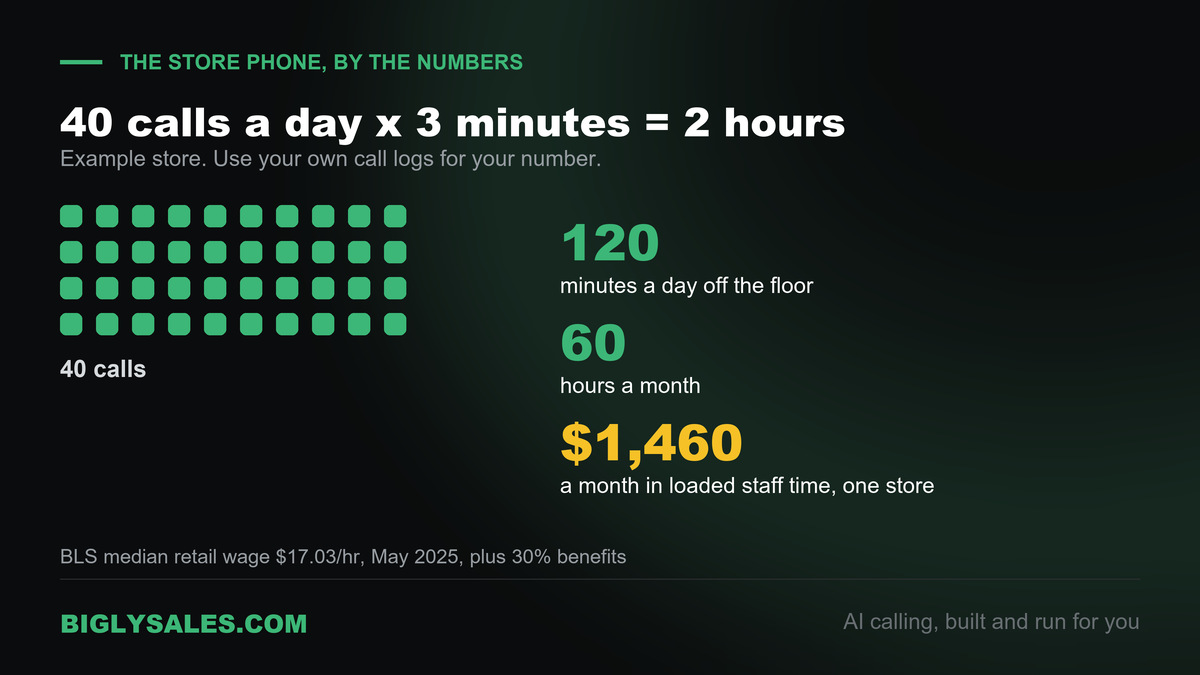
Now put a number on it. The BLS puts the median wage for retail salespersons at $17.03 an hour in May 2025.
Two hours a day for 30 days is 60 hours. That is about $1,022 a month in wages alone.
Add benefits, which make up 30 percent of private industry compensation, and it is closer to $1,460 a month. For one store.
Run ten stores and it is 20 staff hours every single day.
This is an example, not your number. Pull a week of call logs and do the same math with your real volume. It takes ten minutes and the answer is usually bigger than people expect.
One honest point. Moving calls to AI does not cut payroll by itself. It gives those hours back to selling. Whether that turns into revenue depends on what your team does with them.
8 store calls to hand to AI first
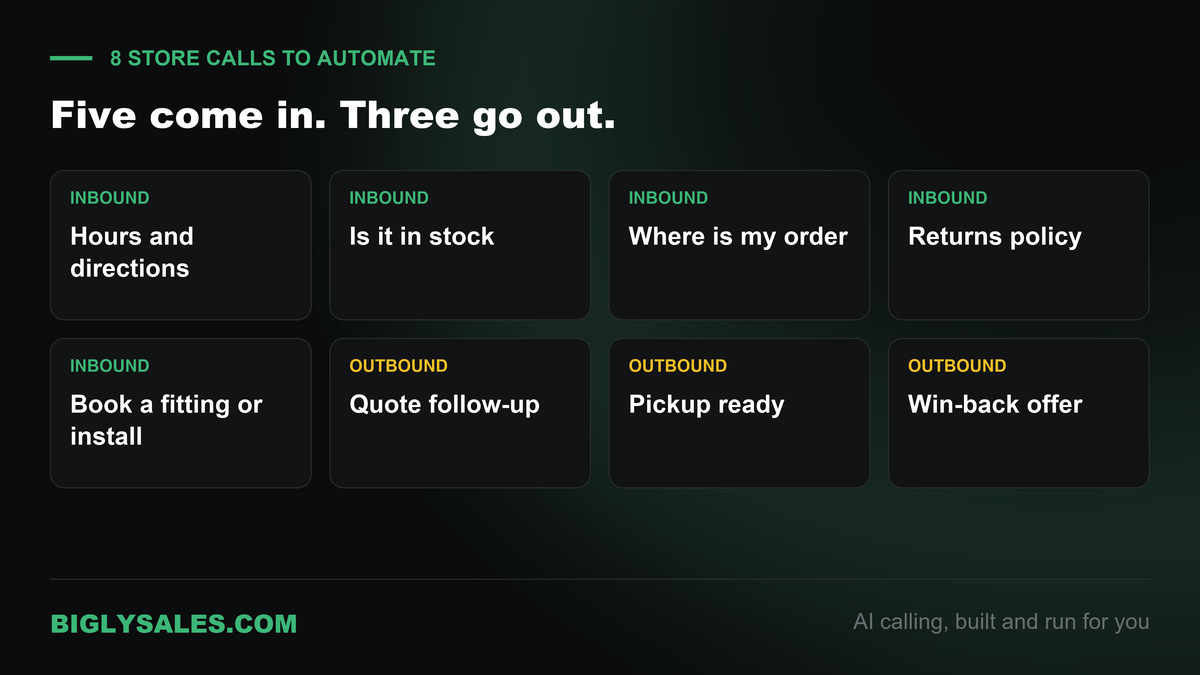
Not every call is a good fit. These eight are. Five come in, three go out.
| Call | Direction | What the AI needs | Transfer to a person when |
|---|---|---|---|
| Hours, directions, holiday schedule | Inbound | Hours and address per location | Rarely |
| Is it in stock | Inbound | Stock lookup from POS or inventory | The item needs an expert opinion |
| Where is my order | Inbound | Order lookup from your order system | The order is lost or damaged |
| Return and exchange policy | Inbound | Your written policy | It is an exception or a refund over your limit |
| Fittings, consults, installs | Inbound and outbound | Calendar access per store | The caller wants a specific staff member |
| Quote and special-order follow-up | Outbound | The inquiry from your CRM | The buyer is ready to talk price |
| Pickup ready and back in stock | Outbound | Order and stock events | The customer asks to change the order |
| Loyalty and win-back offers | Outbound | Consent records and the offer | The customer wants to buy now |
The quote follow-up is the one most stores skip. A web inquiry for a $3,000 sofa sits until someone has a quiet minute. Sometimes that is tomorrow.
Bigly AI agents call new inquiries back in under 60 seconds, including evenings and weekends. That is when the buyer is still on your website.
Free setup session
Hear an AI agent answer your store line
In 30 minutes we build a working agent with your hours, stock questions and return policy, then call your phone with it. Plans start at $99 a month, and the setup is free.
What should stay with your staff
AI handles the repeat questions well. It should not handle everything.
Keep these with your team.
- Complaints. An upset customer wants a manager, not a script.
- Refund exceptions. Anything above the amount your policy lets the AI quote.
- Big-ticket buyers. When someone is ready to talk price on a $5,000 order, put your strongest closer on the line.
- Expert advice. Fit, sizing, compatibility and anything where your staff’s experience is the product.
The AI does not drop these calls. It transfers them live with a summary through a warm transfer, or books a callback when the store is closed.
The customer never has to repeat the story.
What the AI needs from you
An AI voice agent is only as good as what you give it. Here is the list.
- Hours and addresses for every location. Including holiday hours.
- Your policies in writing. Returns, exchanges, price matching, delivery and warranties.
- A way to look things up. Order status and stock usually come from your order system, POS or CRM.
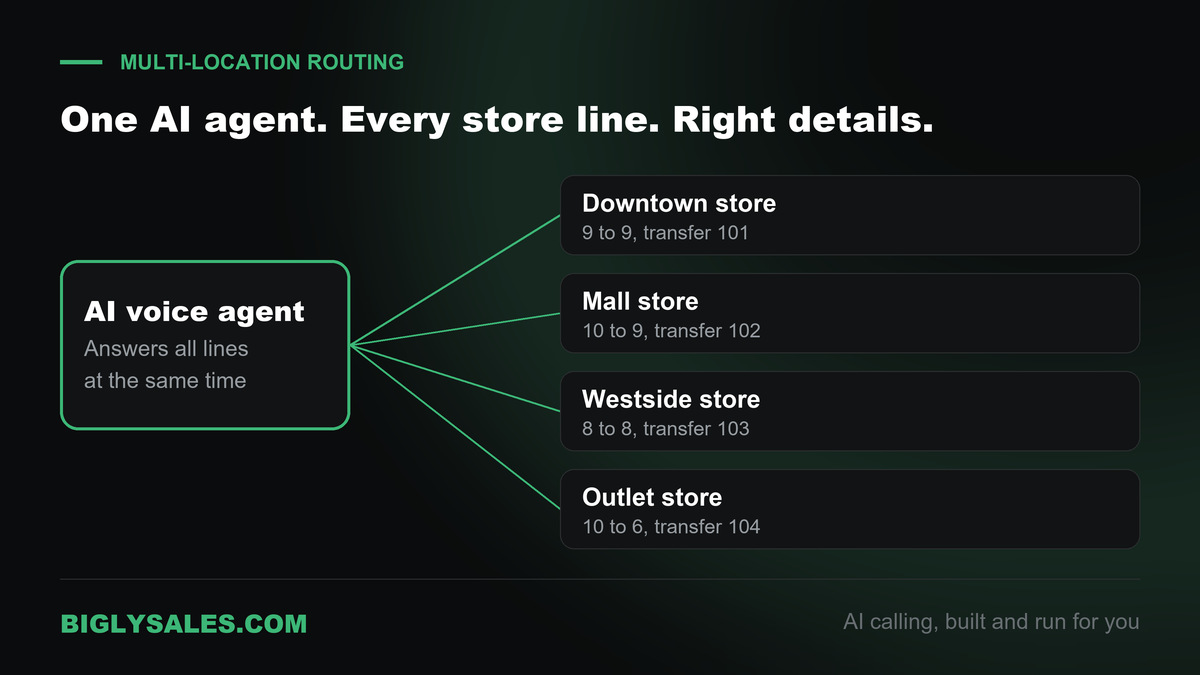
- A transfer number per store. So calls that need a person reach the right building.
- The questions customers ask most. Pull them from your staff. They know.
Bigly sets this up during onboarding and connects to your CRM. For a deeper look at the content side, see how to train AI to answer customer questions.
Most teams go live within 24 hours once the script and policies are approved.
Outbound rules for retailers
Answering calls is simple. Making them has rules.
In February 2024 the FCC ruled that AI generated voices count as artificial voices under the TCPA. So a promotional AI call to a consumer needs prior express written consent.
Service calls are treated differently. Telling a customer their order is ready for pickup is not the same as calling with a sale offer.
Still, treat every outbound list carefully. Check the Do Not Call registry. Call inside legal hours. Honor stop requests right away.
The FTC Telemarketing Sales Rule covers the rest of the basics, and several states also require you to disclose the AI on the call.
Bigly checks consent and Do Not Call status before every outbound dial, with compliance controls built in. Your consent records still have to be accurate. No platform fixes a list you should not be calling.
Store calls vs e-commerce calls
Same industry. Different phone day.
| Factor | Physical store | E-commerce |
|---|---|---|
| Top inbound call | Hours, stock, directions | Where is my order |
| Top outbound call | Quote and special-order follow-up | Abandoned cart recovery |
| Peak time | Store rush hours and weekends | After promotions and shipping delays |
| Hand-off goes to | A specific store | A central support team |
| Data the AI needs | Hours, stock and policies per location | Order and shipping status |
Selling both ways? See AI outbound calling for e-commerce for the online side.
What AI calling costs for a store or a chain
Bigly prices by the minute, and every plan covers inbound and outbound. These are the published plans, checked on our pricing page on November 5, 2026.
| Plan | Monthly price | Included minutes | Fits roughly |
|---|---|---|---|
| Scout Plan | $99 | 500 | A small shop testing after-hours calls |
| Prospector Plan | $500 | 3,000 | One busy store, about 40 calls a day |
| Hunter Plan | $2,999 | 25,000 | A small chain of six to seven stores |
| Closer Plan | $4,999 | 50,000 | A ten store chain, about 36,000 minutes |
| Rainmaker Plan | $9,999 | 125,000 | Large chains with outbound campaigns |
Compare that with the example above. One store spends about $1,460 a month of loaded staff time on the phone. Ten stores spend about $14,600.
Annual billing takes 30 percent off every plan.
Who this is wrong for
A single shop that gets five calls a day does not need this. Answer them yourself.
It is also a poor fit if most of your calls need expert advice. A custom framing shop or a high-end audio store sells on the conversation. Keep those calls human.
And if you cannot get order or stock data out of your systems, the AI will take a lot of messages. Fix the data first. Wondering how this compares to staffing a phone team? Our AI call center vs traditional call center comparison runs the numbers.
AI voice agents for retail FAQ
What is an AI voice agent for retail?
An AI voice agent for retail is software that answers and makes phone calls for a store in a natural voice. It handles store hours, directions, stock questions, order status, returns and bookings using the policies you give it. When a call needs a person, it transfers the caller live to the right store or team with a short summary.
Can AI answer customer service calls for a retail store?
Yes, for the repeat questions. Hours, locations, stock, order status, return policy and appointment bookings are a good fit. The AI answers every call at once, so nothing rings out during a rush. Complaints, refund exceptions and big-ticket buyers should still reach a person, and the AI can transfer them live or book a callback.
Which retail phone calls should be automated first?
Start with the calls your staff answer ten times a day. Store hours, directions and holiday schedules come first, then stock checks and order status. On the outbound side, quote and special-order follow-up usually pays off fastest, because those buyers are ready to spend. Leave complaints and price negotiation with your team.
Can an AI voice agent check stock or order status?
It can if it has the data. The AI looks up order status or stock through your order system, POS or CRM, the same way a staff member would. Without that connection it can only give general answers and take a message. Sort out where the data lives before you launch, because that decides how many calls the AI can fully resolve.
Does AI phone answering work for stores with several locations?
Yes. Each location gets its own hours, address, holiday schedule and transfer number. The AI answers every store line with the right details and routes calls that need a person to the correct store. Chains also get one view of which locations and which questions drive the most calls.
Is it legal for a store to make AI marketing calls?
It can be, with the right consent. The FCC ruled in February 2024 that AI generated voices count as artificial voices under the TCPA. So promotional AI calls to consumers need prior express written consent, an easy opt-out and calls inside legal hours. Service calls like pickup notices are treated differently. This is general information, not legal advice.
Will customers know they are talking to AI?
They should, and Bigly agents say so at the start of every call. Several states now require AI disclosure on calls. In practice, shoppers care more about getting a fast, correct answer than about who gives it. A clear disclosure plus a quick transfer to a person when asked keeps trust intact.
How much does AI phone answering cost for a retail store?
Bigly plans start at $99 a month for 500 minutes and go up to $9,999 a month for 125,000 minutes. A single store taking about 40 three minute calls a day uses roughly 3,600 minutes a month. That is the same two hours a day a staff member would otherwise spend on the phone instead of the floor.
Does AI replace retail store staff?
No. It takes the phone off their hands so they can help the shoppers standing in front of them. The BLS still expects about 550,600 retail sales job openings a year through 2035, because people still shop in stores. The AI covers the calls, and your team covers the floor.
The bottom line
Your store phone is a sales channel that most retailers staff by accident. Whoever is closest picks it up, when they can.
An AI voice agent answers every call at every location, calls back every quote in seconds and hands the important ones to your team. Your staff get their hours back for the shoppers in the store. See how it works on our AI calling for retail page.
Start with one store
Put AI on your busiest store line
Pick one location and we set up the agent with your hours, policies and transfer number. Most teams go live within 24 hours, and you can add stores as you go.