
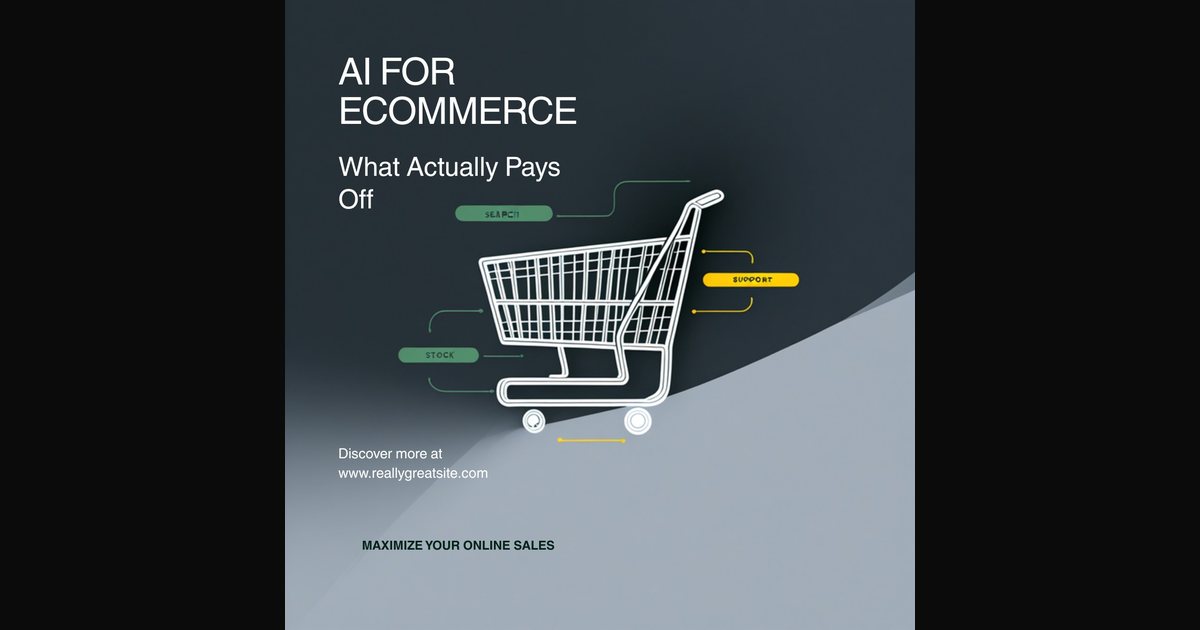


AI for e-commerce means using machine learning to run parts of an online store that used to be manual, including on-site search, product recommendations, demand forecasting, customer support, and outbound contact. That is the whole category. Most of the disappointment around it comes from treating it as one purchase rather than five separate decisions with five different payback periods.
If you run an online store, you have been told AI will fix your conversion rate, your inventory, your support queue, and your ad spend. Some of that is true. A lot of it is a dashboard nobody opens after week three.
Bigly Sales builds AI voice agents, so we have an obvious interest in the phone section below. We have tried to be useful rather than promotional, which means saying plainly which parts of an e-commerce stack we do not sell and which problems a voice agent will not solve.
TL;DR
On-site search and demand forecasting produce most of the measurable return in e-commerce AI, because both work on money you have already spent. Support automation pays off on deterministic contacts such as order status, address changes, and return instructions, and fails on exceptions.
The phone is the largest untouched cost center in most stores, but a call has to protect more margin than it costs, which in practice rules out orders under about seventy five dollars. Do not buy a forecasting model if your sales history is shorter than two full seasons or your stockouts were never recorded, because the model will read a missing sale as weak demand.
Key takeaways
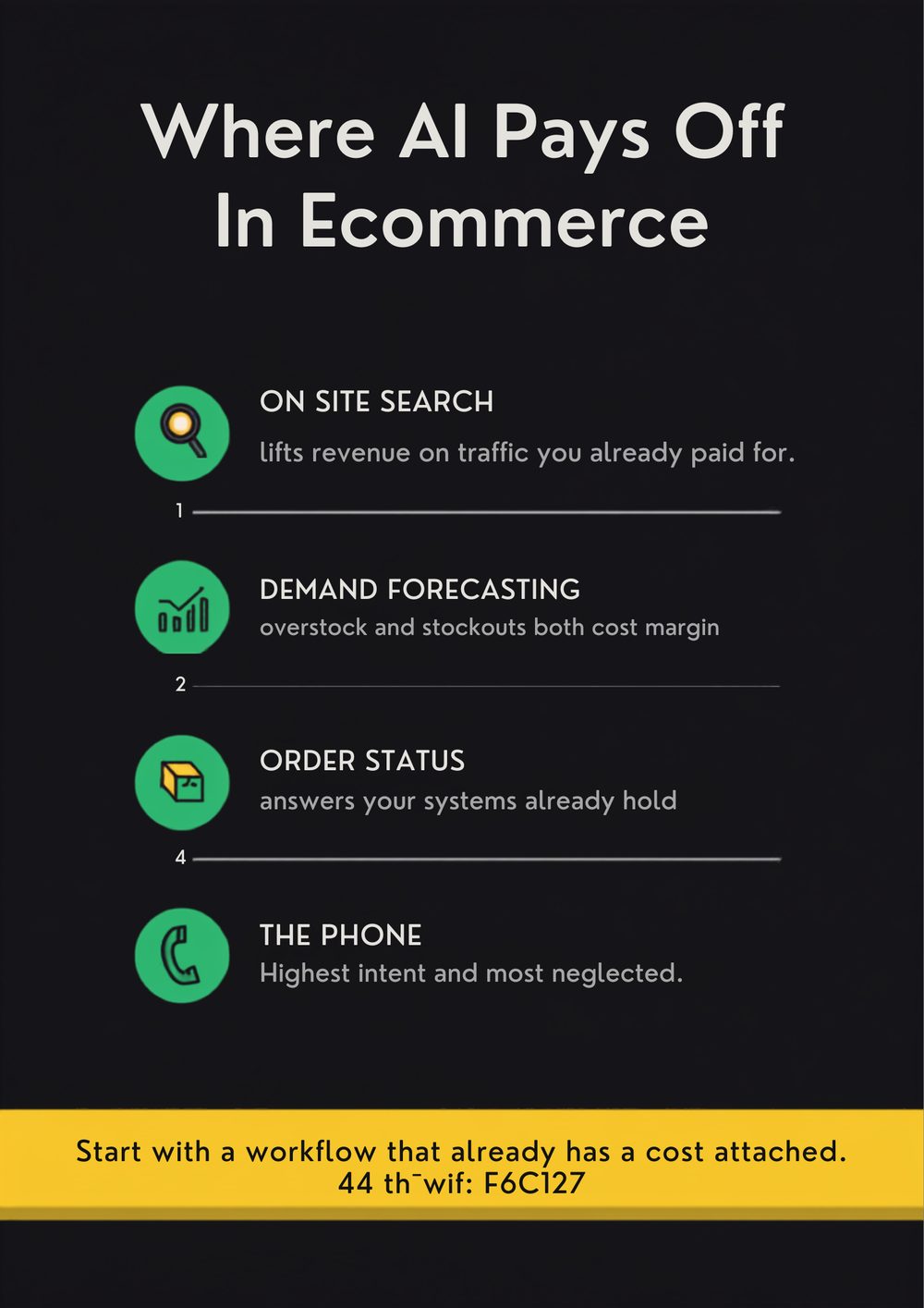
- Start with a workflow that already has a cost attached to it, not with a platform.
- On-site search is usually the fastest measurable win in e-commerce because it works on traffic you already bought.
- Demand forecasting is the least exciting use and often the most profitable, since overstock and stockouts both come straight off margin.
- Automate the deterministic contacts and route exceptions to a person quickly.
- The phone is the most neglected channel in online retail and carries the highest intent per contact.
- Judge every pilot on your own numbers, with kill criteria agreed before anyone signs anything.
Table of contents
- What AI for e-commerce is
- Where AI actually earns its keep
- How the main use cases compare
- The channel most stores automate last
- What to automate first
- How to evaluate an e-commerce AI vendor
- What AI still gets wrong in e-commerce
- A realistic ninety day rollout
- AI for e-commerce FAQ
- The bottom line
What AI for e-commerce is
AI for e-commerce is the use of machine learning models to decide or execute steps in an online store that a person used to handle, such as matching a shopper’s search to the right product, predicting next month’s demand for a size and color, answering a post-purchase question, or placing a follow-up call.
The term covers tools with almost nothing in common. A semantic search engine and a voice agent are both sold as e-commerce AI and they solve unrelated problems on different budgets. The useful question is never whether to adopt AI. It is which workflow you are trying to change and what that workflow costs you today.
Two distinctions make the rest of this guide easier to read. Predictive models estimate something you cannot observe yet, such as demand or churn risk. Generative and conversational models produce language, which is what search, support, and voice agents rely on. They fail differently, so they need different tests.
Where AI actually earns its keep
Three areas produce most of the measurable return in an online store. The rest tends to be interesting rather than valuable.
Product discovery and on-site search
Most store searches are still keyword matching. A shopper types “warm jacket for a toddler” and gets nothing, because your catalog says “insulated infant parka.” That shopper leaves, and you already paid to acquire them.
Semantic search closes that gap by matching intent rather than strings. It is the single change we see move revenue fastest, for an unglamorous reason. You are not buying more traffic. You are failing fewer of the visitors you already have.
Compare revenue per session for shoppers who use search against those who only browse. In most catalogs, search users convert at several times the rate, which makes any dead end in the search box expensive. Fix that first.
Demand forecasting and inventory
This is the use case nobody puts in a case study and the one your finance lead will care about. Overstock ties up cash and ends in markdowns. Stockouts hand the sale to a competitor and often cost you that customer’s next order too.
Forecasting models suit this problem because it is genuinely statistical. Seasonality, promotion lift, lead time variability, and return rates are all patterns in data you already own. You do not need anything exotic. You need someone whose job it is to act on the output.
Support and post-purchase
A large share of contacts after checkout are the same handful of questions. Where is my order, can I change the address, how do I return this, when will the refund land.
Those are worth automating because the answer is deterministic and lives in a system you already own. What does not automate well is the exception. A damaged item, a delivery that went to the wrong state, a customer on their third contact about the same problem. Route those to a person fast, because an automated loop on an already frustrated customer costs more than the labor it saved.
How the main use cases compare
Different AI projects have different data requirements and very different payback periods. Comparing them side by side stops the conversation turning into a debate about which vendor demos best.
| Use case | What it changes | What it needs first | Time to a visible result | Skip it if |
|---|---|---|---|---|
| On-site search | Revenue per session on existing traffic | Clean product attributes and titles | Two to six weeks | Your catalog is under a few hundred items |
| Demand forecasting | Cash tied up in stock and lost sales | Two seasons of order history with stockouts recorded | One to two planning cycles | Sales data is incomplete or manually adjusted |
| Support automation | Cost per contact on routine questions | Order data reachable through an API | Four to eight weeks | Most of your volume is disputes and damage claims |
| Outbound and inbound voice | Answered call rate and recovered orders | Order values that justify a phone touch | Two to four weeks | Average order value is low and margin is thin |
| Generated product copy | Time to publish a new listing | Editorial review capacity | Immediate, with a quality cost | Nobody is available to edit the output |
The channel most stores automate last
Email and chat get automated first because they are easy and asynchronous. The phone gets left alone, which is odd, because it is usually the most expensive contact you handle and the one with the clearest intent. Nobody calls a store casually.
Order status calls
The industry calls these WISMO contacts, short for where is my order. They are high volume, low complexity, and almost entirely answerable from your order management system. A voice agent that can look up an order and read back a real tracking status resolves them on the first call without a queue.
The reason this matters more than the equivalent chat automation is time of day. Order anxiety peaks in the evening and over weekends, which is exactly when most stores have nobody on the phone. Our overview of AI inbound calling for support and lead calls covers how that routing is set up.
Abandoned checkout, by phone rather than by email
Most stores recover abandoned carts with a sequence of emails and accept the open rate they get. For low-value orders that is the right call, because the economics do not support anything else.
For higher-value or considered purchases, a call within minutes of abandonment performs differently, because you can answer the actual objection. Shipping cost, delivery date, sizing, whether the item is in stock in the color they wanted. That is a conversation, not a discount code.
Timing decides the outcome more than the script does, which is the same principle behind speed to lead on inbound inquiries. Our own AI calling platform exists for this pattern, and the honest boundary is that it only earns its setup cost if your order values justify a phone touch. Below roughly the cost of a call, stay on email.
See it on your catalog
Hear an AI agent handle a real order call
We will run a live call against your order data and your objections, not a scripted demo. Twenty minutes, and you keep the recording.
What to automate first
Pick the workflow where you can already state the cost of doing it manually. If you cannot put a number on it, you cannot tell whether the automation worked, and you will end up defending a subscription instead of reporting a result.
A reasonable order of operations for most teams looks like this.
- Fix on-site search first, because it affects revenue on existing traffic and needs no new headcount.
- Automate order status across every channel you already staff, including the phone if you answer it.
- Add forecasting once you have clean sales and returns data, not before.
- Layer in outbound contact for high-value abandonment, where a conversation can beat a coupon.
- Leave refund disputes and damaged item claims with a human.
One more sequencing rule. Do not run two pilots in the same quarter that touch the same team, because you will not be able to attribute the result to either of them.
How to evaluate an e-commerce AI vendor
Most AI demos are built to look effortless. The questions below are the ones that separate a product from a prototype, and none of them are answered on a pricing page.
Ask what it does with your data
Find out whether your catalog, order records, and call transcripts are used to train the provider’s models, how long anything is retained, and who internally can see it. Get those answers in the contract rather than from a sales call. If the store handles health or financial information, ask what happens to a recording that contains it.
Ask how it fails
Every model is wrong sometimes. What matters is what happens next. A support agent should hand off to a person within one exchange when confidence drops. A forecasting model should show its assumptions, not just a number. A voice agent should say plainly that it is an AI assistant when a caller asks.
Ask what integration actually means
Vendors describe an integration as available when it is a documented API rather than a working connector. Ask which fields sync, in which direction, how often, and who fixes it when your platform changes an endpoint. Then ask for a reference customer on your exact stack.
Ask about the exit
Find out how you export your data, how long the contract runs, and what happens to trained voices, prompts, and configurations if you leave. A vendor that has thought about this answers in a sentence. A vendor that has not will change the subject.
What AI still gets wrong in e-commerce
Being specific about the failure modes is more useful than another list of benefits.
Product descriptions generated at scale read like product descriptions generated at scale. Shoppers notice, and so does search. If you generate them, treat the output as a first draft for a person, not as finished copy.
Personalization gets uncomfortable faster than teams expect. Referencing something a shopper did not tell you reads as surveillance rather than service. The test is simple. If you would not say it out loud to their face in a store, do not put it in an email.
Forecasting fails quietly when the data is dirty. A model trained on a period that included a stockout learns that demand was low, when in fact you had nothing to sell. Somebody has to know that and correct for it.
Support bots fail when they cannot hand off. The measure of a good automated support layer is not the containment rate. It is how fast a customer who needs a person actually reaches one.
Claims are the last failure mode, and the most expensive. If a model writes your shipping promises or your review summaries, a person is still accountable for whether they are true. The FTC’s guide to the Mail, Internet, or Telephone Order Merchandise Rule sets out what you have to do when a shipping date slips, and no automation changes that obligation.
A realistic ninety day rollout
Ninety days is enough to prove or kill one workflow. It is not enough to replatform, and any plan that assumes otherwise will quietly become a twelve month project.
- Weeks one and two. Pick one workflow. Write down the current cost, the current volume, and the outcome you want. Get agreement on the number before anyone buys anything.
- Weeks three to six. Run the automation alongside the manual process rather than instead of it. You want a comparison on your own data, not a vendor benchmark.
- Weeks seven to ten. Review where it failed, not where it worked. Every failure is a data problem, a handoff problem, or a scope problem, and each has a different fix.
- Weeks eleven and twelve. Decide to scale it or stop it. A pilot with no kill criteria is not a pilot.
If the store sells into more than one vertical, run the pilot in the one with the highest contact volume rather than the highest revenue. Our industry breakdowns show how call patterns differ by sector, which changes where the automation pays first.
AI for e-commerce FAQ
What is AI for e-commerce?
AI for e-commerce means using machine learning to run parts of an online store that were previously manual, including product search, recommendations, demand forecasting, pricing, customer support, and outbound contact. The term covers a wide range of tools with different costs and payback periods, so the useful question is always which specific workflow you are trying to change.
Which AI use case gives the fastest return for an online store?
On-site search and product discovery, in most cases. It improves revenue from traffic you have already paid to acquire, it does not require new headcount, and the effect usually shows up within weeks rather than quarters. Forecasting produces larger savings but needs clean history first, so it rarely wins on speed.
Can AI handle e-commerce customer service on its own?
It handles repetitive, deterministic contacts well, such as order status, address changes, and return instructions. It should not handle exceptions, disputes, or an already frustrated customer. The quality of the handoff to a person matters more than how many contacts get contained, and a store that optimizes only for containment will see complaints rise.
Does AI work for small e-commerce stores or only large ones?
Search, recommendations, and support automation are sold at small store pricing and are worth adopting early. Forecasting needs enough order history to be meaningful, and phone automation needs order values high enough to justify a call. Scale changes which tools make sense, not whether AI is useful at all.
What are WISMO calls and can they be automated?
WISMO stands for where is my order, and it describes the order status contacts that make up a large share of post-purchase support. They automate well because the answer already exists in your order management system, and a voice agent can look it up and read back a real status without putting the caller in a queue.
Should we recover abandoned carts by phone or by email?
Email for low-value orders, because the economics do not support anything else. A phone call makes sense for higher-value or considered purchases, where the shopper has a specific objection about shipping, sizing, or availability that a conversation can resolve and a discount code cannot. Compare the cost of a call against the margin on the order before you decide.
Will AI-generated product descriptions hurt our search rankings?
Generated descriptions published without editing tend to read as generic, which affects conversion as much as ranking. Treat the output as a first draft, have a person add the specifics only you know about the product, and you avoid most of the risk. The bigger exposure is publishing a claim about the product that nobody checked.
How much data do we need before demand forecasting is useful?
Enough history to cover your seasonal cycle, plus clean records of promotions, stockouts, and returns. Clean matters more than large. A model trained through a stockout will read the missing sales as weak demand unless somebody flags the gap, and that single error can drive an entire season of bad purchase orders.
How do we know whether an AI pilot worked?
Decide the metric and the kill criteria before you start, then run the automation alongside the manual process so you are comparing on your own data. If you cannot state in advance what result would make you stop, you are not running a pilot, you are running a rollout with extra steps.
Do AI voice agents have to tell callers they are not human?
Disclosure requirements vary by state and by context, and consent rules for automated calls are separate and stricter. As a matter of policy, train the agent to answer honestly and immediately when a caller asks whether it is a person, because a caller who feels deceived reacts far more strongly than one who was told up front.
The bottom line
Most disappointing AI projects in e-commerce start with a tool and go looking for a use. The ones that work start with a workflow somebody can already price, and they get compared against the manual version on the store’s own numbers.
Fix search, automate the answers you already have, forecast once your data is honest, and treat the phone as a channel worth automating rather than one worth avoiding. If your order values do not support a call, say so and stay on email. That is a real answer too.
Start with one workflow
Put a number on your phone volume first
Send us your call volume and average order value and we will tell you whether voice automation pays for your store. If it does not, we will say so.