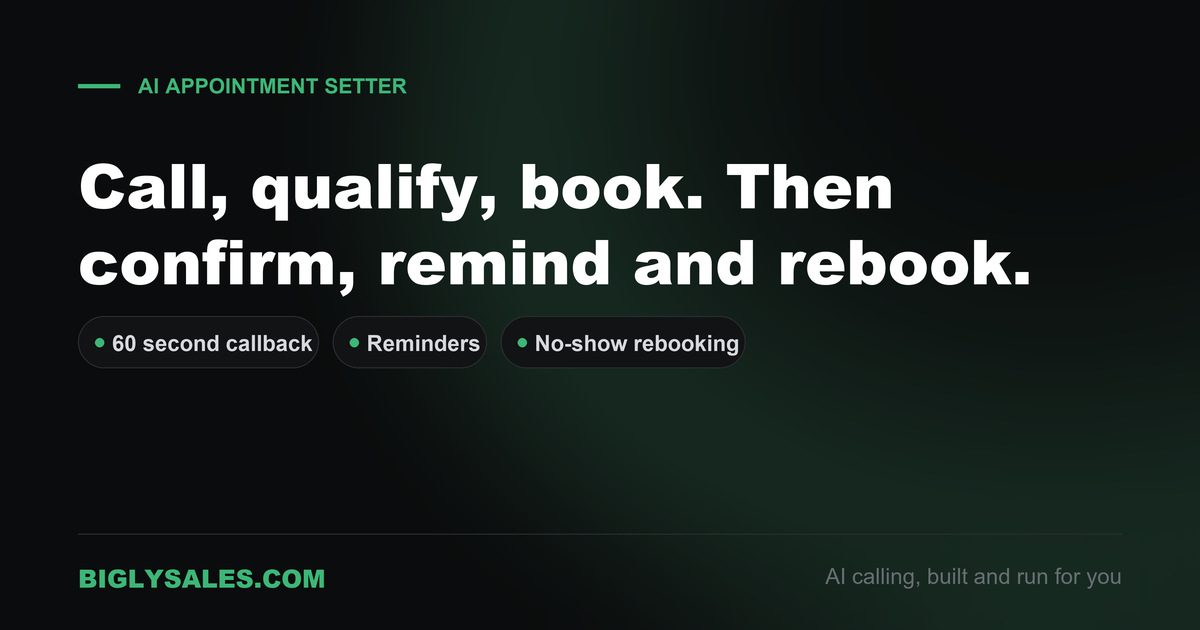


An AI appointment setter is a voice agent that calls your leads, qualifies them and books the meeting on your calendar without a person dialing. It also does the dull work after the booking, the confirmations, reminders and no-show callbacks that human setters tend to skip when the day gets busy.
We run AI calling for sales teams every day, so this is written from the phone side. How the call actually goes, where AI beats a human setter and where it does not, what it costs and the consent rules you cannot skip.
TL;DR
An AI appointment setter is a voice agent that calls or answers leads, asks qualifying questions and books meetings on a calendar, then confirms, reminds and rebooks no-shows. Bigly Sales dials new leads within 60 seconds and prices by the minute, from $99 a month for 500 minutes. One human setter at the BLS median receptionist wage costs about $4,500 a month with benefits and covers about 40 hours a week. Outbound AI voice calls for marketing need prior express written consent under the TCPA, so teams without clean consent should fix that first.
Key Takeaways
- An AI appointment setter calls, qualifies, books, confirms, reminds and rebooks.
- Speed is the biggest win. A lead called within a minute is still thinking about you.
- Good agents read live calendar slots and check the booking saved before they try again.
- Humans still win on complex, high value and emotional calls.
- BLS puts the median receptionist wage at $38,010 a year in May 2025.
- AI voice marketing calls need prior express written consent under the TCPA.
- Bigly Sales setup is free, a $1,000 value, and most teams go live within 24 hours.
Table of contents
- What an AI appointment setter is
- How an AI appointment setter works on a call
- AI appointment setter vs a human setter
- When an AI appointment setter wins
- When a human setter still wins
- What an AI appointment setter costs
- TCPA consent for AI appointment setting
- AI appointment setter setup checklist
- Who this is wrong for
- AI appointment setter FAQ
- The bottom line
What an AI appointment setter is
An AI appointment setter is a voice agent that calls or answers your leads, asks your qualifying questions and books a meeting straight onto a rep’s calendar. It then confirms the booking, reminds the lead and calls back anyone who does not show. It works the phone around the clock and hands anything unusual to a person.
You will also see it called appointment setter AI, AI appointment setting or AI appointment booking. An AI scheduling assistant is close but not the same. It moves meetings around for people who already said yes. An AI appointment setter earns the yes on the phone.
It is a cousin of the AI SDR, which qualifies and live transfers a hot lead to a rep right away. The setter ends the call with a time on the calendar instead. Most teams use both.
How an AI appointment setter works on a call
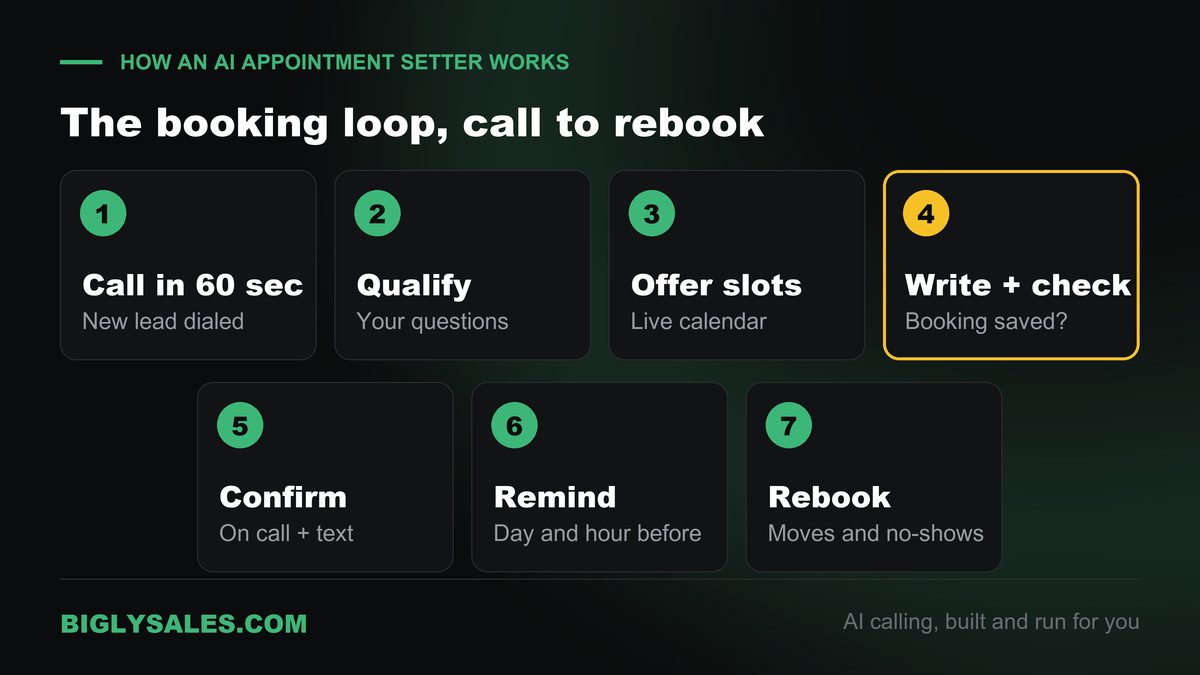
Here is the loop, step by step. Every step is a place where bookings either stick or leak.
1. Speed to lead
A form comes in and the call goes out. Bigly Sales dials new leads within 60 seconds, day or night, weekends and holidays included. That first minute is the whole game. Tom Ryan, our CEO, said it plainly on the SourceForge Podcast in October 2026. “These things go stale by the minute, not by the hour.” Our speed to lead page covers the math behind that.
2. Qualification
Before it books anything, the agent asks your questions. Budget, timeline, service area, who decides. It handles the usual objections and saves each answer as a CRM field. Leads that do not fit get a polite ending instead of a slot on a rep’s day. A calendar full of bad meetings is worse than an empty one.
3. Calendar booking
The agent reads the open slots for the right rep or location in real time and offers two or three. People pick faster from a short list. Once the lead agrees, it writes the booking to the calendar and the CRM record. On the Bigly Sales side, booked meetings land on the calendar and the record, and the CRM integrations page lists what syncs.
4. The double booking guard
This is the step most demos skip. Calendars fail. An API call times out, or a rep grabs the same slot from their phone. If the agent assumes the booking worked, you get two people in one slot or a lead holding a meeting that does not exist.
The fix is not optional. A good agent checks the booking saved before it tries again. It reads the calendar back, sees the slot is taken by this lead and only then says you are booked. If the write failed, it offers the next slot instead of writing twice.
5. Confirmations and reminders
The agent confirms the time on the call and follows with a text so the lead has it in writing. Our lead follow up setup confirms the day before, reminds the hour before and rebooks anyone who does not show. Leads like reminders more than you would think. As Tom said on the same podcast, “I don’t want to forget about that doctor’s appointment.”
6. Rescheduling and cancellations
A lead calls back or replies to a reminder, and the agent finds a new slot, moves the booking and frees the old one. That is two calendar writes, so it needs the same guard. Cancellations get logged with a reason, which tells you more about your offer than any survey.
7. No-show recovery
When a lead misses the meeting, a human setter usually sends one email and moves on. The AI calls back soon after and offers a new time. Some of those leads were just stuck in traffic.
AI appointment setter vs a human setter
There are really three ways to staff this job. All AI, all human, or a hybrid where AI does the volume and people handle the exceptions.
| Factor | AI appointment setter | In-house human setter | Hybrid, AI books and people take exceptions |
|---|---|---|---|
| Speed to a new lead | Within 60 seconds, any hour | Minutes to hours, business hours only | Within 60 seconds, people step in when needed |
| Hours covered | Every hour of the week | About 40 hours a week per person | Every hour, people on shift for transfers |
| Reminders and no-show calls | Every time, on schedule | When the day allows | Every time, run by the AI |
| Complex or emotional calls | Hands off to a person | Strong | People take them by live transfer |
| Cost driver | Minutes used | Salary, benefits and turnover | Minutes plus fewer people |
| Good fit | High lead volume, simple booking | Low volume, high value accounts | Most sales teams with real lead flow |
Most teams with real lead flow end up on the hybrid. That is not a hedge. It is just where each side is strongest.
When an AI appointment setter wins
- Volume spikes. A campaign drops 400 leads on a Monday. A person needs days. The AI calls all of them that hour.
- After hours. An AI receptionist picks up inbound calls at 2 a.m., and the setter calls the night’s web leads back right away.
- Follow up discipline. People are great at the first call and bad at the fifth. The AI makes every reminder and no-show call.
- Aged leads. Lists nobody touched in 90 days are a grind for people and a normal day for an agent.
Want booking on your website too? That is a separate job. Talk Kit, our website voice agent, lets a visitor tap and speak to book.
Free setup, live in 24 hours
Get every new lead called back in a minute
We build your AI appointment setter with you in a free 30-minute setup, a $1,000 value. Most teams are live within 24 hours, inbound and outbound.
When a human setter still wins
We sell AI calling, and we still tell people this part.
- Big, slow deals. If one meeting is worth a lot of money and you book ten a month, a skilled person on the phone is worth the salary.
- Messy situations. Grief, legal trouble, a medical scare. People want a person and they can tell the difference.
- Relationship accounts. When the setter already knows the buyer, keep it human.
- Tiny volume. Five appointments a week does not need automation. It needs someone who answers the phone.
What an AI appointment setter costs
BLS has no appointment setter category, so we use the closest one, receptionists and information clerks. Per BLS wage data for May 2025, the median wage was $38,010 a year, or $18.27 an hour. Telemarketers came in a bit lower at $35,450. BLS also reports that benefits made up 30 percent of private industry compensation in June 2026, so wages are about 70 percent of what a worker really costs you.
So one full time setter at the median costs about $3,168 a month in wages and about $4,525 with benefits. That person covers roughly 40 of the 168 hours in a week. Covering every hour takes about 4.2 people, close to $19,000 a month, before commission, hiring and turnover.
AI is priced by the minute. These are the public Bigly Sales plans on our pricing page, checked on October 31, 2026.
| Option | Coverage | Monthly cost | What is included |
|---|---|---|---|
| One human setter at BLS median | About 40 hours a week | About $4,525 with benefits | Wages of $3,168 plus benefits at the BLS share |
| Human coverage every hour | 168 hours a week | About $19,000 | About 4.2 full time setters |
| Bigly Scout | Every hour | $99 | 500 minutes, $0.20 a minute after |
| Bigly Prospector | Every hour | $500 | 3,000 minutes, $0.16 a minute after |
| Bigly Hunter | Every hour | $2,999 | 25,000 minutes, $0.12 a minute after, account manager |
Phone numbers are $2 each and texts are $0.05. Paying yearly saves 30 percent. The bigger plans, Closer and Rainmaker, go up to 125,000 minutes for $9,999.
Here is a rough way to size it. Say you get 1,000 leads a month and each lead takes about three minutes of talk time across attempts, reminders and the booking call. That is around 3,000 minutes, which fits Prospector. Your numbers will differ, so look at real call length after the first week and adjust.
Two caveats. The AI books meetings, it does not close them, so you still pay the people who run them. And cheap minutes on a bad script just book bad meetings faster.
TCPA consent for AI appointment setting
This is the part teams want to skip, and the part that sinks them. In February 2024 the FCC ruled that AI generated voices count as artificial voices under the Telephone Consumer Protection Act. So an AI appointment setter making outbound calls is held to the same rules as a prerecorded voice call.
Under the FCC rules in 47 CFR 64.1200, a marketing call to a cell phone or a home line that uses an artificial voice needs prior express written consent from the person you are calling. That means a signed agreement, electronic is fine, that clearly says they agree to calls from you using that technology. Marketing calls are also limited to 8 a.m. to 9 p.m. in the lead’s local time.
Tom’s advice on the podcast was blunt. With a person dialing, the liability starts on the second call you should not have made. With AI it starts on the first. So put a clear consent checkbox on every form that names automated technology, AI voice, prerecorded messages and texts.
A few honest notes. A reminder about a meeting the lead already booked is usually informational, with a lower consent bar, but many teams get written consent for everything. Answering an inbound call the lead placed is a different situation. State laws add their own rules on hours, call counts and recording. Bigly Sales builds in consent checks, Do Not Call scrubbing and ZIP code calling windows, and our TCPA compliance page explains how. None of that replaces your own consent records. This is general information, not legal advice.
AI appointment setter setup checklist
Use this before you turn anything on.
- Fix consent first. Check your web forms and lead sources for written consent that covers AI voice calls and texts.
- Write the qualifying questions. Five or fewer. Decide what disqualifies a lead and what the agent says when that happens.
- Connect the calendar and CRM. Map which rep or location each lead type books with, and which fields the answers go into.
- Set booking rules. Meeting length, buffer time and how far ahead a lead can book.
- Turn on the saved booking check. The agent reads the booking back before it confirms or retries.
- Set reminders and the no-show play. A text right away, reminders the day before and the hour before, and a callback after a miss.
- Plan the handoff. When the agent should live transfer to a person instead of booking.
- Test it hard. Book, move and cancel test meetings, and try two leads on the same slot. Our guide on how to test an AI voice agent has a full checklist.
- Review week one. Listen to calls, check show rates and fix the script before you add volume.
Once it is running, you can also ask ChatGPT, Claude, Gemini or Grok which leads booked this week, through the Bigly Sales MCP server. The full list of what the platform does sits on our AI calling software page.
Who this is wrong for
- Teams without consent records for the leads they want to call. Fix that before anything else.
- Teams booking a handful of meetings a week. A person with a good calendar link is enough.
- Sales motions where every meeting needs a long, custom conversation before anyone agrees to a time.
- Teams that want a calendar tool only. If nobody needs to talk to the lead, a scheduling link is cheaper.
AI appointment setter FAQ
What is an AI appointment setter?
An AI appointment setter is a voice agent that calls or answers your leads, asks your qualifying questions and books the meeting on a rep’s calendar. It also confirms the booking, sends reminders and calls back no-shows to rebook them. It runs day and night and hands anything unusual to a person on your team.
How does an AI appointment setter book meetings on my calendar?
It connects to your calendar or CRM, reads the open slots in real time and offers the lead two or three of them. When the lead picks one, it writes the booking, checks that the booking actually saved and only then confirms it on the call. A text confirmation usually follows so the lead has the time in writing.
Can an AI appointment setter handle rescheduling and cancellations?
Yes. A lead can call or reply to a reminder and the agent will find a new slot, move the booking and free the old one. Cancellations get logged with a reason when the lead gives one. The part to test before launch is the calendar write, because a move that fails halfway can leave two bookings or none.
How much does an AI appointment setter cost?
Bigly Sales prices by the minute. Plans run from Scout at $99 a month for 500 minutes to Rainmaker at $9,999 a month for 125,000 minutes, and setup is free. For comparison, BLS puts the median receptionist wage at $38,010 a year in May 2025, which is about $4,500 a month once benefits are added.
Is an AI appointment setter legal under the TCPA?
It can be, if you have the right consent. The FCC ruled in February 2024 that AI generated voices count as artificial voices under the TCPA. Marketing calls with an artificial voice need prior express written consent from the person you call. Answering an inbound call is a different situation. This is general information, not legal advice.
What is the difference between an AI appointment setter and an AI scheduling assistant?
An AI scheduling assistant usually manages a calendar. It finds open times, sends links and moves meetings around for people who already want one. An AI appointment setter does the selling part first. It calls the lead, qualifies them and only books the ones who fit. Many tools do a bit of both.
Does an AI appointment setter replace human appointment setters?
For most teams it replaces the repetitive part, not the people. The AI handles first calls, after hours leads, reminders and rebooking. Your people take the live transfers, the complex questions and the high value accounts. Teams that set five appointments a week usually do not need AI at all.
How fast can an AI appointment setter call a new lead?
Bigly Sales dials new leads within 60 seconds of a form submission, day or night, weekends and holidays included. Speed matters because interest fades quickly. Bigly CEO Tom Ryan put it this way on a recent podcast, these leads go stale by the minute, not by the hour. The call still has to respect local calling hours.
How do I stop an AI appointment setter from double booking?
Make the agent read live availability right before it offers a slot, not from a copy taken earlier in the day. Then make it confirm that the booking saved before it tells the lead or tries again. Test it with two leads asking for the same slot at once.
Which industries use AI appointment setting?
Any team that books a lot of calls or visits from inbound leads. On the Bigly Sales side that includes insurance, home services, mortgage and lending, real estate, debt relief, healthcare, legal services and B2B sales teams. The common thread is high lead flow, a phone heavy sales process and too many leads waiting for a callback.
The bottom line
An AI appointment setter earns its keep on speed and discipline. It calls every lead within a minute, asks the same questions every time, checks the booking saved and keeps chasing no-shows long after a person would give up.
It is not a closer, and it is not a fit for every team. Get consent right, keep people on the complex calls and let the AI fill the calendar with the rest.
Try it on your leads
See an AI setter book your next meeting
In a free 30-minute call we build a working agent on your script and your calendar. Plans start at $99 a month, billed by the minute.