

Cohere AI is a Canadian company that builds AI for searching and using your own company data.
It is not a chat app. You will not find it next to ChatGPT in the App Store.
What Cohere sells is the engine behind a question like this one. “What did customers say about our pricing on calls last month?”
The method that makes that work has a clunky name. RAG. I will explain it in plain English, with no engineering degree needed.
When I checked Google Keyword Planner on November 14, 2026, “cohere” was getting between 10,000 and 100,000 US searches a month. “What is rag” was in the same range.
This is the twelfth and last guide in our AI assistant series. Earlier guides covered Claude, ChatGPT, Gemini, Copilot, Grok, Perplexity, DeepSeek, Meta Muse, Mistral Vibe and Qwen.
Key Takeaways
- Cohere builds AI for businesses, not a consumer chat app.
- RAG means the AI looks up your own files first, then answers from them with citations.
- Cohere’s RAG pieces are Embed to index, Rerank to sort and Command to write the answer.
- North is Cohere’s platform that puts those pieces to work on your company data.
- The free trial key is capped at 1,000 calls a month and is not for commercial use.
- North can connect to any MCP server.
- Most small businesses will be better served by ChatGPT, Claude or Gemini first.
Table of contents
- What Cohere AI is
- Who is behind Cohere
- RAG explained in plain English
- The Cohere pieces that make RAG work
- Example. Asking questions across call transcripts and CRM notes
- What North does for a business
- What Cohere costs
- Where your data goes
- How to try Cohere in one afternoon
- Cohere, MCP and Bigly Sales
- Who Cohere is for and who should skip it
- Cohere vs the other assistants in this series
- Cohere AI FAQ
- The bottom line
What Cohere AI is
Cohere AI is a company that sells AI models and an AI platform to businesses.
Cohere’s home page leads with North. It calls North “a complete agentic enterprise AI platform that you control and deploy on your terms.”
In plain words, Cohere does two jobs.
- It builds models. Command writes text. Embed and Rerank find the right information. Transcribe turns speech into text.
- It builds North. A workplace platform where AI agents search your company’s files and apps and do tasks.
Here is the part that surprises people. Cohere’s products page lists no consumer chat app. You cannot download Cohere and chat with it the way you chat with ChatGPT.
That tells you who it is for. Companies with a lot of private documents, strict data rules and someone technical on the team.
Who is behind Cohere
Cohere is based in Canada. Its privacy policy says it is “a Canadian company subject to Canadian federal privacy laws” and gives a Toronto mailing address.
It sells to large companies. The logo wall on its home page includes Oracle, Dell, SAP, Salesforce and RBC.
Cohere also talks a lot about sovereign AI. That means AI a country or a company can run on its own terms, without sending data to someone else’s servers. You will see the word on almost every Cohere page.
For you, that translates into one practical point. Cohere is built to run where your data already lives.
RAG explained in plain English
RAG is short for retrieval augmented generation. It is a way of making an AI answer from your own documents instead of from memory.
Think of a new hire with a great memory but zero knowledge of your company.
Ask them about your refund policy and they will guess. Hand them the policy first and they will answer correctly. RAG is the step where you hand them the policy.
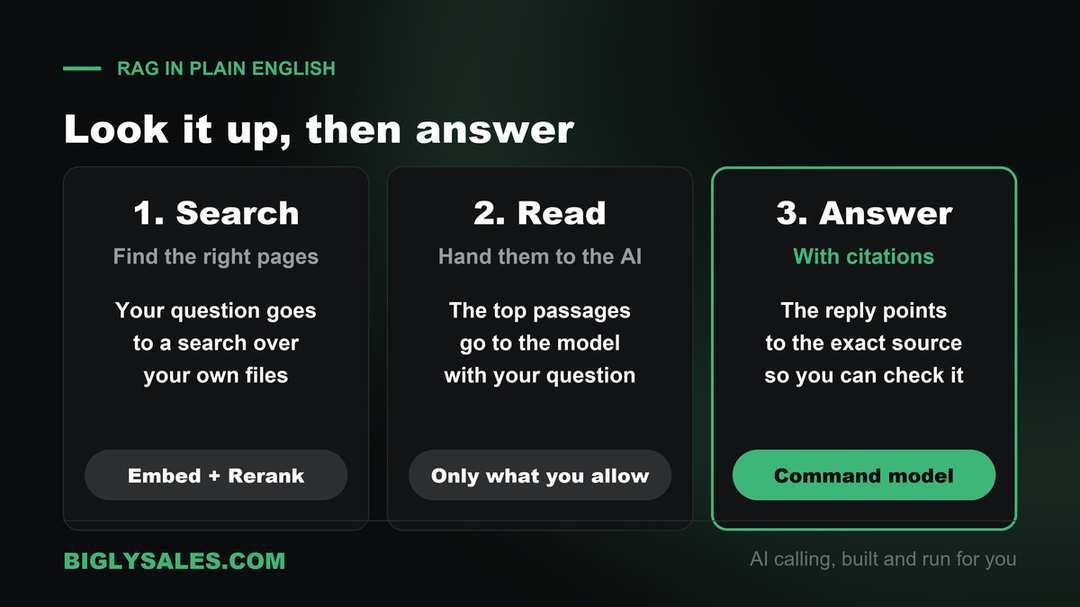
Cohere’s RAG docs break it into three steps.
- Search. The system turns your question into search queries.
- Fetch. It pulls the matching passages from your own data.
- Answer. The model writes a reply from those passages, with inline citations.
The citations matter most. Cohere says its models are trained to produce fine-grained citations out of the box. Each part of the answer points to the document that backs it up.
So when the AI says a customer asked for a callback on Thursday, you can click through and read the line yourself.
Why pasting everything into a chat falls short
You can, for one file. It breaks down at scale.
A month of call transcripts can run to thousands of pages. No chat window holds all of it, and pasting customer data into a consumer app is a privacy problem anyway. RAG searches the whole pile and sends only the few passages that matter.
The Cohere pieces that make RAG work
Cohere sells each step of RAG as its own model, plus two platforms that bundle them. Here is the lineup from Cohere’s model docs and blog, checked on November 14, 2026.
| Piece | What it does in plain words | Latest version |
|---|---|---|
| Embed | Turns each passage into a search key so the system can find text by meaning, not exact words | Embed 5 Pro and Fast, Sep 30, 2026 |
| Rerank | Takes the first search results and puts the most useful ones on top | Rerank 5 Pro and Fast, Oct 21, 2026 |
| Command | Writes the answer from the passages it is given, with citations | Command A+ (May 2026) and Command A |
| Transcribe | Turns recorded speech into text | cohere-transcribe-03-2026 |
| Compass | A ready-made search system that does parsing, indexing and ranking for you | Cloud version in private beta |
| North | The workplace platform where agents use all of the above | North 2, Oct 5, 2026 |
Embed, the index
Embed 5 reads text and images. Cohere says it was trained on more than 100 languages and handles documents up to 128,000 tokens long. That is roughly a short book in one go.
Rerank, the sorter
A first search is fast but rough. Rerank 5 sits on top of the search you already have and reorders the results by how well they answer the question.
Cohere’s pitch for it is fewer tokens. If only the top passages reach the model, each answer costs less and has less noise in it.
Command, the writer
Command is the model that writes the reply. The newest, Command A+, came out on May 20, 2026 under the Apache 2.0 license. Cohere says it supports 48 languages and runs on as few as two H100 GPUs.
Apache 2.0 means a company may download it and use it commercially. That is rare for a model this size from a business-focused vendor.
Example. Asking questions across call transcripts and CRM notes
Here is the use case that makes RAG click for teams that run on the phone.
Bigly Sales handles more than 500,000 AI calls a month. Every one of those calls leaves text behind. Summaries, transcripts and outcomes.
Most of that text is never read again. RAG is how you put it to work.
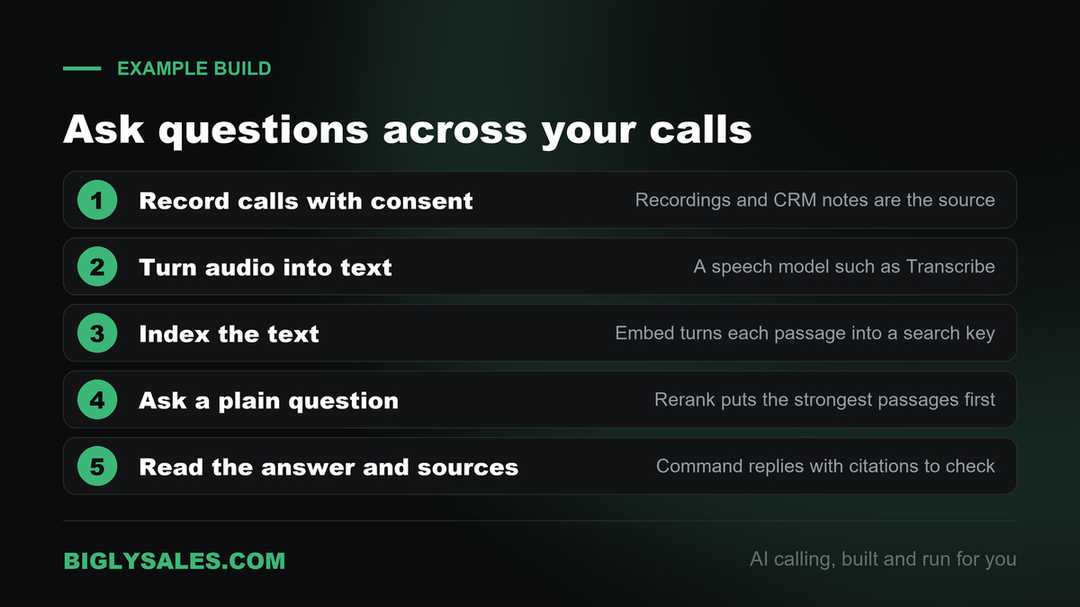
Step 1. Start with recordings you are allowed to keep
Recording rules differ by state, and some states need every party to agree. Our business call recording guide covers the basics. Sort this out before any AI touches a single file.
Step 2. Turn audio into text
If your calls are audio only, a speech model turns them into text. Cohere’s Transcribe model is an open-source 2 billion parameter model under Apache 2.0. It covers 14 languages and takes files up to 25MB.
If your calling platform already gives you transcripts, skip this step.
Step 3. Index the text
Embed turns each chunk of each transcript and each CRM note into a search key. The keys go into a database built for this kind of search.
Step 4. Ask in plain words
A manager types a question. The system finds the closest passages, Rerank sorts them, and Command writes the answer with links to the exact calls.
| Question | What the answer pulls from | Why it helps |
|---|---|---|
| Which objections came up most on last month’s calls? | Transcripts from that month | Shows where your script loses people |
| Who mentioned a competitor by name this week? | Transcripts and CRM notes | Flags deals that need attention now |
| What did this lead say on the last two calls? | That lead’s transcripts | The rep calls back with context |
| Which callers asked about price before booking? | Transcripts and booking outcomes | Shows whether price talk helps or hurts |
| What promises did reps make about delivery dates? | Transcripts and notes | Catches promises nobody tracked |
Step 5. Check the citations
Every answer should link back to the calls it came from. Open two or three. If the quote is not there, do not act on the answer.
One honest note. This is a build, not a button. Someone has to connect your data, choose what gets indexed and keep it current. North and Compass do much of that work for you, but they are sold to companies with budgets to match.
What North does for a business
North is the part of Cohere a manager would actually use. Cohere’s North page says it “runs wherever your data lives.”
Here is what the launch posts say it does.
- Searches your tools. The August 2025 launch post names connectors for Gmail, Slack, Salesforce, Outlook, SharePoint, Linear and network file storage.
- Adds more connectors. The North 2 post from October 5, 2026 adds OneDrive, Microsoft Exchange and Jira, among others.
- Cites every answer. Cohere says all responses include citations so people can check them.
- Remembers context. North 2 agents keep context across sessions instead of starting cold every time.
- Caps spending. Admins can set cost controls, rate limits, user quotas and org-wide caps.
- Runs where you choose. On your own servers, in your cloud or fully air gapped, with no internet link at all.
- Works with other models. Cohere says North is model agnostic, so you can bring other vendors’ models.
Cohere also says North can run on as few as two GPUs. For a company that wants AI inside its own walls, that is a real selling point.
North 2 lists SOC 2 Type 2, ISO 27001 and ISO 42001 certifications. ISO 42001 is the newer standard for managing AI systems.
What North does not do is show you a price. The page offers “Contact sales” and a demo. Expect a sales process, not a sign-up form.
What Cohere costs
Cohere has three price paths. All of this comes from Cohere’s pricing page and its rate limits docs, checked November 14, 2026.
| Path | What it costs | The catch |
|---|---|---|
| Trial API key | Free | Not for production or commercial use. Capped at 1,000 calls a month and 20 chat calls a minute |
| Production API key | Pay as you go, billed monthly or when you owe $250 | Needs an owner on the account to apply |
| North, Compass, private deployment | Custom quote | Contact sales |
| Model Vault (dedicated GPUs) | From $3.00 an hour on demand for an L4 GPU | Promotional rates run through March 31, 2027 |
The pricing page lists token prices for older models only. For example, Command R+ 08-2024 costs $2.50 per million input tokens and $10 per million output tokens. A million tokens is roughly 750,000 words.
On the day I checked, the page did not list prices for Command A, Command A+, Embed 5 or Rerank 5. I will not guess. Check your Cohere dashboard or ask sales for the current numbers.
Rerank is billed by search, not by token. One search unit is one query with up to 100 documents to rank.
Skip the build
Calls, transcripts and follow-ups in one place
Bigly Sales runs fully managed AI calling for inbound and outbound, and every call comes back with a summary and transcript. You get a free 30-minute setup, a $1,000 value, and most teams go live within 24 hours.
Where your data goes
Data handling is the main reason companies pick Cohere, so the details are worth reading. Here is what Cohere’s Enterprise Data Commitments and privacy policy say.
| Question | What Cohere’s documents say |
|---|---|
| Who is the company? | A Canadian company subject to Canadian federal privacy laws |
| Which promises apply to me? | The Enterprise Data Commitments cover paying customers. Trial keys fall under the general terms and privacy policy |
| Can I stop training on my data? | Yes. Turn off the toggle under Settings, then Data Controls, in your dashboard |
| How long are prompts kept? | Logged prompts and outputs are deleted after 30 days |
| Can I get zero retention? | Yes, if Cohere approves your account for zero data retention |
| What about private deployments? | In private deployments and third-party cloud platforms, Cohere does not receive your inputs |
| What happens to trial data? | The privacy policy says it may be used for research and development |
Two points stand out.
First, the trial key is the weak spot. Do not run customer data through a free key. Use public documents for testing.
Second, the strongest privacy option is a private deployment. If North or a Command model runs on your own servers, Cohere never sees what goes in.
How to try Cohere in one afternoon
You can get a feel for Cohere without a sales call. Keep it to public information while you test.
- Make a free account. Cohere creates a trial API key for you when you sign up.
- Open the Playground. It sits in the Cohere dashboard and lets you chat with Command and test Embed without writing code.
- Ask a developer to run the RAG example. Cohere’s RAG docs include a short sample that answers from a list of documents you supply.
- Feed it five public pages. Your own website’s FAQ and pricing pages work well.
- Check the citations. Ask five questions and confirm each answer points to the right page.
| What to test | Question to ask | What a good answer does |
|---|---|---|
| Facts | What does the starter plan include? | Quotes the plan and cites the pricing page |
| Gaps | Do you offer service on Sundays? | Says it is not in the documents instead of guessing |
| Summaries | Summarize our refund rules in three bullets | Stays inside what the page says |
| Comparison | How do the two middle plans differ? | Cites both plans side by side |
| Tricky wording | Can I cancel any time? | Finds the answer even if the page uses other words |
The second test is the most useful one. A good RAG system admits when the answer is not in your files.
Cohere, MCP and Bigly Sales
MCP, the Model Context Protocol, is an open standard that lets an AI assistant talk to other software. Our What Is MCP? explainer covers it in plain words.
Cohere supports MCP through North. Here is what I could verify at the source.
| Where | What the source says | Who it is for |
|---|---|---|
| North | Can integrate with any MCP server for secure access to in-house applications | Companies using North |
| North MCP Python SDK | Open-source kit for building MCP servers that work with North. North only supports the StreamableHTTP transport | Developers |
| Cohere API | No built-in MCP setting documented. Developers can wire tools in through function calling | Developers building their own app |
The details are in the North launch post and the North MCP SDK readme. The readme says North sends an identity token with each request, so the server can check who is asking.
The Bigly Sales MCP server brings your calling data into an AI assistant. Its page names Claude and ChatGPT. Bigly has not published support for Cohere North, so ask your account rep before you plan around it. With a supported assistant, you can ask questions like these.
| You ask | What comes back |
|---|---|
| Who picked up today and wants a demo? | A list of today’s connected calls where the lead asked for a demo |
| Who asked us to call back this week? | Leads who requested a follow-up, with the day they asked for |
| Summarize the call with this lead before I dial. | A short summary with the transcript behind it |
| How is the insurance campaign pacing? | Calls placed, connects and minutes used so far |
| Add these 200 contacts to the reactivation campaign. | The contacts created or updated and sent into the campaign |
This is a different job from the RAG idea above. Cohere searches your documents. Bigly answers about your calls.
Bigly keeps the guardrails in the platform. The assistant sees only what your Bigly account allows. Consent records, DNC scrubbing and local-time calling windows are checked before every dial, so an assistant starting the work does not change who you may call.
The connection steps are not public, so ask your Bigly account rep. Our guide to MCP servers for AI calling lists the questions worth asking first.
Who Cohere is for and who should skip it
Cohere fits
- Companies with thousands of private documents, transcripts or tickets they want to search in plain words.
- Teams in banking, insurance, healthcare or government that must keep data on their own servers.
- Businesses with a developer or IT partner who can build and maintain a RAG system.
- Teams that work in many languages. Embed 5 covers more than 100.
Skip it for now if
- You want a chat app for daily writing. Cohere does not offer one. Try Claude or ChatGPT.
- You live in Google Workspace or Microsoft 365. Gemini and Copilot already search your files.
- You have no technical help. The API needs a developer and North needs a sales process.
- You want AI that makes phone calls. Cohere does not place calls. That is a calling platform’s job.
Cohere vs the other assistants in this series
After twelve guides, here is where Cohere sits next to the tools most businesses already know.
| Assistant | Made by | Good fit for | Watch out for |
|---|---|---|---|
| Cohere | Cohere, Canada | Search and agents over private company data | No consumer app. North is priced by quote |
| ChatGPT | OpenAI, United States | Everyday work with team admin controls | Paid per seat |
| Claude | Anthropic, United States | Long documents and careful writing | Paid per seat for teams |
| Mistral Vibe | Mistral AI, France | EU data hosting by default | Training is on by default on personal plans |
| Qwen | Alibaba, China | Open models you can run yourself | App terms limit it to personal use |
My read is simple. Most teams should start with a general assistant. Cohere earns its place when the question is “what is in our own files” and the answer must stay on your own servers.
For the others, see our guides to DeepSeek, Perplexity, Grok and Meta Muse.
Cohere AI FAQ
What is Cohere AI?
Cohere is a Canadian AI company that builds language models and software for businesses. Its main products are North, a platform for AI agents and search over company data, and a set of models called Command, Embed and Rerank. Unlike ChatGPT or Claude, Cohere does not sell a chat app for consumers. It sells to companies and developers.
What is RAG in AI?
RAG stands for retrieval augmented generation. In plain words, the AI looks up the right pages in your own files first, then writes its answer from those pages. Cohere’s docs describe it as generating text using extra information fetched from an outside data source. It helps the model stay accurate and lets you check where an answer came from.
Is Cohere free?
Partly. Cohere gives every new account a free trial API key. Its pricing page says trial keys are rate limited and may not be used for production or commercial purposes. The rate limits page caps trial keys at 1,000 API calls a month. Production use is pay as you go, and North and Compass are priced by quote through Cohere’s sales team.
What is Cohere North?
North is Cohere’s platform for AI agents at work. It searches company data, connects to tools like Slack, SharePoint, Outlook and Salesforce, and answers with citations. Cohere says it can run in your own cloud, on your own servers or fully air gapped. The current version, North 2, launched on October 5, 2026.
Does Cohere train on my data?
It depends on your account. Cohere’s Enterprise Data Commitments, which cover paying customers, say you can switch off training on your prompts and outputs under Settings, then Data Controls. Logged prompts are deleted after 30 days. Trial key data falls under the general privacy policy, which says it may be used for research and development.
Can Cohere search my call transcripts?
Yes, if your transcripts are text in a place Cohere can reach. Cohere’s Embed and Rerank models are built to search documents, and North connects to file stores and business apps. Cohere also has a speech model called Transcribe that turns audio into text. Record calls only with the consent your state requires.
Is Cohere open source?
Some of it. Cohere released Command A+ on May 20, 2026 under the Apache 2.0 license, which allows commercial use, and says it runs on as few as two H100 GPUs. Its Transcribe speech model is also Apache 2.0. North, Compass, Embed and Rerank are paid products, not open downloads.
Does Cohere work with MCP?
Yes, through North. Cohere’s North launch post says North can connect to any Model Context Protocol server for access to in-house applications. Cohere also publishes an open-source kit for building MCP servers that work with North, and its readme says North only supports the StreamableHTTP transport.
Is Cohere good for small businesses?
Usually not as a first AI tool. Cohere has no consumer app, North is sold through sales calls, and the free key is not for commercial use. A five person company will get more from ChatGPT, Claude or Gemini today. Cohere fits companies with lots of private documents and a technical team or partner.
Can Cohere connect to Bigly Sales?
Bigly Sales has an MCP server that brings your calls, transcripts and follow-up lists into an AI assistant. Its page names Claude and ChatGPT. Cohere North can connect to MCP servers, but Bigly has not published support for North, so ask your Bigly account rep before you plan around it.
The bottom line
Cohere AI is the business-only player in this series. It does not chase you with a chat app. It sells the plumbing that lets an AI answer from your own files, with citations, on servers you control. If you have a mountain of private documents and someone technical, it is worth a test with public data first.
And remember what none of these tools does. Not one of them picks up the phone. When you want AI that calls, qualifies and transfers live to your team, with consent and calling windows checked before every dial, pair your assistant with a calling platform built for that.
Ready to talk
Put your call data to work this week
Bigly Sales plans start at $99 a month for inbound and outbound AI calling. Book a call and we will map a plan to your call volume and show you which assistants the MCP server supports.