

A warm transfer is a call handoff where the first agent briefs the receiving agent before connecting the caller, and a cold transfer is the same handoff with no briefing at all. That single difference decides whether your customer starts over or picks up where they left off.
Most teams never actually choose between them. The transfer style becomes whatever the phone system defaulted to on day one, and nobody revisits it. That is worth revisiting, because the choice shows up in four metrics you already report, and it can quietly cost you deals you had already won.
This guide covers what each transfer type is, when each one is correct, what they cost you in measurable terms, and how AI qualification changes the math for revenue calls.
TL;DR
A warm transfer briefs the receiving agent before the caller is connected. A cold transfer, also called a blind transfer, sends the call through with no introduction. Use cold for simple single purpose routing such as a billing queue. Use warm for revenue calls, escalations, and anything involving money, health, or a cancellation.
The one rule worth writing down is this. Never cold transfer into a queue you have not confirmed is staffed at that hour, and always set a ring timeout with a named fallback so an unanswered transfer returns to a person. If your team is measured on average handle time alone, agents will drift toward cold transfers whether or not that serves the caller, so do not roll this out without changing what you measure first.
Key takeaways
- A warm transfer carries context, a cold transfer carries only the caller
- Blind transfer, cold transfer and unattended transfer all name the same action
- Cold transfers are correct for simple routing and spiking volume, not for revenue calls
- Brief the receiving agent whenever losing context would cost you the outcome
- Handle time alone pushes teams toward cold transfers, so read it with first contact resolution and satisfaction
- Transfer abandon rate is the metric most teams miss and the one that exposes bad routing
- AI qualification makes every handoff warm by construction, without costing an agent handle time
Table of contents
- What a warm transfer is
- What a cold transfer is
- Warm transfer vs cold transfer at a glance
- When a cold transfer is the right call
- When a warm transfer wins
- What transfers actually cost you
- How AI calling changes the decision
- How to set up transfers that do not drop
- Six transfer mistakes worth fixing this week
- What to say during the handoff
- Call transfer FAQ
- The bottom line
What a warm transfer is
A warm transfer is a call handoff in which the agent holding the call speaks privately with the person they are transferring to before connecting the caller. The first agent explains who is on the line, what they need, and what has already been tried. Only then does the caller get handed over.
You will also see this called a consultative transfer or an attended transfer. All three names describe the same thing, which is a transfer with a briefing attached.
From the caller’s side it feels like being introduced rather than being passed around. They do not repeat their account number, their problem, or their mood. The receiving agent opens with something the caller has already said, which is the clearest possible signal that the company was listening.
What a cold transfer is
A cold transfer, also called a blind transfer or an unattended transfer, sends the caller to another extension or queue immediately. The first agent does not speak to whoever picks up. They press transfer, and the call leaves.
The receiving agent answers with no idea who is calling or why. If nobody is available, the caller may land in a queue or a voicemail box, sometimes after having already waited once.
Cold transfers are not automatically bad. They are simply uninformed, and whether that matters depends entirely on the conversation. A caller who asked for store hours does not need an introduction. A caller who just agreed to buy something does.
Warm transfer vs cold transfer at a glance
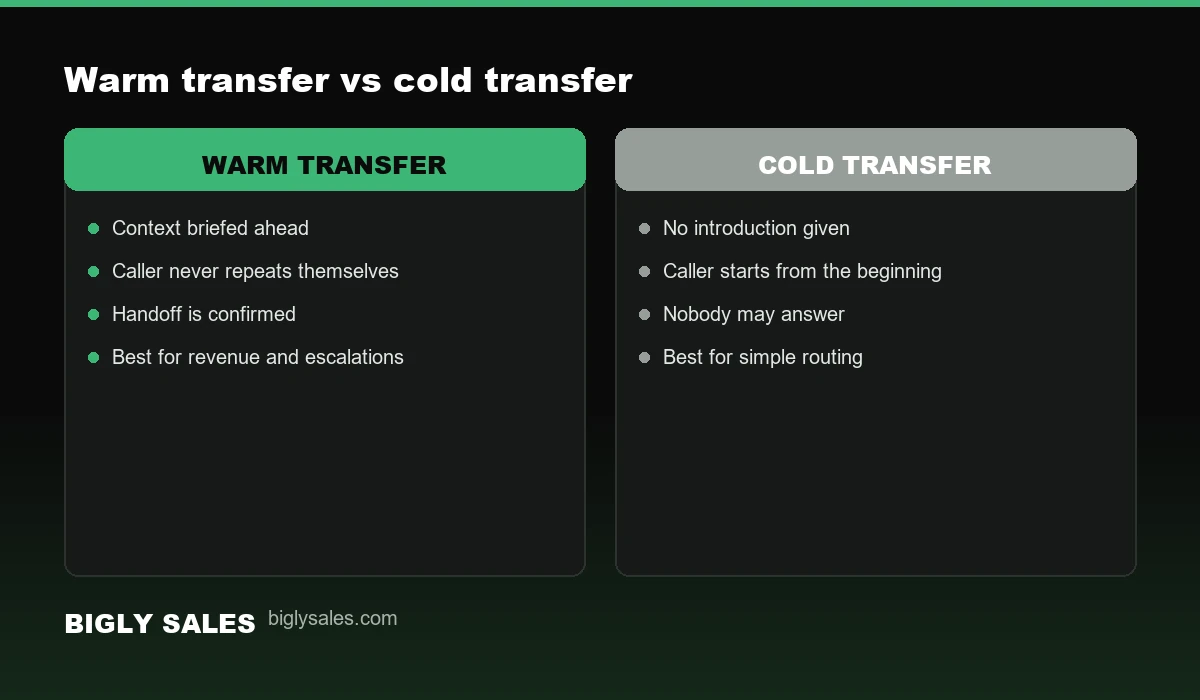
The two styles trade the same currency in opposite directions. The briefed version spends the sending agent’s time to buy the caller continuity. A cold transfer saves that time and charges the caller for it.
| Factor | Warm transfer | Cold transfer |
|---|---|---|
| Caller repeats themselves | No, context is briefed ahead | Usually yes, from the beginning |
| Time cost to first agent | Higher, they stay on the call | Very low, they release immediately |
| Risk of dropping the caller | Low, the handoff is confirmed | Higher, nobody may answer |
| Receiving agent preparedness | Briefed before answering | None |
| Effect on handle time | Raises it for the sending agent | Lowers it for the sending agent |
| Effect on satisfaction | Generally positive | Often negative on complex issues |
| Best fit | Sales, escalations, sensitive calls | Simple routing, single purpose queues |
When a cold transfer is the right call
Reach for a cold transfer when the receiving party needs no context to help.
- The caller asked for a specific department by name, and any available person there can help
- The queue is for a single purpose, such as billing payments or store hours
- The caller reached the wrong number entirely and simply needs redirecting
- Call volume is spiking, and holding agents on the line would grow the queue for everyone
- The receiving team already has full account context on screen the moment the call lands
In these situations a briefing adds delay without adding value. Speed genuinely serves the caller better. The mistake is treating that as a general rule rather than a narrow one.
When a warm transfer wins
Reach for a warm transfer when losing context would cost you the outcome.
- A qualified prospect is ready to talk about buying, where restarting the conversation risks the deal
- An escalation, where the caller is already frustrated and repeating themselves will make it worse
- Anything involving money, health, legal exposure, or a cancellation request
- A specialist handoff, where the receiving agent needs history to be useful at all
- A named account, where the caller expects to be recognized
- Any call where the previous attempt to resolve the issue already failed
On revenue calls the case is straightforward. A prospect who has just said yes is at their most willing right now, and every second of confusion costs some of that willingness. This is why our inbound calling workflow treats the qualified handoff as the moment that matters most.
Warm by default
Every handoff briefed before your rep says hello
See how AI qualification captures caller context and passes it to a live rep on the same call. A working walkthrough takes about twenty minutes.
What transfers actually cost you
Transfer style shows up in numbers your team already reports. Watch these four together, because any one of them read alone will point you the wrong way.
Average handle time
Briefed handoffs raise handle time for the sending agent because they stay on the line through the briefing. Cold transfers lower it. If handle time is the only metric anyone is measured on, agents will drift toward cold transfers whether or not that serves the caller.
First contact resolution
Cold transfers tend to depress first contact resolution because context loss causes repeat calls. A caller who has to explain themselves twice is more likely to give up and call again tomorrow, which moves the cost from one report to another rather than removing it.
Transfer abandon rate
This is the metric most teams do not track and should. It counts callers who disappear during or immediately after a transfer. A high number here usually means cold transfers are landing in unstaffed queues, which is a routing problem wearing a customer service costume.
Satisfaction scores
Being passed around without introduction is one of the most reliably disliked phone experiences there is. If satisfaction dips on transferred calls specifically, transfer style is worth examining before you look at agent performance.
How AI calling changes the decision
The warm versus cold debate assumes a human is doing the transferring and that the briefing costs that human time. AI calling changes both assumptions.
Qualification happens before any human is involved
When an AI agent handles the opening conversation, it has already confirmed who the person is, what they want, and whether they qualify. The transfer that reaches your team is warm by construction, because the context was captured on the way. Our features page shows how that qualification data travels with the call.
Context arrives as data, not as a spoken summary
A human briefing takes thirty seconds and relies on memory. A structured handoff delivers the same context as fields on a screen before the rep says hello. The rep opens the call already knowing the vehicle, the loan amount, the property, or the policy in question.
The briefing no longer costs an agent
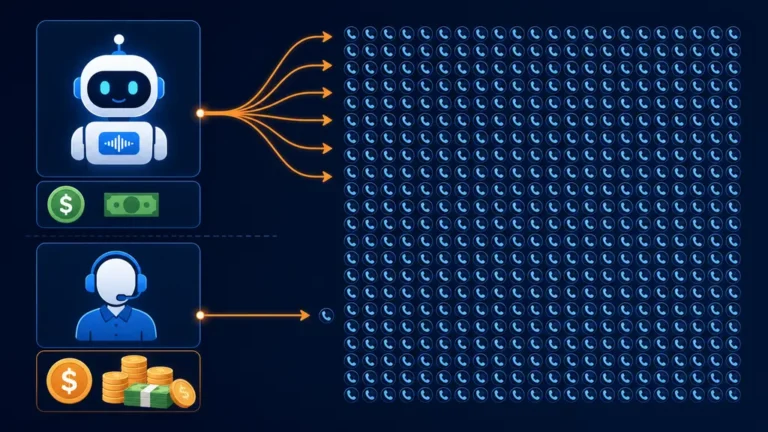
The main argument for cold transfers is that warm ones are expensive in agent time. When the first conversation was handled by AI, there is no sending agent whose handle time suffers. You get the quality of a warm transfer at the cost of a cold one, which is why this stopped being a trade-off for teams running AI qualification.
Where humans still matter most
None of this removes the closer. It removes the part of the job that was never worth a person, which is dialing, waiting, re-explaining, and filtering. The conversation that decides the outcome still belongs to a human being.
An honest caveat
This is not free. An AI qualified handoff is only as good as the questions the agent was told to ask, and a badly scoped script will pass along confident nonsense faster than a human ever could. If your qualifying criteria are not written down and agreed by sales, fix that before automating the front of the call. Teams with very low call volume, or with one person handling every conversation end to end, will not get much from this at all.
How to set up transfers that do not drop
Most transfer problems are configuration problems. Work through these in order.
- Define which call types get a briefing and which get sent straight through, then write it down where agents can see it
- Never cold transfer into a queue you have not confirmed is staffed at that hour
- Set a ring timeout and a named fallback so an unanswered transfer returns to a person rather than to voicemail
- Give the receiving agent a screen pop with caller history, so even a fast transfer carries context
- Tell the caller what is about to happen and who they will be speaking to
- Record transfer outcomes as their own disposition so you can measure the abandon rate
- Review dropped transfers weekly for the first month after any routing change
If you are replacing an older phone tree as part of this work, our comparison of IVR against an AI voice agent covers what changes for routing. Because transfer recording and disclosure carry obligations on outbound calls, review the FTC guidance on complying with the Telemarketing Sales Rule alongside your routing design.
Six transfer mistakes worth fixing this week
These come up constantly in call reviews and none of them require new software to fix.
Transferring without telling the caller
Silence followed by hold music reads as a dropped call. Say the department, say the reason, and say roughly how long it will take.
Briefing on every single call
A briefing costs agent time, and spending it on somebody who just needs the payment line is waste. Match the effort to the stakes.
Transferring into voicemail
If a transfer can land in a voicemail box, it eventually will, usually at the worst possible time. Route the fallback to a live queue instead.
Briefing in front of the caller
The briefing has to be on a private leg of the call. Discussing a caller’s account within their hearing is both awkward and, on regulated calls, a real problem.
No disposition for transfers
If a transferred call is dispositioned the same way as any other, you cannot see the abandon rate, which means you cannot fix it.
Rewarding only handle time
Whatever you measure is what your floor will optimize toward. If handle time is the scoreboard, expect blind transfers and repeat calls.
What to say during the handoff
A good handoff briefing is three sentences and takes under twenty seconds. Say who is on the line, what they want, and what has already happened.
A workable pattern is this. “I have Maria Alvarez on line two, she is calling about the auto loan payoff quote we sent Tuesday, I have already confirmed her identity and the account number. She wants to know whether the figure is still valid this week.”
Then go back to the caller before releasing. “Maria, I have Daniel from the payoff team on the line, he already has your account open and knows what you are asking. I am connecting you now.” That sentence is what turns a transfer from something being done to the caller into something being done for them.
Call transfer FAQ
What is the difference between a warm transfer and a cold transfer?
In a warm handoff, the sending agent speaks to the receiving agent first and explains the situation so the caller does not start over. In a cold transfer the call is sent immediately with no introduction, and the receiving agent answers without any context. The practical difference is who absorbs the cost of continuity, the agent or the customer.
Is a blind transfer the same as a cold transfer?
Yes. Blind transfer and cold transfer are two names for the same action, which is transferring a call without speaking to the receiving party first. Some phone systems label the button blind transfer, others label it cold transfer, and a few call it unattended transfer. The behavior is identical in all three cases.
What is a consultative transfer?
A consultative transfer is another name for a warm transfer. The sending agent consults the receiving agent before handing the caller over, so the receiving agent knows who is coming and why. Attended transfer is a third name for the same thing. If your phone system offers attended and unattended options, attended is the warm one.
Which transfer type is better for sales calls?
Warm transfer, almost always. A prospect who has just qualified is at their most willing at that moment, and making them restart the conversation with a stranger loses some of that momentum. Cold transfers on live sales calls are one of the most common causes of avoidable lost deals, and they are also one of the easiest to fix.
Do cold transfers hurt customer satisfaction?
They can, particularly on complex or emotional calls where the caller has to repeat themselves. On simple routing where any available agent can help, callers generally do not mind and may prefer the speed. Watch satisfaction on transferred calls as its own segment rather than assuming the overall number tells you anything useful.
How does a warm transfer affect average handle time?
It raises handle time for the sending agent because they remain on the call during the briefing, usually by twenty to forty seconds. This is why teams measured only on handle time tend to drift toward cold transfers, and why handle time should be read alongside first contact resolution and satisfaction rather than alone.
Can AI voice agents perform warm transfers?
Yes. An AI agent can qualify the caller, capture the relevant details, and then bridge a human representative into the live call with that context attached. Because no human agent was tied up during the first conversation, you get briefed-handoff quality without the usual handle time cost. The context arrives as data on screen rather than as a spoken summary.
What is a whisper transfer?
A whisper transfer lets a supervisor or the sending agent speak only to the receiving agent while the caller cannot hear. It is a variation of the warm briefing, and it is often paired with barge, where the third party can join the conversation fully if needed. Supervisors use whisper most often for coaching during live calls.
How do I stop transferred calls from being dropped?
Set a ring timeout with a named fallback destination so unanswered transfers return to a live person, never cold transfer into a queue you have not confirmed is staffed, and track the transfer abandon rate as its own metric so the problem is visible. Most dropped transfers are configuration failures rather than agent failures.
Should every call get a warm transfer?
No. Briefings cost agent time, and spending it on a caller who just needs the billing queue is a waste. Match the transfer type to the stakes of the conversation, using warm for revenue, escalations, and sensitive topics, and cold for simple single purpose routing. A written rule beats agent judgment here because it is consistent.
The bottom line
The warm versus cold question is not really about phone system settings. It is about who pays for continuity on a handoff, the agent or the customer, and whether that trade is worth making on this particular call.
Write the rule down, route revenue and escalations warm, route single purpose queues cold, and start tracking transfer abandon rate this month. If you want the qualification captured before your rep ever joins, you can compare pilot pricing or read our guide to Twilio alternatives for voice and AI calling.
Stop losing handoffs
Qualified calls reach your reps with context attached
Bigly Sales qualifies the caller, then bridges your rep into the live conversation. Tell us your routing rules and we will show you the handoff on your own call flow.