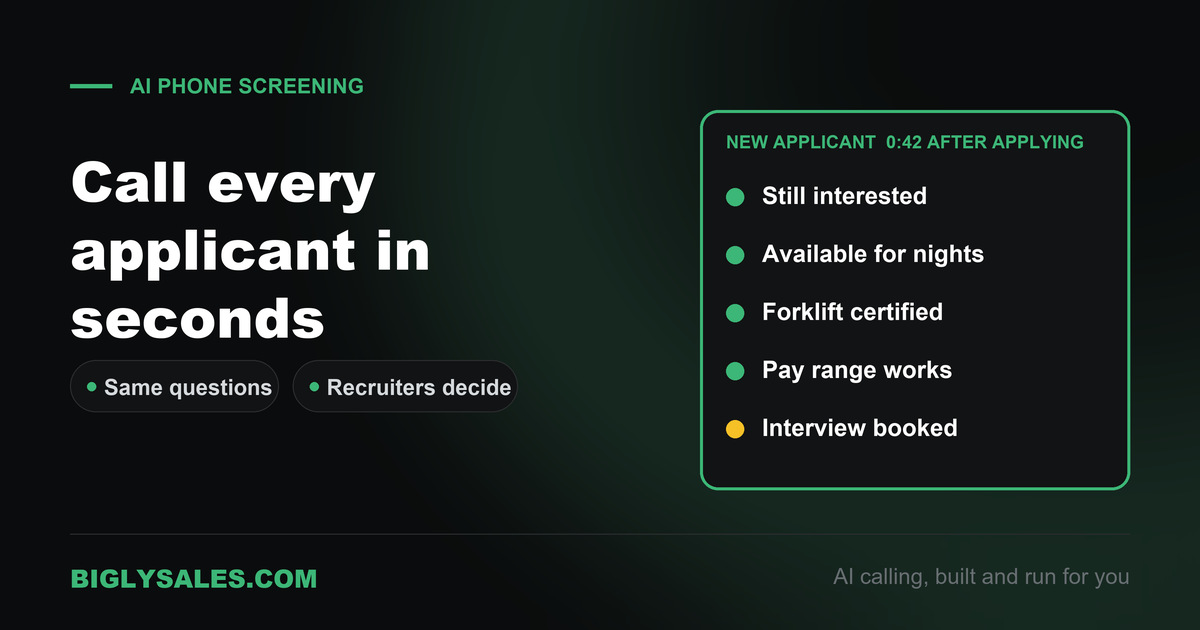


AI phone screening calls every applicant within seconds of applying and asks the same job-related questions, so your recruiters only spend time on people worth placing.
Hourly and high-volume candidates take the first job that calls them back.
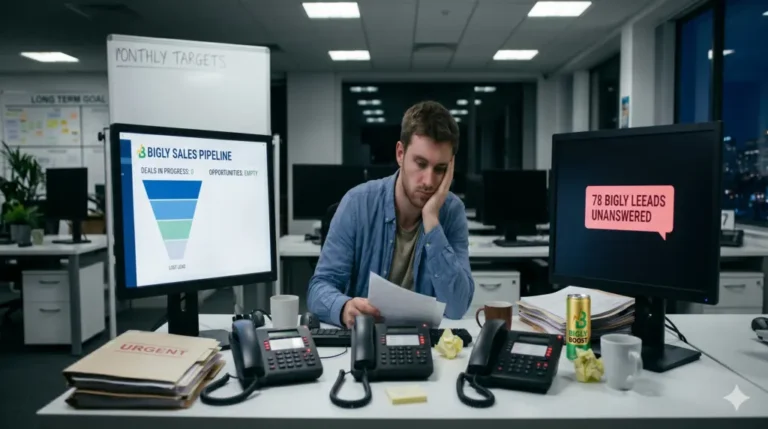
Your recruiters are on another call. That is the whole problem.
This guide covers which recruiting calls to hand to AI, how to keep screening fair and legal, and what it costs.
With pay data from the BLS and our own pricing.
Key Takeaways
- AI calls new applicants in under 60 seconds, including evenings and weekends.
- Fifty fifteen minute screens is 12.5 recruiter hours for one role.
- The AI collects answers. Recruiters make every hiring decision.
- Ask the same job-related questions of every candidate, and nothing about protected traits.
- Shift fill calls go out to the whole bench at once, not one by one.
- AI calls to a candidate’s mobile need prior consent, usually captured on the application.
Table of contents
- What AI phone screening is
- Why speed decides who gets placed
- What phone screens cost your desk
- 6 recruiting calls to hand to AI
- Keep recruiters on the hiring decision
- How to write a fair AI phone screen
- Filling shifts from your bench
- Calling rules for candidate calls
- What the AI needs from you
- What it costs
- Who this is wrong for
- AI phone screening FAQ
- The bottom line
What AI phone screening is
AI phone screening is the use of an AI voice agent to call job applicants, ask structured job-related questions and record the answers for a recruiter to review.
It confirms the candidate is still interested. It checks availability, location and must-have requirements. It books the interview.
Then it puts everything in your ATS. Recording, transcript and answers.
It does not decide who gets hired. On Bigly, the AI does not rank, score or reject anyone. Your recruiters do that.
Think of it as the first ten minutes of every phone screen, done for you on every applicant.
Why speed decides who gets placed
A warehouse worker applies to four jobs on a Sunday night.
Monday at 9 a.m., your recruiter starts working the queue. By the time they reach that applicant, two other agencies have already called. One booked an interview.
This is the same speed to lead problem sales teams have. The first call wins the conversation.
In recruiting, the stakes are a placement and the fee that comes with it.
Bigly AI agents call new applicants in under 60 seconds after they apply. At 10 p.m. too, when working candidates are actually free to talk.
What phone screens cost your desk
Consider a situation where one role gets 50 applicants. Each phone screen takes about 15 minutes, with voicemails and small talk.
That is 750 minutes. 12.5 hours of recruiter time for a single role.
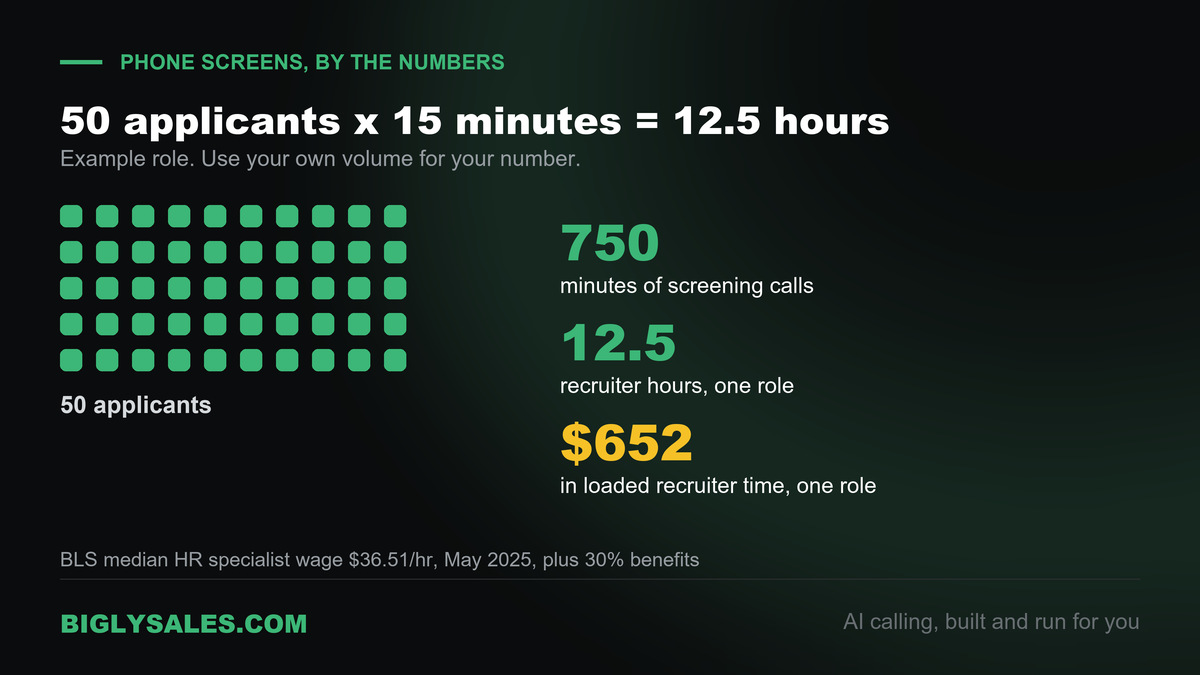
The BLS puts the median wage for human resources specialists, the job that recruits, screens and interviews applicants, at $36.51 an hour in May 2025.
12.5 hours is about $456 in wages. Add benefits, which make up 30 percent of private industry compensation, and it is about $652. Per role.
This is an example. Your screens may be shorter, your roles may get 500 applicants. Run the same math with your numbers.
And notice what that time buys. The same ten questions, asked again and again. Most of it is not recruiting. It is data entry by phone.
6 recruiting calls to hand to AI
These are the calls that eat a recruiter’s day.
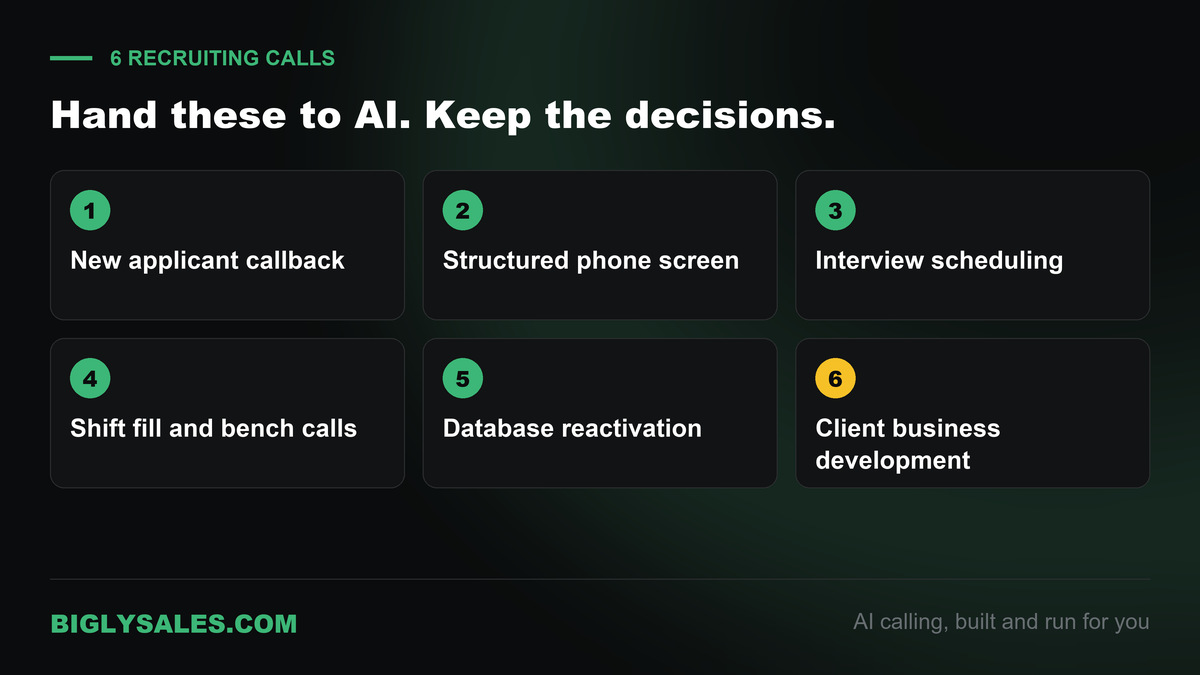
| Call | What the AI does | What it needs | Recruiter takes over when |
|---|---|---|---|
| New applicant callback | Calls in seconds, confirms interest | The application from your ATS or job board | The candidate passes the basics |
| Structured phone screen | Asks the same job-related questions | Your approved question list | Always, to review and decide |
| Interview scheduling | Books, confirms and reschedules | Recruiter or client calendars | The candidate has a special request |
| Shift fill and bench calls | Calls available workers about open shifts | Shift details and the bench list | A worker has a question about the client |
| Database reactivation | Updates availability and skills | Past candidates with consent to call | The candidate fits a current opening |
| Client business development | Qualifies hiring needs, books meetings | Target companies and consent rules | The hiring manager wants to talk terms |
Start with the first one. New applicant callbacks are where speed matters most and where the AI pays off fastest.
Free setup session
Hear an AI agent screen a candidate
In 30 minutes we build a working screening agent with your questions and call your phone with it. Plans start at $99 a month, and the setup is free.
Keep recruiters on the hiring decision
This is the most important part of the whole setup.
Several laws now regulate automated tools that score, rank or reject candidates. New York City Local Law 144 requires a bias audit and candidate notice for automated employment decision tools. And the EEOC has made clear that employers stay responsible for discrimination caused by AI tools they use.
Those rules focus on tools that substantially assist or replace the hiring decision.
So keep the AI on the information side. It asks. It records. Your recruiters review and decide.
Bigly agents work that way by design. Confirm the rules for your locations with employment counsel. This is general information, not legal advice.
There is an upside here too. Every candidate gets the same questions in the same order, and every answer is recorded.
That is far easier to defend than notes from a rushed call at five to five on a Friday.
How to write a fair AI phone screen
A good screen is short, job-related and identical for everyone applying to the role.
- Confirm interest. Is the candidate still looking, and for this role?
- Check availability. Start date, shifts and hours they can work.
- Check must-haves. Licenses, certifications or equipment the job requires.
- Confirm location. Can they get to the site?
- Check pay fit. Share the range and ask if it works.
- Book the next step. An interview or a recruiter call.
Keep it to five minutes or less. And never ask about age, family plans, health, religion or anything else tied to a protected trait.
Write the list with your recruiters. Then have counsel read it once.
Filling shifts from your bench
A client needs six forklift operators tomorrow at 6 a.m. It is 4 p.m.
Your recruiter starts calling down the bench. One at a time. Voicemail, voicemail, no answer, a yes, voicemail.
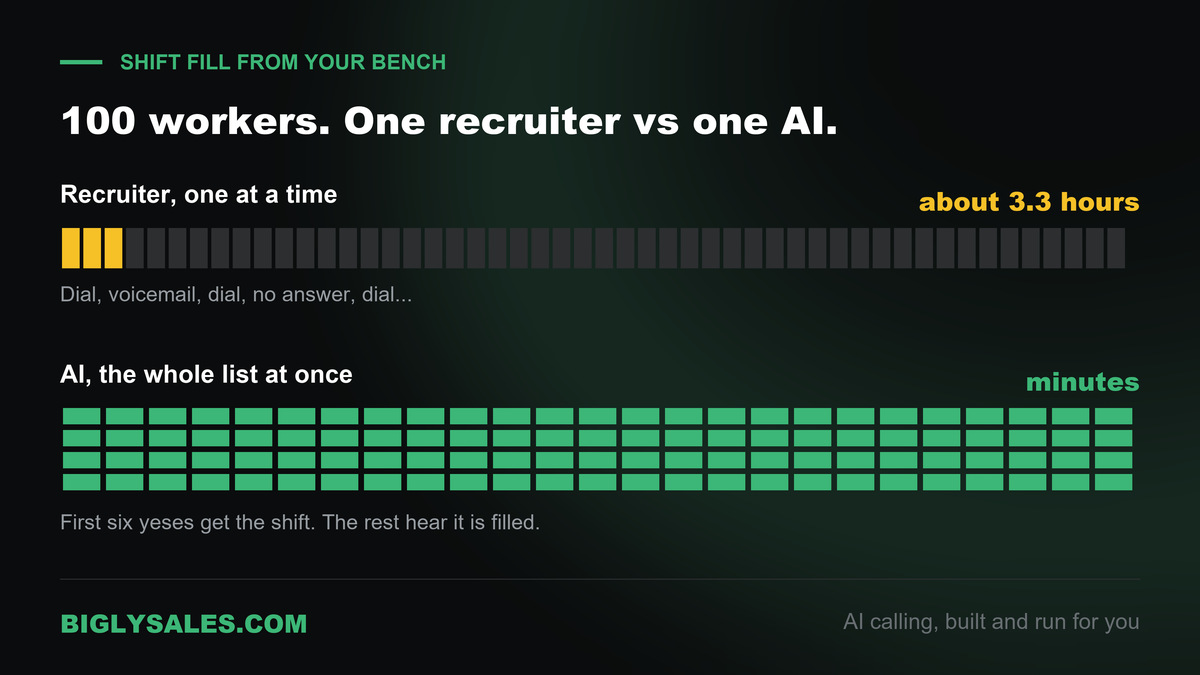
Say each attempt takes about two minutes. One hundred workers is over three hours of dialing.
The AI calls the whole list at once, gives the shift details and confirms who accepts. The first six yeses get the shift, and the rest hear it is filled.
That is the same idea behind any outbound AI campaign, applied to your own workers.
Calling rules for candidate calls
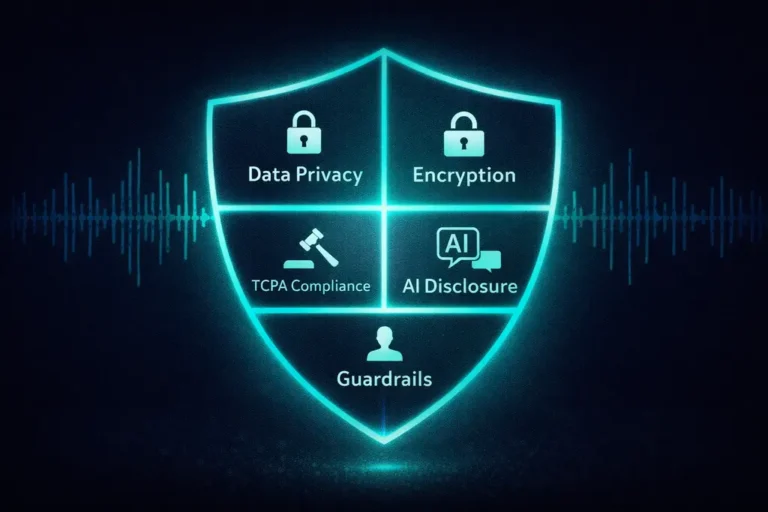
In February 2024 the FCC ruled that AI generated voices count as artificial voices under the TCPA.
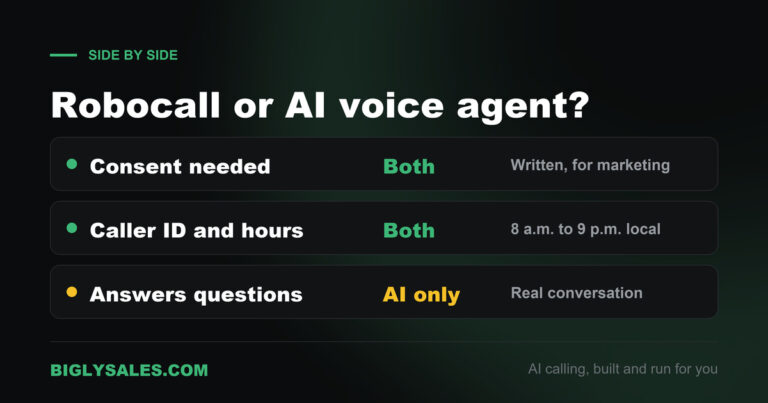
So an AI call to a candidate’s mobile phone needs the candidate’s prior consent. That consent is usually captured on the application or job board form. Make sure your form says it clearly.
Business development calls to hiring managers are different. Those are sales calls, and the consent rules for AI voice calls apply in full.
Several states also require you to disclose the AI on the call. Bigly agents disclose it on every call and honor stop requests in real time, with compliance controls built in.
What the AI needs from you
- Your screening questions per role. Approved by your team.
- A trigger. New applications from your ATS or job boards.
- Calendars. So the AI can book interviews without back and forth.
- A hand-off rule. Who gets the candidate after the screen, and how fast.
- Consent language. On your application, so calls are allowed.
Bigly sets this up and writes every answer to your CRM or ATS. Most teams go live within 24 hours once the questions are approved.
For the scheduling side, see how an AI appointment setter books interviews and meetings.
What it costs
Bigly prices by the minute, and every plan covers inbound and outbound. These are the published plans, checked on our pricing page on November 5, 2026.
| Plan | Monthly price | Included minutes | Five minute screens, roughly |
|---|---|---|---|
| Scout Plan | $99 | 500 | 100 |
| Prospector Plan | $500 | 3,000 | 600 |
| Hunter Plan | $2,999 | 25,000 | 5,000 |
| Closer Plan | $4,999 | 50,000 | 10,000 |
| Rainmaker Plan | $9,999 | 125,000 | 25,000 |
Not every call is a full screen. Voicemails and quick no’s use less. Annual billing takes 30 percent off every plan.
Who this is wrong for
Executive search does not need this. When you fill five senior roles a year, every call should be you.
It is also a poor fit if you want software to pick candidates for you. Bigly will not do that, and the legal risk of tools that do is growing.
And if you hire two people a month, a recruiter with a free afternoon is enough. Hiring for your own phone team instead? Our post on fixing the call center hiring cycle covers that side.
AI phone screening FAQ
What is AI phone screening?
AI phone screening is the use of an AI voice agent to call job applicants and ask a set of structured, job-related questions by phone. It confirms interest, availability, location and basic requirements, records the answers in your ATS and books an interview. On Bigly, the AI gathers the answers and recruiters make every hiring decision.
Is it legal to use AI to phone screen candidates?
It can be, when it is set up correctly. Ask every candidate the same job-related questions, disclose that the caller is an AI and keep hiring decisions with people. Rules like New York City Local Law 144 focus on tools that substantially assist or replace hiring decisions. Confirm the details with employment counsel. This is not legal advice.
Does the AI decide which candidates move forward?
Not on Bigly. The agents collect information and do not rank, score or reject candidates. Recruiters review the answers and recordings and decide who moves on. That keeps humans accountable for the decision, which is where the EEOC and local laws put the responsibility anyway.
How fast can AI call a new applicant?
Bigly AI agents call new applicants back in under 60 seconds after they apply, including evenings and weekends. That matters for hourly and high-volume roles, where candidates often apply to several jobs at once. The first employer or agency to reach them usually gets the conversation.
What questions should an AI phone screen ask?
Keep them job-related and the same for every candidate in a role. Good examples are availability, shift preference, location or commute, required licenses or certifications, and pay range fit. Never ask about age, family plans, health, religion or other protected traits. Write the list with your recruiters and review it with counsel.
Can AI fill open shifts for a staffing agency?
Yes. The AI calls your available workers about an open shift, gives the details and confirms who accepts. Because it calls the list at the same time instead of one by one, shifts get filled faster. It works well in light industrial, warehouse, healthcare and hospitality staffing, where shifts open with little notice.
Do candidates mind talking to an AI?
Most care more about getting a fast call back than about who makes it. Bigly agents say they are AI at the start of every call, keep the screen short and offer a recruiter when the candidate asks. Calling in the evening, when working candidates are free, also helps more of them pick up.
Does AI phone screening work with our ATS?
Bigly writes call outcomes, answers, recordings and transcripts to your CRM or ATS, so recruiters do not have to re-ask anything. The integration is set up during onboarding. If your ATS cannot accept the data, answers can still be delivered in a report, but the workflow is smoother with a direct connection.
How much does AI phone screening cost?
Bigly plans start at $99 a month for 500 minutes and go up to $9,999 a month for 125,000 minutes, with 30 percent off on annual billing. A five minute screen uses about five minutes. So the Prospector Plan, $500 for 3,000 minutes, covers roughly 600 short screens a month.
The bottom line
In high-volume recruiting, the agency that calls first gets the conversation. AI phone screening calls every applicant in under a minute, asks the same fair questions every time and fills shifts from your bench at once.
Your recruiters keep the part that needs judgment. Deciding who to place. See how it works on our AI calling for recruitment and staffing page.
Start with one desk
Call every new applicant this week
Pick one role or one desk and we set up the screening agent, questions and hand-off to your recruiters. Most teams go live within 24 hours.