

A predictive dialer exists to solve one problem. Your reps spend most of their day listening to ringing, voicemail greetings, and disconnected tones instead of talking to people. The dialer’s answer is to place more calls than you have reps, predict when someone will free up, and hand them only the calls a human actually picked up.
It works. It has also quietly become harder to run well every year, for reasons that have nothing to do with the software and everything to do with what carriers now do to unrecognized numbers.
This guide covers how predictive dialing actually works, how it differs from the other three dialer types, the compliance ceiling that limits how aggressive you can set it, and where an AI voice agent changes the arithmetic rather than just speeding it up.
TL;DR
A predictive dialer places more calls than you have available reps and uses live pacing data to guess when one will free up, which is what raises talk time per rep per hour. Federal telemarketing rules cap abandoned calls at three percent of calls answered by a person, and carrier spam labeling punishes exactly the high-volume behavior predictive dialing depends on. Below roughly ten concurrent reps, a power or progressive dialer is the better buy, and if the real problem is that nobody answers, no dialer will fix it.
Key Takeaways
- A predictive dialer places multiple calls per available rep and uses live pacing data to predict when the next rep will be free.
- Preview, progressive, and power dialers trade throughput for control, and for most teams one of them is the better fit.
- The FTC Telemarketing Sales Rule caps abandoned calls at three percent of calls answered by a person, with a two-second live connect requirement.
- Prediction needs scale. Below roughly ten concurrent reps, it is an aggressive power dialer with a fancier name.
- Carrier spam labeling punishes the exact behavior predictive dialing depends on, so the tactic decays the harder you lean on it.
- An AI voice agent removes the constraint the whole dialer category is built around, which is that a human has to be free for the call to happen at all.
Table of contents
- What a predictive dialer is
- The four dialer types compared
- The pacing math and where it breaks
- The compliance ceiling on how hard you can dial
- Why predictive dialing gets harder every year
- Where an AI voice agent changes the equation
- How to choose
- Predictive dialer FAQ
- The bottom line
What a predictive dialer is
A predictive dialer is outbound calling software that dials more numbers than you have available reps and routes the connected calls to whoever is free. The word “predictive” refers to the pacing algorithm, which watches your live metrics and estimates how many calls to launch so that a human is ready at the moment somebody answers.
It continuously guesses four things. How many of these numbers a person will answer. How long the average conversation lasts. How long a rep needs between calls. And how soon the next rep hangs up.
Get the guess right, and reps move from conversation to conversation with almost no dead time. Get it wrong in one direction and reps sit idle, which is what you were paying to avoid. Get it wrong the other way, and calls are answered with nobody there to speak, which is a legal problem, not just an awkward one.
The four dialer types compared
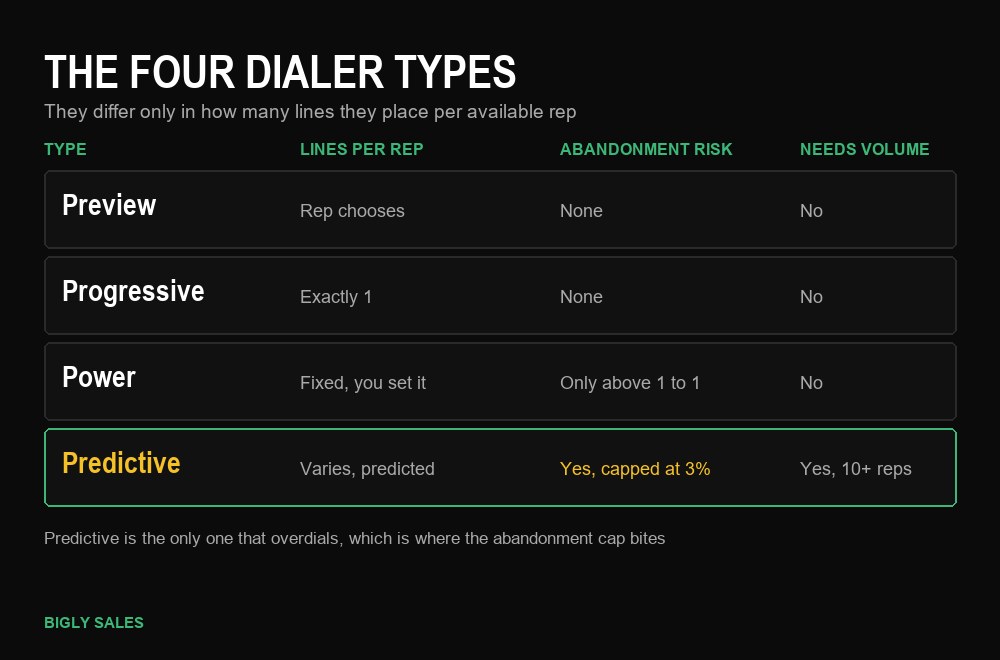
People shop for a predictive dialer when what they need is often one of the other three. The key difference is how much control the rep retains.
| Dialer type | Lines per available rep | Abandoned calls | Rep control | Best for |
|---|---|---|---|---|
| Preview | One, dialed manually | None | Highest | High-value B2B and legal intake, where context matters more than volume |
| Progressive | Exactly one, automatic | None | High | Teams that cannot risk abandoning anyone |
| Power | A fixed ratio you set, often two or three | Low and predictable | Medium | Most small and mid-sized teams |
| Predictive | Variable, decided by the pacing algorithm | Highest, capped at three percent by rule | Lowest | Large teams on high-volume consumer campaigns |
Preview dialer
The rep sees the record first, reads the history, and chooses when to dial. This is the slowest option by a wide margin, but it is the right choice when each conversation is highly valuable or the context is complicated. Common in high-value B2B and in legal intake.
Progressive dialer
Dials automatically as soon as a rep becomes free, strictly one call per rep. No prediction and no overdialing, so no abandoned calls. You give up idle time savings in exchange for never abandoning anyone.
Power dialer
Dials a fixed number of lines per available rep, often two or three, rather than predicting. Simpler than predictive and easier to keep compliant, because the ratio is something you set rather than something an algorithm decides. A reasonable middle setting for most teams.
Predictive dialer
Adjusts the ratio continuously based on live pacing. It achieves the highest talk time per rep per hour and the highest chance of abandoning a call. It needs volume to work, because the prediction is statistical. Point one at a small list with three reps and the algorithm has nothing to learn from.
The pacing math and where it breaks
The core number is your connect rate. If one in five dials reaches a live person, then to keep ten reps talking, the dialer needs roughly fifty calls in flight. That ratio is where productivity comes from and where the risk lives.
Three things break the model in practice.
The connect rate moves during the day. Morning behaves differently from late afternoon, and a list of aged records behaves nothing like fresh inbound leads. An algorithm tuned to last week’s average will overdial the slow hours.
Talk time varies more than averages suggest. A campaign with a mean of four minutes can be made up of ninety-second brush-offs and twelve-minute conversations. Averages hide that spread, and the pacing engine works from averages.
Small teams break the statistics entirely. Prediction needs enough concurrent activity to be meaningful, so a predictive dialer running five seats is usually just an aggressive power dialer with extra steps.
The compliance ceiling on how hard you can dial
This rarely comes up in a demo, but it sets a hard limit on how aggressive your pacing can be.
Under the Federal Trade Commission’s Telemarketing Sales Rule, an outbound campaign relying on the abandoned call safe harbor has to keep abandoned calls at no more than three percent of calls answered by a person, measured per campaign over a 30-day period. The same rule requires that when a person answers, a live representative connects within two seconds of that person’s greeting. Ring the phone for fewer than fifteen seconds or four rings, and you are also outside the safe harbor. The text is in 16 CFR 310.4, and the FTC’s guide to complying with the Telemarketing Sales Rule puts it in plain language. Read one of them before anyone touches the pacing slider.
Read that in reverse, and it tells you the real constraint. A predictive dialer’s whole value is overdialing, and the rule caps overdialing at whatever produces a three percent abandonment rate. Every vendor pitch about maximum agent utilization is bounded by that number, and the setting that hits it is the one you have to be able to evidence.
State rules can be stricter, and consent obligations sit on top of all of these regulations. Our guide to TCPA compliance for AI outbound calling covers the consent side properly.
Skip the pacing math
Hear it on your own list
There is no ratio to tune and nobody to abandon when the agent takes the call itself. We will run it against your leads on a 30-minute screen share, and you can judge the recording rather than the pitch.
30 minutes · screen shared · no obligation
Why predictive dialing gets harder every year
Predictive dialers were designed for a world where an unknown number got answered. That world is mostly gone.
Carriers now score outbound numbers and label suspected spam before the phone rings. High volume dialing from a fresh number is close to a textbook spam signature, which means the more aggressively you dial, the faster your numbers degrade. The dialer then compensates for the falling connect rate by dialing even harder, which degrades the numbers further. That loop is the single most common reason a dialer that worked last quarter stops working this one.
Call authentication is now part of whether you get through at all, which we cover in how STIR SHAKEN affects your outbound answer rates. The short version is that a predictive dialer multiplies your dials. It does nothing about why people are not answering them.
Where an AI voice agent changes the equation
Being clear about the category difference matters here. Bigly Sales does not sell a predictive dialer, so treat this as the argument for a different approach rather than a feature comparison.
Every dialer in the list above exists to solve one constraint, which is that a human has to be free at the exact moment someone answers. Prediction, pacing ratios and abandonment risk all follow from that single fact.
An AI voice agent removes the constraint instead of optimizing around it. The agent takes the call itself, so there is no queue to predict and no reason to abandon anyone. It qualifies against your criteria, and it brings a rep in only when a caller is worth a rep’s time. Your closers stop absorbing voicemails and wrong numbers, which is what the dialer was really trying to reduce.
Two honest caveats. This is a bigger change than swapping dialers, because your script becomes the product, and it needs building properly. And it does not exempt you from anything. Consent, quiet hours, suppression, and record keeping apply exactly as before. What changes is that agent utilization stops being the metric you are managing. You can read how the platform handles that in every Bigly Sales feature.
How to choose
- Fewer than about ten reps on the phone at once, use a power or progressive dialer. Prediction needs volume that a team that size will never generate.
- High-value conversations where context matters, use preview dialing, and accept the lower throughput.
- Large teams on high-volume consumer campaigns are where predictive genuinely earns its cost, provided somebody owns the abandonment number.
- If your problem is falling answer rates rather than rep idle time, a dialer is the wrong purchase. Fix number health and authentication first.
- If the real goal is fewer wasted rep hours rather than more dials per hour, look at removing the human from the first touch instead of pacing around them.
If a term in this piece is unfamiliar, the AI calling glossary defines the dialing, compliance and metrics vocabulary in one place.
Predictive dialer FAQ
What is a predictive dialer?
A predictive dialer is outbound calling software that places more calls than you have available reps and uses live pacing data to estimate when the next rep will be free. Connected calls are routed to whoever is available, which reduces the time reps spend listening to ringing and voicemail.
What is the difference between a predictive dialer and a power dialer?
A power dialer dials a fixed number of lines per available rep, a ratio you set yourself. A predictive dialer adjusts that ratio continuously based on live metrics. Predictive gives more talk time per hour and carries a higher risk of abandoning calls, while power is simpler to keep compliant.
Are predictive dialers legal in the United States?
Yes, with conditions. Campaigns relying on the abandoned call safe harbor in the FTC Telemarketing Sales Rule must keep abandonment at no more than three percent of calls answered by a person over a 30-day period, connect a live representative within two seconds of the greeting, and ring for at least fifteen seconds or four rings. Consent rules and state law apply on top of that.
What is a good abandonment rate for a predictive dialer?
Below three percent, because that is the ceiling in the federal safe harbor rather than a best practice target. Many teams run tighter than that deliberately, since the measurement is per campaign over a rolling period and a bad day can pull the average up.
How many agents do you need for a predictive dialer to work?
Roughly ten or more reps on the phone at the same time before prediction beats a simple ratio. The pacing algorithm is statistical, so with a handful of seats it does not have enough concurrent activity to predict anything useful.
Do predictive dialers hurt your phone number reputation?
They can, and it is the most common reason performance decays. Carriers score outbound numbers, and high volume dialing from unfamiliar numbers resembles spam behavior, so numbers get labeled, answer rates fall, and the dialer compensates by dialing harder. That feedback loop is worth monitoring from day one.
What is the difference between a predictive dialer and an auto dialer?
“Auto dialer” is the umbrella term for any software that dials without a person pressing the numbers. Predictive is one type of auto dialer, alongside preview, progressive, and power dialing. Vendors use auto dialers loosely, so ask which pacing model is actually running.
Can a predictive dialer leave voicemails?
Many detect answering machines and can drop a prerecorded message, but answering machine detection is imperfect and adds delay at the start of a call, which contributes to the dead air people hang up on. Prerecorded messages also carry their own consent requirements.
Is a predictive dialer still worth it in 2026?
For large teams running high-volume consumer campaigns with someone actively managing abandonment and number health, yes. For smaller teams, or where the real problem is that people are not answering rather than that reps are idle, the money is usually better spent on number health, authentication, or removing the human from the first touch entirely.
The bottom line
A predictive dialer is a good answer to a specific question, which is how to keep a large group of reps talking rather than waiting. If that is genuinely your bottleneck and you have the volume to make the prediction work, it earns its cost.
If your reps are idle because nobody is answering, more dials will not fix it and will probably make it worse. And if the underlying goal is to stop spending human hours on calls that were never going to convert, the better move is to change who takes the first call rather than how fast you hand it over. Book a demo if you want to hear what that sounds like on your list.
Ready when you are
See what your list sounds like when AI takes the first call
Bring your own leads. We will show you the qualification logic, the live transfer, and the compliance controls sitting behind it, then tell you honestly whether your call volume justifies it.