

Backchanneling is the set of short acknowledgment signals a listener sends while the other person is still speaking, sounds and words like “mm-hmm,” “right,” “got it,” and “I see.” On a phone call they are the only proof the listener is still there and still following.
Think about the last time you called a company and landed in a phone tree. You knew within three seconds. There was a pause, a flat prompt, and nothing that felt like a person. Now think about a call where the voice on the other end said “mm-hmm” when you paused and “got it” when you finished a thought. That second experience has a name in communication science, and it is the variable that most often separates AI voice agents prospects stay on the line with from the ones they hang up on inside 30 seconds.
This guide defines the term, explains why it changes sales outcomes, and gives you a way to test whether the platform you use or are considering actually does it.
TL;DR
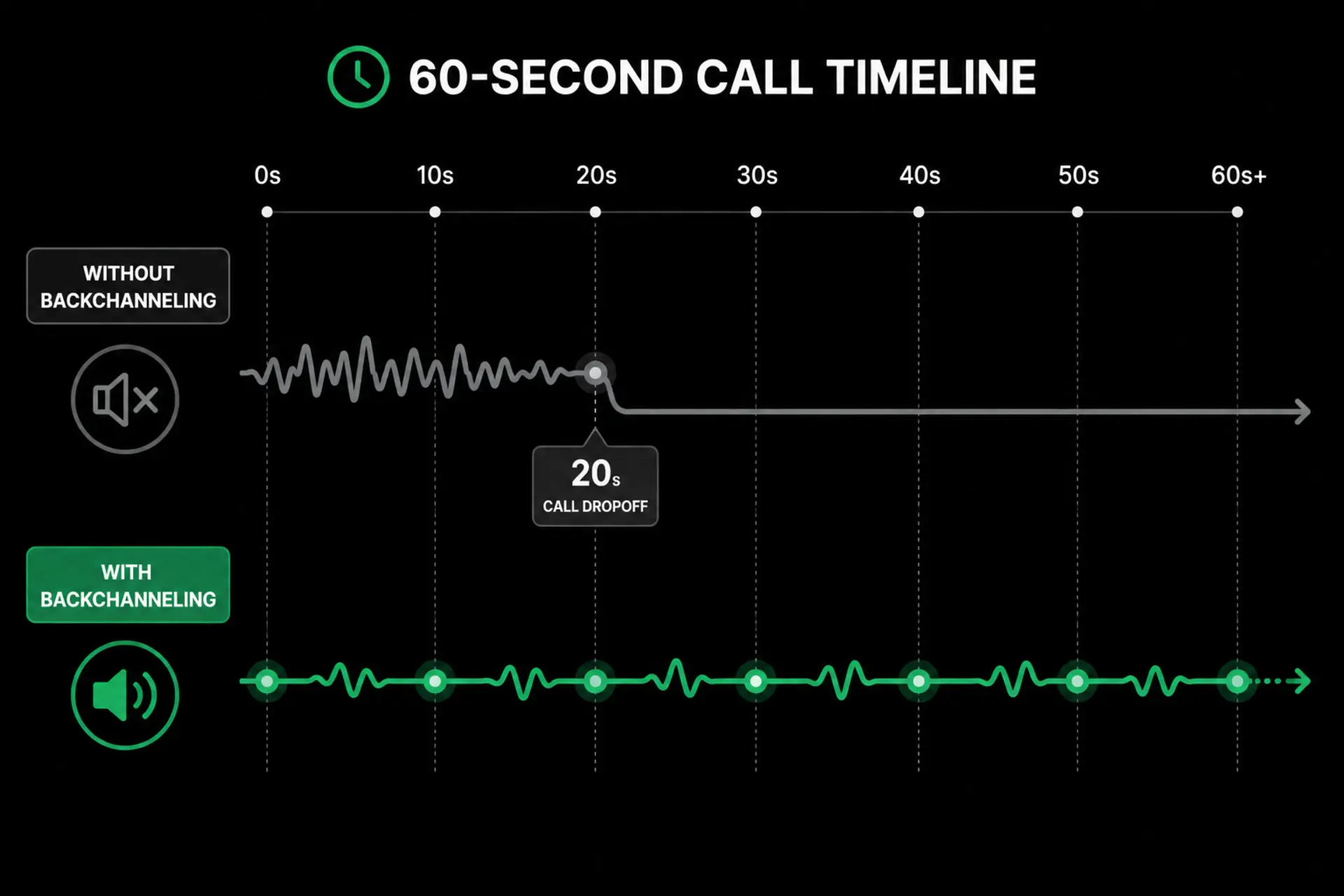
Backchanneling is the “mm-hmm” and “right” a listener makes while you are still talking. Humans do it without thinking. An AI voice agent only does it if the vendor engineered it, and many did not. When it is missing, prospects stop talking, and the damage shows up as hang-ups inside the first 20 seconds and thin qualification notes.
Test it by listening to one complete unedited call recording, not a highlight reel. If the agent is silent for the entire time the prospect speaks, or repeats the same word on a fixed timer, it is not listening. One caveat. Better listening cues will not rescue a bad list or a weak offer, so fix targeting first if that is where your real gap sits.
Key takeaways
- Backchanneling is the small verbal cues a listener gives while someone else speaks, and it signals active listening without taking the floor.
- Humans do it naturally. AI voice agents have to be built to do it, and plenty of platforms skipped that work.
- Without it, calls feel robotic, early hang-up rates climb, and prospects share far less than they would with a human rep.
- Good implementations vary the cue and time it to real pause points instead of firing on a fixed interval.
- Test any platform by listening to one full unedited recording and tracking how long the prospect talks.
- Prospect talk time is the metric to watch. Low talk time is often mistaken for a targeting problem.
- Listening cues improve conversation quality. They do not fix a bad list, a weak offer, or poor follow-up.
Table of contents
- What backchanneling is
- Why backchanneling matters in a sales conversation
- How AI voice agents produce it
- Three ways platforms handle it
- Seven signs your platform does it well
- What calls without it look like
- What to listen for on your next demo
- How to measure it in your own call data
- Backchanneling FAQ
- The bottom line
What backchanneling is
Backchanneling is the set of verbal and nonverbal acknowledgment signals a listener sends while the other person is speaking. In conversation these are sounds and words like “mm-hmm,” “right,” “I see,” “go on,” and “absolutely.” They tell the speaker you are present and following along without interrupting or taking over the turn.
Face to face, the same job is done by nodding, leaning forward, and eye contact. On a phone call none of that exists. The verbal signals are all you have, which is why they carry so much more weight on a call than in a meeting.
The term comes from linguistics research done in the 1970s, which established that listening is not passive. It is a continuous two-way exchange. The person speaking monitors the listener for these micro-signals and adjusts pace, detail, and openness based on what comes back. Strip the signals out and speakers slow down, get uncertain, and often stop.
That is the whole reason this matters for AI. A human rep backchannels because they grew up doing it. An AI agent has to be deliberately built to do it. Many platforms treat a call as a script delivery mechanism rather than a conversation, and the result is a call that works technically and that nobody wants to stay on.
Why backchanneling matters in a sales conversation
A sales call is not a one-way pitch. The rep who wins is usually the one who gets the prospect to open up. When someone raises an objection or explains their situation, they need to feel heard before they will keep going, and that is exactly where the acknowledgment cues do their work.
Without them there are unnatural gaps. The prospect wonders whether the line dropped or whether the system understood them. They stop sharing. When they stop sharing, you lose the information that actually decides the deal. Their timeline, their real budget, and the real objection under the stated one all stay hidden.
With the cues in place, the prospect keeps going and usually says more than they planned to. A well-placed “I see” after someone mentions a pain point can buy three more minutes of context you would never get from a scripted question and answer exchange. That context is the difference between a name on a list and a real opportunity.
There is a trust dimension too. Buyers tolerate AI calls far better than they did two years ago, but only when the call feels like a genuine exchange. If the agent makes them feel like they are talking into a machine, they attach that feeling to your brand rather than to the vendor who built the agent.
How AI voice agents produce it
A capable AI voice agent does not read a script and wait for gaps. It monitors the incoming audio in real time, distinguishes a speaker who is mid-thought from one who has finished a point, and inserts the right cue at the right moment.
Timing matters as much as the word. A “mm-hmm” half a second early sounds like an interruption. Half a second late sounds robotic. The model has to understand speech rhythm and natural pause patterns, not just the words being said.
The stronger systems are trained on real sales conversations rather than generic dialogue. They can tell a prospect trailing off in thought from one who has finished and is waiting. They rotate the signals so the same phrase does not land on every turn. And they know when to say nothing, because a cue at the wrong moment is worse than silence.
None of that is a trivial engineering problem. It takes real-time audio analysis, a trained understanding of turn-taking, and a signal library that matches how people actually speak. Platforms that added it late tend to show the seams quickly, and it shows up in your call data before it shows up in a demo.
Three ways platforms handle it
Almost every AI calling platform falls into one of three buckets. Knowing which one you are hearing on a demo takes about two minutes.
| Approach | How it works | What the prospect hears | Typical result |
|---|---|---|---|
| None | Agent stays silent until the prospect stops speaking, then delivers the next scripted line | Dead air during their turn, then an abrupt pivot | Early hang-ups and one-word answers |
| Fixed interval | A single cue is inserted on a timer or after any detected silence | The same word repeating at oddly regular points | Prospect notices the pattern inside a minute and disengages |
| Real time | Audio is analyzed continuously for pitch, cadence, and clause boundaries, and a varied cue is placed at genuine pause points | A call that sounds like someone is listening | Longer prospect talk time and fuller qualification notes |
Ask any vendor which of the three rows describes their product. The answer is usually clear from how quickly they answer.
Hear the difference
Listen to a full call, not a highlight reel
We will walk you through an unedited recording so you can judge the listening behavior yourself. It takes about 20 minutes.
Seven signs your platform does it well
Not every AI voice platform handles this properly. These are the signs that it was built in rather than bolted on.
- The model was trained on real sales calls, not generic dialogue. Generic training data produces agents that understand words but not rhythm. Ask what the model was trained on before you go further.
- The cues vary. If every acknowledgment is “mm-hmm” in the same tone, the prospect notices inside the first minute.
- The agent does not overdo it. “Right” or “I see” every few words becomes noise. Cues should land at genuine breaks, not on a timer or after any silence at all.
- Prospects keep talking past the first 30 seconds. That is the real test. A high connect-to-conversation ratio with average conversations under a minute points straight at this gap.
- The vendor can show recordings across call types, including objection-heavy ones, not only the calls that went well.
- The agent responds to content. After a prospect finishes a point, it references what was said instead of jumping to the next scripted question.
- The vendor can tell you where the logic sits in the architecture and whether it runs in real time or on fixed intervals. A vague answer here is itself an answer.
Bigly Sales is our platform, founded in 2020 and headquartered in the Miami-Ft. Lauderdale area, serving over 30 enterprise clients on outbound campaigns. We built the listening side of the call in from the start rather than adding it later, because CEO Tom Ryan built the product around the view that performance at scale depends on how the agent handles listening, not only talking. The honest caveat is that no amount of conversational polish rescues a poorly targeted list.
What calls without it look like
The pattern on calls with weak listening cues is consistent enough to diagnose from the metrics alone.
Hang-up rates spike in the first 20 seconds. The prospect hears a pause that does not feel right, assumes it is a low-grade automated system, and disconnects before the agent asks a single question. Prospects who do stay describe the call as weird or robotic, which is a complaint about rhythm rather than voice quality. The voice can sound perfectly human while the exchange does not.
Qualification data comes back thin. Prospects answer the minimum and stop. You end up with a list of contacts you reached rather than a list of qualified leads, and the CRM fills up while the pipeline stays empty.
Over time this reaches your brand. Prospects who have a strange AI call tell colleagues, and in B2B sales, where buying committees overlap with peer networks, that travels quickly. It is also worth remembering that the call still carries the same legal obligations as any other outbound call, including disclosure when a prospect asks whether they are speaking with an AI. The FTC guidance on the Telemarketing Sales Rule is the primary source to work from, and our notes on TCPA compliant AI calling platforms cover the controls to ask vendors about.
What to listen for on your next demo
Before you commit to an AI calling platform, ask for one full recorded call rather than an edited reel. Four things tell you almost everything.
- Does the agent make any acknowledgment while the prospect speaks, or is it silent through their entire turn? Silence during the prospect’s turn means the behavior was never built.
- When the prospect finishes a point, does the agent respond to what was said, or pivot to the next scripted question regardless? An agent that ignores content is processing, not listening.
- Does it feel like a dialogue or a survey? Questions in sequence with no verbal texture between them means a call script with a voice wrapped around it.
- Ask how the model was trained and on what data, and where the logic sits in the stack. The quality of that answer says a lot about how seriously the team took conversation design.
If you are still building your shortlist, our roundup of the best AI cold calling software is a reasonable place to compare the wider field.
How to measure it in your own call data
You do not need a lab to evaluate this. Three numbers already in your call reports will tell you where you stand.
Prospect talk time as a share of the call
Pull the average across at least 200 completed calls. If the agent is talking for most of the call, the conversation is a monologue with pauses. Rising prospect talk time after a script change is the cleanest evidence that the listening behavior improved.
Hang-ups in the first 20 seconds
Track this separately from overall drop-off. Early hang-ups happen before the offer has been heard, so they are almost never an offer problem. They are a rhythm problem.
Fields captured per completed conversation
Count how many qualification fields come back filled on an average completed call. Thin capture with high connect rates points at prospects who answered the minimum and left. Compare that number against the same fields captured by a human rep on the same segment, since that is the realistic ceiling.
Run these three before and after any change to the agent, and give each version at least two weeks so the sample is large enough to trust.
Backchanneling FAQ
What is backchanneling in communication?
Backchanneling is the verbal and nonverbal signals a listener gives while someone else is speaking. In spoken conversation those signals include phrases like “mm-hmm,” “got it,” “I see,” and “right.” They tell the speaker that the listener is present and following along without interrupting or taking the floor. Linguistics researchers identified the behavior in the 1970s as a core feature of natural conversation rather than an optional politeness.
Why does backchanneling matter on phone calls?
On a phone call the listener cannot use eye contact, nodding, or posture to show engagement, so verbal cues become the only available signal. Without them, short silences read as dead air or a dropped line, and the speaker loses confidence in the exchange. The effect is amplified on outbound sales calls, where the prospect starts out skeptical and is looking for a reason to end the call.
How do I know if my AI calling tool has it?
Ask the vendor for one full recorded call rather than an edited highlight. Listen for whether the agent acknowledges the prospect mid-turn and whether the phrases vary or repeat. Count how long the prospect speaks without stopping. If the prospect pauses after each sentence as though waiting for the system to catch up, the cues are either missing or badly timed. Then check the same behavior on an objection-heavy call.
What does bad backchanneling sound like?
It fails in two ways. The first is total silence, where the agent says nothing while the prospect speaks and only responds once they stop, which turns the call into a voice survey. The second is mechanical repetition, where the same word appears at regular intervals regardless of what was said, which sounds programmed within about a minute. Both patterns raise early hang-up rates and reduce how much prospects volunteer.
Does Bigly Sales use backchanneling?
Yes. Bigly Sales is our own platform, founded in 2020 and headquartered in the Miami-Ft. Lauderdale area, and the listening behavior was built into the AI voice agent from the start rather than added later. The agent analyzes audio in real time and places varied cues at natural conversation points. Request a demo and ask for an unedited recording so you can judge it against your own standard.
How does an AI know when to backchannel?
Capable agents analyze the incoming audio stream continuously and look for patterns that separate a speaker mid-thought from one trailing off or finishing a point. Pitch, cadence, and pause length all feed that decision. When the model detects a continuation, it inserts a brief acknowledgment. When it detects a natural endpoint, it waits and then answers more fully instead of talking over the prospect.
Can backchanneling be trained or customized?
Platforms trained on large sets of real sales conversations generally sound more natural than those trained on generic dialogue. Some let you tune the frequency or the specific phrases used, which helps match a brand tone or a vertical. Ask whether the model saw industry-specific call data, since the patterns differ noticeably across insurance, real estate, and financial services conversations.
What is the difference between backchanneling and interrupting?
Backchanneling happens while the other person still holds the floor and does not take it from them. An interruption cuts the speaker off and starts a new turn. A “mm-hmm” placed in a natural breath or at a clause boundary is backchanneling. The identical phrase delivered over the top of a running sentence is an interruption, and it damages rapport rather than building it.
Does backchanneling improve conversion rates?
It improves conversation quality, which is a leading indicator rather than a guarantee. Calls where prospects speak longer and volunteer more context tend to produce better qualified opportunities, and these cues are a primary driver of prospect talk time because they remove the uncertainty that makes people go quiet. Conversion still depends on offer, targeting, and follow-up, so treat this as one input among several.
What should I listen for on an AI call demo?
Pay less attention to what the agent says and more to how the prospect responds. A strong demo shows a prospect speaking in full sentences, volunteering context beyond the question asked, and not pausing awkwardly to check whether anyone is there. Listen for varied acknowledgments, natural timing, and a conversation that builds toward a discovery outcome instead of marching through a checklist of scripted questions.
The bottom line
Backchanneling is a small feature with an outsized effect on whether prospects stay on the phone. It is also one of the few things you can evaluate honestly in an afternoon, because it is audible in any unedited recording and measurable in call data you already collect.
Do not treat it as a cure-all. Better listening cues raise talk time and thicken your qualification notes. They will not fix a list that was never a fit or an offer that does not land. Get the targeting right first, then judge platforms on how they handle the listening side of the call.
Free trial
Test the listening on your own calls
Run a real segment of your list and hear how the agent handles pauses and objections. Setup takes about an afternoon.