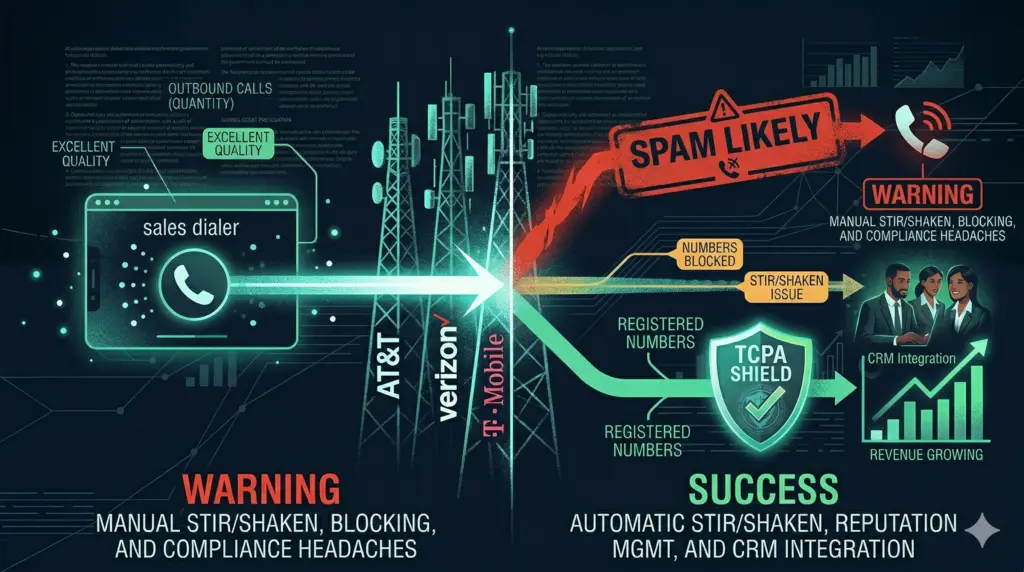


Carrier call labeling is the process a phone network uses to decide whether your outbound call rings normally, arrives marked as “Spam Likely,” or never connects at all. It happens on the receiving side, in the milliseconds before the screen lights up, and it judges behavior rather than intent.
Your outbound team is dialing. The numbers are going out. The activity metrics look healthy. The conversations are not happening at the rate they should.
Most sales managers respond by adjusting the wrong variables. They rewrite scripts, move dialing windows, buy new lead sources, and hire different reps. None of it moves the number, because the decision that matters was already made upstream of the ring.
TL;DR
Three carrier analytics companies decide whether your outbound calls get through. Hiya scores traffic for AT&T, TNS scores it for Verizon, and First Orion scores it for T-Mobile. Each keeps its own record, so a single phone number holds three separate reputation scores that can disagree with each other.
Those scores read behavior, not intent. Answer rates below 15 to 20 percent, connections that end under 30 seconds, and more than roughly 150 dials per day on one line all look like robocalling to carrier algorithms. A legitimate business that hits those thresholds gets the same label as a bad actor.
If you place fewer than a few hundred calls a week, this is not your bottleneck. Managed number infrastructure will not pay for itself at that volume, and your answer rate problem is more likely list quality or timing.
Key takeaways
- A phone number has three reputations, one per major carrier, and they are scored independently.
- STIR/SHAKEN attestation proves who you are. It does not protect you from a behavior-based spam label.
- Low answer rates, short call durations, and high per-number velocity are the three signals that flag numbers fastest.
- Labeling compounds. A flagged number earns fewer answers, which strengthens the flag, which earns fewer answers still.
- Buying fresh numbers without changing dialing behavior reproduces the same reputation profile within weeks.
- Complaints from calls placed outside legal dialing windows feed straight into the same carrier scoring engines, so compliance failures show up as answer rate failures.
- Managed infrastructure moves typical answer rates from the 10 to 20 percent range toward 40 to 65 percent, but only for teams with real call volume.
Table of contents
- What carrier call labeling is
- How the carrier network evaluates every call you place
- The three carrier gatekeepers: Hiya, TNS, First Orion
- 7 signals that get your numbers labeled
- Legacy dialing versus adaptive dialing
- What happens when your number gets flagged
- How to audit your number reputation in an afternoon
- How to fix a labeled number
- Why compliance and reputation are the same problem
- Building an answer rate your revenue can rely on
- Carrier labeling FAQ
- The bottom line
What carrier call labeling is
Carrier call labeling is a real-time scoring decision made by the recipient’s phone network, which either delivers your call cleanly, attaches a warning such as “Spam Risk” or “Scam Likely,” or blocks the call before it ever rings. The score behind that decision is built from historical calling patterns, consumer feedback, and network data attached to the number you dialed from.
Two things about this definition matter operationally. First, the decision belongs to the receiving carrier, not to your telephony provider, so your vendor cannot promise you clean delivery. Second, the decision is made about the number, not about your company. Your brand reputation, your license, and your intentions are invisible to the scoring engine.
That is why an insurance agency with a spotless record and a fraudulent operation running the same dialing pattern can end up wearing the same label on the same screen.
How the carrier network evaluates every call you place
Every outbound call placed in the United States travels through a chain of telecommunications infrastructure before it reaches a handset. At the originating end, your telephony provider signs the call with a digital certificate under STIR/SHAKEN, the caller authentication framework established by the Pallone-Thune TRACED Act. That certificate assigns an attestation level which travels with the call.
At the terminating end, the recipient’s carrier receives the call, verifies the attestation, and passes it through an analytics engine before deciding how to handle it. The engine does not simply confirm the call is authentic. It evaluates a behavioral profile assembled from calling history, complaint signals, and live network data, then returns one of three outcomes: deliver clean, label, or block.
All of this happens before the phone rings and before any human decides whether to answer. By the time your prospect looks at the screen, the context in which they receive you has already been chosen for them.
The three attestation levels
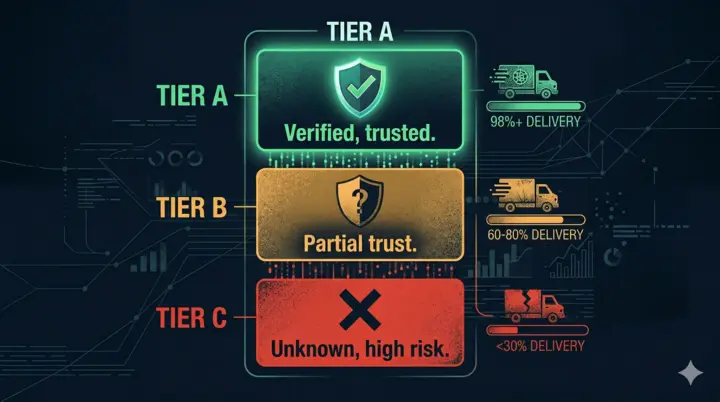
Attestation is the foundation of the evaluation. Under STIR/SHAKEN, calls receive one of three levels. Full attestation at the A level means the originating carrier verified that the number belongs to the business placing the call and that the business is authorized to use it. Partial attestation at the B level means that provider knows the customer but cannot confirm authorization for that specific number. Gateway attestation at the C level means it has no established relationship with the calling party at all.
The TNS 2026 Robocall Investigation Report states that in 2025, 85 percent of voice traffic between Tier-1 carriers was signed and verified under STIR/SHAKEN, and 93 percent of that signed traffic held A-level attestation. Traffic between smaller regional providers lags badly, with only 17.5 percent signed. Depending on who supplies your numbers, a meaningful share of your calls may be crossing the network unauthenticated, which sets them up for labeling before anyone evaluates the content.
Attestation is only the first layer. A call with full A-level attestation can still be labeled, because STIR/SHAKEN verifies identity and says nothing about behavior. Behavior is scored separately, by the three companies below.
The three carrier gatekeepers: Hiya, TNS, First Orion
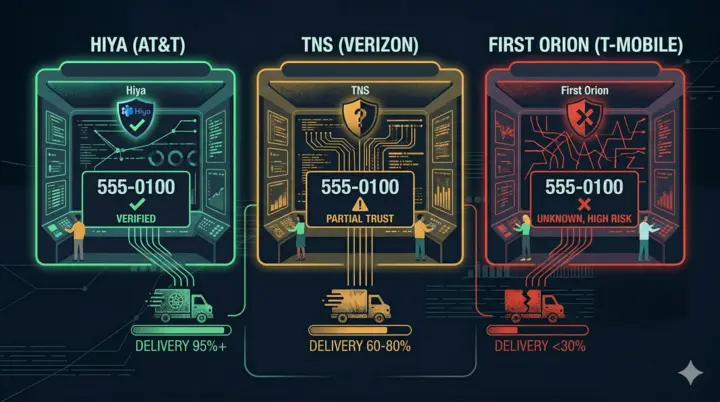
AT&T, T-Mobile, and Verizon do not build their spam detection in house. They contract with specialized analytics firms that monitor patterns across billions of calls, build reputation scores for phone numbers, and make labeling recommendations applied in real time. Those three firms are the actual gatekeepers of your outbound program.
| Provider | Carrier served | Consumer products | What it weighs most |
|---|---|---|---|
| Hiya | AT&T, plus a large share of Android handsets | Hiya app, device-level protection | Volume per number, answer rate, duration patterns, in-app user reports |
| TNS | Verizon | Call Guardian | Cross-network traffic modeling, complaint density, proprietary thresholds |
| First Orion | T-Mobile | PrivacyStar, Call Protect, branded calling | Business verification data alongside behavioral signals |
Hiya assigns reputation scores based on call volume per number, answer rate, duration patterns, and complaint signals from its app user base. When a number crosses its threshold, a label such as “Spam Risk” appears on AT&T screens before the recipient decides anything.
TNS runs Call Guardian for Verizon and publishes an annual Robocall Investigation Report that remains one of the better public data sources on labeling trends. It evaluates similar signals to Hiya but applies its own thresholds and scoring method.
First Orion powers T-Mobile detection and takes a slightly different approach by folding business verification data into the behavioral picture. It also manages the branded calling infrastructure that lets verified businesses display a company name, logo, and reason for calling, which lifts answer rates for the businesses that qualify.
Car dealerships that call back internet leads feel this first, and our dealership AI calling page shows how those callbacks run with TCPA and DNC checks before the dial.
The structural implication is the one most teams miss. A number’s reputation is not one score. It is three scores, held by three organizations, computed from three different data sets. A number can be clean on one carrier and labeled on another, so an outbound team reporting a single blended answer rate is flying blind.
7 signals that get your numbers labeled
Each analytics provider weights these differently, but the same seven behaviors show up in all three models.
- High velocity on a single line. Concentrating 200 to 500 or more dials per day on one number is the fastest way to trigger a flag. Managed operations typically cap a line at roughly 75 to 150 per day.
- Low answer rates. Sustained answer rates below 15 to 20 percent read as evidence that recipients are actively avoiding the number.
- Very short call durations. A consistent pattern of connections ending under 30 seconds reinforces the unwanted-calling signal.
- Missing or weak attestation. Calls arriving with B or C level attestation start the evaluation with a handicap.
- Consumer complaints. Reports filed through spam apps or directly with a network accelerate flagging faster than any other input.
- Number age and rotation churn. Brand new lines pushed straight into heavy rotation attract suspicion from the first day of use.
- Geographic mismatch. A single area code dialing nationally at volume looks different from a distributed local presence pool, and the models notice.
None of these signals asks what your business does or whether the person on the other end asked to hear from you. They are pattern tests, and legitimate outbound programs fail them routinely.
Legacy dialing versus adaptive dialing
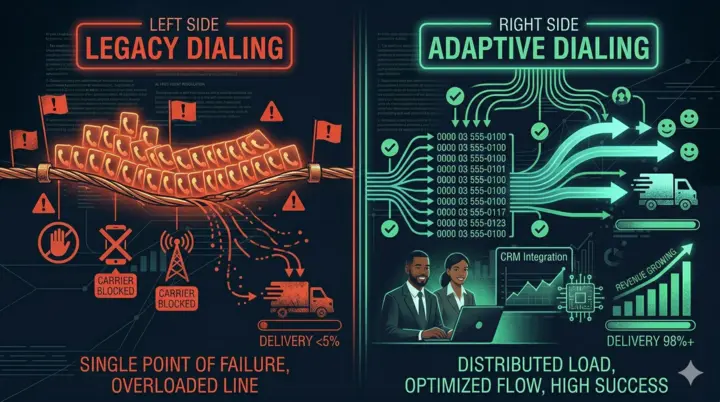
The behaviors that trigger labeling are not arbitrary. They are precisely the behaviors of legacy dialing systems, which were designed when carrier filtering was minimal and concentrated high-volume dialing was a reasonable strategy. The contrast below explains why two operations with identical lead quality and identical products can sit 30 points apart on answer rate.
| Dimension | Legacy dialing | Adaptive dialing |
|---|---|---|
| Number pool | Small, shared, or recycled | Large, dedicated, registered |
| Per-number velocity | 200 to 500 or more calls per day | Capped inside published thresholds, roughly 75 to 150 per day |
| Number registration | None, or self-registered | Whitelisted with all three analytics providers |
| STIR/SHAKEN attestation | B or C level, inconsistent | A level, consistent on every call |
| Spam monitoring | Reactive, after the damage lands | Continuous number health scoring |
| Number replacement | Manual, after complaints surface | Automated, before answer rates degrade |
| Local presence | None or static | Dynamic, matched to recipient geography |
| Duration management | No controls | Velocity rules prevent ultra-short call spikes |
| Reputation tracking | Untracked | Monitored separately across Hiya, TNS, First Orion |
| Typical answer rate | 10 to 20 percent | 40 to 65 percent with managed infrastructure |
The gap between these two columns is not a technology gap. It is an infrastructure management gap. Legacy dialing concentrates activity on a few lines without regard for the signals that pattern sends. Adaptive dialing distributes volume across a large managed pool so that, to the scoring models, the traffic looks like measured legitimate communication.
Branded calling adds a further layer on top of adaptive dialing. When a call arrives with a verified business name, logo, and reason for calling on screen, the recipient’s decision shifts from “I do not know this number” to “I can see who this is.” The lift is real, though it requires business verification rather than a caller ID setting.
Answer rate audit
See how your numbers score before you dial again
We will pull your reputation across all three analytics networks and show you which lines are already degrading. The review takes about 20 minutes.
What happens when your number gets flagged
Labeling is usually invisible to the operation until the damage is substantial. Most call center platforms report total dials and total conversations. They do not break answer rate down by carrier, and they do not raise an alarm the moment a line starts accumulating negative signals.
The pattern is consistent. Answer rates decline gradually and get attributed internally to seasonality, lead quality, or timing. By the time the decline is undeniable, the responsible numbers may have been labeled for weeks. Every dial placed during that window added to the negative signal instead of adding to revenue.
Then the damage compounds. A labeled number produces more unanswered calls. More unanswered calls lower the answer rate. A lower answer rate strengthens the spam signal. The model flags the number harder. That loop is why labeled lines rarely recover and why swapping in fresh numbers fails as a standalone fix.
New numbers dropped into the same high-velocity, unregistered environment develop the same profile on the same timeline. In some cases they begin flagging within hours, because number age and day-one calling behavior are themselves inputs to the score.
How to audit your number reputation in an afternoon
You do not need a vendor to find out whether this is your problem. Work through the following in order.
- Segment answer rate by destination carrier. Export the last 30 days of call detail records and group answer rate by the recipient’s network. A 12 point spread between two of them is the clearest available proof that labeling, not lead quality, is driving the decline.
- Rank your lines by daily dial count. Any number exceeding roughly 150 dials in a day is running outside the range managed operations hold to.
- Check duration distribution. If more than half of your connected calls end under 30 seconds, you are feeding the exact signal the models look for.
- Test your attestation level. Ask your telephony provider to confirm in writing what attestation your traffic receives. If the answer is not A level on every call, that is a fixable gap.
- Call your own numbers. Place a test call from each line to handsets on all three networks and photograph the screen. This is crude and it works.
- Look up each line with the free reputation checkers. Hiya, TNS, and First Orion all publish lookup and remediation portals for businesses.
An afternoon of this usually tells you whether you have a labeling problem, a list problem, or a script problem. Teams frequently discover it is two of the three.
How to fix a labeled number
Remediation follows a fixed order, and skipping steps wastes the effort.
Step 1: Stop dialing from the flagged line
Every additional call from a labeled number deepens the score. Pull it out of rotation the day you identify it rather than letting it finish the campaign.
Step 2: File remediation requests with all three providers
Each analytics firm maintains a business portal for disputing a label. File with all three even if the number appears clean on two of them, because scores drift independently and a pending dispute is cheap.
Step 3: Fix the behavior that caused it
Cap per-line velocity, register the replacement numbers, spread volume across a pool large enough to hold each line inside threshold, and enforce dialing windows. If the underlying pattern does not change, the replacement lines will follow the original ones down.
Step 4: Expect partial recovery at best
Scores improve slowly when a number demonstrates sustained healthy behavior, but most labeled lines never return to their original performance. Plan for replacement, and treat remediation as the fallback rather than the strategy. Our glossary entry on AI calling terminology covers the related concepts if you are briefing a team on this for the first time.
Why compliance and reputation are the same problem
There is a feedback loop between TCPA compliance and number reputation that most outbound operations underestimate.
Calls placed outside permitted dialing windows, before 8 AM or after 9 PM in the recipient’s local time zone, generate higher complaint and rejection rates. Those complaints feed directly into the same carrier analytics engines that decide labeling. A campaign that violates a state calling restriction does not only create legal exposure. It actively degrades the number health that determines your answer rates for months afterward.
The Federal Trade Commission’s guidance on complying with the Telemarketing Sales Rule covers the registry synchronization and disclosure obligations that sit alongside the TCPA. Teams evaluating vendors on this dimension should read our breakdown of TCPA compliant AI calling platforms before signing anything.
The practical version is simple. An outbound program that enforces federal and state rules automatically produces fewer complaints, which produces slower reputation decay, which produces higher answer rates on the contacts who genuinely want to hear from you. A program that relies on manual checks produces the opposite, and the models notice within weeks.
Building an answer rate your revenue can rely on
The path from poor answer rates to strong ones is not about better leads or better scripts. It is about sending the right signals to the scoring engines and maintaining that posture as their models update.
Operations reaching 40 to 65 percent answer rates in 2026 run dedicated registered number pools inside published velocity thresholds, hold A-level attestation on every call, monitor reputation separately across Hiya, TNS, and First Orion, replace lines before they flag rather than after, and enforce consent and window rules at the system level so complaints never accumulate in the first place.
Bigly Sales manages each of those components before a single call is placed. Number acquisition, registration, local presence deployment, velocity management, spam monitoring, and automated line lifecycle management are the foundation of how the platform runs rather than optional settings. If you want the narrower version of this topic, our guide to fixing Spam Likely on sales calls goes deeper on remediation specifically.
One honest caveat. This is infrastructure built for teams placing real volume across regulated verticals. If you dial a few dozen prospects a week, or your list is unconsented, none of it will help you and you should fix those inputs first.
Carrier labeling FAQ
Why do my calls show as Spam Likely when my business is legitimate?
Analytics engines evaluate behavior, not intent. A legitimate business that concentrates high volume on a few lines, produces low answer rates, or dials without A-level attestation triggers the same signals as an actual robocaller. The model cannot read good intentions, only data. The response is technical rather than creative: registered numbers, whitelisting, controlled per-line velocity, and reputation monitoring. Rewriting the script or shifting dial times will not clear a label that behavioral data created.
What is the difference between Hiya, TNS, and First Orion?
They are the three analytics companies providing spam detection for AT&T, Verizon, and T-Mobile respectively. Each maintains an independent reputation database built from behavioral signals and consumer feedback on its own network. A phone number therefore has three reputations, not one, and they routinely disagree. An operation that does not segment answer rate by destination network cannot tell which of the three is driving a decline or where to file remediation.
Does A-level STIR/SHAKEN attestation prevent spam labels?
A-level attestation lowers the risk substantially but does not eliminate it. STIR/SHAKEN verifies that the number belongs to the business placing the call and that the business is authorized to use it. Behavioral scoring runs separately and afterward. A properly attested number still earns a label if it dials at high velocity or produces low answer rates. Treat attestation as a necessary foundation rather than a complete solution.
How long does a labeled number take to recover?
Recovery is slow and unreliable. Scores improve gradually when a number shows sustained healthy answer rates, appropriate velocity, and no complaints, but in practice most labeled numbers never return to their pre-flag performance. The operationally sound approach is proactive replacement before a line is fully labeled. File remediation requests anyway, since they cost nothing, but do not build your quarter around them succeeding.
What is adaptive dialing?
Adaptive dialing distributes outbound volume across a large managed pool of dedicated, registered numbers so that each line stays inside carrier velocity thresholds. It adds continuous reputation monitoring, automated number lifecycle management, A-level attestation on every call, and local presence matching. Legacy dialing concentrates volume on small, often shared pools with no registration or monitoring. The behavioral difference between the two is exactly what the scoring models are built to detect.
How many calls per day can one number safely place?
There is no published universal limit, because each analytics provider sets its own thresholds and adjusts them. As a working rule, managed operations hold a single line to roughly 75 to 150 dials per day and watch answer rate as the real constraint. Numbers pushing 200 to 500 or more per day are the ones that flag first. The safer framing is to size your number pool to your volume rather than hunting for a number you can push to its limit.
Will buying new phone numbers fix my answer rate?
Not on its own. New lines introduced into an unchanged dialing environment develop the same reputation profile on the same timeline, and sometimes faster, because number age and day-one behavior are scored inputs. Replacing numbers works only as part of a change to velocity, registration, attestation, and complaint control. Teams that rotate numbers quarterly without fixing the pattern are paying a subscription to repeat the same failure.
Does branded calling improve answer rates?
Yes, and it is one of the few levers that improves the recipient’s decision rather than just avoiding a penalty. Branded calling displays your verified business name, logo, and reason for calling on the handset. First Orion operates it for T-Mobile and Hiya offers comparable programs. It requires business verification with the provider, it carries a per-number cost, and it does not override a bad behavioral score, so treat it as an addition to healthy infrastructure rather than a substitute.
Is this a problem for inbound or only outbound?
Labeling applies to outbound traffic, since it scores the number placing the call. It still reaches inbound-heavy businesses through callbacks, appointment confirmations, and missed-call recovery, all of which are outbound events placed from your lines. Any team that returns calls at volume from a small set of numbers can accumulate a label without ever running a prospecting campaign.
The bottom line
Answer rate is an infrastructure metric before it is a sales metric. Three carrier analytics companies score your numbers on behavior, they score them separately, and they do it before your prospect has any chance to evaluate what you were calling about. Scripts and lead sources cannot reach that decision.
Fix the inputs the models actually read. Distribute volume across registered lines, hold attestation at A level, watch reputation network by network, retire lines before they flag, and enforce dialing rules automatically so complaints never start the spiral. Do that and your answer rate starts reflecting your lead quality, which is the only thing you were trying to measure in the first place.
Managed infrastructure
Stop losing conversations to a label
Registered numbers, A-level attestation, and reputation monitoring across all three analytics networks, handled for you. Most teams are live inside two weeks.