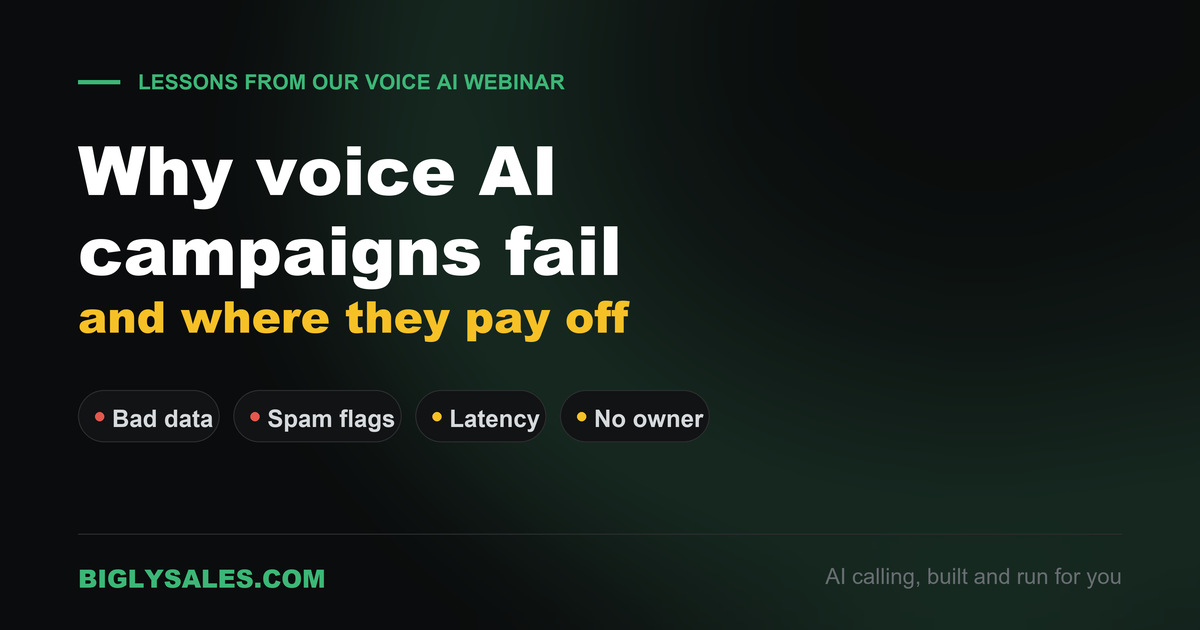


Voice AI campaigns fail for four reasons, and the AI itself is rarely the main one.
On October 21 we ran a live webinar called The State of Voice AI Calls in 2026. Our CEO Tom Ryan answered questions from our account manager Heather for about thirty minutes.
This post is the useful part of that session. What broke campaigns, where AI calling makes money and the questions Tom would ask before buying from anyone, including us.
TL;DR
Most voice AI calling campaigns fail because of bad lead data, spam flagged phone numbers, slow replies or no internal owner. Tom Ryan puts the ideal reply time at one second or less and says three to four seconds can push conversions close to zero. The quickest returns come from calling warm leads fast and following up on people who already showed interest. If you plan to call old purchased lists with no consent, AI will not fix that and the TCPA risk runs $500 to $1,500 per call.
Key Takeaways
- Speech to speech AI removed most of the old problems with noise, short answers and interruptions.
- Bad data is the number one reason campaigns fail. If there is no intent, do not call it.
- A number labeled spam gets answered 50 to 100 times less, in Tom’s experience.
- Keep reply time at one second or less. Past two seconds, calls start falling apart.
- Every program needs one owner who knows cost per lead and cost per sale.
- Speed to lead, old leads, unfinished applications, abandoned carts, failed payments and repeat buyers pay off first.
- Ask any vendor who owns the AI and who owns the phone lines.
Table of contents
- What changed in voice AI this year
- Why voice AI campaigns fail
- Blocker 1 is bad data
- Blocker 2 is spam flags and broken telephony
- Blocker 3 is latency
- Blocker 4 is nobody owns the program
- Where voice AI pays off
- Why consent and the TCPA matter so much
- Questions to ask a voice AI vendor
- A quick checklist before your next campaign
- Voice AI campaigns FAQ
- The bottom line
What changed in voice AI this year
Speech to speech AI is the big change. It listens to the raw audio of the call and answers in audio, with no text step in between.
Until a few months ago most AI calls worked in three steps. Speech became text. The text went to a language model. The reply was turned back into speech.
All of that had to happen in under a second. If any step ran slow, the person on the phone felt the pause.
The transcription step caused most of the trouble. Heather said her name and the transcript read hot leather. A buyer said condo and the system heard avocado.
If you said a whole sentence, it would typically get it right, but if you said just a word or two, it would often times get it wrong. That all goes away with speech to speech.
Tom Ryan, CEO of Bigly Sales
Noise was the other problem. Older systems guessed someone was talking from the volume and length of a sound. A car horn could pass for a voice.
Tom tested the new setup in a stadium box during a college football game. The crowd got so loud the people next to him could not hear each other. The AI kept the conversation going.
So the AI is in a much better place. That makes the other four problems more important, not less.
Why voice AI campaigns fail
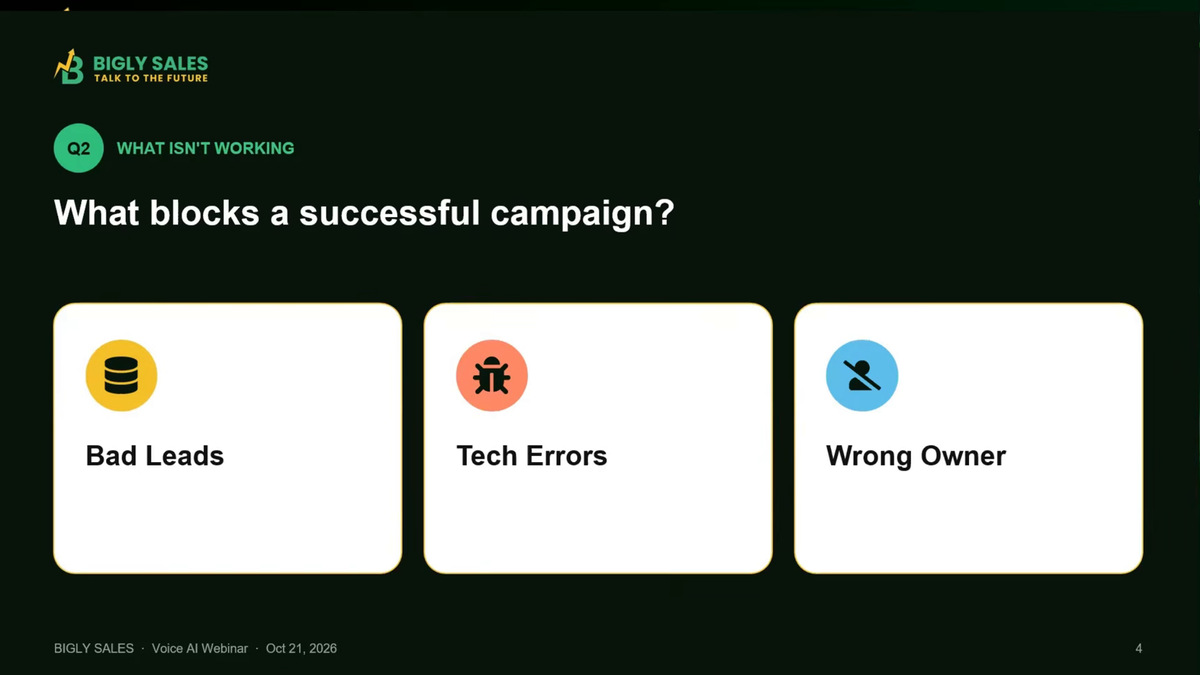
Here is the slide we used in the webinar. Bad leads, tech errors and the wrong owner. We split tech errors in two below, because latency deserves its own section.
| Blocker | What you see | What to check first |
|---|---|---|
| Bad data | Wrong names, wrong numbers, no interest | Where each list came from and how old it is |
| Spam flags | Answer rates collapse on some numbers | How your numbers are labeled at each carrier |
| Latency | People ask if anyone is there and hang up | Reply time at your real call volume |
| No owner | Nobody can say which campaign makes money | Cost per lead and cost per sale by data source |
Blocker 1 is bad data
This is the number one issue by a landslide, according to Tom.
The story usually goes like this. A company has collected fifty million records over thirty years. They want the AI to call all of them and see who bites.
If there is no intent on the data, don’t call it. Don’t just call the phone book.
Tom Ryan, CEO of Bigly Sales
Old lists are full of numbers that changed hands. The AI asks for Heather and gets someone who has never heard of her. It calls about car insurance and reaches a person with no car.
Nobody can sell to that person. A better voice will not change it.
Tom shared one client story. They had several lead sources, and one of them converted at almost nothing. They switched it off and kept their Facebook, Google and website leads. Their conversion rate went to something like 30%.
Same AI. Same script. Different data.
Blocker 2 is spam flags and broken telephony
Outbound AI calling needs two things to work. The AI and the phone lines.
When a carrier shows your call as spam, people stop answering. Tom put it plainly.
If something is showing up as spam, the answer rate is 50 to 100 times lower than if it doesn’t come up as spam.
Tom Ryan, CEO of Bigly Sales
That number comes from what Tom has seen across our own calling, not from a published study. But anyone who has watched a number get labeled knows the drop is brutal.
Other things break too. Phone lines that pass bad data. Servers that get overloaded when call volume spikes. If the vendor does not manage that load, quality falls exactly when you scale.
If your numbers are already flagged, start with our guide on how to fix Spam Likely on sales calls.
Blocker 3 is latency
Latency is the pause between when a person stops talking and when the AI answers. Tom gave three simple thresholds.
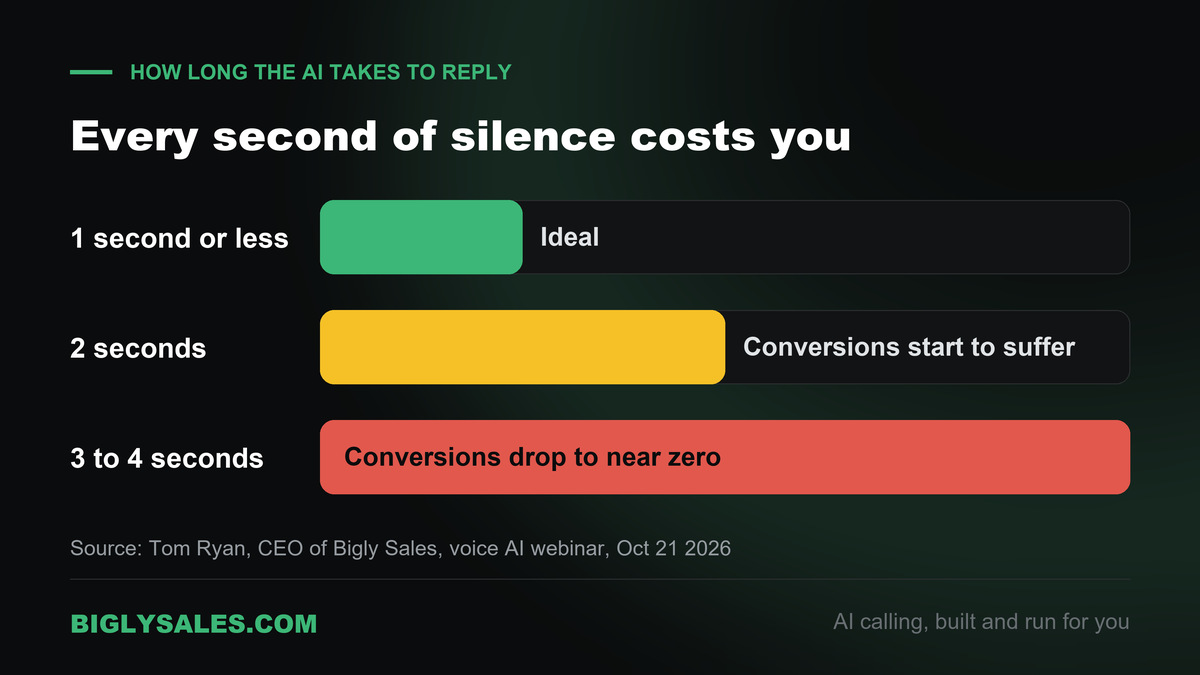
- One second or less. Ideal.
- Two seconds. Conversions start to suffer.
- Three to four seconds. Expect conversions to drop to almost zero.
The reason is simple. After about two seconds people say hello, can you hear me. That interruption restarts the AI. Then it happens again.
The call never gets going, the person gets annoyed and hangs up.
One more warning from Tom. The demo is the cleanest call you will ever hear. It is easier to call one person than a hundred at once, and latency usually climbs as volume goes up. Ask how fast replies are at your real volume.
Free setup call
See your own calls answered in one second
Bigly Sales runs the AI and the phone lines for you, so you have one team to call when something needs fixing. A free setup call shows how it would work with your leads and script.
Blocker 4 is nobody owns the program
Tom compares a voice AI program to picking stocks. You can spend ten minutes or ten hours on it. You cannot spend zero and expect it to work.
Here is what goes wrong. The owner says yes to AI calling and hands it down. It gets passed again and again until it lands with someone who has never heard the sales script.
That person does not know the cost per lead, the cost to win a customer or the profit on a sale. So nobody can tell what is working.
It is simple, it is not easy. It is not rocket science, but you have to look at it and you have to know your numbers.
Tom Ryan, CEO of Bigly Sales
The right owner is usually a VP of sales, a VP of marketing or a sales director. Someone who wants the program to work and spends at least five or ten minutes a day on it.
The two things Tom looks at first are the data source and the age of the data. Segment every campaign by both.
Where voice AI pays off
All six places below have one thing in common. The person already showed interest. You are not buying a single new lead.
1. Speed to lead
This is the first thing Tom would fix in any company. In his experience consumer leads drop off by around 90% when nobody calls within the first hour.
He told a story from his own mortgage search. He filled out three online forms. The third company called the second he hit enter. He stayed on that call for fifteen minutes while the other two companies called and got no answer. He went with the one that called first.
The problem might not be your leads. It might be how fast you call them. Our speed to lead guide covers the research behind this.
2. Dead leads
These are people who showed interest and never closed. Life got in the way. They went on vacation or got busy.
Calling them back a week, a month or three months later works across financial services, home services and insurance. Tom calls it found money.
3. Unfinished applications
Someone started an insurance or mortgage application and never sent it back. The AI calls, answers questions and asks when they can finish it.
4. Abandoned carts
Do not call five minutes later. Wait one to three hours, then ask if they had any questions and maybe offer a small discount. Tom has seen this convert at about a 10% clip.
5. Failed payments
When a card is declined, most people do not reach for another card. They move on. A quick call plus a text with a new payment link brings many of them back.
6. Repeat customers
Gutter cleaning every October. An oil change every six months. Vitamins that run out every month. If your product has a life on it, call before it runs out.
| Use case | Who you call | When to call |
|---|---|---|
| Speed to lead | New inquiries | Within minutes of the form |
| Dead leads | Interested people who never closed | A week, a month or three months later |
| Unfinished applications | People who started and stopped | A day or two after they stall |
| Abandoned carts | Shoppers who left items behind | One to three hours later |
| Failed payments | Buyers whose card was declined | Soon after the decline, with a text link |
| Repeat customers | Past buyers of a recurring product | Just before they usually buy again |
We do a lot of this follow up for clients. Here is how our AI lead follow up works.
Why consent and the TCPA matter so much
In the US, marketing calls that use an artificial or prerecorded voice to reach a cell phone need prior express written consent. The FCC confirmed in its February 2024 ruling that AI generated voices count as artificial voices under the TCPA.
In practice that means clear consent language on every web form or sign in sheet. Tom suggests naming generative AI, prerecorded voice and text messages in that language.
The money at stake is large. The TCPA allows $500 per illegal call, and up to $1,500 when the violation is willful or knowing.
Tom said these used to be nuisance suits settled for a few thousand dollars. Now they are mostly filed as class actions that ask for years of phone records. Multiply $500 to $1,500 by every call in those records and the exposure gets frightening fast.
A common trap is a number that changed owners. You had consent from the old owner, not the new one. That is one more reason old lists are risky.
And consent alone is not enough. Even a fully legal list will not sell if nobody on it wants what you offer.
For the details, read our guide to TCPA compliance for AI calling and the state by state calling rules. This is general information, not legal advice.
Questions to ask a voice AI vendor
Tom listed the questions he would ask any company before signing. They apply to us too.
- Can I hear real calls? It should pass the ear test. If the demo has long pauses, production will be worse.
- How do you measure success? You should see outcomes for every call, such as conversations, transfers, texts sent and appointments booked, as a share of calls made.
- Does it fit my sales process? If your team works with live transfers, the AI has to transfer live.
- Does it connect to my CRM? Salesforce, HubSpot, GoHighLevel or whatever you use. Opt outs especially must flow back, because you are legally required to stop calling those people.
- Who owns the technology? Many vendors run on someone else’s platform. Their support is only as good as the company underneath.
- Who runs the phone lines? When the AI company and the phone company are different, each can blame the other. You want one company that is accountable for both.
Want to see how AI compares with a human team on cost and coverage first? Read human vs AI sales agents.
A quick checklist before your next campaign
- Every list has a known source, a date and recorded consent.
- Bought or very old lists are left out or tested in small batches first.
- Every outbound number is checked for spam labels at the major carriers.
- Reply time is tested at full volume and stays near one second.
- One named person owns results and reviews them every day.
- Results are split by data source and lead age.
- Opt outs sync to your CRM automatically.
- You start with speed to lead and old leads before anything cold.
Want the full numbers behind these lessons? Our free voice AI white paper covers them, and our pre webinar overview has the background.
Voice AI campaigns FAQ
Why do voice AI calling campaigns fail?
Most fail for reasons outside the AI. The biggest is bad data, meaning old or bought lists with no buying intent. Next come spam labels and phone line problems, then slow replies that make people hang up. The last is ownership. When no one inside the company tracks cost per lead and cost per sale, nobody can tell what is working.
What is a good latency for an AI phone call?
Aim for a reply in one second or less. In our webinar Tom Ryan said two seconds starts to hurt conversions, and three to four seconds can push them close to zero. Long gaps make people ask if anyone is there, which restarts the AI and stalls the call. Test latency at your real call volume, not on a single demo.
What is speech to speech AI?
Speech to speech AI listens to the raw audio and answers in audio, with no separate transcription step in the middle. Older systems turned speech into text, sent it to a language model, then turned the reply back into speech. Each handoff added delay and mistakes. Speech to speech handles background noise, short answers and interruptions far better.
Where does voice AI pay off first?
Start with speed to lead, calling every new inquiry within minutes. After that, look at old leads your team gave up on, unfinished applications, abandoned carts, failed payments and repeat customers who are due to buy again. All six reach people who already showed interest, so you are not paying for new leads to get results.
Do I need consent to make AI phone calls?
Yes for most marketing calls. The FCC ruled in February 2024 that AI generated voices count as artificial voices under the TCPA. Marketing calls that use one to reach a cell phone need the person’s prior express written consent. Put clear consent language on every form you collect leads with. This is general information, not legal advice.
How much can a TCPA violation cost?
The TCPA lets people sue for $500 per illegal call, and a court can raise that to $1,500 when the violation is willful or knowing. Most cases are now filed as class actions, so the number of calls adds up fast. That is why consent records and fresh data matter more than any single call script.
Who should run a voice AI program inside a company?
One person who knows the numbers. That is usually a VP or director of sales or marketing. They should know the script, the cost per lead, the cost to win a customer and the profit on each sale. Tom Ryan suggests at least five to ten minutes a day reviewing results by data source.
What should I ask a voice AI vendor before buying?
Ask to hear real calls, not only the demo. Ask how they measure success and what reports you get. Check that it supports live transfers and connects with your CRM, including opt outs. Then ask who owns the technology and who runs the phone lines. One accountable company is easier to work with than two that blame each other.
The bottom line
The AI part of voice AI got much better this year. Most campaigns that fail now fail on data, phone lines, slow replies or ownership.
Start where people already raised their hand. Call new leads in minutes, go back to the ones your team gave up on and keep consent records clean. Then add cold outreach only if the numbers say it pays.
Talk to our team
Let us run the AI and the phone lines
Bigly Sales runs fully managed inbound and outbound AI calling on 200+ whitelisted lines, with compliance controls built in. Most teams go live within 24 hours of a free setup call.